
TL;DR:
- Many Finnish entrepreneurs wrongly associate rising sales with financial stability, risking cash flow issues due to overlooked expenses and tax obligations. Effective budgeting connects financial goals with business objectives, allowing for scenario testing, performance monitoring, and sustainable growth, especially in uncertain economic conditions. Without proper cash flow management and accurate bookkeeping, businesses face unexpected shortfalls, missed opportunities, and increased financial risk, emphasizing the importance of regular budgeting and professional support.
Many Finnish entrepreneurs believe that rising sales are a reliable sign of financial health. In practice, a business can post impressive revenue figures and still run into serious cash flow problems, unexpected tax bills, or a sudden inability to cover payroll. Budgeting is not simply a bookkeeping formality. It is a structured discipline that keeps your financial decisions aligned with your actual business goals, and it is one of the most important habits you can build as an entrepreneur operating in Finland's competitive market.
Table of Contents
- Why budgeting is fundamental for Finnish entrepreneurs
- Common pitfalls: What happens when you skip budgeting
- Smart budgeting tools and strategies for Finnish businesses
- Cash flow: Your business oxygen
- Expert insights: What most Finnish entrepreneurs miss
- Here's what most budgeting advice misses for Finnish entrepreneurs
- How Finovate can help you build smarter budgets
- Frequently asked questions
Key Takeaways
| Point | Details |
|---|---|
| Budgeting is a must | Every Finnish entrepreneur needs a working budget for stable cash flow and informed decision-making. |
| Track cash, not just profit | Maintaining 3-6 months of operating expenses helps you weather tough times. |
| Leverage local resources | Use Finnish government tools, digital templates, and public grants for smarter budget planning. |
| Avoid revenue-only focus | Growing sales do not guarantee cash flow—watch your expenses and payment cycles carefully. |
Why budgeting is fundamental for Finnish entrepreneurs
Now that we have challenged the revenue myth, it is important to clarify what budgeting really accomplishes for entrepreneurs in Finland. A budget is far more than a spreadsheet of projected numbers. It is a living document that connects your financial targets to your broader business objectives and gives you a clear framework for every decision you make throughout the year.
Budgets serve as monetary action plans reflecting business objectives, enabling monitoring of revenues and expenses, scenario testing, and timely reactions to changes.
Understanding accounting rules in Finland is a natural starting point, because the legal and regulatory environment shapes what your budget must account for. Finnish entrepreneurs face specific obligations around VAT reporting, income tax prepayments, and statutory record-keeping, all of which have direct financial consequences if you fail to plan for them.
A well-constructed budget helps you in several concrete ways:
- Align financial targets with business goals: Your budget translates ambitions such as hiring a new employee or expanding to a second location into specific numbers, so you can assess whether those ambitions are realistic.
- Monitor performance and spot issues early: When you compare actual results against your budget each month, you can identify declining margins or rising costs before they become crises.
- Test scenarios before they happen: What if a key client reduces their orders by 30%? A budget with scenario analysis lets you model that situation and prepare a response in advance.
- Support sustainable growth: Entrepreneurs who budget consistently are far better positioned to act on opportunities, because they already know what financial headroom they have available.
The discipline of regular budgeting also builds confidence. When you can walk into a bank meeting or a conversation with an investor and present a clear, data-driven financial plan, you demonstrate that you manage your business with rigour. That credibility matters enormously in Finland's business culture, where trust and transparency are highly valued.
Common pitfalls: What happens when you skip budgeting
While the benefits are clear, let us explore what can go wrong if you neglect to budget in today's uncertain environment. The consequences are not abstract. Finnish SME data paints a sobering picture of what happens when businesses operate without a financial plan.
According to the PK Barometer Spring 2025, Finnish SMEs are reporting a profitability expectations balance of -6 and an investment balance of -13, signalling that a significant share of small and medium-sized businesses expect conditions to worsen rather than improve. In an environment like this, operating without a budget is a serious risk.
| Consequence of skipping budgeting | Likely outcome |
|---|---|
| No cash flow monitoring | Unexpected shortfalls at month end |
| No expense tracking | Overspending on non-essential costs |
| No scenario planning | Inability to respond to revenue drops |
| No tax forecasting | Surprise tax bills and potential penalties |
| No investment planning | Missed growth opportunities |
When you do not budget, you lose the ability to respond promptly to financial shocks. A sudden drop in client orders, an unexpected equipment repair, or a delayed payment from a major customer can each push an unprepared business into a liquidity crisis. Without a budget, you have no baseline to measure the impact against and no pre-planned response to activate.
Practical optimising SME bookkeeping is closely linked to budgeting. When your bookkeeping is accurate and up to date, your budget becomes a reliable tool. When bookkeeping is neglected, your budget is built on faulty data and loses its value entirely.
Common warning signs that a business is suffering from a lack of budgeting include:
- Consistently running out of cash before the end of the month despite adequate sales
- Receiving tax demands that feel surprising rather than anticipated
- Making hiring or investment decisions based on gut feeling rather than financial data
- Being unable to explain to a lender or partner where your money actually goes
Understanding your financial report requirements is also essential here. Finnish law requires certain financial disclosures depending on your business structure, and your budget should be constructed with those obligations clearly in view.
Smart budgeting tools and strategies for Finnish businesses
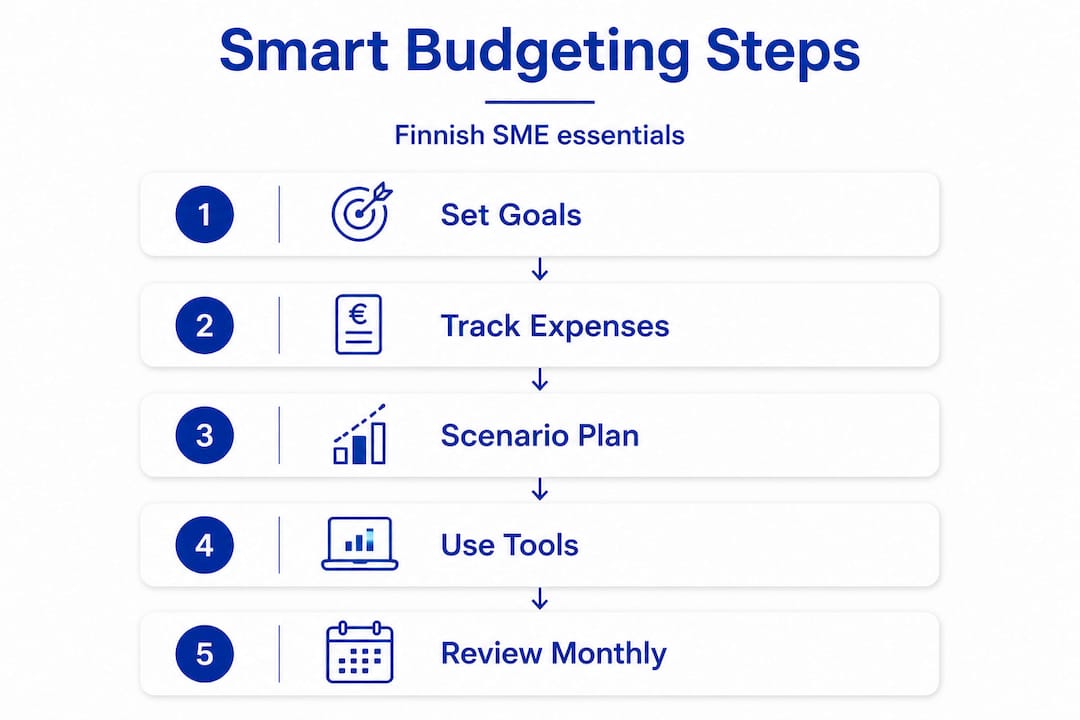
Knowing the pitfalls raises a question: how do successful Finnish entrepreneurs actually budget and what tools do they choose? The good news is that there is a wide range of practical options available, from simple Excel templates to sophisticated cloud-based accounting software.
Finnish government resources like Suomi.fi emphasise regular budgeting to plan revenues and expenses, monitor implementation, and prevent financial difficulties before they escalate. This guidance is not merely theoretical. It reflects the practical reality that businesses which budget consistently are significantly less likely to face insolvency or cash flow crises.
| Tool type | Best for | Key features |
|---|---|---|
| Excel templates | Sole traders and micro-businesses | Monthly P&L, yearly result, scenario tabs |
| Cloud accounting software | Growing SMEs | Real-time data, automated reports, VAT tools |
| Professional advisory | All sizes | Customised planning, tax integration, compliance |
Scenario analysis deserves particular attention. This technique involves building at least two or three versions of your budget: a base case, a conservative case assuming a 20% revenue drop, and an optimistic case. Running these scenarios regularly means you are never caught completely off guard by market changes. You have already thought through the implications and identified the levers you can pull.
Pro Tip: Build your conservative scenario first. If your business can survive a 20% revenue drop without requiring emergency action, you have a genuinely resilient financial plan. If it cannot, you know exactly where to focus your cost management efforts.
Following SME bookkeeping best practices ensures that the data feeding your budget is accurate. Poor bookkeeping produces unreliable budget comparisons, which defeats the purpose of the exercise entirely. If you are unsure whether your current bookkeeping setup is adequate, reviewing accounting services available to Finnish entrepreneurs is a worthwhile step.
You should also familiarise yourself with essential tax tips relevant to your business structure. Tax obligations in Finland, including prepayment tax and VAT cycles, must be built into your budget as fixed outflows. Treating them as surprises is one of the most common and most avoidable financial mistakes Finnish entrepreneurs make.
Cash flow: Your business oxygen
Budgeting only works if you keep a close eye on the money that enters and leaves your business. Cash flow and profitability are not the same thing, and confusing the two is a mistake that catches many entrepreneurs off guard. Your profit and loss statement might show a healthy margin, but if your customers pay on 60-day terms and your suppliers require payment within 14 days, you can find yourself in serious trouble despite being technically profitable.
A profitable business can still fail if it runs out of cash. Profit is an accounting concept; cash is what pays your bills.
Here is a practical framework for managing cash flow effectively:
- Track cash in and cash out weekly. Monthly reviews are not frequent enough when cash is tight. Weekly visibility gives you time to act before a shortfall becomes a crisis.
- Build a cash reserve of 3-6 months of operating expenses. A 90-day reserve is the minimum benchmark for business survival during unexpected disruptions.
- Invoice promptly and follow up on overdue payments. Every day a payment is delayed is a day your cash reserve is under unnecessary pressure.
- Separate your business and personal finances completely. Mixing the two makes it nearly impossible to get an accurate picture of your business cash position.
- Forecast cash flow 90 days ahead. A rolling 90-day cash flow forecast gives you early warning of potential shortfalls and time to arrange solutions.
Maintaining solid bookkeeping compliance is the foundation of reliable cash flow management. If your records are not accurate and current, your cash flow forecast will be unreliable, and you will be making decisions based on incomplete information.

Pro Tip: Fast-growing businesses are particularly vulnerable to cash flow crises. When sales are rising rapidly, the temptation is to reinvest everything immediately. Resist this. Protect your cash reserve even when growth feels assured, because growth itself creates additional cash demands before the revenue from that growth arrives.
Expert insights: What most Finnish entrepreneurs miss
Having covered the value of budgeting and cash flow, let us summarise some advanced lessons and practical insights that not all entrepreneurs recognise. These are the areas where well-intentioned business owners often make costly assumptions.
The most common blind spot is the belief that revenue growth automatically solves financial problems. Revenue growth does not fix cash flow if fixed costs rise unchecked alongside it. As your business grows, your cost base tends to grow too, often faster than you expect. Rent, payroll, software subscriptions, and insurance all tend to increase as a business scales, and if you are not monitoring your cash conversion cycle (the time it takes to turn your investment in inventory and services into actual cash), you can find yourself in a worse position than when you were smaller.
A compelling example of what disciplined cash management can achieve comes from the Finnish business world. Tight cash control enabled bootstrapping to €13.5 million in revenue without external funding, by prioritising best-selling products and maintaining fast inventory turnover. This is not an isolated case. It reflects a broader principle: financial discipline, not just ambition, is what drives sustainable growth.
Key insights that successful Finnish entrepreneurs apply:
- Monitor your cash conversion cycle regularly, not just your profit margin.
- Use public resources actively. Public grants cover 40-70% of RDI costs through Business Finland, reducing the capital burden on growing businesses significantly.
- Invest in systems, not just sales. Predictable cash flow comes from reliable processes, not from chasing the next big client.
- Review your budget monthly and adjust it quarterly. A budget that is not reviewed is not a budget. It is a wish list.
Understanding the accounting firms' role in supporting Finnish SMEs goes beyond compliance. A good accounting partner helps you interpret your financial data and translate it into better decisions. Similarly, digital accounting efficiency is increasingly important as Finnish businesses adopt cloud-based tools that automate routine tasks and free up time for strategic planning.
Pro Tip: Business Finland and Ornamo both offer tools and resources specifically designed for Finnish SMEs. If you have not explored what is available to your business, you may be leaving significant financial support on the table.
Here's what most budgeting advice misses for Finnish entrepreneurs
Most generic budgeting advice is written for a broad international audience, and it tends to overlook the specific realities of running a business in Finland. Finland has distinct seasonal patterns that affect many industries, from retail to construction to professional services. A budget that does not account for these cycles will consistently produce inaccurate forecasts, and inaccurate forecasts lead to poor decisions.
We have worked with Finnish entrepreneurs across a wide range of sectors, and we consistently observe that the businesses which struggle most are not those with the lowest revenue. They are the ones that treat budgeting as an annual exercise rather than an ongoing discipline. They prepare a budget in January, file it away, and then react to financial events as they arise rather than anticipating them.
The availability of government-backed resources in Finland is also frequently underutilised. Many entrepreneurs are unaware that grants, subsidised advisory services, and digital tools exist specifically to support their financial planning. Tapping into these resources is not a sign of weakness. It is smart financial management.
We also believe that budgeting should never be reduced to cost-cutting alone. The goal is not simply to spend less. It is to allocate your resources in the way that best supports your business objectives. Sometimes that means investing more in a particular area, not less. A budget gives you the clarity to make that call with confidence rather than anxiety.
If you are considering whether professional support could improve your financial management, exploring the SME accountant benefits available to Finnish businesses is a practical next step.
How Finovate can help you build smarter budgets
Once you understand the value and pitfalls of budgeting, partnering with the right experts can transform your results. At Finovate, we support Finnish entrepreneurs with practical, hands-on financial management services designed specifically for the realities of operating a small or medium-sized business in Finland.
Whether you need reliable bookkeeping, tax planning, payroll processing, or a straightforward monthly invoicing service to keep your cash flow moving, we have services built around your needs. Our accounting for entrepreneurs package is particularly well suited to light entrepreneurs and growing SMEs who want professional support without the overhead of an in-house finance team. We help you build budgets that are grounded in real data, compliant with Finnish regulations, and genuinely useful for making better business decisions. Get in touch with us to find out how we can support your financial planning.
Frequently asked questions
What is the ideal budgeting frequency for Finnish small businesses?
Monthly budgeting is recommended to monitor performance and enable quick adjustments. Regular budgeting helps Finnish entrepreneurs plan revenues and expenses, track implementation, and prevent financial difficulties before they escalate.
How much cash reserve should I keep as a Finnish entrepreneur?
Aim for 3-6 months of operating expenses in reserves, with 90 days as the minimum to cover emergencies. A 90-day cash reserve is the recognised survival benchmark for small businesses facing unexpected disruptions.
What local grants help with budgeting and financial planning in Finland?
Business Finland offers grants that cover 40-70% of RDI costs, and additional public resources are available through Ornamo and Suomi.fi to support sustainable financial planning.
What is a common budgeting mistake entrepreneurs make?
Focusing only on revenue growth without monitoring cash flow and rising fixed costs is the most frequent error. Revenue growth alone does not resolve cash flow problems when expenses are scaling at the same pace or faster.
Where can I find free budgeting templates suitable for Finnish businesses?
Excel budgeting tools are available from Ornamo, covering monthly profit and loss, yearly results, and scenario analysis, and Suomi.fi also provides practical guidance and resources for Finnish entrepreneurs.
Recommended
- Essential Tax Tips for Finnish Entrepreneurs | Finovate Accounting Services
- Deductible expenses in Finland: Smart tax strategies
- Optimise capital income tax in Finland: entrepreneur's guide
- Step-by-step guide: How to start a business in Finland
- How to create a business budget for UK SME growth
- Élaborer un plan de croissance : guide pour TPE/PME – GDMO Vision