

TL;DR:
- Starting a business in Finland involves validating your idea, choosing the right company structure, and completing efficient registration.
- Entrepreneurs should focus on professional bookkeeping, legal compliance, and leveraging Finnish support resources to avoid costly mistakes.
- Delegating financial tasks early and seeking expert guidance helps ensure smoother growth and funding opportunities.
Starting a business in Finland is an exciting step, but the process can feel overwhelming when you face unfamiliar legal structures, registration requirements, and financial obligations all at once. Many aspiring entrepreneurs stall not because their idea is weak, but because they are unsure where to begin. This guide walks you through each essential stage, from validating your concept to setting up compliant accounting practices, so you can move forward with confidence. Whether you are a first-time founder or transitioning from employment, the steps below will help you avoid the most costly early mistakes.
Table of Contents
- Validating your business idea and planning
- Choosing the best company form in Finland
- Registering your business and meeting legal requirements
- Setting up business finances and accessing funding
- Building accounting practices and ensuring tax compliance
- What most new Finnish entrepreneurs overlook
- Expert support makes your business journey smoother
- Frequently asked questions
Key Takeaways
| Point | Details |
|---|---|
| Validate before registering | Plan your business and check demand before committing to legal steps or investments. |
| Choose the right structure | Select a company form based on your goals, liability tolerance, and tax needs. |
| Don’t overlook compliance | Meet registration, tax, and accounting standards from day one to avoid fines and funding roadblocks. |
| Use official resources | Advisory services like Uusyrityskeskus and digital tools make starting up in Finland faster and less risky. |
| Consider outsourcing | Professional accounting support can save time and ensure lasting financial health. |
Validating your business idea and planning
Before you register anything or spend a single euro, you need to know whether your business idea is genuinely viable. This means more than believing in your product or service. It means assessing real market demand, understanding who your customers are, and being honest about your own skills and capacity.
A solid business plan is your most important early tool. It does not need to be lengthy, but it must address a few core questions:
- What problem does your product or service solve?
- Who is your target customer, and how will you reach them?
- What are your expected costs and revenue in the first 12 months?
- What risks could threaten the business, and how will you manage them?
Fortunately, you do not have to figure this out alone. Finland offers excellent free advisory support for new entrepreneurs. You can develop a business plan with guidance from Finnish Enterprise Agencies (Uusyrityskeskus) and Business Finland, both of which provide no-cost consultations to help you stress-test your idea before committing resources.
It is also worth using the start-up checklist on Suomi.fi to confirm you have covered every preparatory step. This checklist is particularly useful for identifying obligations you may not have considered, such as insurance requirements or sector-specific permits.
Pro Tip: Speak to at least five potential customers before writing your business plan. Real feedback will sharpen your value proposition and save you from building something nobody wants.
Once your idea is validated, you will also want to think ahead about financial management. Understanding accounting services for small businesses early on helps you budget for professional support and avoid surprises later.
Choosing the best company form in Finland
Once your business idea is finely tuned, the next crucial decision is the company structure you will operate under. The legal form you choose affects your personal liability, how you are taxed, and how much administrative work you take on each year.

Here is a brief comparison of the most common options:
| Company form | Liability | Tax treatment | Minimum capital | Best suited for |
|---|---|---|---|---|
| Sole trader (toiminimi) | Personal | Progressive income tax | None | Solo operators, low-risk trades |
| Limited company (Oy) | Limited | 20% corporate tax | None since 2019 | Growth-focused startups, multiple founders |
| General partnership (Ay) | Joint personal | Income tax on partners | None | Small teams with shared responsibility |
| Limited partnership (Ky) | Mixed | Income tax on partners | None | Investors with silent partners |
As the company form guidance from Business Finland confirms, a sole trader structure is the simplest starting point, while a limited company suits startups expecting growth or multiple founders. Importantly, Finland removed the minimum share capital requirement for Oy companies in 2019, making it far more accessible for early-stage entrepreneurs.
Key considerations when choosing your structure:
- Personal liability: A sole trader is personally liable for all business debts. An Oy protects your personal assets.
- Tax efficiency: Corporate tax for an Oy is a flat 20%, whereas sole traders pay progressive income tax on profits.
- Administrative load: An Oy requires formal bookkeeping, annual accounts, and board decisions. A sole trader has lighter obligations.
For a deeper look at how each structure affects your finances, our guide on Finnish accounting rules and company forms explained are worth reading before you decide.
Pro Tip: If you plan to apply for Business Finland grants or hire employees within two years, an Oy structure is often better positioned to meet eligibility criteria.
Registering your business and meeting legal requirements
After selecting the optimal business structure, it is time to formally register and ensure you meet all legal obligations. The registration process in Finland is straightforward, particularly if you use the digital channels available.
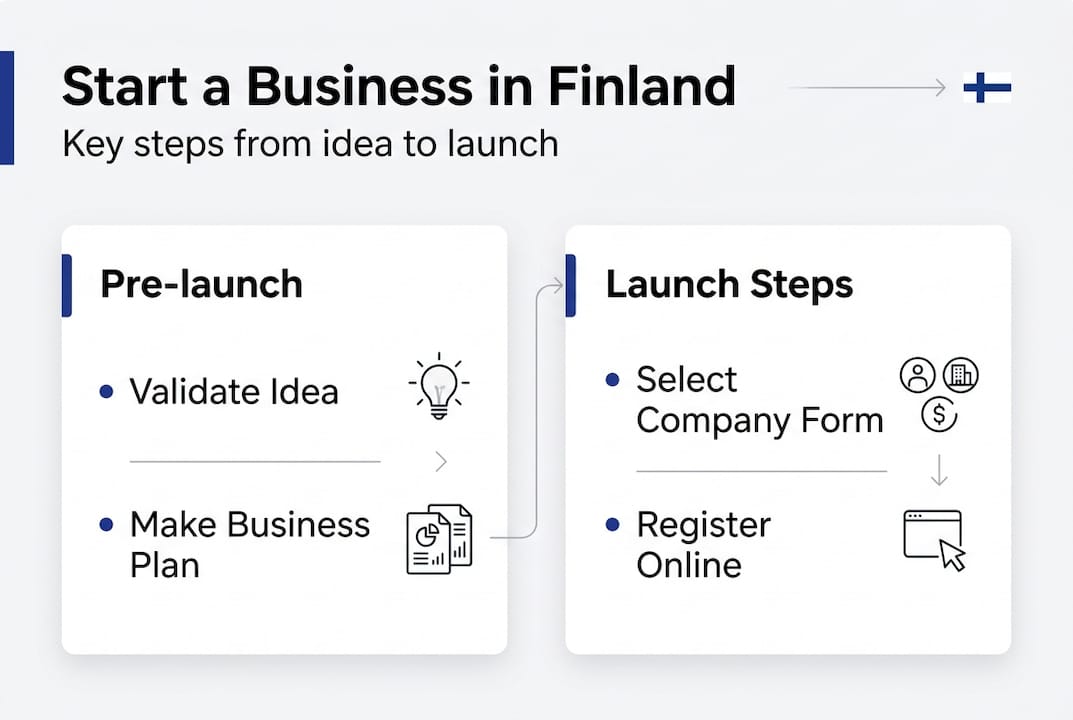
Here is a step-by-step overview:
- Prepare your Y-form (the official start-up notification form for your chosen company type).
- Submit via ytj.fi or Suomi.fi to notify both the Trade Register and the Tax Administration simultaneously.
- Register for VAT if your annual turnover is expected to exceed the threshold.
- Register as an employer if you plan to hire staff from the outset.
- Arrange YEL pension insurance if you are self-employed, as this is legally mandatory.
- Check for sector-specific licences relevant to your industry.
The registration process via ytj.fi is fully digital, and processing takes as little as 1-3 days when your documents are complete. This is one of the genuine advantages of the Finnish system.
Fastest company registrations in Finland are completed in as little as 1-3 days when submitted online with all required documents in order.
For VAT and employer registrations, the Tax Administration handles these through the same submission process. You should also check for licences and permits on Suomi.fi, particularly if you operate in regulated sectors such as food service, healthcare, or construction. YEL pension insurance is mandatory for self-employed individuals and must be arranged separately with a pension provider.
For a thorough overview of ongoing obligations after registration, our article on essential Finnish compliance rules covers what you need to maintain year after year.
Setting up business finances and accessing funding
With your business officially registered, the next test is building a financially robust foundation and making the most of Finnish support schemes. One of the most important early steps is separating your business and personal finances completely.
Opening a dedicated business bank account is not just good practice. It is essential for clean bookkeeping, accurate tax reporting, and presenting a credible financial picture to lenders or grant bodies. Mixing personal and business transactions is one of the most common and costly mistakes new entrepreneurs make.
Finland offers several funding options worth exploring:
- Start-up grant (starttiraha): Available from the TE Office for unemployed individuals starting a business. Apply before registering your company.
- Finnvera loans: Government-backed loans for early-stage businesses that may not yet qualify for traditional bank financing.
- Business Finland grants: Research and innovation funding for growth-oriented companies.
- Traditional bank loans: Available once you have a solid business plan and some trading history.
You can find detailed start-up grant information on the TE Services website, including eligibility criteria and application steps. As confirmed by Finnish enterprise resources, the TE Office, Finnvera, and Business Finland are the three primary funding channels for new businesses.
Pro Tip: Tidy, well-organised financial records significantly improve your chances of securing grants and loans. Lenders and grant bodies look for evidence that you manage money responsibly. Our bookkeeping basics guide will help you build those habits from day one.
Building accounting practices and ensuring tax compliance
Strong accounting and tax management are the backbone of a sustainable operation, so here is how to stay on top. Getting this right from the beginning saves you time, money, and stress as your business grows.
First, understand which bookkeeping method applies to you. Double-entry bookkeeping is mandatory for limited companies and certain sole traders, while smaller sole traders may use single-entry bookkeeping. If you are unsure which applies, a professional accountant can confirm this quickly.
Key accounting and tax obligations to track:
- Annual tax return: Filed after your financial year ends, reporting all income and deductible expenses.
- Prepayment tax: You pay estimated taxes in advance throughout the year based on projected income.
- VAT returns: Filed monthly, quarterly, or annually depending on your turnover.
- Payroll reporting: Required if you employ staff, with monthly submissions to the Tax Administration.
Finnish authorities recommend engaging a professional accountant early, particularly for limited companies, to ensure accurate reporting and avoid penalties.
As corporate tax rates confirm, Oy companies pay a flat 20% corporate tax, while sole traders pay progressive income tax on business profits. Understanding this distinction helps you plan withdrawals and distributions more effectively.
For practical guidance on working with a professional, read about the benefits of hiring an accountant and review our tax filing advice for Finnish entrepreneurs. You can also review the official Finnish accounting requirements directly on the Tax Administration website.
Pro Tip: Good financial records do more than keep you compliant. They make grant applications, permit renewals, and loan requests significantly smoother and faster.
What most new Finnish entrepreneurs overlook
With the fundamentals covered, it is worth focusing on some crucial lessons learned from real-world experience. One pattern we see repeatedly is new entrepreneurs trying to manage everything themselves, particularly in the early months when cash is tight and time is scarce.
This instinct is understandable, but it is often counterproductive. Attempting to handle registration, bookkeeping, tax filings, and business development simultaneously leads to errors, missed deadlines, and wasted energy. The cost of fixing a compliance mistake almost always exceeds the cost of professional support from the start.
Free advisory resources are also significantly underused. Uusyrityskeskus and Business Finland offer genuinely valuable guidance, yet many founders skip these services and make strategic decisions based on incomplete information. This is a missed opportunity that can shape the entire trajectory of a business.
The entrepreneurs we see thrive earliest are those who delegate financial tasks quickly. Outsourcing bookkeeping is not a luxury reserved for larger companies. It is a practical decision that frees your attention for sales, product development, and customer relationships. Those who prioritise compliance from day one are better positioned for funding applications, less stressful tax periods, and smarter long-term growth. Starting right is always easier than correcting mistakes later.
Expert support makes your business journey smoother
If you feel overwhelmed, you are not alone, and world-class support is available to help you start strong. Managing registration, bookkeeping, tax compliance, and financial planning simultaneously is a significant challenge for any new entrepreneur.
At Finovate, we specialise in helping Finnish entrepreneurs and small businesses handle exactly these challenges. From bookkeeping and tax preparation to payroll and business advisory services, we provide the financial management support you need to focus on growing your business. If you are just starting out and need a simple way to invoice clients, our Invoicing Service Pro is designed for light entrepreneurs and makes billing straightforward from day one. Get in touch with us today and let us help you build a compliant, financially sound business from the ground up.
Frequently asked questions
What is the fastest way to register a company in Finland?
Registering online via ytj.fi can take 1-3 days, provided your documents are complete and correctly prepared.
When is VAT registration required for a Finnish business?
You must register for VAT once your annual turnover exceeds the applicable threshold, currently in the range of €15,000 to €20,000.
Do I need to hire an accountant when starting my business?
It is strongly recommended, particularly for limited companies, as professional accounting support ensures compliance and significantly reduces the risk of costly errors.
Which company form best suits a solo entrepreneur in Finland?
A sole trader structure is usually the simplest and most cost-effective option for individual entrepreneurs operating with low risk and modest turnover.