
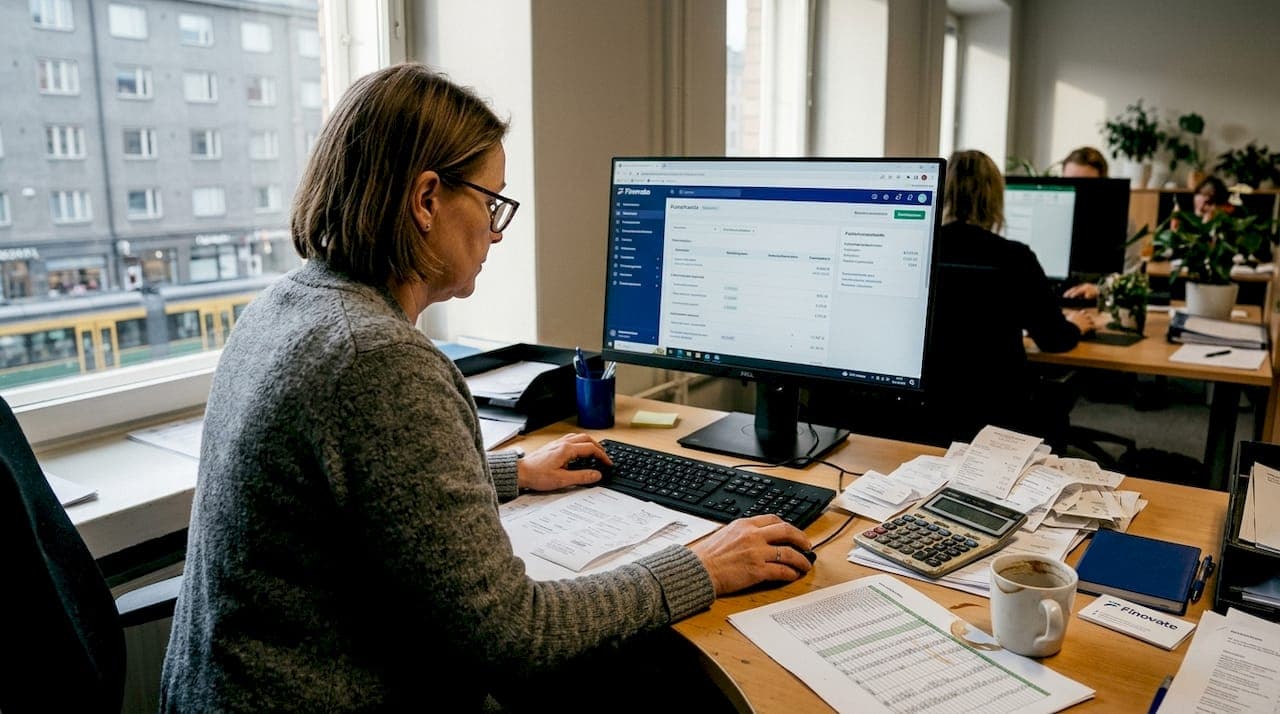
Many small business owners in Finland assume that managing bookkeeping in-house keeps costs down and gives them full control. In practice, the opposite is often true. Research shows that outsourcing statutory statements leads to higher accruals quality and improved financial reporting for small Finnish firms. This guide covers the real benefits, the genuine risks, and the practical steps you need to make outsourcing work for your business.
Table of Contents
- Understanding bookkeeping for Finnish SMEs
- Top reasons to outsource bookkeeping
- Risks and challenges of outsourcing
- Expert tips for maximising value from outsourcing
- How to get started with outsourcing your bookkeeping
- Streamline your bookkeeping with expert support
- Frequently asked questions
Key Takeaways
| Point | Details |
|---|---|
| Boost accuracy and compliance | Outsourcing bookkeeping improves financial reporting quality for Finnish SMEs and lowers the risk of compliance errors. |
| Achieve significant cost savings | Businesses may save up to 50% on invoice processing and administrative costs with the right outsourced provider. |
| Balance benefits with risk | Hybrid oversight and careful provider selection mitigate key risks such as data security and loss of control. |
| Customise your outsourcing journey | Start with core compliance tasks, review performance regularly, and expand services as your business needs grow. |
Understanding bookkeeping for Finnish SMEs
Bookkeeping is the systematic recording of every financial transaction your business makes. For Finnish SMEs, this means far more than simply logging income and expenses. It includes preparing statutory financial statements, filing VAT returns, managing payroll records, and ensuring compliance with the Finnish Accounting Act and Tax Administration requirements. These obligations apply regardless of your company size.
The complexity grows quickly. Finnish regulations require specific accrual-based accounting methods, strict documentation standards, and timely submissions to the Finnish Tax Administration (Verohallinto). Missing a deadline or misclassifying an expense can trigger penalties or audits. You can read more about the foundations in our guide to bookkeeping basics for small businesses in Finland.
For most SME owners, the core pain points are:
- Time burden: Bookkeeping can consume 10 or more hours per month for a small business owner with no accounting background.
- Regulatory complexity: Finnish statutory requirements change regularly, and staying current demands ongoing professional attention.
- Error risk: Mistakes in VAT filings or income statements carry direct financial consequences.
- Software and systems: Choosing and maintaining compliant accounting software adds another layer of cost and effort.
Providers handling accounting services in Finland use automation and specialist expertise to manage these compliance-heavy tasks, reducing error risks compared to in-house DIY approaches.
Top reasons to outsource bookkeeping
The advantages of outsourcing go well beyond convenience. They translate into measurable financial and operational gains for Finnish SMEs.
Improved accuracy and compliance
Professional bookkeepers use dedicated software and structured workflows. This reduces the likelihood of errors in VAT returns, income statements, and statutory filings. Automated bookkeeping tools used by specialist providers flag inconsistencies before they become costly problems.
Real cost savings

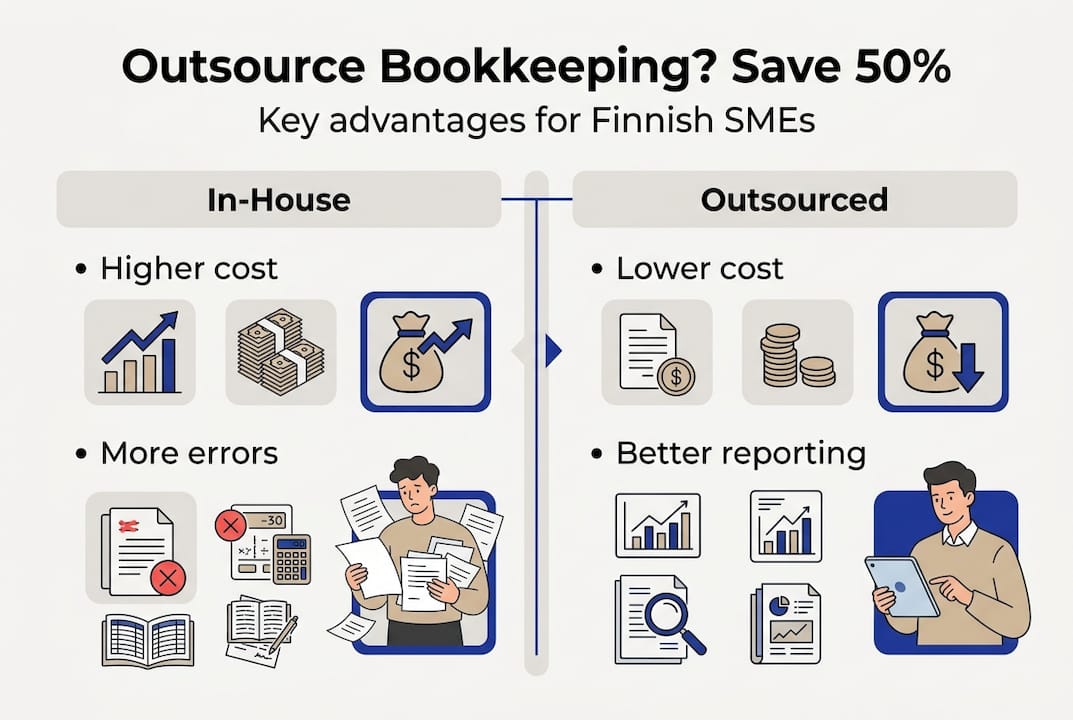
The numbers are compelling. Research on Finnish firms shows that outsourcing improves reporting quality in small companies, and real-world cases demonstrate up to 50% savings in invoice processing costs when switching from in-house to outsourced models. That is a significant reduction for any SME watching its margins.
| Factor | In-house bookkeeping | Outsourced bookkeeping |
|---|---|---|
| Monthly cost | Variable, often higher | Predictable fixed fee |
| Compliance accuracy | Depends on owner skill | Specialist-managed |
| Time commitment | 10+ hours per month | Near zero for owner |
| Software costs | Owner-funded | Included in service |
| Scalability | Limited | Flexible as you grow |
Focus on your core business
Every hour you spend reconciling accounts is an hour not spent on sales, product development, or customer service. Outsourcing frees you to focus on what actually grows your business. Understanding the different accounting methods in Finland can help you appreciate why specialist knowledge matters here.
Key benefits at a glance:
- Lower risk of regulatory penalties
- Access to up-to-date knowledge of Finnish tax law
- Consistent, audit-ready financial records
- Reduced need for in-house accounting staff
Pro Tip: When evaluating providers, ask specifically about their experience with Finnish statutory filings and VAT compliance. A provider familiar with Verohallinto requirements will save you far more than one offering a generic service.
Risks and challenges of outsourcing
Outsourcing is not without its challenges. A balanced view requires acknowledging the genuine risks so you can manage them effectively.
- Data security: Sharing sensitive financial data with a third party introduces risk. Ensure any provider you work with uses encrypted data transfer, secure cloud storage, and clear data processing agreements compliant with GDPR.
- Loss of operational control: When an external party manages your books, you may feel disconnected from your own financial position. Without regular reporting, this can lead to surprises at year-end.
- Over-reliance on providers: If your provider makes an error or ceases trading, your compliance obligations do not pause. You need contingency plans.
- Rapid transition challenges: Moving from in-house to outsourced bookkeeping quickly can create gaps. Strong operational management is required during accelerated outsourcing transitions to avoid data loss or missed filings.
"In accelerated financial accounting outsourcing, strong operational management is required." This finding from University of Eastern Finland research highlights that the transition phase itself carries the highest risk, not the steady-state outsourcing relationship.
The cost and risk of outsourcing are well-documented in Finnish business literature. The consensus is clear: risks are manageable with the right controls. A hybrid model, where you retain oversight of key financial decisions while delegating execution, is widely regarded as best practice. Our step-by-step bookkeeping guide outlines what internal oversight should look like even when you outsource.
Expert tips for maximising value from outsourcing
Knowing the risks is only half the picture. Here is how to structure your outsourcing arrangement to get the best possible results.
Choose a provider with Finnish SME experience
Not all accounting firms understand the specific needs of Finnish small businesses. Look for providers who regularly handle statutory financial statements, VAT filings, and Verohallinto submissions. Experience with your industry sector is a bonus.
Start with core statutory tasks
Research confirms that longer outsourcing relationships focused on statutory statements deliver the strongest quality improvements. Adding peripheral tasks like payroll in the early stages does not always add proportional value. Build the relationship on the essentials first.
Pro Tip: Review your outsourcing arrangement every six months. Check that your provider is meeting agreed turnaround times, that your financial reports are accurate, and that you understand the numbers being presented to you.
Actionable steps for maximising value:
- Define clear deliverables and deadlines in your contract from day one
- Request monthly management reports, not just annual statutory statements
- Maintain a simple internal log of key financial figures so you stay informed
- Plan for staged outsourcing if you are a very small startup, beginning with statutory filings and adding services as you grow
For freelancers and independent contractors, our guide on freelancer accounting strategies covers how to approach this transition. If payroll is a concern, reviewing payroll service options for Finnish SMEs will help you decide what to bundle with your bookkeeping arrangement.
How to get started with outsourcing your bookkeeping
Putting outsourcing into practice does not need to be complicated. Follow these steps to move from in-house to outsourced bookkeeping with confidence.
- Audit your current process: List every bookkeeping task you currently handle, how long each takes, and where errors most commonly occur.
- Define your requirements: Identify which tasks are statutory obligations and which are optional. Prioritise the former when briefing providers.
- Research and shortlist providers: Look for firms with proven experience in selecting accounting services for Finnish SMEs. Ask for references from businesses of a similar size.
- Review contracts carefully: Ensure the contract specifies deliverables, turnaround times, data security measures, and termination terms. Avoid open-ended arrangements with no performance benchmarks.
- Plan your data migration: Organise your existing financial records before handover. Clean, well-organised data makes onboarding faster and reduces the risk of errors.
- Establish oversight mechanisms: Even after outsourcing, schedule monthly check-ins to review reports and ask questions. This is the hybrid model in practice.
Research on accelerated outsourcing transitions confirms that monitoring challenges are highest in the early stages. Building oversight into your process from the start protects you during this period. Our bookkeeping guide for SMEs provides a detailed checklist for the transition phase.
| Step | In-house model | Outsourced model |
|---|---|---|
| Compliance management | Owner-led, error-prone | Expert-managed |
| Cost structure | Variable, unpredictable | Fixed monthly fee |
| Flexibility | Low, tied to owner capacity | High, scales with business |
| Reporting quality | Inconsistent | Consistent, audit-ready |
| Time to complete filings | Slow, owner-dependent | Fast, process-driven |
Streamline your bookkeeping with expert support
If you are ready to stop spending evenings on spreadsheets and start focusing on growing your business, we are here to help. At Finovate, we work with Finnish SMEs to take the complexity out of financial management, from statutory bookkeeping to VAT filings and beyond.
Our services are designed specifically for small and medium-sized businesses in Finland. Whether you need full bookkeeping support, a reliable invoicing service, or specialist accounting for delivery partners and light entrepreneurs, we have a solution that fits. Our Finovate accounting experts are ready to discuss your specific situation and recommend the right level of support. Get in touch today to arrange a consultation and find out how much time and money you could save by outsourcing your bookkeeping to a team that knows Finnish compliance inside out.
Frequently asked questions
Does outsourcing bookkeeping save money for Finnish SMEs?
Many Finnish SMEs see up to 50% savings in invoice processing costs when outsourcing compared to handling bookkeeping in-house, alongside reduced penalties from improved compliance.
What are the main risks when outsourcing bookkeeping in Finland?
The main risks are data security, loss of control, and monitoring rapid transitions, but careful provider selection and hybrid oversight checks can reduce them significantly.
Should very small Finnish startups outsource or keep bookkeeping in-house?
Very small startups can manage basics in-house initially, but outsourcing statutory tasks becomes more valuable as compliance obligations grow and the business scales.
How can SMEs ensure quality when outsourcing bookkeeping?
Regular performance reviews every six months, clear contracts with defined deliverables, and a focus on statutory filing quality ensure sustained accuracy from outsourced providers.