

Juggling client projects is hard enough without worrying whether you've filed VAT returns correctly or missed a pension insurance deadline. Many freelancers in Finland find accounting rules confusing and time consuming, risking penalties that eat into hard-earned income. This guide walks you through the essential accounting duties, tax rules, and financial management steps you need to master in 2026. By understanding your legal obligations and implementing smart record-keeping practices, you'll avoid compliance headaches and focus on what you do best.
Table of Contents
- Understanding your freelance status and legal obligations
- Managing VAT responsibilities as a freelancer
- Complying with pension insurance and social security requirements
- Practical steps for recording income and expenses accurately
- How Finovate can simplify your freelance accounting
- Frequently asked questions about freelance accounting
Key takeaways
| Point | Details |
|---|---|
| Freelancers using invoicing services are entrepreneurs under Finnish law | This classification determines your tax and social insurance obligations |
| VAT registration is required above €20,000 annual income | You must file returns every tax period even with zero activity |
| YEL pension insurance is mandatory over €9,423.09 yearly income | Required if self-employment lasts at least four months continuously |
| Income type affects tax treatment significantly | Wages versus trade income carry different reporting requirements |
| Accurate expense records reduce your tax burden | Deductible costs must be documented properly for Tax Administration |
Understanding your freelance status and legal obligations
Before diving into VAT rates and filing deadlines, you need to know how Finnish law classifies your work. If you use an invoicing service to bill clients, you're considered an entrepreneur under employment and social insurance legislation, regardless of whether you've registered a formal business. Light entrepreneurs in Finland are entrepreneurs under this legal framework, which means specific accounting and tax duties apply to you.
Your invoicing service company typically pays you either wages or trade income after deducting their service fee and mandatory payments. This distinction matters enormously for tax purposes. Wages trigger different withholding rules than trade income, and you'll need to track which type you receive each month. The classification also determines whether you file personal income tax returns or business tax declarations.
Registering as a freelancer in Finland involves notifying the Trade Register and Tax Administration of your business activities. Even light entrepreneurs who operate through invoicing services must ensure their tax details are current. Your legal status directly impacts whether you owe VAT, need YEL insurance, and how you document income on annual tax returns. Missing registration steps creates compliance gaps that Tax Administration will eventually flag.
Pro tip: Keep copies of all invoicing service statements showing how your gross income was split between fees, taxes, and net payment. These documents prove your income type and simplify tax filing when deadlines approach.
For comprehensive support managing these obligations, consider professional accounting for light entrepreneur services that handle registration, bookkeeping, and compliance in one package.
Managing VAT responsibilities as a freelancer
Value added tax catches many freelancers by surprise once their income crosses certain thresholds. Light entrepreneurs must register for VAT when trade income exceeds €20,000 annually. This isn't optional; Tax Administration expects you to monitor your turnover and register proactively before hitting the limit. Once registered, you'll charge VAT on invoices, file periodic returns, and remit collected tax to authorities.

Finland operates multiple VAT rates depending on goods and services sold. The general VAT rate is 25.5%, covering most services freelancers provide. Reduced rates of 14% apply to food products and restaurant services, whilst 10% covers books, pharmaceuticals, and certain cultural events. Most consulting, design, and professional services fall under the 25.5% bracket, so you'll likely charge this standard rate to clients.
| VAT category | Rate | Common freelance services |
|---|---|---|
| General rate | 25.5% | Consulting, design, programming, marketing |
| Reduced rate | 14% | Restaurant services, catering |
| Reduced rate | 10% | Cultural services, publications |
| Zero rate | 0% | Intra-EU sales, exports |
Filing deadlines demand attention even when you have no VAT to report. VAT returns must be filed every tax period regardless of business activity. Most freelancers file monthly or quarterly depending on turnover. Missing a nil return carries the same penalties as missing a return with tax due, so set calendar reminders well before each deadline.
Payment happens through MyTax or direct bank transfer using reference numbers Tax Administration provides. VAT is a self-assessed tax, meaning you calculate what's owed, file the return, and pay without receiving an invoice. You must report domestic sales accurately, including any goods you use privately from business stock. Errors in self-assessment trigger audits and interest charges, so double-check figures before submitting returns.
Pro tip: Set aside 25.5% of every client payment in a separate bank account immediately. This ringfences VAT funds and prevents cash flow surprises when payment deadlines arrive.
For deeper guidance on optimising your tax position, explore these essential tax tips for Finnish entrepreneurs covering deductions, timing strategies, and common pitfalls.
Complying with pension insurance and social security requirements
Pension obligations puzzle many freelancers until Tax Administration sends unwelcome reminders. YEL pension insurance becomes mandatory when self-employment income exceeds €9,423.09 annually in 2026. This threshold applies to your confirmed earned income, the amount you genuinely expect to make from self-employment after deducting business expenses. It's not about turnover; it's about sustainable earnings that would qualify as pensionable income.
Duration matters as much as income. YEL insurance is required when self-employment lasts four uninterrupted months after you turn 18 and before reaching retirement age. Even if you start freelancing part-time whilst holding another job, these months count towards the four-month threshold. Once both conditions are met, you have legal obligation to arrange insurance through a pension provider.
Skipping YEL insurance carries serious consequences beyond missing future pension accrual. Tax Administration can impose retroactive insurance requirements with penalties and interest if they discover you qualified but didn't insure. You'll also lack access to earnings-related unemployment benefits, sickness allowances, and rehabilitation support that YEL coverage provides. These safety nets matter when income fluctuates or health issues interrupt work.
Foreign nationals operating as self-employed in Finland face additional complexity. EU citizens may already contribute to home country social security systems, potentially exempting them from Finnish YEL requirements under coordination rules. Non-EU freelancers typically must join Finnish pension insurance when working primarily in Finland. Clarify your status with Finnish Centre for Pensions before assuming exemption applies.
Arranging YEL insurance involves contacting pension providers, declaring your confirmed earned income, and paying quarterly premiums. You'll need to reassess this income annually and adjust coverage if earnings change significantly. Underestimating income to reduce premiums backfires because your pension accrues based on declared amounts, leaving you with inadequate retirement benefits later.
Pro tip: Declare YEL income conservatively at first, then increase it after six months when you better understand sustainable earnings. This avoids overpaying premiums during uncertain startup phases whilst maintaining compliance.
Professional accounting for light entrepreneur services can calculate your YEL income correctly and handle pension provider communications, removing guesswork from compliance.
Practical steps for recording income and expenses accurately
Theory means nothing without execution. Accurate record-keeping separates compliant freelancers from those facing tax adjustments and penalties. Start by tracking every invoice you send through your invoicing service. Light entrepreneurs receive income via invoicing services which pay wages or trade income after processing payments. You need records showing gross invoice amounts, service fees deducted, taxes withheld, and net amounts received.
- Download monthly statements from your invoicing service showing all transactions.
- Categorise each payment as wages or trade income based on how the service processed it.
- Record deductible business expenses with receipts attached: equipment, software subscriptions, training, travel, workspace costs.
- Reconcile bank deposits against invoicing service statements to catch any discrepancies.
- Store digital copies of invoices, receipts, and statements in organised folders by month and year.
Distinguishing wages from trade income affects tax filing procedures. Wages appear on your annual tax return as employment income with tax already withheld. Trade income requires you to declare turnover, deduct expenses, and calculate tax on net profit. Mixing these categories creates filing errors that delay refunds or trigger additional assessments.
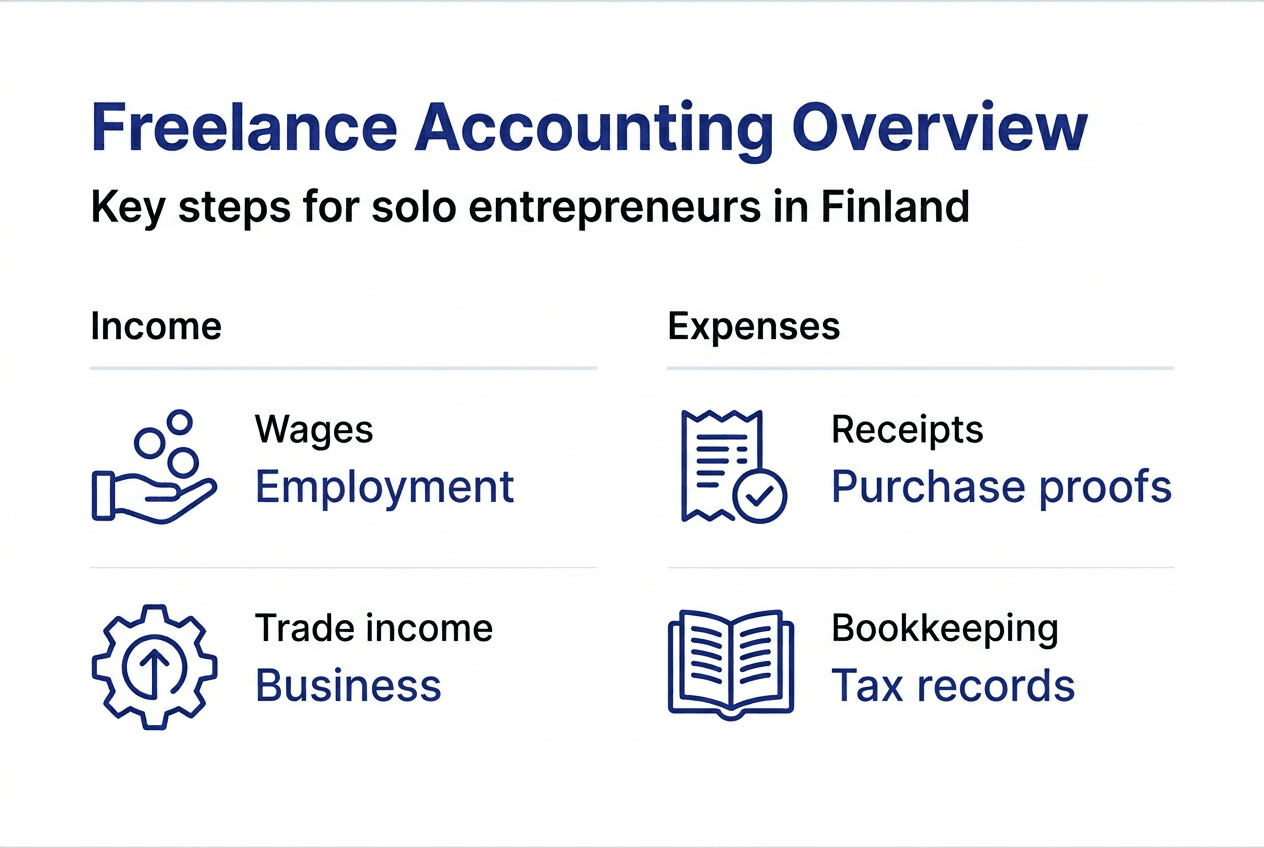
Deductible expenses reduce your tax burden, but only when properly documented. Tax Administration accepts costs that are necessary and reasonable for generating income. Office supplies, professional software, client meeting expenses, and work-related travel qualify. Personal expenses like groceries or family holidays don't, even if you occasionally check email during them. Keep receipts showing what you bought, when, and for which business purpose.
Monthly bookkeeping prevents year-end chaos. Set aside two hours each month to update records, categorise expenses, and verify bank reconciliations. This rhythm catches errors whilst transactions remain fresh in memory. Waiting until tax deadline pressure builds guarantees rushed work and missed deductions.
| Requirement | Action | Common mistake |
|---|---|---|
| Income documentation | Download invoicing service statements monthly | Waiting until tax season to gather records |
| Expense receipts | Save digital copies immediately after purchase | Losing paper receipts before scanning |
| Bank reconciliation | Match deposits to invoices weekly | Ignoring small discrepancies that compound |
| VAT tracking | Separate VAT received from revenue | Treating VAT as income and spending it |
Pro tip: Use cloud accounting software that syncs with your bank account and invoicing service. Automated transaction imports save hours and reduce manual entry errors that plague spreadsheet bookkeeping.
Streamline this entire process with professional invoicing services like invoicing service monthly or invoicing service pro 2 that handle payment processing, tax calculations, and provide ready-to-use financial reports.
How Finovate can simplify your freelance accounting
Managing VAT returns, YEL calculations, and monthly bookkeeping whilst delivering client work stretches even the most organised freelancers thin. Finovate specialises in expert accounting and tax services designed for Finnish freelancers using invoicing services. We handle VAT registration, filing, and payment scheduling so you never miss deadlines or face penalties.
Our invoicing service pro 2 option processes payments efficiently with transparent fees whilst maintaining full compliance with Finnish regulations. We also offer comprehensive accounting for delivery partners and other light entrepreneurs, covering everything from expense categorisation to annual tax return preparation. Partnering with Finovate frees you to focus on billable work whilst we ensure your accounting meets every legal requirement.
Frequently asked questions about freelance accounting
What happens if I exceed the VAT threshold mid-year?
You must register for VAT immediately once your trailing twelve-month turnover crosses €20,000. Registration takes effect from the start of the month when you exceed the limit. You'll charge VAT on all invoices from that point forward and file your first return covering that partial period.
Can I deduct home office expenses when working from my flat?
Yes, but only the proportionate business use. If you dedicate one room exclusively to work in a four-room flat, you can deduct 25% of rent, utilities, and internet costs. Mixed-use spaces require careful calculation, and Tax Administration scrutinises home office claims closely.
How often must I update my YEL income declaration?
You should reassess annually and whenever income changes significantly. If your earnings increase or decrease by more than 20% from your declared amount, contact your pension provider to adjust coverage. This ensures accurate pension accrual and appropriate premium costs.
What records must I keep and for how long?
Retain all invoices, receipts, bank statements, and tax returns for six years from the end of the tax year. Digital storage meets legal requirements provided files remain readable and unaltered. Tax Administration can audit this full period, so don't delete old records prematurely.
Do I need separate business and personal bank accounts?
Whilst not legally required for light entrepreneurs, separate accounts dramatically simplify bookkeeping and expense tracking. Mixing personal and business transactions creates reconciliation nightmares and increases error risk during tax filing. Open a dedicated business account even if you operate informally.
For more detailed tax optimisation strategies, visit these tax tips for Finnish entrepreneurs covering advanced planning techniques and deadline calendars.