
Manual bookkeeping is one of the most persistent drains on time and resources for small and medium-sized businesses in Finland. Chasing receipts, reconciling bank statements by hand, and worrying about VAT deadlines are not just tedious — they create real compliance risk. The good news is that minimising human errors in data entry, tax calculations, and reporting is now well within reach for businesses of any size. This article explains what bookkeeping automation actually involves, why Finnish SMEs stand to gain the most, and how to put it into practice without disruption.
Table of Contents
- What is automated bookkeeping and how does it work?
- Core benefits for Finnish SMEs: accuracy, compliance, and savings
- What tasks can and cannot be automated?
- Choosing the right automation tools and providers
- Implementation checklist: getting started with bookkeeping automation
- Professional support for streamlined bookkeeping automation
- Frequently asked questions
Key Takeaways
| Point | Details |
|---|---|
| Automation boosts accuracy | AI-driven bookkeeping minimises errors and ensures regulatory compliance for Finnish SMEs. |
| Save time and costs | Automating routine tasks frees up staff for higher value work and reduces operating expenses. |
| Human review is essential | Automated systems need oversight for edge cases and strategic decisions, retaining the value of expertise. |
| Local compliance matters | Choose automation tools that support Finnish tax, VAT, and EU regulatory requirements. |
What is automated bookkeeping and how does it work?
Automated bookkeeping uses software to carry out accounting tasks with minimal human input. Rather than manually entering every transaction or cross-checking every invoice, the software handles these processes continuously and consistently. This is not a single technology but a combination of several working together.
According to research on AI in bookkeeping, the core methodologies include:
- Artificial intelligence (AI) and machine learning (ML): These categorise transactions automatically, learning from patterns in your financial data over time.
- Optical character recognition (OCR): This scans and extracts data from invoices and receipts, removing the need for manual data entry.
- Robotic process automation (RPA): This handles repetitive tasks such as bank reconciliations and report generation.
- Cloud integration: This connects your financial data across platforms in real time, giving you an up-to-date picture of your finances at any moment.
These tools work best when paired with human oversight. For most routine transactions, the software operates independently. For anything unusual or complex, a qualified accountant steps in to review. If you are exploring cloud accounting workflows for your business, understanding this balance is the right starting point.
Core benefits for Finnish SMEs: accuracy, compliance, and savings
Now you know what automation is — let's get specific about why it is especially valuable for Finnish SMEs. Resource constraints are real. Most small businesses in Finland cannot afford a full in-house finance team, which makes every hour spent on manual bookkeeping a direct cost to the business.
Automation addresses this directly. Minimising human errors in data entry and tax calculations means fewer corrections, fewer penalties, and more reliable financial reports. This matters particularly in Finland, where VAT reporting and payroll obligations follow strict EU and local rules.
The time savings are measurable. Empirical benchmarks show savings of over 30 minutes per tax return, faster month-end closes, and a significant reduction in rework. For a business processing dozens of transactions weekly, this adds up quickly.
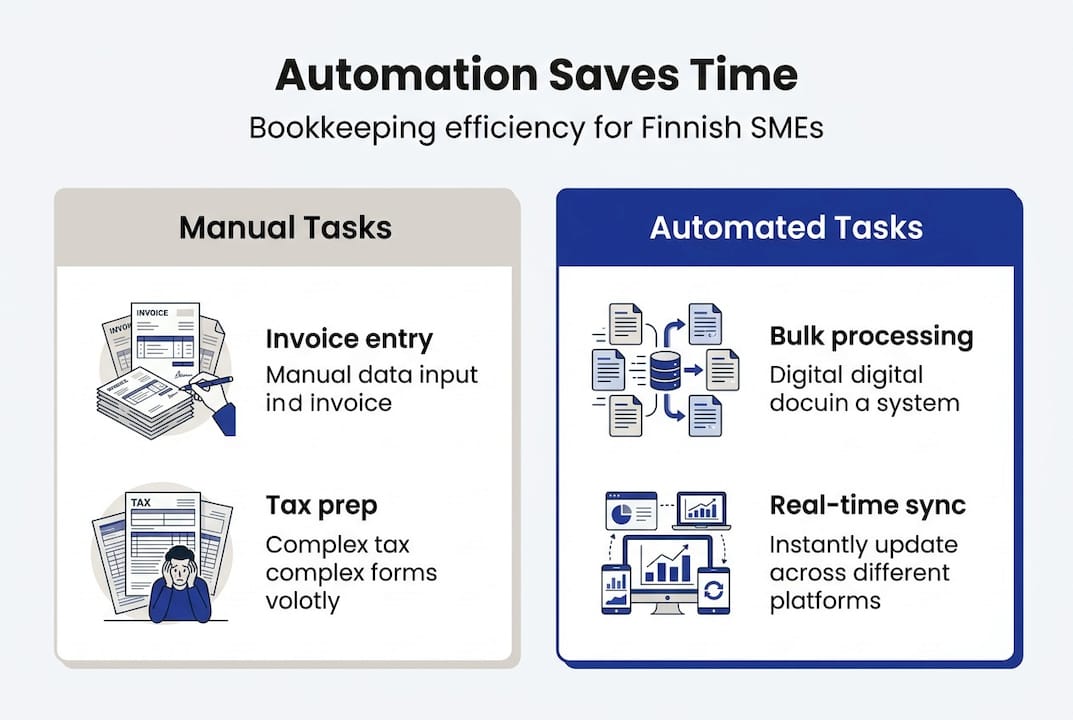
Here is a direct comparison of manual versus automated bookkeeping for a typical Finnish SME:
| Task | Manual process | Automated process |
|---|---|---|
| Invoice processing | 10-15 min per invoice | Under 1 min per invoice |
| Bank reconciliation | Several hours monthly | Minutes, run automatically |
| VAT calculation | Manual cross-checking | Calculated in real time |
| Month-end close | 4-5 days | 1-2 days |
| Error rate | Higher, human-dependent | Significantly reduced |
The bookkeeping advantages extend beyond time. As your business grows, automation scales with you without requiring proportional increases in headcount.

Pro Tip: When selecting automation tools, prioritise those with built-in Finnish and EU compliance features. This ensures your VAT reporting and payroll calculations meet local requirements from day one, without costly customisation later.
What tasks can and cannot be automated?
Understanding the benefits, it is important to know what you can and cannot hand over to automation. Not every bookkeeping task is equally suited to software handling.
Tasks that are well suited to automation include:
- Processing and matching purchase and sales invoices
- Categorising bank transactions by type and supplier
- Reconciling bank accounts against your ledger
- Generating standard financial reports
- Calculating and filing routine VAT returns
- Tracking and classifying employee expenses
Tasks that still require human judgement include:
- Reviewing unusual or one-off transactions
- Interpreting complex tax scenarios specific to your business
- Making strategic financial decisions based on reports
- Handling disputes, corrections, or audit queries
- Advising on business structure or tax planning
AI automates 70-80% of basic transactions in client accounting services, enabling businesses to scale without a proportional increase in staff. But the remaining 20-30% matters enormously.
"Edge cases like unusual transactions require human oversight. Automation works best for routine tasks, while humans handle judgement calls and anomalies." — AI Thought Leaders Survey 2026
This is why automating routine transactions works best as part of a broader approach that keeps qualified professionals involved. Automation handles the volume; people handle the nuance.
| Bookkeeping task | Automation suitable? | Human review needed? |
|---|---|---|
| Invoice processing | Yes | Occasionally |
| Bank reconciliation | Yes | For exceptions |
| VAT return filing | Mostly | For complex cases |
| Tax strategy | No | Always |
| Audit response | No | Always |
Choosing the right automation tools and providers
Having seen the separation between what can and cannot be automated, the next step is selecting the right solution. This decision shapes how smoothly your transition goes and how much value you actually extract.
Here is a structured approach to choosing wisely:
- Identify your core needs. Start by listing the tasks that consume the most time or cause the most errors. Invoice processing, VAT calculations, and bank feeds are common starting points for Finnish SMEs.
- Check compatibility with existing systems. Your chosen tool should connect with your current bank, invoicing software, and payroll system without requiring a complete overhaul.
- Verify local and EU compliance features. Automation streamlines operations for Finnish SMEs, but only if the tool supports Finnish VAT rules, payroll requirements, and EU data regulations.
- Assess support and usability. Look for providers offering Finnish-language support, clear pricing, and interfaces that your team can use without extensive training.
- Plan for growth. Choose automation solutions that can scale as your transaction volume increases, rather than tools you will outgrow within a year.
One risk worth noting: implementation needs expertise, and over-reliance on automation without human review can create data quality issues. Starting with a trial period and reviewing outputs carefully before going fully live is a sensible approach.
Pro Tip: Avoid choosing a tool based on price alone. A cheaper solution that lacks Finnish compliance features or requires heavy manual correction will cost you more in the long run than a well-supported platform.
Implementation checklist: getting started with bookkeeping automation
Ready to act? Here is a clear path to implement automation successfully, without overwhelming your team or disrupting your operations.
- Map your current processes. Write down every bookkeeping task your business performs and how long each takes. This reveals where the biggest bottlenecks are and where automation will have the most impact.
- Set measurable goals. Define what success looks like. For example, reduce manual data entries by 70%, or cut your month-end close from five days to two. Specific targets keep the project on track.
- Shortlist and trial tools. Select two or three solutions that match your needs and run a trial with real data. Assess accuracy, ease of use, and how well they handle Finnish-specific requirements.
- Train your team. Ensure everyone who touches financial data understands how the new system works and knows when to flag exceptions for human review. Clear ownership of the oversight role is essential.
- Review and adapt regularly. Automation is not a one-time setup. Schedule quarterly reviews to assess whether the system is performing as expected and adjust settings as your business evolves.
It is worth noting that accountants currently spend 62% of their time on compliance tasks such as bookkeeping. Automation reduces this burden significantly, freeing your finance team or external accountant to focus on advisory work that genuinely moves your business forward. For practical guidance on getting started, the automation implementation tips on our blog cover common pitfalls and proven approaches.
Professional support for streamlined bookkeeping automation
Automation delivers real results, but getting the setup right from the start makes all the difference. Many Finnish SMEs find that working with an experienced accounting partner removes the guesswork and avoids costly mistakes during implementation.
At Finovate, we provide accounting expertise tailored specifically to Finnish businesses. Whether you need help selecting the right tools, ensuring your VAT and payroll processes meet local requirements, or simply want a reliable partner to oversee your financial reporting, we are here to support you. Our monthly invoicing automation service is designed for businesses that want a straightforward, compliant solution without the overhead of managing it alone. You can also explore our full range of all accounting services to find the right level of support for your business. Contact us today to discuss how we can help you move forward with confidence.
Frequently asked questions
Is automated bookkeeping safe for my business in Finland?
Yes. Reputable automated bookkeeping tools use secure data practices and are built to meet local and EU compliance standards, reducing errors in tax calculations and reporting.
How much time can I actually save by automating bookkeeping?
Automation saves over 30 minutes per tax return and can handle up to 80% of basic transactions without manual input, significantly reducing your team's workload.
Will I still need an accountant if I automate my bookkeeping?
Yes. Unusual transactions and complex tax scenarios still require human judgement, and an accountant remains essential for strategy, oversight, and handling exceptions.
Can automation handle Finnish VAT and payroll specifics?
Most modern solutions offer VAT and payroll automation, but you should verify local compliance features before committing, as not all tools are configured for Finnish requirements out of the box.