
TL;DR:
- Finnish SMEs increasingly outsource accounting to improve accuracy and compliance.
- Outsourcing reduces costs, stress, and error risks while enabling business growth.
- Partnering with professionals offers strategic insights, technology advantages, and regulatory protection.
Over half of European companies outsource financial services, and Finland is no exception. For small and medium-sized business owners managing VAT deadlines, payroll obligations, and corporate tax filings simultaneously, the question is rarely "should I get help?" but rather "how soon?" Managing compliance, tax efficiency, and business growth alone is genuinely difficult, and the risks of getting it wrong are costly. This guide walks you through the core reasons Finnish SMEs hire professional accountants, the compliance and cost benefits involved, the strategic advantages on offer, and how to choose the right partner for your business.
Table of Contents
- Why outsourcing accounting is the Finnish SME norm
- Crucial compliance and tax benefits for Finnish businesses
- Financial advantage: Cost savings and business focus
- Decision-making, technology, and expertise: The accountant's strategic role
- Why doing it all yourself is rarely worth the risk
- Get expert help with your accounting
- Frequently asked questions
Key Takeaways
| Point | Details |
|---|---|
| Improved compliance | Hiring an accountant ensures you meet Finnish deadlines and tax rules, reducing risks of costly errors. |
| Cost and time savings | Outsourcing can save up to 50% on accounting expenses and lets you focus on growing your business. |
| Strategic business support | Professional accountants provide reporting, automation, and advice that drive smarter decisions. |
| Right time to outsource | If your SME is growing or facing complex taxes, outsourcing is safest and most efficient. |
Why outsourcing accounting is the Finnish SME norm
Outsourcing accounting has become standard practice across the Nordic region, and Finnish SMEs are firmly part of this trend. The shift is not simply about convenience. Research shows that outsourcing improves accruals quality in small Finnish firms, meaning your financial reports are more accurate and reliable when a professional handles them. That matters enormously when you are applying for financing, preparing for audits, or simply trying to understand your own business performance.
Many owners assume that managing accounts in-house saves money. In reality, the comparison between in-house vs outsourced accounting often reveals the opposite. Consider the following:
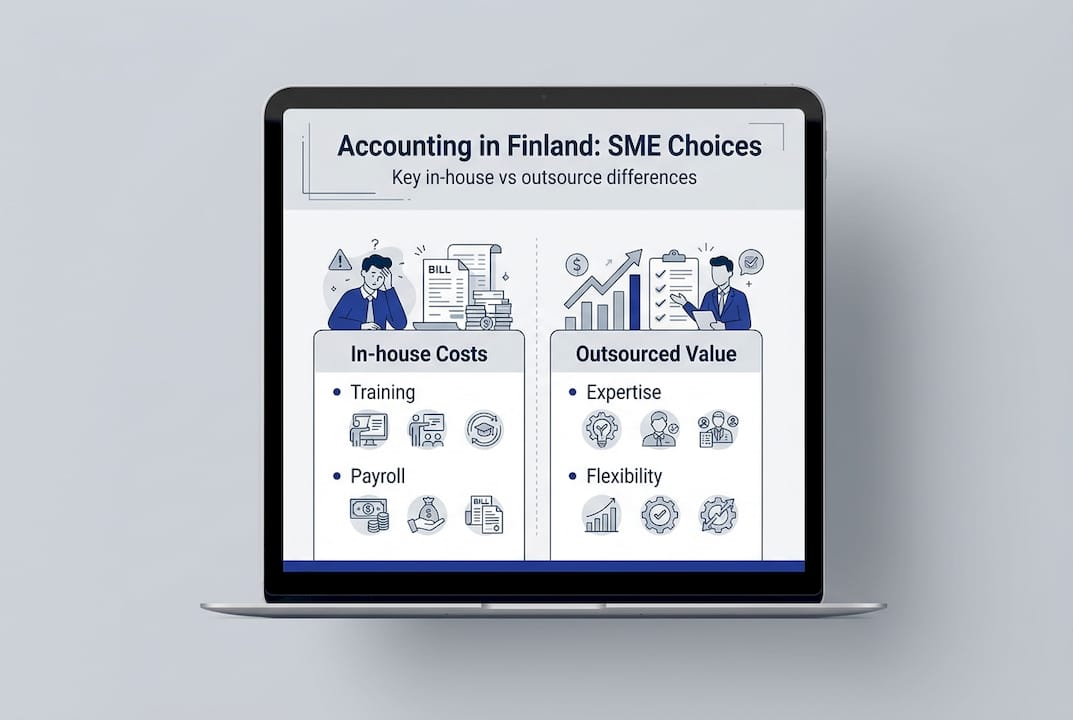
| Factor | In-house accounting | Outsourced accounting |
|---|---|---|
| Staff costs | Salary, benefits, training | Fixed monthly fee |
| Scalability | Limited by headcount | Scales with your needs |
| Expertise | One person's knowledge | Team of specialists |
| Software costs | Paid separately | Usually included |
| Risk of errors | Higher without oversight | Reduced with checks |
The advantages of outsourcing for Finnish small businesses go beyond the numbers on a spreadsheet. When you work with a dedicated accounting firm, you gain access to a team that stays current with Finnish tax law, reporting standards, and regulatory changes. You are not dependent on one employee who might leave or fall ill at a critical moment.
Here is what Finnish SME owners consistently report as the main benefits of outsourcing:
- Reduced stress around tax deadlines and annual filings
- Faster, more accurate monthly reporting
- Access to advice on deductions and allowable expenses
- More time to focus on running and growing the business
"Outsourcing accounting is no longer a luxury for Finnish SMEs. It is a practical, cost-effective decision that directly improves financial reporting quality and business confidence."
If you want to save 50% on bookkeeping costs compared to in-house solutions, the evidence strongly supports making the switch sooner rather than later.
Crucial compliance and tax benefits for Finnish businesses
The efficiency gains of outsourcing are compelling, but the regulatory requirements and tax risks in Finland make hiring an accountant even more essential. Finnish businesses face a structured set of obligations that must be met accurately and on time. The Finnish Tax Administration recommends using a professional accountant for accounting and reporting obligations to ensure compliance. That recommendation exists for good reason.
Here are the key compliance areas a professional accountant manages on your behalf:
- Corporate tax registration and annual filings with the Finnish Tax Administration
- VAT registration, quarterly reporting, and reconciliation
- Payroll tax calculations and employer contributions
- Advance tax payments and adjustments throughout the year
- Annual accounts preparation in line with Finnish Accounting Standards (FAS)
- Document retention in line with Finnish bookkeeping law
Missing a deadline or miscalculating a deduction can trigger penalties, interest charges, or even an audit. These are not abstract risks. They are common accounting pitfalls that affect businesses of all sizes, particularly those without dedicated financial expertise.
Tax efficiency is another major benefit. A qualified accountant knows which deductions apply to your business type, whether that is vehicle expenses, home office costs, R&D allowances, or depreciation on equipment. They also ensure your advance tax payments are calibrated correctly so you are not hit with a large unexpected bill at year end.
The table below summarises key Finnish tax obligations and typical deadlines:
| Obligation | Frequency | Typical deadline |
|---|---|---|
| VAT return | Monthly or quarterly | 12th of following month |
| Corporate tax return | Annual | Four months after financial year end |
| Payroll reporting | Monthly | 5th of following month |
| Advance tax payment | Several times per year | As scheduled by Tax Administration |
For a full overview of what is required, reviewing tax compliance essentials is a useful starting point. You can also find essential tax tips specific to Finnish entrepreneurs.
Pro Tip: Always verify your accountant holds recognised Finnish certifications such as KHT or HT, and confirm they have experience with FAS or IFRS transitions if your business is growing or planning to expand internationally.
Financial advantage: Cost savings and business focus
Beyond compliance, there are bottom-line business reasons why outsourcing accounting is smart, especially for small and growing Finnish firms. The cost argument is straightforward. Outsourcing can cut costs by up to 50% in invoice processing compared to managing the same tasks in-house, and that figure does not account for the overhead savings on office space, software licences, and employer contributions.

For most Finnish SMEs, the pricing model for outsourced accounting is both predictable and flexible. You pay a fixed monthly fee based on transaction volume and service scope. As your business grows, the service scales with you. There are no recruitment costs, no sick leave cover to arrange, and no training budget to maintain.
The time savings are equally significant. Research indicates that outsourcing can reduce manual admin tasks by up to 70%, freeing business owners to focus on sales, product development, customer relationships, and strategic planning. That is time that directly contributes to revenue growth rather than administrative compliance.
Here is a practical breakdown of where cost savings accumulate:
- No salary overheads: No employer pension contributions, holiday pay, or sick pay
- Software included: Most accounting firms include platforms like Procountor or Netvisor in their fees
- Error reduction: Fewer costly mistakes means fewer penalties and less time spent correcting filings
- Audit readiness: Clean, accurate books reduce the time and cost of any audit process
- Scalable service: Only pay for the level of support you actually need
Understanding the different accounting methods examples available to Finnish businesses can also help you choose the most tax-efficient approach from the outset. Combining the right method with professional support compounds the financial benefit over time. Reviewing bookkeeping best practices for Finnish small businesses is a practical next step.
Pro Tip: When evaluating accounting firms, ask specifically which software platforms they use. Firms working with Procountor or Netvisor can offer significant automation benefits, reducing your manual input and improving real-time visibility into your finances.
Decision-making, technology, and expertise: The accountant's strategic role
While costs matter, the accountant's contribution to strategic decisions and technology adoption is often the tipping point for SMEs ready to grow. A good accountant does far more than file returns. They become a trusted adviser who helps you interpret your financial data and make informed choices.
Professional accountants support Finnish business growth by providing structured input on budgeting, cash flow forecasting, and profitability analysis. When you are considering hiring staff, investing in equipment, or entering a new market, having accurate financial projections makes the decision far less risky.
Modern accounting firms also leverage technology to deliver better results faster. Cloud-based platforms enable real-time reporting, automated VAT submissions, and digital payroll processing. These tools reduce the margin for human error and give you instant access to key performance indicators (KPIs) without waiting for a monthly report.
Here are the strategic areas where a professional accountant adds measurable value:
- Cash flow management: Identifying patterns and preventing shortfalls before they become problems
- Budgeting and forecasting: Building realistic financial models for the year ahead
- International expansion: Navigating VAT rules, transfer pricing, and foreign reporting requirements
- R&D incentives: Identifying and claiming research and development tax credits available in Finland
- Risk reduction: Removing key-person dependency and strengthening internal financial controls
"The accountant's role has evolved well beyond compliance. Today, they are a strategic partner who helps Finnish SMEs grow with confidence, using data and expertise to inform every major business decision."
For businesses with employees or international sales, understanding the role of a tax adviser is particularly relevant. The complexity of cross-border transactions, employer obligations, and multi-currency reporting demands specialist knowledge. Exploring accounting technology solutions can also reveal how much of this work can now be automated.
Why doing it all yourself is rarely worth the risk
There is a genuine temptation for Finnish business owners to manage their own accounts, particularly in the early stages when transaction volumes are low and software tools appear to make it straightforward. We understand that impulse. But it is worth being honest about what DIY accounting actually costs you over time.
The evidence is clear. Longer outsourcing relationships improve financial reporting quality more than short-term or task-specific arrangements. A one-off fix before your tax deadline is not the same as having a professional who knows your business, your sector, and your financial history.
For very simple operations with minimal transactions, handling basic bookkeeping in-house may be manageable short-term. But the moment you take on employees, begin selling abroad, or need to manage electronic reporting obligations, the risk of errors increases sharply. Missed deadlines, unclaimed deductions, and incorrect VAT filings are not minor inconveniences. They carry real financial consequences.
Our view is that the Finnish SME bookkeeping guide makes this clear: professional support is the safe default for any business with growth ambitions.
Pro Tip: If your business is growing, handles payroll, or has any international sales activity, outsourcing is not optional. It is the responsible choice that protects both your finances and your time.
Get expert help with your accounting
For those convinced that professional support is the smart choice, partnering with local experts is just a click away. At Finovate, we provide tailored accounting and financial management services designed specifically for Finnish SMEs and entrepreneurs. Whether you need monthly bookkeeping, tax planning, or payroll processing, we have a solution that fits your business.
Our monthly invoicing service is ideal for entrepreneurs who want straightforward, predictable support. If you are working as a light entrepreneur or delivery partner, our accounting for delivery partners service is built for your specific needs. Explore our full range of accounting and tax solutions and find the right fit for where your business is today.
Frequently asked questions
Is outsourcing accounting really cheaper than hiring in-house staff?
Yes, for most Finnish SMEs, outsourcing can cut admin costs by up to 50% and eliminates overhead expenses such as employer contributions, software licences, and training budgets.
When should I definitely hire an accountant for my Finnish business?
Hire an accountant as soon as you face VAT obligations, payroll, business growth, or international sales. Outsourcing provides tax certainty and helps you avoid costly errors that are especially common for startups and growing SMEs.
What qualifications should I check before hiring an accountant in Finland?
Look for official certifications such as KHT or HT, and confirm experience with Finnish GAAP or FAS. For growing or internationally active businesses, expertise in FAS and IFRS transitions is particularly important.
Can I handle small-scale bookkeeping on my own at first?
For very simple businesses with few transactions, DIY can work short-term, but growth quickly demands professional support, especially once employees, foreign sales, or electronic reporting obligations are involved.
Recommended
- Accounting firms in Finland: driving real business growth
- Right accounting services for Finnish small businesses
- Accounting methods in Finland: Key examples for entrepreneurs
- Why outsource bookkeeping: save 50% for Finnish SMEs
- SME profitability guide: 11.3% average and how to beat it
- Why Small Businesses Need Bookkeeping Services