

Finland boasts one of the EU's lowest corporate tax rates at 20%, yet many small and medium-sized businesses still overpay taxes due to complex compliance requirements and missed optimisation opportunities. Tax advisors provide specialised expertise that transforms this challenge into competitive advantage. This guide explains how engaging the right tax advisory support helps Finnish SMBs navigate regulatory complexity, minimise liabilities, and build sustainable growth.
Table of Contents
- Why small businesses need tax advisors in Finland
- Understanding Finnish tax regulations and SMB compliance
- Core services provided by tax advisors to Finnish SMBs
- Common misconceptions about the role of tax advisors
- Comparing tax advisory options: what SMBs should look for
- Applying tax advisory insights: practical steps for SMB owners
- Summary and next steps: maximising benefits from your tax advisor
- Discover expert tax advisory and accounting services at Finovate
- Frequently asked questions
Key takeaways
| Point | Details |
|---|---|
| Tax advisors specialise beyond routine accounting | They offer strategic planning, compliance management, and international tax guidance tailored to Finnish SMB needs. |
| Early engagement prevents costly mistakes | Proactive advisory support identifies tax reliefs, optimises structures, and avoids penalties before problems arise. |
| Finnish tax system requires local expertise | Understanding VAT thresholds, permanent establishment rules, and evolving regulations demands specialist knowledge. |
| Selection criteria matter significantly | Evaluate advisors based on Finnish SMB experience, transparent pricing, and proactive communication style. |
| Strategic tax planning drives business growth | Advisors help SMBs make informed decisions that improve cash flow and support long-term objectives. |
Why small businesses need tax advisors in Finland
Finnish SMBs operate in a tax environment that combines competitive rates with significant complexity. The 20% corporate tax rate positions Finland favourably against EU counterparts, but navigating local regulations, VAT requirements, and international considerations demands specialist knowledge.
Tax advisors deliver value far beyond routine accounting. Where accountants focus on historical record keeping and basic compliance, tax advisors provide forward-looking strategic planning. They analyse business structures, identify optimisation opportunities, and ensure you claim every available relief. This proactive approach prevents errors that trigger penalties and protects cash flow during growth phases.
The Finnish tax system presents unique challenges that general practitioners often miss:
- Evolving regulations require constant monitoring and adaptation
- International trade introduces cross-border tax obligations
- VAT registration thresholds and filing schedules demand precision
- Permanent establishment rules affect foreign-owned businesses
- Strategic decisions like entity structure impact long-term liabilities
Many SMBs discover these complexities only after facing audits or penalties. Tax advisors help you stay ahead by mapping regulatory requirements to your specific business model. They translate technical tax law into actionable strategies, enabling confident decision-making. When you need expert accounting and tax services in Finland, advisors become strategic partners who align tax planning with business objectives.
Consider the Finnish tax handbook as your starting point for understanding obligations. Tax advisors then customise this framework to your circumstances, identifying opportunities that generic guidance cannot address.
Understanding Finnish tax regulations and SMB compliance
Finnish SMBs must master several core tax obligations to maintain compliance and avoid penalties. Corporate income tax applies at a flat 20% rate to profits, requiring accurate record keeping and timely filing. This straightforward rate structure masks underlying complexity in allowable deductions, capital allowances, and loss carry-forward provisions.
Value Added Tax presents additional requirements that vary by business model. SMBs must register for VAT when taxable turnover exceeds specific thresholds, then file returns monthly, quarterly, or annually depending on volume. The standard VAT rate stands at 24%, with reduced rates of 14% and 10% applying to certain goods and services. Misclassifying products or services leads to incorrect filings and subsequent penalties.
Permanent establishment rules particularly affect businesses with international ownership or cross-border operations. The tax system defines specific criteria that trigger permanent establishment status, creating tax obligations even for foreign companies without physical presence. Understanding these thresholds prevents unexpected liabilities.
| Tax obligation | Key requirement | Filing frequency | Common pitfall |
|---|---|---|---|
| Corporate income tax | 20% on profits | Annual | Incorrect deduction claims |
| VAT registration | Threshold based | Monthly/quarterly/annual | Late registration |
| Employer contributions | Social security payments | Monthly | Miscalculating rates |
| Withholding tax | Salary and dividend payments | Monthly | Missing deadlines |
Common compliance failures stem from inadequate record keeping, missed filing deadlines, and misunderstanding deduction rules. Tax authorities impose penalties ranging from late payment interest to substantial fines for deliberate errors. These costs often exceed the expense of preventative advisory support.

Pro tip: Register for MyTax online services and update your business details immediately when circumstances change. This simple practice prevents administrative errors and ensures tax authorities communicate correctly.
Navigating these requirements demands attention to detail and current knowledge of regulatory changes. The essential tax tips for Finnish entrepreneurs provide practical guidance, but complex situations benefit from personalised advisory support that addresses your specific business model.
Core services provided by tax advisors to Finnish SMBs
Tax advisors deliver comprehensive support that extends far beyond annual return preparation. Their core services address immediate compliance needs whilst building long-term strategic value for growing businesses.
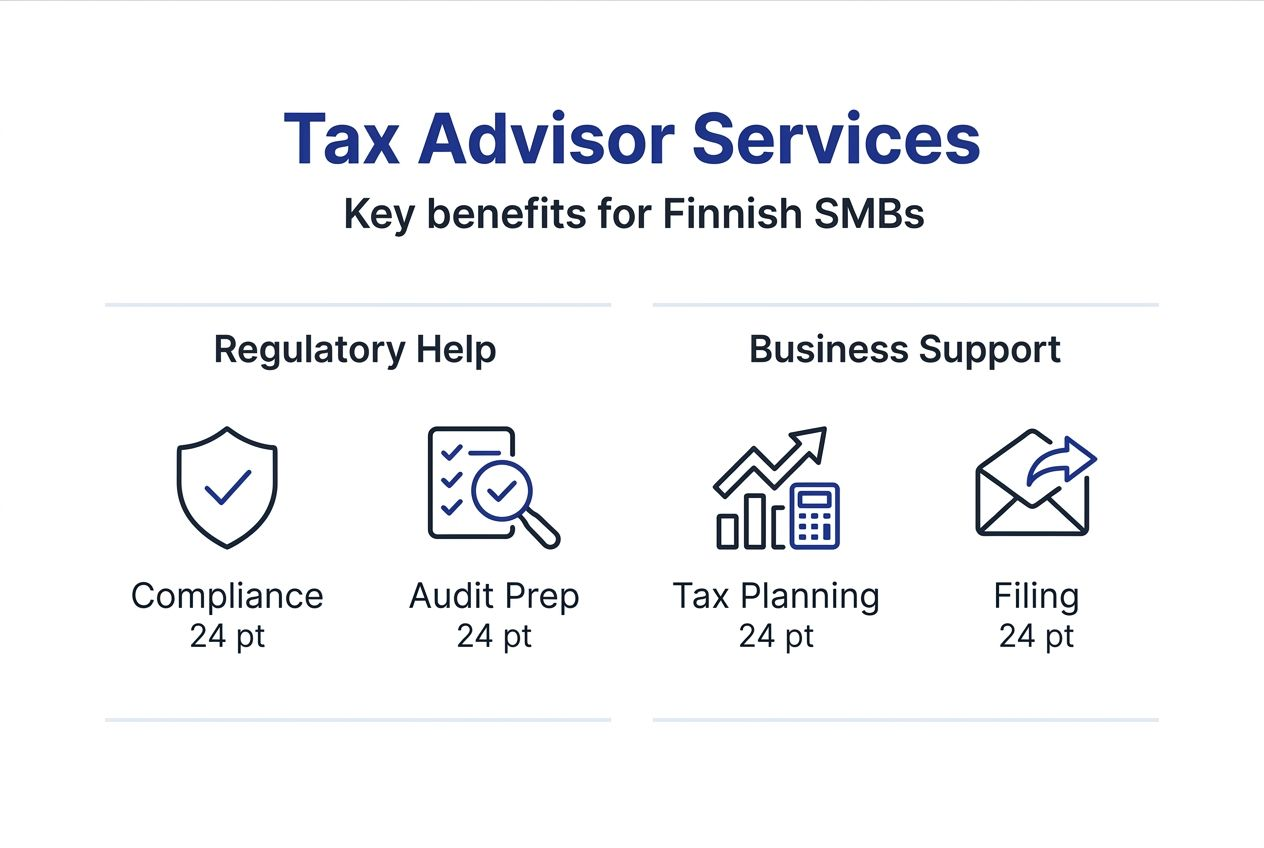
Tax planning and optimisation form the foundation of advisory relationships. Advisors analyse your business structure, revenue streams, and growth plans to identify opportunities for legitimate tax minimisation. They recommend optimal entity structures, timing strategies for major transactions, and investment decisions that maximise after-tax returns. This proactive planning approach transforms tax from a compliance burden into a strategic tool.
Preparation and filing services ensure accuracy whilst freeing your time for core business activities. Advisors gather financial data, calculate liabilities, complete returns, and submit documentation to tax authorities. They verify deduction eligibility, apply current rates correctly, and maintain audit trails that withstand scrutiny. This attention to detail prevents costly errors and reduces audit risk.
Representation during tax audits and disputes provides critical protection when authorities question your filings. Advisors communicate with tax officials on your behalf, prepare supporting documentation, and negotiate settlements when disagreements arise. Their expertise in tax law and audit procedures often resolves issues faster and more favourably than business owners handling matters independently.
International tax guidance addresses cross-border complications that increasingly affect Finnish SMBs:
- Transfer pricing rules for related party transactions
- Double taxation treaty benefits and applications
- Foreign tax credit calculations and claims
- Expatriate employee taxation and social security coordination
- Import and export VAT treatment
Pro tip: Engage your tax advisor before entering new markets or hiring international staff. Early planning prevents expensive mistakes and identifies reliefs you might otherwise miss.
These services combine to create comprehensive support that adapts to your business lifecycle. Whether you need basic compliance assistance or complex international tax structuring, advisors scale their involvement to match your requirements. Explore accounting services that integrate tax advisory with broader financial management for maximum efficiency.
Common misconceptions about the role of tax advisors
Many SMB owners hold incorrect assumptions about tax advisors that prevent them from accessing valuable support. Clarifying these misconceptions helps you recognise when specialist advice delivers genuine benefit.
The most prevalent confusion conflates tax advisory with general accounting. Accountants maintain financial records, prepare statements, and handle routine compliance. Tax advisors specialise in strategic planning, complex regulations, and optimisation opportunities. Whilst many accounting firms offer both services, the skills and focus differ significantly. You need both, but for different purposes.
Reactive tax filing represents another common misunderstanding. Many businesses engage advisors only during tax season, treating them as sophisticated form fillers. This approach misses the primary value advisors provide. Proactive tax planning throughout the year identifies opportunities, prevents problems, and positions your business for optimal outcomes. Annual engagement delivers compliance. Ongoing relationships deliver strategic advantage.
Some SMB owners believe tax advisory only benefits large corporations with complex structures. This misconception costs small businesses significant money. Finnish tax regulations affect all business sizes, and advisors tailor strategies to SMB circumstances. Early-stage companies particularly benefit from structural decisions that avoid costly reorganisations later. Growing businesses need expertise as complexity increases.
Key misconceptions that limit SMB success:
- Tax advisors simply file returns like accountants
- Advisory services cost more than they save
- Small businesses don't need specialised tax support
- You can handle everything with online tools and generic guidance
- Engaging advisors signals tax authority scrutiny
Delaying advisory engagement until problems arise proves far more expensive than preventative support. Penalties, missed reliefs, and suboptimal structures create costs that compound over time. Many SMBs discover this reality only after facing audits or realising they overpaid taxes for years.
Recognise that tax advisors serve as strategic partners who protect your interests and enhance profitability. Their expertise transforms regulatory obligations into competitive advantages. When you need accounting for delivery partners in Finland, choosing providers who integrate tax advisory with operational accounting delivers maximum value.
Comparing tax advisory options: what SMBs should look for
Selecting the right tax advisor requires evaluating multiple factors beyond price. Finnish SMBs benefit most from advisors who combine technical expertise with practical business understanding and responsive communication.
Prioritise Finnish tax system expertise when evaluating candidates. Advisors should demonstrate current knowledge of local regulations, VAT requirements, and compliance obligations specific to SMBs. Ask about their experience with businesses similar to yours in size, industry, and structure. International tax experience matters if you trade across borders or employ foreign staff.
Communication style significantly impacts the advisory relationship. Effective advisors explain complex tax concepts in plain language, respond promptly to questions, and proactively alert you to relevant changes. They should understand your business objectives and align tax strategies accordingly. Schedule introductory meetings to assess whether their approach matches your preferences.
| Service type | General accounting firm | Specialised tax advisor | Integrated provider |
|---|---|---|---|
| Tax return preparation | Standard | Advanced | Comprehensive |
| Strategic planning | Limited | Extensive | Integrated with accounting |
| International tax | Basic | Specialist | Coordinated |
| Audit representation | Referral basis | Direct | Direct |
| Typical cost | Lower hourly rates | Higher hourly rates | Package pricing |
| Best for | Simple structures | Complex situations | Growing SMBs needing both |
Cost structures vary significantly across providers. Some advisors charge hourly rates, others offer fixed fees for specific services, and integrated providers package tax advisory with accounting services. Evaluate total value rather than comparing hourly rates in isolation. A higher-priced advisor who identifies substantial savings delivers better returns than a budget option who misses opportunities.
Transparency in pricing builds trust and enables accurate budgeting. Request detailed proposals that itemise services, explain billing practices, and outline what triggers additional charges. Avoid advisors who provide vague estimates or resist discussing fees openly.
Pro tip: Prioritise advisors who demonstrate proven SMB experience and offer transparent, value-based pricing. References from similar businesses provide insight into real-world performance beyond marketing claims.
Consider how advisors integrate with your existing financial management. Seamless coordination between tax advisory and routine accounting improves efficiency and data accuracy. Explore tax advisory options for light entrepreneurs that bundle services for simplified management and often better overall value.
Applying tax advisory insights: practical steps for SMB owners
Engaging a tax advisor effectively requires preparation and ongoing collaboration. Follow these practical steps to maximise the value you receive from advisory relationships.
-
Assess your current compliance status and identify knowledge gaps. Review recent tax filings, note areas of uncertainty, and list questions about optimisation opportunities. This preparation focuses initial advisory conversations on your specific needs.
-
Select a qualified advisor using the criteria outlined earlier. Request proposals from multiple candidates, compare their approaches, and check references thoroughly. Choose based on expertise fit rather than price alone.
-
Prepare comprehensive financial and business data for your first advisory meeting. Gather previous tax returns, financial statements, business plans, and information about upcoming major decisions. Complete data enables accurate analysis and specific recommendations.
-
Implement recommended tax strategies systematically. Work with your advisor to prioritise actions, establish timelines, and assign responsibilities. Document decisions and track progress against planned objectives.
-
Maintain regular communication throughout the year. Schedule quarterly reviews to assess performance, discuss regulatory changes, and adjust strategies as your business evolves. Don't wait for year-end to engage your advisor.
-
Adapt continuously to tax law changes and business developments. Tax regulations evolve frequently, and your business circumstances shift as you grow. Ongoing advisory relationships identify implications early and position you to respond effectively.
Pro tip: Schedule advisory meetings before major business decisions like expansion, restructuring, or significant asset purchases. Early consultation prevents tax complications and identifies optimal approaches.
Effective collaboration requires you to provide complete, accurate information and respond promptly to advisor requests. Delayed communication or incomplete data limits the quality of advice you receive. Treat your advisor as a strategic partner whose success depends on understanding your full business picture.
Document all tax-related decisions and the reasoning behind them. This practice creates valuable audit trails and helps you learn from experience. When you need accounting for Ltd/Oy companies, integrated providers streamline data flow between accounting and tax advisory functions.
Regular engagement transforms one-time compliance support into strategic advantage. You build institutional knowledge, catch problems early, and optimise continuously rather than reacting to crises.
Summary and next steps: maximising benefits from your tax advisor
Tax advisors play a critical role in Finnish SMB success by transforming complex regulatory obligations into strategic opportunities. They provide expertise that extends far beyond routine compliance, offering proactive planning, risk management, and optimisation strategies tailored to your specific circumstances.
The most successful SMBs engage advisors early and maintain ongoing relationships throughout their business lifecycle. This approach prevents costly mistakes, identifies savings opportunities promptly, and ensures tax strategies align with business objectives. Waiting until problems arise or treating advisory as a one-time purchase limits the value you receive.
Strategic tax planning delivers measurable benefits. Optimised structures reduce liabilities legally, proper compliance avoids penalties and interest charges, and informed decision-making supports sustainable growth. These outcomes justify advisory costs many times over, particularly as your business scales and complexity increases.
Take action now to strengthen your tax position. Review your current compliance status, identify areas where specialist support would add value, and select an advisor who demonstrates Finnish SMB expertise. Prepare comprehensive business information and schedule an initial consultation to explore opportunities specific to your circumstances.
Maintain regular communication with your chosen advisor, implement recommendations systematically, and adapt strategies as regulations and business conditions evolve. This disciplined approach transforms tax from a compliance burden into a competitive advantage. Discover essential tax tips for Finnish entrepreneurs to complement professional advisory support.
Your investment in quality tax advisory pays dividends through reduced liabilities, avoided penalties, improved cash flow, and confident decision-making. Prioritise this relationship as a core component of your business infrastructure.
Discover expert tax advisory and accounting services at Finovate
Navigating Finnish tax regulations whilst growing your business demands expertise and attention that many SMB owners struggle to provide internally. Finovate specialises in delivering comprehensive accounting and tax advisory solutions tailored specifically to Finnish small and medium-sized businesses.
Our team combines deep knowledge of local tax regulations with practical business experience across diverse industries. We provide strategic planning that minimises liabilities, ensures compliance, and supports your growth objectives. From routine tax return preparation to complex international tax structuring, we scale our services to match your evolving needs.
Pro tip: Early consultation with tax specialists often uncovers immediate savings opportunities and prevents expensive compliance mistakes that many SMBs discover only during audits.
Explore our accounting services designed for Finnish businesses at every stage. Whether you need comprehensive support for accounting for delivery partners or specialised solutions for accounting for light entrepreneurs, Finovate delivers integrated financial management that simplifies operations and enhances profitability. Contact us today to discuss how we can streamline your tax and accounting management.
Frequently asked questions
What exactly does a tax advisor do for Finnish small businesses?
Tax advisors help Finnish SMBs optimise tax liabilities through strategic planning, ensure compliance with complex regulations, and provide representation during audits. They analyse business structures, recommend timing strategies for transactions, and identify reliefs that reduce overall tax burdens legally.
How do tax advisors differ from general accountants in Finland?
Accountants focus on historical record keeping, financial statement preparation, and routine compliance tasks. Tax advisors specialise in forward-looking strategic planning, complex regulatory interpretation, and optimisation opportunities. Many firms offer both services, but the expertise and focus differ substantially.
When should Finnish SMBs engage a tax advisor?
Engage tax advisors early, ideally during business formation when structural decisions create long-term tax implications. Continue the relationship as you grow, face compliance questions, expand internationally, or encounter audit situations. Proactive ongoing engagement delivers far more value than reactive crisis management.
Are tax advisory services worth the cost for small businesses?
Quality tax advisory typically saves SMBs significantly more than the service costs through identified reliefs, avoided penalties, and optimised structures. A single missed deduction or compliance error often exceeds annual advisory fees. Evaluate value based on total financial impact rather than service price alone.
How do I select the right tax advisor for my Finnish SMB?
Prioritise advisors with proven Finnish SMB experience, transparent pricing models, and strong communication skills. Request references from similar businesses, verify their knowledge of regulations affecting your industry, and assess whether their approach aligns with your business objectives and preferences.