

Finnish SMEs evade €120 million in taxes annually, yet most of these businesses are not deliberately breaking the law. Many simply find the rules confusing, the deadlines hard to track, and the paperwork overwhelming. The good news is that tax compliance in Finland has become significantly more manageable thanks to digital tools and clearer guidance from the Finnish Tax Administration. This guide covers the essentials of Finnish tax compliance, recent rule changes for 2026, and practical steps you can take right now to keep your business on the right side of the law.
Table of Contents
- What tax compliance means for Finnish businesses
- Corporate tax basics: rates, returns, and deadlines
- VAT essentials: thresholds, rates, and filing
- Recent changes and compliance pitfalls for SMEs in 2026
- Practical steps for stress-free compliance
- How Finovate can simplify your tax compliance
- Frequently asked questions
Key Takeaways
| Point | Details |
|---|---|
| Tax compliance is critical | Understanding and managing tax rules helps Finnish SMEs avoid costly mistakes. |
| Digital tools simplify filing | Using MyTax and automating reminders makes compliance more manageable for entrepreneurs. |
| Know the latest rules | 2026 brings changes to VAT relief and reporting, so keep updated to avoid surprises. |
| Get help when needed | Professional advisors can save you time and stress, especially with complex or new tax rules. |
What tax compliance means for Finnish businesses
Tax compliance is straightforward in principle: it means meeting all your legal obligations to register, calculate, file, and pay taxes correctly and on time. In Finland, this covers several key responsibilities that every SME owner should understand from day one.
The main components of compliance include:
- Registration: Enrolling your business in the correct tax registers, such as the VAT register or the prepayment register.
- Timely filing: Submitting returns and declarations by the required deadlines.
- Correct calculations: Accurately reporting taxable income, deductible expenses, and VAT amounts.
- Recordkeeping: Maintaining organised financial records that support your filings.
The central platform for managing all of this is MyTax, the Finnish Tax Administration's digital service. MyTax allows online management of filings, payments, and registrations, making it the ideal starting point for entrepreneurs who want to stay organised. You can also find essential tax tips to complement what MyTax offers.
Did you know? Digital adoption among Finnish businesses continues to rise, and MyTax is now the preferred channel for the vast majority of tax filings across all business types.
Pro Tip: Set up automatic reminders in your calendar for every recurring tax deadline. Missing a filing date, even by one day, can trigger late fees and unnecessary stress.
Corporate tax basics: rates, returns, and deadlines
With compliance defined, let's break down what your tax rates and responsibilities look like in practice. Understanding the numbers and the process removes a great deal of uncertainty.
Finland's corporate income tax rate for limited liability companies is 20%. This is internationally competitive and applies to the net taxable income of your company after allowable deductions.
Key fact: At 20%, Finland's corporate tax rate sits comfortably within the range of other EU member states, making it a stable environment for business planning.
Here is a summary of key tax rates, deadlines, and filing channels for common Finnish business structures:
| Business type | Tax rate | Filing deadline | Preferred channel |
|---|---|---|---|
| Limited liability company (Oy) | 20% | Within 4 months of accounting period end | MyTax |
| General partnership | Progressive | Within 4 months of accounting period end | MyTax |
| Sole trader | Progressive | Spring tax return deadline | MyTax |
| Co-operative | 20% | Within 4 months of accounting period end | MyTax |
For limited companies, the income tax return must be filed within four months after the end of the accounting period, preferably via MyTax. Here is the step-by-step process:
- Close your accounts and prepare your financial statements for the period.
- Calculate your taxable income by adjusting accounting profit for non-deductible items.
- Log in to MyTax and complete the corporate income tax return form.
- Attach supporting documents, including your profit and loss account and balance sheet.
- Submit the return before the four-month deadline and pay any tax due.
Understanding accounting methods for entrepreneurs will help you prepare accurate figures before you reach step two. If you operate as a limited company, our accounting for ltd companies service can handle this process for you.
VAT essentials: thresholds, rates, and filing
Corporate taxes are only half the picture. Most SMEs also face VAT compliance, and this is where many businesses make avoidable mistakes. Here is what you need to know.

VAT registration is mandatory when your annual VAT-liable turnover exceeds €20,000, a threshold that has applied since 2025. Businesses below this level are exempt but may register voluntarily to reclaim input VAT on purchases.
| Scenario | Turnover | VAT registration |
|---|---|---|
| Mandatory registration | Over €20,000 per year | Required |
| Voluntary registration | Under €20,000 per year | Optional |
| Zero-rated supplies only | Any level | Depends on activity |
Finland's VAT rates for 2026 are:
- Standard rate: 25.5% (applies to most goods and services)
- Reduced rate: 14% (applies to food, animal feed, and restaurant services)
- Reduced rate: 10% (applies to books, medicines, passenger transport, and cultural events)
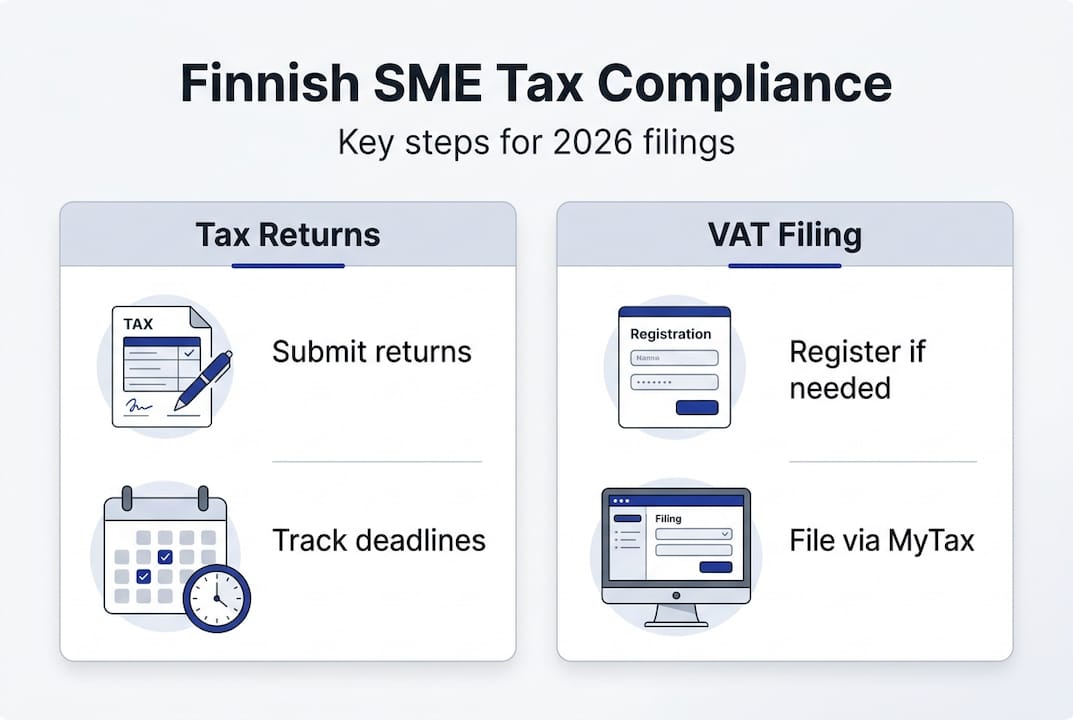
VAT returns are filed periodically via MyTax, with the frequency depending on your annual turnover. Monthly filing applies to larger businesses, quarterly to mid-sized ones, and annual filing to smaller operators.
Pro Tip: Even if your business had no sales activity during a filing period, you are still required to submit a VAT return. Failing to do so counts as a missed filing and may attract penalties.
For freelancers, understanding VAT filing for freelancers is especially important. Solid small business bookkeeping basics will also help you keep VAT records accurate throughout the year. If you want a structured approach, our bookkeeping guide walks you through the process step by step. You may also find it useful to review common tax questions that other small business owners frequently raise.
Recent changes and compliance pitfalls for SMEs in 2026
Having understood the fundamentals, let's look at what has changed and what traps to avoid this year. Staying current with regulatory updates is just as important as understanding the baseline rules.
Key changes and points to watch in 2026 include:
- End of VAT relief for smallest businesses: The VAT relief scheme for businesses with turnover up to €30,000 was available for 2024 but ended in 2025. If you relied on this relief, you need to reassess your VAT position now.
- Stricter reporting for foreign operations: Permanent establishment rules for businesses with foreign operations have become more closely scrutinised. If your business operates across borders, review your reporting obligations carefully.
- R&D deductions: Businesses investing in research and development can benefit from 50% accelerated depreciation and additional deductions on qualifying wages and services. This is an opportunity many SMEs overlook.
The tax burden itself remains a real concern. 66% of SMEs report that high taxation reduces their willingness to grow and invest. While we cannot change the rates, we can help you make sure you are not paying more than you legally owe.
Common compliance mistakes to avoid:
- Filing returns late because deadlines were not tracked.
- Misapplying VAT rates to goods or services.
- Failing to update registrations when your business structure or turnover changes.
- Overlooking deductions that could legitimately reduce your tax bill.
Pro Tip: Add every tax deadline to your business calendar at the start of the year. Include a two-week buffer before each deadline so you have time to gather documents and resolve any issues.
Understanding the role of tax advisor in your business can make a significant difference when navigating these changes. You can also revisit practical tax tips to keep your approach sharp. For context on how dividend income is treated, a dividends tax guide can offer useful comparative perspective.
Practical steps for stress-free compliance
With common pitfalls in mind, here are practical steps to keep compliance hassle-free and business-focused. These steps apply whether you are just starting out or have been operating for years.
- Register correctly from the start. Enrol in the right tax registers for your business type and turnover level. Use MyTax digital services to complete registrations online without paperwork delays.
- Track your turnover continuously. Monitor your revenue monthly so you know when you are approaching VAT or other registration thresholds.
- Set filing deadlines in advance. Map out every return deadline for the year and assign responsibility for each one within your team or to your accountant.
- Digitalise your financial records. Use accounting software to record transactions in real time. This makes filing faster and reduces the risk of errors.
- File via MyTax. The platform is reliable, secure, and provides confirmation of receipt. It also stores your filing history, which is useful during any future review.
- Seek professional advice when uncertain. Tax rules change, and some situations are genuinely complex. Consulting an expert early is far less costly than correcting a mistake after the fact.
Pro Tip: Automate your document backup to a secure cloud service. Keep a digital paper trail of every invoice, receipt, and filing confirmation. If the Tax Administration ever requests documentation, you will be ready within minutes.
For further reading, our actionable tax tips cover additional strategies, and the Finovate blog is regularly updated with guidance relevant to Finnish SMEs.
How Finovate can simplify your tax compliance
Navigating Finnish tax rules is manageable with the right support. At Finovate, we work with entrepreneurs and SMEs across Finland to take the complexity out of compliance, so you can focus on running your business.
Our services are built around your needs. Whether you need help with invoicing through our Invoicing Service Pro, structured accounting for limited companies, or a broader advisory relationship, we are here to help. Explore our full range of accounting services to find the right fit for your business. Get in touch with us today for a personal consultation on your tax compliance needs.
Frequently asked questions
What is the VAT registration threshold for Finnish businesses in 2026?
VAT registration is mandatory if your taxable turnover exceeds €20,000 per year, a rule that has been in place since 2025. Businesses below this threshold are exempt but may register voluntarily.
How often must I file corporate tax returns in Finland?
Limited companies must file an income tax return within four months after their accounting period ends, which typically means once per year.
What are the main VAT rates in Finland for 2026?
Finland applies a standard VAT rate of 25.5%, with reduced rates of 14% for food and restaurant services and 10% for books, medicines, and passenger transport.
Can SMEs voluntarily register for VAT below the threshold?
Yes. Businesses below €20,000 turnover can register for VAT voluntarily, which allows them to reclaim input VAT on business purchases and expenses.
What is the corporate income tax rate in Finland for SMEs?
The corporate income tax rate for Finnish limited liability companies is 20%, applied to net taxable income after allowable deductions.