

TL;DR:
- Finnish accounting firms offer comprehensive services including tax, payroll, advisory, and digital transformation guidance.
- Outsourcing accounting tasks improves compliance and reporting quality but requires ongoing strategic collaboration.
- Embracing digital tools with professional support enables SMEs to keep pace with technological and regulatory changes.
Many entrepreneurs assume that hiring an accounting firm means someone will handle their invoices and little else. In Finland, that assumption can cost you. Professional accounting firms do far more than record transactions. They navigate complex tax legislation, manage payroll obligations, guide salary and dividend decisions, and support digital transformation. As regulatory pressure grows and the Finnish tax authority tightens enforcement, the gap between businesses that use firms strategically and those that treat them as a last resort is widening. This guide breaks down exactly what accounting firms deliver, where they add the most value, and how you can use them to protect and grow your business.
Table of Contents
- Core functions of accounting firms in Finland
- Compliance and regulatory navigation made simple
- Outsourcing and in-house: what SMEs miss in the debate
- Digital transformation and the rise of intelligent accounting
- A fresh perspective: the overlooked strategic value of accounting firms
- Tap into Finnish accounting expertise for your business
- Frequently asked questions
Key Takeaways
| Point | Details |
|---|---|
| Beyond bookkeeping | Finnish accounting firms deliver statutory, advisory, and compliance services that support business growth. |
| Compliance ensured | Professional support helps you meet strict Finnish regulations and avoid costly mistakes. |
| Digital progress gap | SMEs can boost efficiency by adopting digital tools with guidance from expert firms. |
| Outsourcing advantages | Outsourcing key tasks raises reporting quality but is strongest when balanced with internal insights. |
Core functions of accounting firms in Finland
To understand their true value, let us break down the key functions accounting firms deliver for Finnish businesses.
Many owners think of accounting as a back-office task. In reality, accounting services for small businesses in Finland cover a wide range of statutory and advisory obligations that directly affect your bottom line. The distinction matters because getting it wrong is expensive.
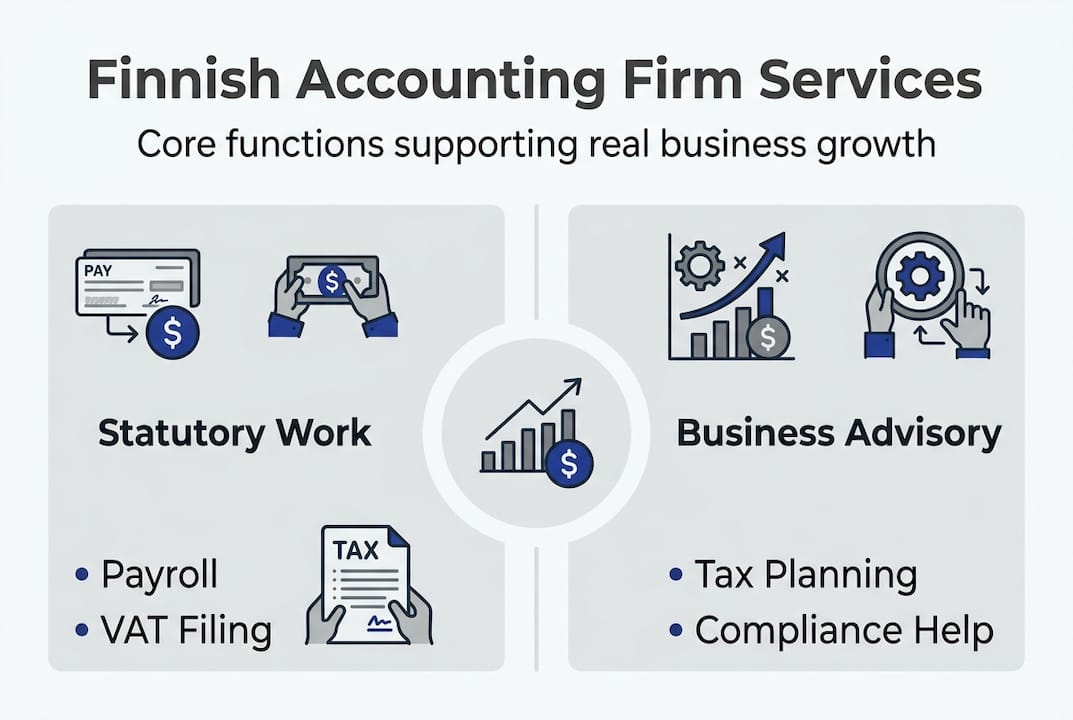
Finnish law sets clear reporting requirements based on company size. Micro companies are exempt from audits, while small companies face simplified but still mandatory reporting obligations under the Finnish Accounting Act. Understanding which category your business falls into determines your compliance workload and the level of professional support you need.
Here is what a full-service accounting firm typically covers for Finnish SMEs:
- Statutory accounts preparation and annual financial statements
- Payroll processing, including pension contributions and tax withholdings
- VAT reporting and monthly or quarterly tax declarations
- Corporate income tax filing and advance tax management
- Business advisory, including salary versus dividend structuring
- R&D tax incentive guidance and eligibility assessments
- Cash flow forecasting and financial planning support
One area where firms add particular value is salary and dividend optimisation. Finnish entrepreneurs operating through a limited company (Oy) can choose how to extract income, and the tax implications vary significantly. Getting this wrong means overpaying tax or triggering penalties. Understanding the different accounting methods in Finland helps you see why professional guidance is not optional for growing businesses.
Pro Tip: Do not wait until year-end to engage your accountant. Firms that review your financials quarterly can catch errors, flag risks, and identify tax-saving opportunities before it is too late to act.
Compliance and regulatory navigation made simple
Having outlined the primary services, it is crucial to see how firms simplify the often-daunting compliance landscape for SMEs.
Finnish compliance obligations are not static. VAT rules, payroll regulations, and reporting deadlines shift regularly, and missing one can trigger fines or audits. The table below summarises the core obligations most Finnish SMEs face:
| Obligation | Frequency | Who it applies to |
|---|---|---|
| VAT declaration | Monthly or quarterly | VAT-registered businesses |
| Payroll tax reporting | Monthly | All employers |
| Annual accounts filing | Annually | All limited companies |
| Corporate income tax | Annually, with advance payments | All Oy companies |
| Audit requirement | Annually | Companies above small-company thresholds |
A professional firm follows a structured process to keep you compliant year-round:
- Initial review of your current obligations and any outstanding filings
- Calendar setup with all key deadlines mapped to your business cycle
- Monthly reconciliation of accounts and VAT positions
- Payroll processing with accurate withholding and pension contributions
- Advance tax monitoring to avoid underpayment penalties
- Annual accounts preparation and submission to the Finnish Trade Register
- Post-filing review to identify improvements for the next period
"Finnish tax authorities apply strict scrutiny to errors in VAT and payroll reporting. A single miscalculation can trigger a formal review and penalties that far exceed the cost of professional support."
Beyond avoiding penalties, firms guide you through tax compliance in Finland with a forward-looking approach. For example, the Finnish tax authority offers an R&D deduction for qualifying research and development costs, yet many SMEs never claim it because they are unaware it exists. A good firm surfaces these opportunities proactively. You can also explore our bookkeeping compliance guide and learn more about the role of Finnish tax advisors in protecting your business.
Outsourcing and in-house: what SMEs miss in the debate
With compliance handled, the next question is whether to outsource, keep tasks in-house, or use a hybrid approach.
The outsourcing debate often focuses on cost. That is the wrong starting point. The real question is where your time and expertise are best spent. Research shows that outsourcing to accounting firms improves financial reporting quality for SMEs, particularly in accruals accuracy and regulatory compliance. The comparison below helps clarify the trade-offs:
| Factor | Outsourcing | In-house |
|---|---|---|
| Cost | Predictable monthly fee | Variable, includes salaries and training |
| Compliance coverage | Broad, kept current by firm | Depends on staff knowledge |
| Speed of reporting | Fast, with dedicated resources | Can be slower during busy periods |
| Flexibility | Scales with business needs | Limited by headcount |
| Quality control | Firm-level review processes | Relies on individual staff |
Outsourcing works best in these situations:
- Your business lacks in-house accounting expertise
- You are navigating a regulatory change or new tax obligation
- Your company is growing and reporting complexity is increasing
- You need specialist advice on payroll, VAT, or corporate structuring
However, outsourcing everything is not always the answer. Some tasks, such as daily expense tracking or basic invoicing, are often better managed internally. Explore outsourcing bookkeeping in Finland to understand where the boundary lies, and review bookkeeping best practices to strengthen your internal processes.
Pro Tip: Retain oversight of your cash flow position even when outsourcing fully. Reviewing a weekly cash summary takes minutes and ensures you stay informed about your business's financial health without duplicating your accountant's work.
Digital transformation and the rise of intelligent accounting
As technology reshapes accounting, let us examine how digital transformation is redefining what Finnish firms deliver.
The numbers are striking. Only 11% of small Finnish firms currently use AI in their accounting processes, compared to 41% of large enterprises. That gap represents both a risk and an opportunity for SMEs willing to act now.
Digital maturity in accounting tends to follow a predictable path:
- Manual accounting: Paper records, spreadsheets, and reactive reporting
- Basic automation: Cloud-based software, automated bank feeds, and digital invoicing
- Process integration: Connected payroll, VAT, and accounting systems with reduced manual input
- Data analytics: Real-time dashboards, forecasting tools, and performance reporting
- AI-assisted accounting: Automated anomaly detection, predictive cash flow, and intelligent reconciliation
Most Finnish SMEs sit at stages one or two. Moving forward requires investment, but the barriers are manageable with the right support. Cost is the most common concern, followed by a lack of internal expertise and resistance to process change.
This is where accounting firms play a practical role beyond compliance. They evaluate software vendors, manage data migration, and ensure that new systems meet Finnish regulatory requirements. They also help you avoid costly mistakes, such as adopting tools that do not integrate with the Finnish tax authority's reporting systems.
For owners ready to start, the practical first steps are straightforward: move to a cloud-based accounting system, implement digital payroll processing, and request regular digital reports from your firm. Explore digital accounting trends for SMEs to see what a phased upgrade looks like in practice.
A fresh perspective: the overlooked strategic value of accounting firms
Most conversations about accounting firms focus on compliance and technology. Both matter. But the most undervalued benefit is something quieter: ongoing strategic insight.
We have seen many businesses treat their accounting firm as a once-a-year necessity. They send documents, receive accounts, and move on. That approach leaves significant value on the table. The firms that genuinely support business growth are those engaged regularly, not just at year-end. Quarterly reviews, for example, surface cash flow risks months before they become crises. They also reveal growth opportunities that raw numbers alone would not highlight.
There is also a risk management dimension that rarely gets discussed. When regulations change, when a major customer delays payment, or when you are considering a new hire, your accounting firm should be one of your first calls. They hold a detailed picture of your financial position and can model the impact of decisions before you commit.
The firms that pay off most are those you treat as ongoing advisors, not replaceable vendors. AI tools and automated reports are genuinely useful, but human expertise is what turns data into decisions. If you are evaluating your current setup, start by asking whether your firm proactively contacts you with insights, or whether you always have to ask. That distinction reveals the real quality of the relationship. Consider choosing the right accounting partner carefully, because the right firm does not just record your past. It helps you plan your future.
Tap into Finnish accounting expertise for your business
If you are ready to leverage the full value of professional expertise, here is how to get started with trusted Finnish advisors.
At Finovate, we provide Finnish entrepreneurs and business owners with accounting services built for real-world complexity. Whether you need a straightforward invoicing service for SMEs or full accounting for light entrepreneurs, we have solutions designed for your stage of growth.
Our team handles compliance, payroll, VAT, tax planning, and business advisory so you can focus on running your business. We stay current with Finnish regulatory changes and proactively share what matters to you. Reach out today to discuss which service level fits your needs and how we can support your financial management from day one.
Frequently asked questions
What distinguishes accounting firms from bookkeepers in Finland?
Accounting firms handle statutory compliance, advanced tax planning, and strategic advisory, going well beyond the routine transaction recording that bookkeepers provide. Broader firm services include audit support, financial statements, and regulatory guidance.
How do Finnish firms help with tax optimisation?
They guide structure choices such as salary versus dividends and ensure you benefit from available incentives, including the R&D combined deduction for qualifying businesses.
Is it safer to outsource or keep accounting in-house in Finland?
Outsourcing generally improves reporting quality for SMEs, but retaining some internal oversight of cash flow and key figures ensures you stay informed and in control.
Are Finnish SMEs keeping pace with digital transformation in accounting?
Most SMEs lag behind large firms, with only 11% using AI compared to 41% of large enterprises, but phased upgrades with firm support make the transition achievable.