

TL;DR:
- Finnish law requires all legal entities to prepare annual financial statements, regardless of size.
- Proper financial reports are vital for legal compliance, tax filing, securing loans, and building trust.
- From 2027, XBRL structured filing will be mandatory, streamlining digital submission and comparison.
Many small business owners in Finland assume that financial statements are something only large companies worry about. That assumption can be costly. Under the Finnish Accounting Act, all legal persons must prepare annual financial statements, regardless of size. This includes limited companies, cooperatives, and even some sole traders. Missing this obligation does not just mean paperwork trouble. It can result in fines, damaged credibility with lenders, and lost business opportunities. This article explains who must prepare financial reports, what documents are required, when to file, and what happens if you do not.
Table of Contents
- Who must prepare financial reports in Finland?
- Why are financial reports necessary for Finnish SMEs?
- What documents and data are needed for compliant financial statements?
- Deadlines, filing procedures, and consequences for Finnish SMEs
- What most guides miss about Finnish financial reporting
- Making Finnish financial reporting effortless for your SME
- Frequently asked questions
Key Takeaways
| Point | Details |
|---|---|
| Know your obligations | Almost all Finnish SMEs must prepare annual financial statements to remain compliant with the law. |
| Proper documents are essential | Accurate bookkeeping and documentation simplify financial reporting and prevent costly errors. |
| Filing deadlines matter | Missing filing deadlines leads to significant fines and reputational risks for your business. |
| Benefits go beyond compliance | Well-prepared reports aid in tax filing, securing loans, and making better business decisions. |
| New reporting rules | XBRL electronic filing will be required from 2027, making early preparation wise for all SMEs. |
Who must prepare financial reports in Finland?
Understanding your legal obligations starts with knowing which category your business falls into. In Finland, the Accounting Act draws a clear line between legal persons and sole traders.
Legal persons include limited liability companies (Oy), cooperatives, partnerships, and associations. These entities must always prepare annual financial statements, without exception. Sole traders (toiminimi) are only required to do so if they exceed specific size thresholds or use a non-calendar financial year.
The size thresholds that trigger reporting obligations for sole traders are:
- Balance sheet total exceeds €100,000
- Annual turnover exceeds €200,000
- Average number of employees exceeds three
If a sole trader meets at least two of these three criteria, full financial statements become mandatory. For freelancers and self-employed individuals, understanding these rules is essential. You can read more about freelancer accounting requirements to see how these rules apply in practice.
Audit requirements follow a similar logic. A statutory audit is required if a company meets at least two of the following in two consecutive financial years: balance sheet over €100k, turnover over €200k, or more than three employees. Most micro-entities fall below these thresholds, but it is worth checking annually as your business grows.
From 2027, XBRL (eXtensible Business Reporting Language) structured filing will become mandatory for small entities. This is a digital format that standardises how financial data is submitted electronically. It is worth preparing your systems now rather than scrambling later.
The following business types are generally exempt from full financial statement requirements:
- Sole traders below the size thresholds above
- Individuals engaged in very small-scale trade with no employees
For a full overview of what documents are required by business type, the financial statements guidance from Suomi.fi is a reliable reference.
Pro Tip: Even if you are currently exempt, keep your bookkeeping organised as if you were required to report. Growth can push you over a threshold mid-year, and disorganised records are far harder to reconstruct than to maintain.
Why are financial reports necessary for Finnish SMEs?
Financial reports are not just a legal formality. They serve a range of practical purposes that directly affect your business's health and future.
From a legal standpoint, the Finnish Accounting Act and the Patent and Registration Office (PRH) require that companies file their financial statements on time. Failure to comply is not treated lightly. Fines are issued, and persistent non-compliance can attract regulatory scrutiny.

Beyond compliance, financial statements are essential for completing your corporate tax return, securing business loans, entering supplier contracts, and demonstrating financial health to investors or partners. Banks and funding bodies in Finland routinely request the last one to three years of financial statements before approving credit.
The business advantages of accurate reporting include:
- Profitability analysis: Understanding which products or services generate the most margin
- Liquidity monitoring: Knowing whether you have enough cash to cover short-term obligations
- Tax planning: Identifying allowable deductions and planning for tax liabilities before year-end
- Benchmarking: Comparing your performance against industry averages published by Statistics Finland
"Accurate financial statements are the foundation of sound business decisions. Without them, you are managing blind."
For Finnish SMEs, tax compliance for businesses is closely tied to the quality of your financial reporting. Errors in your statements can trigger corrections to your tax return, leading to additional assessments and interest charges. Getting it right the first time saves significant time and money.
Financial reports also build public trust. In Finland, filed financial statements are publicly accessible through the PRH. Customers, suppliers, and potential partners can review your figures. A clean, timely set of accounts signals stability and professionalism.
What documents and data are needed for compliant financial statements?
Preparing compliant financial statements requires gathering specific records well before the filing deadline. Leaving this to the last month creates unnecessary pressure and increases the risk of errors.
The core documents you need to compile are:
- Complete bookkeeping records using double-entry accounting, as required for all legal entities under Finnish law
- Sales invoices and purchase receipts covering the entire financial year
- Bank statements for all business accounts, reconciled to your accounting records
- Payroll data including salaries, employer contributions, and pension payments
- VAT return data filed throughout the year with the Finnish Tax Administration
- Loan and lease agreements relevant to the financial year
According to Finnish accounting requirements, all of these must be accurate and complete before you can produce a reliable set of financial statements.
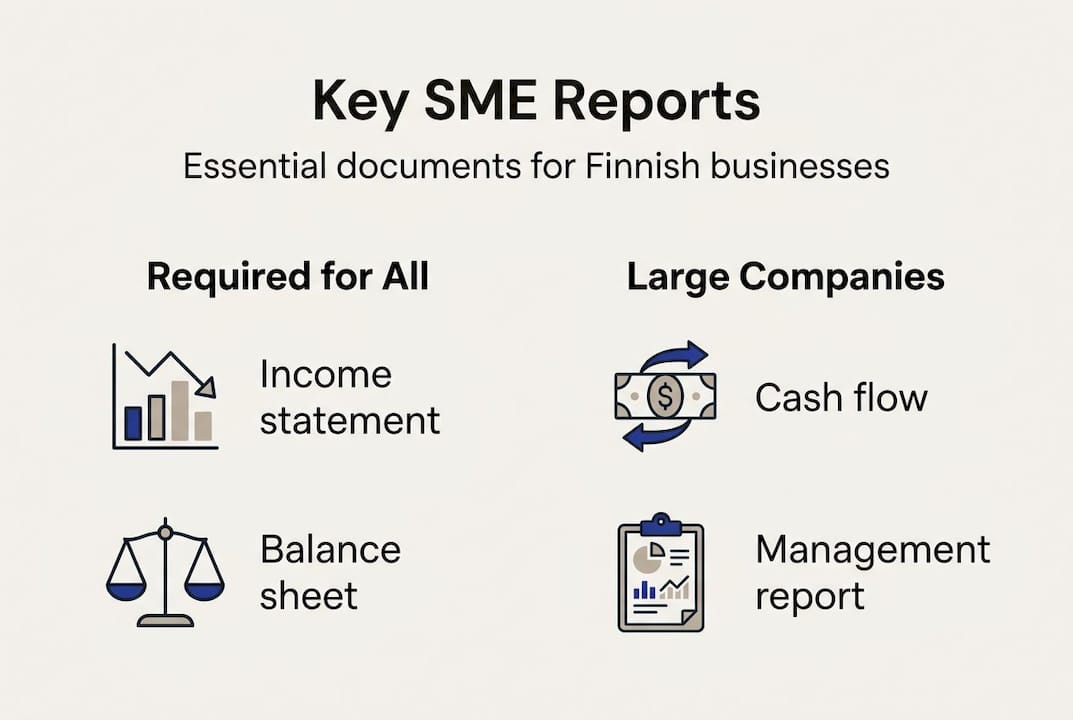
The level of detail required in the final statements depends on your company's size. Here is a comparison:
| Requirement | Micro/small company | Large company |
|---|---|---|
| Income statement | Required | Required |
| Balance sheet | Required | Required |
| Notes to accounts | Required | Required |
| Cash flow statement | Not required | Required |
| Board of directors' report | Not required | Required |
| XBRL digital filing | From 2027 | Already required |
Regarding accounting standards, most Finnish SMEs use FAS (Finnish Accounting Standards), which is simpler and more suited to domestic operations. IFRS (International Financial Reporting Standards) is generally reserved for listed companies or those with international investors. For practical guidance on maintaining your records throughout the year, our step-by-step bookkeeping guide and bookkeeping best practices articles offer detailed advice.
For a full list of required financial statements by company type, the PRH website is the definitive source.
Pro Tip: Create a shared digital folder for each financial year. Store every invoice, receipt, and bank statement there as they arrive. This one habit alone can save several hours at year-end and significantly reduces the risk of missing documentation.
Deadlines, filing procedures, and consequences for Finnish SMEs
Knowing the deadlines is not enough. You also need to understand the steps involved and the consequences of missing them.
Here is the standard timeline for a company with a 31 December financial year-end:
| Milestone | Deadline |
|---|---|
| Financial statements prepared | Within 4 months of year-end (30 April) |
| Board approval and signing | Before filing |
| Filed with PRH | Within 8 months of year-end (31 August) |
| Corporate tax return submitted | Within 4 months of year-end |
The step-by-step process is as follows:
- Close your bookkeeping for the financial year
- Prepare the income statement and balance sheet
- Draft the notes to accounts
- Have the board of directors approve and sign the statements
- Submit to the PRH via their online portal
- File your corporate tax return with the Finnish Tax Administration
Financial statements must be filed within 8 months of the financial year-end. If you miss this deadline, the PRH will issue fines. The fine is €300 if you are between two and four months late, rising to €600 if you are more than four months late. These fines can escalate if non-compliance continues.
Key figure: Fines of €300 to €600 are issued for late filing, and the PRH can pursue further enforcement action for persistent non-compliance.
From 2027, XBRL filing becomes mandatory for small entities. This means your accounting software must be capable of generating structured digital reports in the required format. If your current system cannot do this, now is the time to upgrade or consult a professional.
Common mistakes that delay filing include:
- Incomplete or unreconciled bookkeeping records
- Missing payroll or VAT data
- Failure to obtain board signatures before the deadline
- Underestimating the time needed for notes preparation
For a broader view of your obligations, our guide on essential accounting rules covers the key compliance points Finnish businesses must follow.
What most guides miss about Finnish financial reporting
Most articles focus on the obvious: deadlines, fines, and document lists. But there are less visible issues that catch Finnish SME owners off guard.
One common surprise is that a non-calendar financial year can trigger full financial statement requirements even for small sole traders who would otherwise be exempt. If your financial year does not align with the calendar year, the standard exemptions may not apply. Check this carefully.
On the topic of audit thresholds, some business owners view the low limits as burdensome. We see it differently. Low audit thresholds exist to protect creditors and maintain trust in the business environment. They are unlikely to change soon, and accepting that reality is more productive than resisting it.
The upcoming XBRL requirement is often framed as extra administrative work. In practice, structured digital reporting makes year-on-year comparison significantly easier. Once your data is in a standardised format, spotting trends in revenue, costs, and margins becomes faster and more reliable.
Finally, the process of preparing financial statements is itself a strategic exercise. Reviewing your figures forces you to confront what is working and what is not. Our SME compliance tips article explores how this annual review can inform better business decisions throughout the year.
Making Finnish financial reporting effortless for your SME
Meeting all of Finland's financial reporting requirements takes time, precision, and up-to-date knowledge. For many business owners, that is time better spent running and growing their business.
At Finovate, we support Finnish SMEs and micro-entrepreneurs with bookkeeping, financial statement preparation, tax filing, and payroll. Whether you are a light entrepreneur using our invoicing service or a growing Oy looking for full accounting for entrepreneurs, we handle the compliance so you do not have to. Our team stays current with every regulatory change, including the upcoming XBRL requirements. Explore our full range of Finovate accounting services and find the right solution for your business today.
Frequently asked questions
Do all small businesses in Finland need to prepare financial statements?
All legal entities must prepare annual financial statements, but sole traders are only required to do so if they exceed size thresholds or use a non-calendar financial year.
What are the penalties for late filing of financial reports in Finland?
Late filing incurs fines of €300 if two to four months late, rising to €600 if filed more than four months after the deadline.
What details must be included in micro and small company financial statements?
Micro and small companies must include an income statement, balance sheet, and notes to accounts, but a cash flow statement and board of directors' report are not required.
What is XBRL and how will it affect Finnish SMEs?
From 2027, XBRL becomes mandatory for structured electronic filing of financial reports, making submission and year-on-year comparison more straightforward for SMEs.
How do financial reports help Finnish SMEs beyond legal compliance?
They are essential for completing tax returns, obtaining loans, and entering business contracts, while also supporting informed decisions on profitability and cash flow.