

TL;DR:
- Regular bookkeeping ensures legal compliance, accurate tax filings, and prevents penalties in Finland.
- Up-to-date financial records provide real-time insights, supporting better decision-making and business growth.
- Digital and double-entry methods are recommended for scaling, accuracy, and meeting legal requirements.
Roughly 40% of small businesses fall behind on their bookkeeping, quietly creating problems that range from cash flow surprises to tax penalties. For Finnish SMEs, this is not simply an administrative inconvenience. Irregular records can trigger compliance issues, cloud your view of profitability, and close doors to funding at precisely the moment you need them open. This article walks you through the legal requirements, the business case for staying current, and the practical steps to build a bookkeeping routine that actually supports your growth.
Table of Contents
- Regulatory compliance: Avoiding tax penalties and legal risks
- Business performance: Real-time financial insights for growth
- Bookkeeping methods: Double-entry vs single-entry and digital adoption
- How often to update your books: Finding your SME's rhythm
- Why most SMEs underestimate regular bookkeeping (and how to get ahead))
- Move from paperwork to peace of mind with expert help
- Frequently asked questions
Key Takeaways
| Point | Details |
|---|---|
| Compliance foundation | Regular bookkeeping ensures adherence to Finnish tax laws and prevents fines. |
| Business clarity | Up-to-date records provide vital real-time insights to guide growth and cash flow management. |
| Higher earnings | SMEs using professional bookkeeping services report up to 11.5% more annual revenue. |
| Digital efficiency | Switching to digital and double-entry systems simplifies compliance and accuracy. |
Regulatory compliance: Avoiding tax penalties and legal risks
In Finland, your accounting records are not just internal documents. They form the direct basis for calculating VAT, income tax, and other statutory obligations. When records are incomplete or delayed, errors in tax submissions become almost inevitable, and Finnish authorities are increasingly processing these submissions digitally, which means discrepancies are spotted faster than ever before.
Taxes are based directly on your accounting records, so late or inaccurate entries do not just create administrative headaches. They can result in underpaid taxes, fines, and interest charges. The Finnish Tax Administration expects businesses to maintain orderly books throughout the financial year, not scramble to reconstruct them at year-end.
For a thorough overview of your obligations, our compliance and bookkeeping guide covers the key statutory requirements in plain language. It is also worth reviewing Finnish tax compliance essentials if you want to stay ahead of 2026 regulatory expectations.
The most common compliance pitfalls we see among Finnish SMEs include:
- Late entries: Recording transactions weeks after they occur makes reconciliation unreliable and increases audit risk.
- Missing invoices: Gaps in purchase or sales documentation leave your VAT calculations open to challenge.
- Errors from infrequent updates: The longer the gap between updates, the more likely that figures are estimated rather than verified.
- Incomplete payroll records: Payroll must be documented accurately, with supporting records for each pay period.
"Bookkeeping done once a year is not bookkeeping. It is reconstruction. And reconstruction is where errors, penalties, and stress originate."
Business owners who treat their books as a once-a-year obligation before the tax deadline are effectively flying blind for most of the year. Staying current is not about perfectionism. It is about protecting your business from avoidable legal and financial risk.
Business performance: Real-time financial insights for growth
Compliance is the floor, not the ceiling. The real advantage of regular bookkeeping shows up in how clearly you can see your business at any given moment. When your records are current, you know exactly where your cash is, which customers owe you money, and whether your margins are holding up.
Regular bookkeeping provides real-time financial insights that support informed decision-making and cash flow management. This matters because cash flow problems do not announce themselves in advance. They build quietly, and up-to-date books are your early warning system.

The numbers back this up. Businesses using professional bookkeeping services see 11.5% higher annual revenue on average, largely because better financial visibility leads to smarter decisions. For practical guidance, our bookkeeping best practices article and bookkeeping basics guide are good starting points.
| Area | With regular bookkeeping | Without regular bookkeeping |
|---|---|---|
| Cash flow visibility | Clear and current | Delayed, often unknown |
| Error frequency | Low, caught early | High, compounding over time |
| Tax planning | Proactive and accurate | Reactive and often costly |
| Investor or lender confidence | Strong | Undermined by gaps |
| Month-on-month comparison | Easy and reliable | Difficult or impossible |
Pro Tip: Reconcile your bank statements and outstanding invoices every month without exception. It takes less time than most business owners expect, and it prevents small discrepancies from becoming expensive problems.
Three actionable insights you gain from timely financials:
- Accurate budgeting: You can allocate resources confidently when you know your actual income and outgoings.
- Early warnings: Declining margins or rising costs appear in your records before they affect your operations.
- Stakeholder confidence: Banks, investors, and potential partners want to see clean, current accounts before they commit.
Bookkeeping methods: Double-entry vs single-entry and digital adoption
Not every Finnish SME uses the same bookkeeping system, and Finnish law specifies when each is required. Choosing the right method matters both for legal compliance and for the quality of information your records produce.
Double-entry bookkeeping is mandatory when your business meets at least two of three thresholds: a balance sheet above €100,000, annual turnover above €200,000, or an average of more than three employees. If you fall below these thresholds, single-entry bookkeeping is permitted, though your records must still be adjusted to an accruals basis for tax purposes.
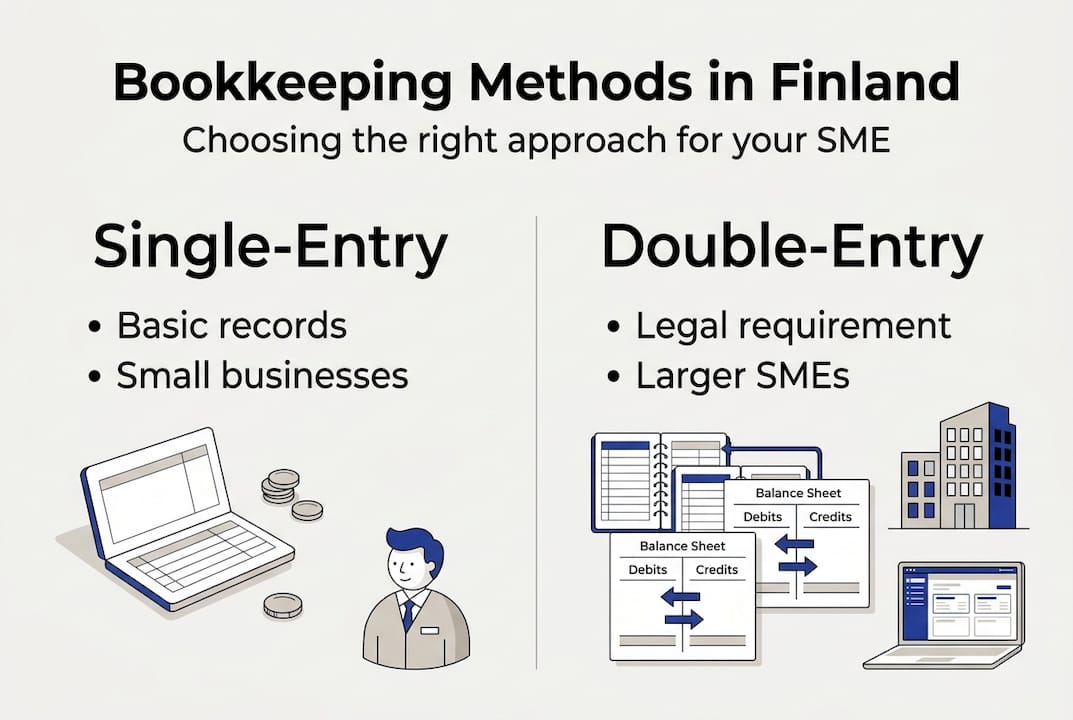
| Feature | Single-entry | Double-entry |
|---|---|---|
| Legal requirement | Smaller SMEs below thresholds | Required above thresholds |
| Complexity | Lower | Higher, but more precise |
| Error detection | Limited | Built-in cross-checking |
| Financial reporting | Basic | Full balance sheet and P&L |
| Suitability for scaling | Restricted | Strongly recommended |
Even if you are not legally required to use double-entry, we recommend it for any business with growth ambitions. It produces a complete picture of your assets, liabilities, and equity, which is exactly what lenders and investors want to see. Our step-by-step bookkeeping guide explains how to get started with double-entry even if you have no accounting background.
Moving from manual to digital bookkeeping is a significant step for many SMEs, but it pays for itself quickly. Here is how to approach the transition:
- Audit your current records: Identify gaps, inconsistencies, and paper documents that need to be digitised.
- Choose a cloud accounting platform: Select software that integrates with Finnish banking and tax systems.
- Migrate historical data: Transfer at least the current financial year's records into the new system.
- Set up automated bank feeds: Connect your business accounts so transactions import automatically each day.
- Establish a monthly review routine: Schedule time each month to check figures, reconcile accounts, and flag any anomalies.
For more on this, our guides on optimising bookkeeping workflow and bookkeeping automation walk through the practical steps in detail.
How often to update your books: Finding your SME's rhythm
Frequency is one of the most practical questions Finnish SME owners ask about bookkeeping, and the answer depends on your business rather than a single universal rule. The good news is that there is a clear framework you can apply immediately.
Monthly or weekly updates are the standard recommendation, with frequency depending on transaction volume. For most small businesses, monthly reconciliation is sufficient and manageable. For businesses processing high volumes of sales, purchases, or both, weekly updates reduce the risk of errors accumulating.
The 40% of businesses that update their books irregularly tend to share one thing in common: they wait until there is a reason to look, rather than looking on a schedule. By then, problems are already embedded in the figures.
Factors that should shape your update interval:
- Transaction volume: More transactions mean more opportunities for errors and a greater need for frequent reconciliation.
- VAT registration status: VAT-registered businesses must submit regular VAT returns, making monthly bookkeeping practically essential.
- Growth plans: If you are seeking finance or planning to take on larger clients, clean and current records are non-negotiable.
- Number of employees: Payroll creates regular, time-sensitive entries that require consistent attention.
- Seasonal variation: Businesses with peaks and troughs in turnover benefit from more frequent updates during busy periods.
Pro Tip: Use your cloud accounting platform's reminder or scheduling features to lock in a recurring bookkeeping session each month. Treat it like a fixed appointment. Consistency beats intensity every time.
It is also worth noting that if your annual turnover falls below €20,000 you may qualify for VAT exemption, which reduces some administrative burden. However, you are still legally required to maintain accurate accounting records for all transactions. Our accounting services for SMEs article covers the options available, and if you are weighing whether to handle this in-house or externally, our outsource bookkeeping guide is a useful reference.
Why most SMEs underestimate regular bookkeeping (and how to get ahead)
There is a persistent assumption among Finnish business owners that bookkeeping is primarily for the tax authorities. You keep records, you file your return, and then you move on. This view misses the point almost entirely.
In our experience, the SMEs that review their books monthly are consistently better positioned to spot opportunities and avoid nasty surprises. They do not need an accountant to tell them their margins are thinning or their debtor days are creeping up. The numbers tell them directly, and early enough to act.
The real cost of falling behind is not just a fine or a correction. It is the tax savings you did not claim because the records were not clear enough. It is the bank loan you could not pursue because your accounts were six months out of date. It is the stress that accumulates when financial chaos meets a deadline.
Simple, consistent digital routines outperform heroic year-end efforts every time. Building bookkeeping into your regular business rhythm is not a burden. It is one of the most practical decisions you can make for long-term clarity. If you are considering whether outside support would help, our article on the benefits of hiring an accountant is worth reading before you decide.
Move from paperwork to peace of mind with expert help
Keeping your books accurate, current, and compliant is straightforward in principle, but it takes consistent effort and the right tools. Many Finnish SMEs find that specialist support makes the difference between bookkeeping feeling like a burden and feeling like a genuine business asset.
At Finovate, we offer tailored bookkeeping and financial management services designed for Finnish businesses of every size. Whether you are a sole trader looking for an Invoicing Service Pro package or a growing company that needs full monthly reconciliation and compliance support, we can help. We also offer dedicated accounting for delivery partners and light entrepreneurs. Let us handle the numbers so you can focus on running your business.
Frequently asked questions
How often should a Finnish SME update its bookkeeping records?
Monthly updates are standard for most businesses, while weekly reconciliation is recommended for high-volume operations to keep financials current and catch issues before they compound.
Who must use double-entry bookkeeping in Finland?
If your SME meets two of the following criteria: turnover above €200,000, assets over €100,000, or more than three employees on average, double-entry bookkeeping is legally required.
What are the main consequences of irregular bookkeeping?
40% of small businesses that fall behind face cash flow problems and missed opportunities, alongside compliance risks, potential penalties, and difficulty securing finance.
Are very small Finnish businesses exempt from VAT bookkeeping?
Businesses with annual turnover below €20,000 may qualify for VAT exemption, but they are still legally required to maintain accurate accounting records for all transactions.