
TL;DR:
- Recordkeeping in Finland is essential for legal compliance, financial clarity, and supporting business growth. All companies must maintain proper accounting records, including financial statements, receipts, and supporting documents, with deadlines strictly enforced. Accurate and well-structured records provide operational insights, facilitate growth, and protect businesses from penalties and reputational damage.
Recordkeeping is not simply paperwork that sits in a filing cabinet. For Finnish small and medium-sized businesses, it is the foundation of compliance, financial clarity, and long-term growth. Many business owners treat recordkeeping as a formality, something to address only when tax season arrives. This thinking carries real risk. PRH fines of €300 or more apply to companies with uncorrected Trade Register deficiencies, and these penalties double on repeat offences. Beyond fines, poor records restrict your ability to make sound business decisions, secure financing, and pass an audit without stress.
Table of Contents
- Legal requirements for business records in Finland
- Types of accounting systems and recordkeeping methods
- Operational advantages of accurate records
- Risks and penalties for poor recordkeeping
- A Finnish accountant's perspective: What most SMEs miss about recordkeeping
- How Finovate can help simplify your recordkeeping
- Frequently asked questions
Key Takeaways
| Point | Details |
|---|---|
| Legal compliance essential | Finnish SMEs must keep thorough records to avoid fines and ensure business legitimacy. |
| Choose the right system | Selecting single or double-entry accounting ensures compliance and business insight. |
| Operational benefits | Accurate records enable better decision-making and support growth through reliable data. |
| Avoid costly penalties | Lax recordkeeping leads to fines, tax increases, and missed business opportunities. |
| Automate for efficiency | Automated systems reduce errors and make future-proofing easier for Finnish SMEs. |
Legal requirements for business records in Finland
While penalty risks are real, understanding the legal framework helps businesses stay compliant and avoid problems before they arise.
Finnish law is clear on this subject. All companies in Finland must maintain proper accounting records, with management personally responsible for ensuring that accounting is properly arranged and that business receipts and supporting documents are collected and stored. This obligation applies regardless of company size, legal structure, or turnover level. Whether you operate as a sole trader, a limited liability company, or a cooperative, the requirement to maintain organised records is the same.
Understanding the accounting rules in Finland helps you build a compliant system from the start. The key documents you must maintain include:
- Income statements showing revenues and expenses over the financial year
- Balance sheets reflecting assets, liabilities, and equity at the period end
- Receipts and supporting documents for every transaction, both incoming and outgoing
- Payroll records and documentation of employee-related costs
- VAT records and calculations for each reporting period
Deadlines matter just as much as the documents themselves. Financial statements must be prepared within 4 months of the financial year end and filed with the PRH Trade Register within 8 months for limited companies. Small businesses exceeding certain thresholds, specifically a balance sheet over €350,000, turnover above €700,000, or more than 10 employees, must also submit full financial statements. These are not advisory guidelines. They are statutory obligations with financial consequences for non-compliance.
The Trade Register makes certain records publicly available. This transparency requirement means that other businesses, lenders, and partners can review your financial statements. Maintaining accurate and well-presented records therefore protects your reputation, not just your legal standing.
Pro Tip: Even the smallest businesses should date and number every document at the point of entry. This simple habit makes compliance reviews, audits, and financial statement preparation significantly faster and more straightforward.
Familiarising yourself with bookkeeping basics in Finland gives you a practical starting point for setting up your recordkeeping correctly from day one.
Types of accounting systems and recordkeeping methods
With legal requirements in mind, selecting the right accounting system ensures both compliance and future flexibility.
The two primary approaches to recordkeeping are single-entry and double-entry bookkeeping, and each serves a different type of business. Double-entry bookkeeping on an accruals basis is mandatory for companies and corporations. Small self-employed individuals may use single-entry bookkeeping, but they must still adjust to an accruals basis for tax reporting purposes. If a sole trader exceeds any of the following thresholds, double-entry becomes mandatory:
- Balance sheet total exceeds €100,000
- Annual turnover exceeds €200,000
- More than 3 employees on average during the year
The table below summarises the key differences between the two methods and when each applies:
| Feature | Single-entry | Double-entry |
|---|---|---|
| Who can use it | Small sole traders below thresholds | All companies, corporations, and larger sole traders |
| Basis | Cash or simplified accrual | Full accrual |
| Complexity | Lower | Higher |
| Strategic insight | Limited | Strong |
| Mandatory threshold | Below €100k balance / €200k turnover / 3 employees | Above any of those thresholds |
For light entrepreneurs and micro-entities, the recordkeeping requirements are lighter, but they still exist. If you operate through a light entrepreneur invoicing platform, income is still taxable and must be reported accurately. Foreign branches of Finnish companies must also maintain separate records in line with Finnish accounting standards.
The compliance guide for Finnish SMEs provides further detail on how to structure records based on your business model.
When choosing between methods, consider where your business is heading, not just where it is today. A sole trader with ambitious growth plans who starts with single-entry bookkeeping may find themselves having to overhaul their entire records system when they cross a threshold. This creates unnecessary disruption and potential gaps in historical records.
Understanding the full range of accounting methods in Finland helps you make an informed decision that suits both your current size and your future ambitions.
Pro Tip: Even if you are not yet required to use double-entry bookkeeping, setting it up from the outset makes scaling significantly easier. It also gives you richer financial data for decision-making from day one.
Operational advantages of accurate records
Beyond compliance, accurate records deliver strategic advantages for Finnish SMEs that can directly improve profitability and resilience.
Many business owners think of their accounts only as a reporting tool. In practice, well-maintained records give you a real-time view of business performance. Accrual accounting provides a true profitability view and supports tracking of key financial ratios that help you make better decisions. These ratios include:
| Financial ratio | What it measures | Why it matters |
|---|---|---|
| Receivables turnover | How quickly customers pay | Identifies cash flow risk |
| Inventory turnover | How fast stock is sold | Highlights overstock or shortages |
| Gross profit margin | Revenue minus cost of goods sold | Shows pricing effectiveness |
| Current ratio | Short-term assets vs liabilities | Assesses ability to meet obligations |
ERP systems (enterprise resource planning platforms) and modern accounting software reduce manual errors and improve financial visibility. Businesses that rely on spreadsheets or paper records face a much higher risk of inconsistencies, missed entries, and data loss. These errors do not just cause compliance issues. They distort your view of the business, leading to decisions based on inaccurate information.
Accurate records also support accounting for growth. When you apply for a business loan, the bank will request your financial statements and often several years of historical accounts. A well-maintained set of records signals to lenders that your business is managed responsibly. Incomplete or inconsistent records, on the other hand, create doubt and often result in rejected applications or higher interest rates.
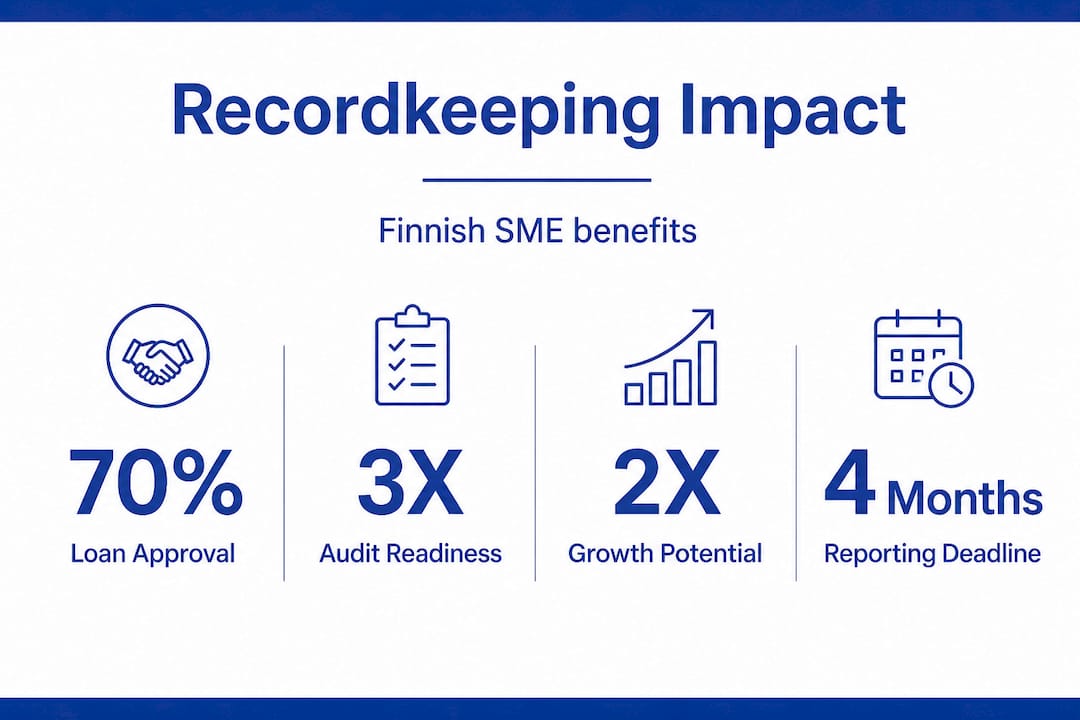
Audit readiness is another significant benefit. Companies that maintain organised records throughout the year experience far less disruption when a tax authority review occurs. The same applies to internal audits and annual financial statement preparation. Time spent on year-end accounting is directly proportional to the quality of your records throughout the year.
Implementing Finnish bookkeeping best practices throughout the year rather than scrambling at year end significantly reduces both costs and errors. Regular reconciliation of bank accounts, prompt recording of receipts, and consistent categorisation of expenses are habits that pay dividends well beyond compliance.
Risks and penalties for poor recordkeeping
Understanding these risks underscores why consistent recordkeeping is non-negotiable for Finnish SMEs.
The consequences of poor records are more varied and more serious than most business owners realise. They range from direct financial penalties to lost business opportunities and failed audits.
"Failure to maintain records or file on time leads to penalties: late-filing penalty fees, punitive tax increases from Vero; PRH fines €300 for uncorrected Trade Register deficiencies, rising to €600 for public companies, and doubling on repeat offences." Source: PRH enforcement guidance
The key risks you face with poor recordkeeping include:
- Financial penalties from both Vero (the Finnish Tax Administration) and PRH for late or incomplete filings, with escalating fines for repeat failures
- Punitive tax increases where Vero estimates your taxable income based on incomplete records, often resulting in a higher tax assessment than your actual liability
- Audit failure due to missing or disorganised documentation, leading to extended reviews and potential back-payments
- Lost business transparency when your Trade Register entries are incorrect or missing, damaging credibility with partners, lenders, and customers
- Missed growth opportunities when incomplete financial records make it impossible to demonstrate business health to investors or lenders
Contractor payment records must be kept for 7 years to comply with audit requirements and support accurate tax reporting. Failing to maintain these records can result in tax estimations that are far higher than your actual costs, which directly reduces your net profit.
The essential documents for Finnish SMEs that must be retained include not just financial statements but also contracts, delivery notes, bank statements, and correspondence related to significant transactions.
Meeting the financial report requirements for Finnish SMEs is not a once-a-year task. It requires consistent attention throughout the financial year to ensure that when deadlines arrive, your records are complete and accurate.
A Finnish accountant's perspective: What most SMEs miss about recordkeeping
In our experience working with Finnish businesses of all sizes, the most common gap is not ignorance of the rules. Most business owners know they must keep records. The gap is strategic. They keep records for compliance only and miss the operational insights that good accounting can provide.
Many SMEs stop at meeting the minimum legal requirements and never ask what their records can tell them about the business. Which products or services generate the most margin? Which customers consistently pay late? Where are costs rising faster than revenue? These questions are answered by your accounting records, but only if those records are accurate, timely, and structured correctly.
Manual systems seem appealing because they feel simple and low-cost. In practice, they often lead to inconsistencies, missed entries, and a significant amount of time spent reconciling errors at year end. We have seen businesses spend weeks sorting through paper records because no one maintained a consistent system during the year. The hidden cost of this approach far exceeds the investment in a proper accounting system.
Automation changes this. Modern accounting tools integrated with your invoicing and banking reduce the risk of human error and give you a current view of your financial position at any point in the month. This is not a luxury for larger businesses. It is increasingly accessible and practical for sole traders and small companies alike.
The right accounting services for your business size and structure make a genuine difference to both compliance and strategic insight. When you set up recordkeeping with future growth in mind, rather than for today's minimum requirements, you build a system that supports your ambitions rather than constraining them.
Pro Tip: When choosing accounting software or a service provider, ask specifically how the system or service scales as your business grows. A system that suits a sole trader today should not require a complete overhaul when you take on employees or expand your turnover.
How Finovate can help simplify your recordkeeping
Maintaining accurate business records does not have to feel overwhelming. With the right support, compliance becomes a natural part of running your business rather than a source of stress. Finovate provides financial management services designed specifically for Finnish businesses, from bookkeeping and tax preparation to payroll and advisory support.
Whether you are a limited company owner seeking full bookkeeping support or a light entrepreneur needing a straightforward invoicing solution, we have services that match your situation. Our Invoicing Service Pro makes it easy to issue compliant invoices and track income, while our accounting for light entrepreneurs provides tailored support for those operating through light entrepreneur platforms. For broader business accounting needs, Finovate Accounting Services covers everything from annual financial statements to ongoing bookkeeping and tax planning. Reach out to us today and take the first step towards recordkeeping that works for your business.
Frequently asked questions
How long must Finnish SMEs keep business records?
Business records must be kept for at least 7 years, including contractor payment records, to comply with audit requirements and support accurate tax reporting.
What happens if I miss a financial statement filing deadline?
Late filings can result in penalty fees, increased tax assessments from Vero, and PRH fines up to €300 or €600 for public companies, with those amounts doubling for repeat offences.
Can small businesses use single-entry bookkeeping in Finland?
Small self-employed individuals may use single-entry bookkeeping, but must switch to double-entry if they exceed thresholds of €100k balance sheet, €200k turnover, or 3 employees.
Are business records in Finland public?
Yes. Annual financial statements for limited companies must be filed with the PRH Trade Register and are publicly accessible, ensuring financial transparency for lenders, partners, and other stakeholders.