
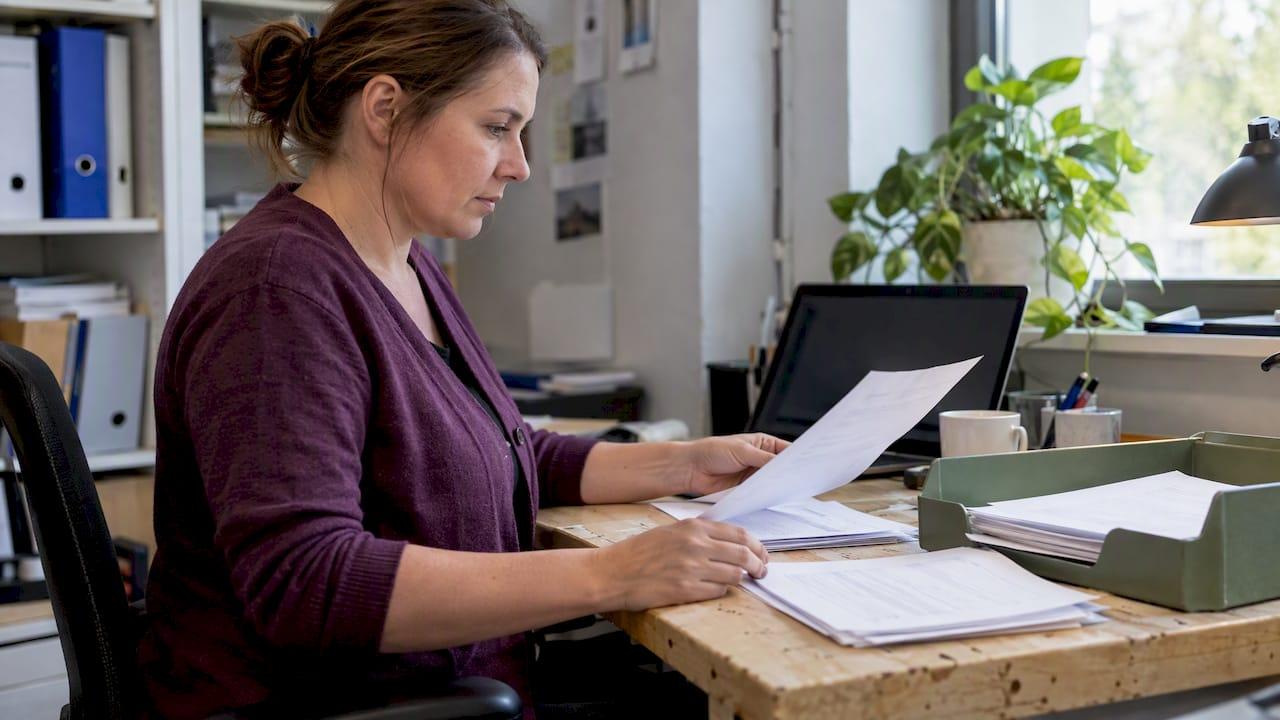
Ostolaskujen kierrätys (purchase invoice circulation) is the stage where a supplier invoice is sent to the right people to be checked and approved before it is paid and booked. The invoice goes to whoever knows whether the purchase was real and correct (asiatarkastaja), then to someone with the authority to approve spending (hyväksyjä). Only then does it move on to payment from accounts payable (ostoreskontra) and into the books. For a one-person toiminimi the route may be a single person. For a growing Oy it is a defined chain with rules, limits and a record of who did what.
This guide explains the steps, the roles, the common problems and what to automate. It is written for Finnish entrepreneurs and small businesses who want a routine that is safe, fast and easy for their accountant to work with.
TL;DR
- Circulation means checking and approving each purchase invoice before it is paid. It sits between receiving the invoice and paying it from accounts payable.
- The basic chain is receipt, coding, factual check (asiatarkastus), approval, posting, payment on the due date.
- Even a one-person business benefits from a fixed routine: one inbox for invoices, one weekly slot for approving, and one place to store the result.
- E-invoices in Finnish formats can be read by systems automatically, which removes most manual typing. Exceptions still need a human.
- Keep the invoice, the approval trail and the payment record together, so that your accountant and any later audit can follow each purchase.
Table of Contents
- What ostolaskujen kierrätys means
- Why circulation matters for a small business
- The steps from receipt to payment
- Who should check and who should approve
- What to do when something goes wrong
- Paper, PDF or e-invoice: what changes
- Paper trail: what to keep
- A simple routine for a solo entrepreneur
- Perspective: what we see in practice
- How Finovate can take this off your desk
- Common mistakes to avoid
- Setting up circulation in your company: a checklist
- FAQ
- Sources
What ostolaskujen kierrätys means
Three terms are easy to mix up, so it helps to separate them.
- Ostolasku (purchase invoice): the invoice you receive from a supplier for something your business bought. It shows the amount you owe, the due date and the payment terms.
- Ostoreskontra (accounts payable): the ledger that lists incoming invoices and their payment status, so you can see what falls due and how much cash you will need.
- Kierrätys (circulation): the approval step in between. The invoice is passed to the person who can confirm it is correct, and then to the person who can approve it for payment.
A sales invoice (myyntilasku) is the opposite direction: you issue it to your customer. If you are unsure which one a document is, ask who owes whom. If your business owes the money, it is an ostolasku. For the sales side, see our guide to what sales invoicing is for a Finnish entrepreneur.
Why circulation matters for a small business
It is tempting to pay every invoice that lands in your inbox. In practice, a circulation step protects you in four ways.
- You pay for what you actually received. The factual check confirms that the invoice relates to your business and that quantities and prices match what was agreed in a contract or order.
- You catch fraud. University guidance on the purchase-invoice process notes that circulating invoices also helps to identify possible fraudulent invoices. Fake invoices that copy a real supplier's layout and change the bank account number are a familiar pattern, and a second pair of eyes is the cheapest defence.
- You protect your VAT deduction. A buyer can deduct VAT only where the seller is liable for it and has issued a document showing the tax. The Finnish Tax Administration also says no deduction is allowed if the buyer knew, or should have suspected, that the transaction was part of fraud, as set out in its guidance on deductions for purchases from sellers outside the VAT register. An invoice that nobody looked at is an invoice nobody questioned.
- You know your cash position. Approved invoices with due dates give you an honest picture of what you will pay in the coming weeks.
The steps from receipt to payment
Large organisations describe the process in many stages. A description of the purchase invoice process lists receiving or importing the invoice, routing it to the owner of the cost centre, coding, content review where needed, first and second approval, posting to the general ledger and payment on the due date. For a small business the same logic fits into six steps.
1. Receive the invoice in one place
Decide where all invoices arrive. For most businesses this is an e-invoice address plus a single email inbox for PDFs. Ask suppliers to send invoices only there. Paper invoices should be scanned the day they arrive.
2. Code the invoice
Coding (tiliöinti) means assigning the expense account, the VAT treatment and, if you use them, a project or cost centre. For regular suppliers the coding is nearly always the same, so it can be set once and reused. If you are not sure how a cost should be treated, leave it for your accountant rather than guessing.
3. Check the facts (asiatarkastus)
The person who ordered or received the goods or service confirms that:
- the supplier, amount and description match what you ordered;
- the goods or services were delivered;
- the bank details are the same as on earlier invoices from that supplier;
- the invoice is addressed to your company with the correct business ID.
This is the step that cannot be automated away. Software can read the invoice, but only someone who knows the business can say whether it was right.
4. Approve the invoice (hyväksyntä)
The approver confirms the invoice may be paid. In a small company this is usually the owner or managing director. Where the same person orders and approves, add a simple rule: anything unusual, or above an amount you set, gets a second look from your accountant or a partner.
5. Post it to the books
After approval the invoice is posted to accounts payable and the ledgers. Finnish rules require that transactions are recorded in both chronological and systematic order. The government proposal behind the Accounting Act also allows electronic receipts and records, as long as they can be produced in readable form. Our step-by-step bookkeeping guide shows how this fits into the monthly routine.
6. Pay on the due date
Pay on the due date, not earlier and not later, unless the invoice offers a cash discount that is worth taking. Paying early costs you working capital. Paying late can bring late-payment interest and strain a supplier relationship. Match each payment to the invoice so the status in accounts payable changes from open to paid.
Who should check and who should approve
The two roles are separate for a reason. According to the support documentation of an accounting system, the factual verifier checks that the invoice is valid and free of errors, while the approver needs approval rights. Routes can include several verifiers, and can be automated under defined rules.
For a small business, a workable set-up looks like this:
| Business size | Checker | Approver | Extra control |
|---|---|---|---|
| Toiminimi, no staff | You | You | Accountant reviews coded invoices monthly |
| Oy with a managing director only | Managing director | Managing director | Second approver, such as the accountant, for large or new-supplier invoices |
| Oy with a few employees | The person who ordered | Managing director | Amount limits per person |
| Several teams or locations | Budget owner | Budget owner, then finance | Written approval matrix |
The thresholds are yours to set. What matters is that they are written down and followed, so you can explain later why an invoice was paid.
What to do when something goes wrong
Most invoices pass without trouble. The exceptions are where a routine proves its worth.
- The amount or content is wrong. Do not pay and do not edit the invoice yourself. Ask the supplier for a credit note (hyvityslasku) or a corrected invoice, and keep the correspondence with the original. In one accounting system, for instance, an invoice rejected by an approver is moved to an "unclear" status for the main user to handle. The principle is worth copying even with a spreadsheet: a rejected invoice gets a visible status and an owner.
- The approver is away. Name a deputy in advance. Otherwise invoices wait, due dates pass and you pay late fees for a reason that was entirely avoidable.
- The bank account has changed. Never approve a change of account details from an email alone. Call the supplier on a number you already had, and note the call.
- You do not recognise the supplier. Ask colleagues and check the contract or order history before approving. If you suspect fraud, do not pay, and contact your accountant and your bank.
- The invoice is a duplicate. Search accounts payable by supplier and invoice number before approving. Duplicates are common when a supplier sends both an e-invoice and a PDF reminder.
Paper, PDF or e-invoice: what changes
The process is the same, but the effort is not. A paper invoice has to be opened, scanned, typed in and physically passed around. A PDF in an inbox still needs manual typing. A proper e-invoice arrives as structured data.
In Finland, the national formats include Finvoice and TEAPPSXML, and systems can read and process these automatically. The same source explains that the EN16931 standard defines the core elements of an e-invoice so that its essential content passes between systems unchanged, and that shared formats reduce manual work, errors and costs. If a supplier still sends PDFs, ask whether they can send an e-invoice. The Verkkolaskuosoitteisto, maintained by Finnish e-invoice operators and banks, can be used to check recipient addresses before invoices are sent, which helps suppliers get your address right.

What can be automated
With electronic circulation, several steps can be handled by rules rather than by hand. Software descriptions of electronic circulation mention automatic coding for regular suppliers, coding suggestions that learn from earlier invoices, reminders and approval rules within set amount limits. Sensible automation for a small business is modest:
- automatic receipt of e-invoices into accounts payable;
- fixed coding for recurring suppliers such as rent, telecoms and insurance;
- reminders to approvers before a due date;
- an amount limit under which a recurring invoice goes straight to approval.
Do not automate the judgement. A recurring invoice that suddenly doubles should still be read by a person.
Paper trail: what to keep
Each purchase should leave a complete trail that someone else could follow without asking you. Keep together:
- the invoice itself in its original form (e-invoice data, PDF or scan);
- the coding and the posting reference in the books;
- a note of who checked and who approved, and when;
- the payment record from your bank;
- any correspondence about corrections or credit notes.
The legal retention periods are set in the Accounting Act (kirjanpitolaki). Check the current periods with the Finnish Tax Administration or your accountant, and do not discard material when you change accountant or software: ask for a full export first. We list the documents most businesses need in our guide to essential bookkeeping documents for Finnish SMEs, and our recordkeeping requirements guide goes through the rules in more detail.
A simple routine for a solo entrepreneur
If you run a toiminimi, a taxi or courier business, or you are a light entrepreneur, you do not need an approval matrix. You need a habit. This is a routine that takes about fifteen minutes a week:
- Monday: open the invoice inbox and the e-invoice list. Forward anything that arrived on paper after scanning it.
- Check each invoice: is it yours, is the amount right, is the account number familiar?
- Mark the status: approved, query or rejected. Write the reason for a query in one line.
- Schedule payments for the due dates, not the day you approve.
- Send the batch to your accountant at the same time every month, or share access to your system.
Fuel, vehicle costs, insurance, phone and software are the invoices that dominate a driver's or courier's purchase side. Because they repeat, coding them once and keeping a single folder per month is enough. Fuel receipts that are not invoices still belong in the same monthly batch.
Perspective: what we see in practice
In our experience, the invoices that cause trouble for small businesses are rarely the large ones. They are the invoices that sat in a personal email account, were paid without a check, or reached the accountant three months late with no explanation. A routine fixes this far more reliably than any software.

We work with entrepreneurs and micro-businesses in Finland, and we build our service on Odoo ERP so that invoices, bookkeeping and reporting sit in one connected system rather than in separate files. The practical benefit is that what you approve is what your accountant books, and nobody retypes it. Our advice is to start with the routine and add automation second: pick one inbox, name a checker and an approver, set an amount limit and write it down on one page. When that works, tools make it faster. When it does not exist, tools make the mess faster.
If you are unsure how your purchase invoices should be coded or when VAT can be deducted, ask before you pay. A short question to your accountant is cheaper than a correction in the annual accounts. For the wider picture, see our overview of SME accounting procedures for Finland.
— Busayo
How Finovate can take this off your desk
If you would rather not run the routine yourself, we can handle your bookkeeping and VAT reporting so that purchase invoices are coded and booked consistently each month. Our published plans start at €40 per month for freelancers, light entrepreneurs and solo traders (toiminimi) and €120 per month for limited companies (osakeyhtiö); see the pricing page for what each covers. Monthly bookkeeping, VAT filing and payroll are described on our services page, and if you also issue invoices, we offer an invoicing service with a 2% fee. You can read how invoicing is set up in our practical guide to invoicing in Finland.
Common mistakes to avoid
- Paying from the bank's mobile app before approving. The payment becomes the only record. Approve first, then pay.
- Letting one person do everything without any review. Even a monthly look by your accountant is a control.
- Mixing private and business purchases. Private costs paid from the business account create questions at year end. Our guide to expense invoicing for Finnish entrepreneurs covers the difference.
- Ignoring due dates until a reminder arrives. Reminder fees and interest are avoidable costs.
- Deleting invoices after paying them. The invoice is the evidence for the expense and for any VAT deduction. Keep it.
- Treating accurate records as paperwork. They determine your tax result and your ability to answer questions fast. We explain why accurate records benefit Finnish SMEs in a separate article.
Setting up circulation in your company: a checklist
- List your regular suppliers and the usual coding for each.
- Choose a single inbox and, if possible, an e-invoice address for all invoices.
- Name the checker and approver, and a deputy for each.
- Set an amount limit above which a second person must approve.
- Decide how a rejected or unclear invoice is marked and who resolves it.
- Agree with your accountant when each month's batch is delivered.
- Review the routine after three months and adjust the limits.
FAQ
Mitä tarkoittaa ostolaskujen kierrätys?
It means passing a purchase invoice to the people who must check and approve it before it is paid. The invoice is verified for content, approved by someone with the right to commit the company's money, and then posted and paid. It is the control step between receiving an invoice and paying it.
Mitä on ostoreskontra?
Ostoreskontra is the accounts payable ledger. It holds the details of incoming invoices and their payment status, so you can follow due dates and plan the cash you need. A purchase invoice normally enters it after it has been received and approved.
Do I need circulation software if I am a sole trader?
Not necessarily. A single inbox, a weekly check and a clear status for each invoice are enough for a toiminimi with few suppliers. Software becomes useful when invoice volumes grow, when several people approve invoices, or when you want recurring suppliers coded automatically.
Who can approve an invoice in a small company?
Usually the owner or the managing director, as the person who can commit the company's money. The checker, who confirms the goods or service were received, can be a different person. Where one person does both, add a limit above which your accountant or a partner also reviews the invoice.
Is the e-invoice the same as a PDF invoice?
No. An e-invoice is structured data in a format such as Finvoice, which systems can read directly. A PDF is an image of an invoice that usually still has to be typed or interpreted. E-invoices cut manual work and errors, so ask suppliers for them where you can.
Sources
- 3.1 Stages of the Purchase Invoice Process (Aalto University wiki)
- Vähennysoikeus arvonlisäverovelvollisten rekisteriin merkitsemättömältä myyjältä tapahtuneesta ostosta (Vero.fi)
- HE 266/2002 vp (Finlex)
- Approving and verifying invoices (Netvisor support)
- Laskujen kierto sekä uuden laskun käsittely (Maestro support)
- Verkkolaskuformaatit (TIEKE)
- Verkkolaskuosoitteisto (TIEKE)
- Ostolaskut ja ostoreskontra (Fivaldi)