

TL;DR:
- Expense invoicing involves issuing detailed, compliant invoices to document and bill business costs efficiently. Proper structure, clear payment terms, and consistent documentation are essential for cash flow and audit readiness. Using the right tools and timely invoicing practices can accelerate payments and ensure legal compliance in Finland.
Expense invoicing is the formal process of issuing detailed invoices that document and bill business-related costs, enabling transparent accounting and prompt reimbursement. For entrepreneurs and small business owners in Finland, understanding expense invoicing is not optional. It directly affects your cash flow, your audit readiness, and your ability to claim legitimate deductions. This guide covers the core components of a valid expense invoice, the best practices for invoicing that speed up payment, common pitfalls to avoid, and the tools best suited to Finnish business conditions.
What is expense invoicing and why does it matter?
Expense invoicing is the recognised industry term for systematically recording and billing business expenses through formal invoices. The process sits at the intersection of expense reporting and the invoice creation process. Done correctly, it gives both you and your clients a clear, auditable record of every cost. Done poorly, it delays payment, creates disputes, and exposes you to tax risk.

Finnish invoicing standards require invoices to function as legal documents. That means every invoice you issue must be traceable, accurate, and compliant with Finnish VAT regulations. For light entrepreneurs and sole traders especially, the quality of your invoices determines how quickly money reaches your account.
What are the essential components of a valid expense invoice?
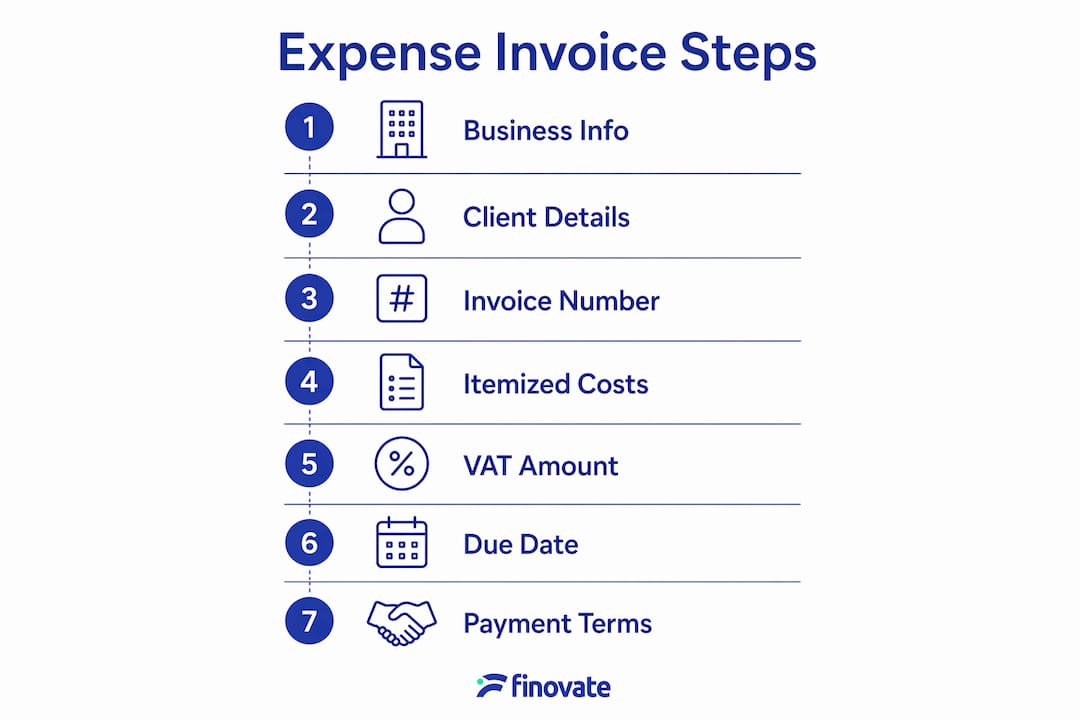
A valid expense invoice must include legal business names with contact details for both parties, a unique invoice number, clear itemised descriptions with dates and amounts, a subtotal, applicable taxes, a grand total, and explicit payment instructions. Each element serves a specific purpose. Missing even one can cause an accounts payable team to reject or delay your invoice.
Here is what every expense invoice must contain:
- Your business name and contact details, including your Finnish Business ID (Y-tunnus)
- Client's full legal name and address
- A unique invoice number for tracking and audit purposes
- Invoice date and a specific calendar due date (never "payable upon receipt")
- Itemised line items with individual dates, descriptions, and amounts
- Subtotal, VAT rate and amount, and the grand total due
- Payment instructions, including your IBAN, payment reference number, and accepted methods
The due date deserves particular attention. Mid-2026 invoicing standards actively discourage vague terms like "upon receipt" and recommend specific calendar dates instead. A client's accounts department processes invoices by date. Vague terms create ambiguity and give accounts payable a reason to deprioritise your invoice.
Finnish invoicing also requires you to state the VAT percentage and the euro amount of VAT separately. This is not optional. It is a legal requirement under Finnish tax law, and it applies whether you are invoicing a domestic client or an EU business partner.
Pro Tip: If you work with recurring clients, use a consistent invoice template that pre-fills your business details, VAT number, and payment instructions. Tools like invoice templates from EZ BIZ can give you a compliant starting point that reduces errors and saves time.
How to structure and send expense invoices to speed up payment
The timing and format of your invoice affect how quickly you get paid. Send invoices immediately after completing an expense, a milestone, or a project phase. Waiting even a few days reduces the psychological urgency for the client and pushes your invoice further down their processing queue.
Follow these steps to maximise payment speed:
- Send on the right day. Invoices sent Tuesday through Thursday before 10 AM are processed faster. Monday inboxes are crowded, and Friday invoices risk sitting unread over the weekend.
- Make your invoice mobile-friendly. 60% of business emails are opened on mobile devices, so a poorly formatted invoice creates friction before the client even reads the total.
- Embed a one-click payment link. Mobile-friendly invoices with prominent payment buttons accelerate payment by 1–3 days. Tools like Deelo generate invoices with embedded payment links automatically.
- Accept multiple payment methods. Credit card fees are typically around 2.9%, but delayed payments cost more than those fees. Accepting cards, bank transfers, and online payment services removes friction for the client.
- State late payment terms clearly. Late payment policies involving flat fees or interest charges must be stated on both the invoice and the contract to be legally enforceable.
Pro Tip: Align your invoicing cadence with your client's accounting cycle. If your client closes their books on the last Friday of the month, submit your invoice by the Wednesday before. Ask clients directly when their payment runs are scheduled. This single habit removes the most common cause of "net 30" invoices stretching to net 60.
What are common mistakes in expense invoicing and how to avoid them?
The most common mistake in expense invoicing is treating invoices as static billing documents rather than clear communication tools that tell a logical story for accounts payable approval. An invoice that confuses the reader delays payment. An invoice that tells a clear story gets approved on the first pass.
The most damaging errors include:
- Vague line item descriptions. "Consulting services" tells accounts payable nothing. "Strategy session, 3 hours, 12 June 2026, at €120/hour" tells them everything they need.
- Missing receipts or supporting documents. Every line item should link to an original receipt or approval. Delayed reconstruction of documentation leads to errors and audit risk.
- Inconsistent expense categories. Switching category names between invoices makes reconciliation harder for both you and your client. Starting with 8–12 categories and splitting only when a category exceeds 5% of monthly expenses keeps your records manageable.
- Ambiguous payment terms. "Net 30" without a specific calendar date creates confusion. Specifying an exact due date alongside the payment term removes all ambiguity for the client's accounts department.
"Treat every invoice as a binding contract and document all related information as expenses occur." This principle from Gruv's expense reporting guidance captures the right mindset. If you would not be comfortable presenting a line item to a tax auditor, it does not belong on your invoice without proper documentation.
Poor audit trails are a particular risk for Finnish entrepreneurs. The Finnish Tax Administration (Verohallinto) requires businesses to retain accounting records for six years. An invoice without linked receipts, project codes, or client approvals is a liability, not an asset, in an audit. Build traceability into your process from the first invoice you issue, not after a problem arises.
Which tools and methods improve expense invoicing for finnish small businesses?
Choosing the right tools for expense invoicing comes down to one principle: the lowest-friction method you can consistently maintain is the best method for your business. A sophisticated tool you abandon after two weeks is worse than a simple spreadsheet you use every day.
The options range from manual to automated:
| Tool / Method | Best For | Key Feature | Limitation |
|---|---|---|---|
| Microsoft Excel or Google Sheets | Sole traders with low invoice volume | Full control, no cost | Manual data entry, error-prone |
| Harvest | Freelancers tracking time and expenses | Simple receipt uploads, time tracking | Limited automation for Finnish VAT |
| Deelo | Entrepreneurs wanting automated invoices | Embedded payment links, automated reminders | Newer platform, smaller user base |
| Finovate Invoicing Service | Finnish small businesses needing compliance | VAT-compliant, local expertise | Subscription cost |
Harvest suits freelancers who need to track both time and expenses in one place, with straightforward receipt uploads attached to client projects. Deelo goes further by generating invoices with embedded payment links and automated follow-up reminders, which directly addresses the payment speed problem.
For Finnish entrepreneurs, the VAT compliance layer adds complexity that generic international tools do not always handle correctly. Finnish VAT rates, reverse charge rules for EU transactions, and the Y-tunnus requirement on invoices are details that a locally focused service handles by default.
Pro Tip: Photograph or scan receipts the moment you incur an expense. Apps like the camera function in your accounting software or a dedicated receipt scanner mean you never reconstruct documentation from memory. Link each receipt to the relevant client or project immediately. This habit takes thirty seconds per expense and saves hours during tax season.
You can find a detailed walkthrough of expense tracking methods for Finnish entrepreneurs on the Finovate blog, covering category structures and tool selection in practical terms.
Key takeaways
Effective expense invoicing requires compliant invoice structure, precise payment terms, and consistent documentation habits that protect your cash flow and audit readiness.
| Point | Details |
|---|---|
| Include all mandatory elements | Every invoice needs your Y-tunnus, itemised lines, VAT details, and a specific calendar due date. |
| Send mid-week before 10 AM | Tuesday to Thursday mornings give your invoice the best chance of same-cycle processing. |
| Link receipts from day one | Attach original receipts and approvals to each line item immediately to protect against audit risk. |
| Choose low-friction tools | Pick the expense tracking method you will actually use consistently, whether that is a spreadsheet or Deelo. |
| State late payment terms clearly | Flat fees or interest charges are only enforceable if stated on both the invoice and the contract. |
Why i think most small business owners underestimate invoice design
After working with Finnish entrepreneurs across a range of industries, the pattern I see most often is this: business owners spend significant effort on delivering excellent work, then rush the invoice as an afterthought. That is the wrong order of priorities.
An invoice is the last impression you leave before money changes hands. A poorly structured invoice signals disorganisation to your client's accounts team, and accounts teams have discretion over processing priority. A clean, complete invoice with a specific due date, a one-click payment link, and properly labelled line items communicates professionalism at exactly the moment it matters most.
The detail I find most overlooked is the audit trail from day one. Finnish entrepreneurs often think about audit readiness only when Verohallinto comes knocking. By then, reconstructing six months of receipts and approvals is painful and imprecise. Linking each expense to its receipt and project code as it happens costs almost nothing. Failing to do so can cost you deductions, credibility, and time.
My practical advice: treat your invoicing process as a system, not a task. Set a fixed day each week to issue invoices. Use a template that already contains your legal details and VAT information. Review your bookkeeping workflow quarterly to catch inconsistencies before they accumulate. The entrepreneurs I see managing cash flow well are not necessarily the most profitable. They are the most consistent.
— Busayo
How Finovate can handle your expense invoicing
Managing expense invoicing correctly takes time, attention to detail, and knowledge of Finnish VAT requirements. Finovate provides invoicing services built specifically for Finnish entrepreneurs and small business owners who want compliant, professional invoices without the administrative burden.
Finovate's monthly invoicing service covers invoice creation, VAT compliance, and payment tracking so you can focus on your business rather than your paperwork. For businesses with higher invoice volumes or more complex needs, the Invoicing Service Pro adds enhanced accuracy and faster turnaround. Both services are designed to reduce errors, protect your audit trail, and get you paid on time. Contact Finovate to find the right plan for your business.
FAQ
What is expense invoicing?
Expense invoicing is the formal process of issuing invoices that document and bill business-related costs to clients or for internal reimbursement. It combines expense reporting with the invoice creation process to produce a legally compliant, auditable record.
What must a valid expense invoice include in finland?
A valid Finnish expense invoice must include your Y-tunnus, the client's legal name and address, a unique invoice number, itemised line items with dates and amounts, the VAT rate and euro amount, a grand total, and a specific calendar due date.
When is the best time to send an expense invoice?
Invoices sent Tuesday through Thursday before 10 AM are processed faster, as Monday inboxes are crowded and Friday invoices risk delays over the weekend.
How do i speed up payment on my invoices?
Use mobile-friendly invoices with embedded one-click payment links, accept multiple payment methods, and send invoices immediately after completing work. Mobile-friendly invoices with prominent payment buttons accelerate payment by 1–3 days on average.
How long must i keep expense invoices in finland?
Finnish law requires businesses to retain accounting records, including invoices and supporting receipts, for six years. Linking receipts and approvals to each invoice at the time of issue is the most reliable way to meet this requirement without administrative stress.