
TL;DR:
- Many Finnish entrepreneurs view invoices as simple payment reminders, but they also serve as legal, accounting, and compliance tools. Proper invoicing ensures legal transaction records, accurate accounts receivable, and compliance with tax requirements, benefiting cash flow and professionalism. Adhering to Finnish-specific invoicing rules, such as sequential numbering, VAT details, and structured references, enhances efficiency, compliance, and client trust.
Many Finnish entrepreneurs treat invoices as simple payment reminders, something to send when a job is done and money is owed. That view is understandable, but it undersells what sales invoicing actually does for your business. Understanding what is sales invoicing properly means recognising invoices as formal legal documents, accounting records, and compliance tools all at once. Whether you are a freelancer, a light entrepreneur, or a growing SME, getting invoicing right from the start protects your finances, satisfies Finnish tax requirements, and keeps cash flowing predictably.
Table of Contents
- What is a sales invoice and why is it important?
- How does the sales invoicing process work for Finnish businesses?
- Key invoicing requirements and best practices for Finland
- Practical benefits and challenges of using sales invoicing effectively
- Rethinking sales invoicing: beyond compliance to business advantage
- Supporting your invoicing and accounting in Finland
- Frequently asked questions
What is a sales invoice and why is it important?
A sales invoice is a document the seller sends to the buyer to request payment for goods or services that were sold, including itemised product or service details, quantities, prices, and the payment terms. That definition covers the mechanics, but the importance of sales invoicing goes much further than collecting money.
At its core, a sales invoice performs three distinct roles in your business. First, it is a legal record of a transaction between two parties. Second, it feeds directly into your accounts receivable, telling you exactly what is owed and when. Third, it supports tax reporting and accounting, because Finnish tax authorities expect your records to correspond with your invoices.
A well-formed sales invoice typically includes:
- Your business name, address, and VAT registration number
- The buyer's name and contact details
- A unique, sequential invoice number
- The date of issue and the payment due date
- An itemised list of goods or services with unit prices and quantities
- The VAT rate applied and the total VAT amount
- The total amount due, including and excluding VAT
- Payment terms and bank account details
It is also worth clarifying the difference between an invoice and a receipt. An invoice requests payment before it is made. A receipt confirms payment after it has been received. These are not interchangeable documents, and mixing them up can cause problems in your accounting records. For a fuller picture of Finnish invoicing essentials, it helps to understand both documents and when each applies.
Pro Tip: Always issue your invoice on or shortly after the delivery of goods or services. Late invoicing is one of the most common reasons for delayed payment and cash flow gaps in small Finnish businesses.
With the basics clear, let's explore how the sales invoicing process typically works in practice.
How does the sales invoicing process work for Finnish businesses?
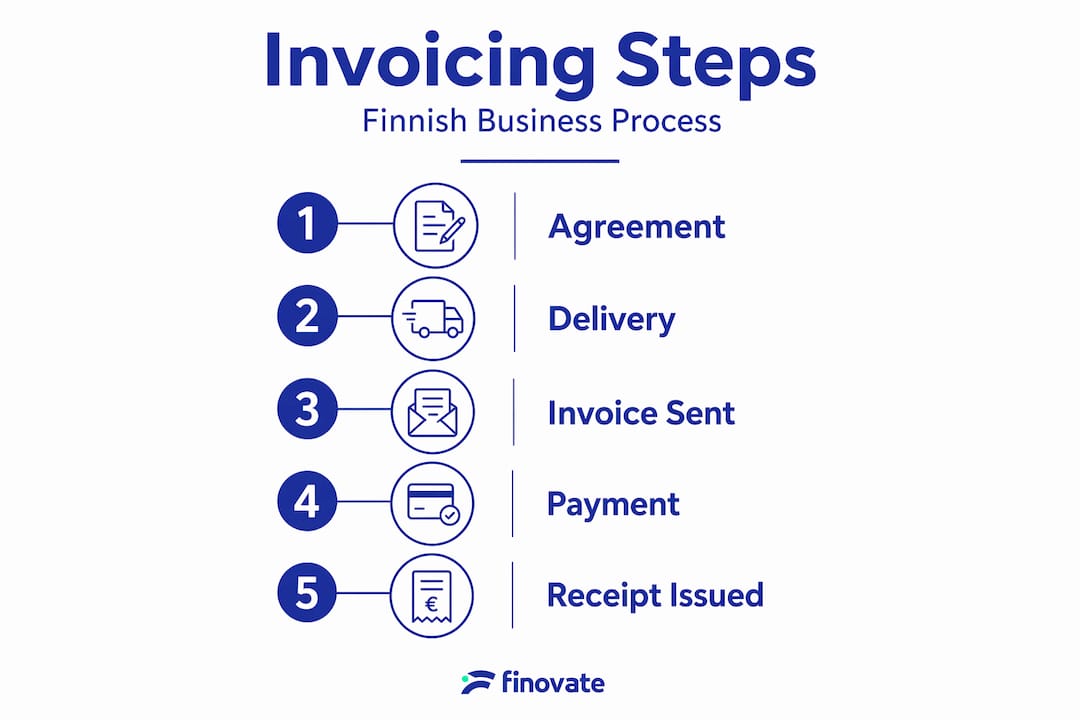
A typical invoicing workflow starts when the transaction is agreed, the seller creates and sends the sales invoice with itemised line details and both parties' information, and then the revenue and receivable is tracked until payment is received. Here is how that looks, step by step, for a Finnish business:
- Agreement and delivery. You agree on the scope of work or sale with your client and deliver the goods or services. The obligation to invoice begins at this point.
- Invoice creation. You generate the invoice, filling in all required fields: your details, the buyer's details, a description of what was delivered, quantities, unit prices, VAT rates, and total amounts.
- Invoice delivery. You send the invoice promptly. In Finland, electronic invoicing (e-invoicing) is standard for business-to-government transactions and is increasingly expected in B2B relationships as well.
- Buyer verification. The buyer checks the invoice against their purchase order or agreed contract. Discrepancies at this stage are a leading cause of delayed payment, so accuracy matters.
- Payment processing. The buyer pays by the due date, referencing the invoice correctly. Your accounts receivable record is updated once payment arrives.
- Reconciliation. You match the incoming payment to the open invoice in your accounting system, closing the receivable.
Note that a receipt is issued only after Step 6, once payment is confirmed. Everything before that point in the process is part of the invoicing cycle, not the receipt cycle.
Pro Tip: Send invoices by e-invoice where possible, even for B2B transactions. Finnish businesses are familiar with the format, and e-invoices typically result in faster payment and fewer disputes over what was agreed.
For businesses that find this process time-consuming, professional invoicing management can take the administrative load off your hands and keep your cash flow on track.
Understanding the process sets the scene for the unique Finnish invoicing requirements you must follow to stay compliant.
Key invoicing requirements and best practices for Finland
Finnish invoicing sits within a broader EU VAT framework, but there are local specifics you cannot ignore. Getting these wrong does not just look unprofessional. It can delay payments, trigger compliance issues, and create headaches during tax audits.
Here are the core requirements:
- VAT details are mandatory. Every invoice must show the applicable VAT rate, the VAT amount, and totals both with and without VAT. This applies whether you are invoicing another business or a consumer.
- Sequential invoice numbering is non-negotiable. Sequential invoice numbering with a unique number helps traceability for accounting and tax records. Gaps in your numbering sequence can raise questions during an audit.
- The viitenumero is your reconciliation tool. In Finland, a viitenumero (structured reference) is used to automatically match incoming payments to the correct invoice, reducing reconciliation effort for accounts teams. It is not legally required for all invoices, but it is standard practice and strongly advisable.
- B2G invoicing has additional rules. For Finnish government invoicing, invoices must have correct VAT information and must include order-level identifiers such as the order number to enable automatic processing.
- Line-level data matters. Each item or service must appear as a separate line, with its own description, quantity, unit price, and VAT treatment. Header-level totals alone are not sufficient for compliant invoicing.
| Requirement | B2B invoicing | B2G invoicing |
|---|---|---|
| VAT details | Required | Required |
| Sequential invoice number | Required | Required |
| Viitenumero | Strongly recommended | Required |
| Order number | Optional | Required |
| E-invoice format | Common | Mandatory |
| Row-level itemisation | Required | Required |
Understanding these distinctions is part of broader Finnish accounting practices that every entrepreneur should familiarise themselves with. If you are just getting started, a dedicated guide to invoicing setup in Finland will help you avoid the most common mistakes from day one.
Pro Tip: Generate your viitenumero using the Finnish standard algorithm and include it on every invoice you send, even for B2B transactions. When your client pays, automated matching eliminates the manual checking that eats into your working day.
With Finnish invoicing essentials understood, let's examine the practical benefits and challenges entrepreneurs face.
Practical benefits and challenges of using sales invoicing effectively
The benefits of using sales invoices go well beyond getting paid. When your invoicing is structured correctly, the whole of your financial management becomes more reliable.
Sales invoicing is not just "getting paid." It also serves as your formal transaction record for accounting and tax support, which is why invoices typically need clear, structured line-item data and legally relevant fields.
Here is what structured invoicing does for your business day to day:
- Improves cash flow visibility. Every open invoice represents money you are owed. A well-maintained accounts receivable list tells you exactly when to expect income and when to follow up.
- Supports accurate tax filing. Your invoices are the primary source for calculating VAT obligations and taxable income. Incomplete or inconsistent invoices create reconciliation problems that slow down your tax returns.
- Builds client trust. A professionally formatted invoice signals that you run a serious, organised business. Clients are more likely to pay promptly when your invoice is clear and complete.
- Reduces reconciliation workload. Structured references and clear line-level data mean your bank transactions can be matched to invoices quickly, whether you do this yourself or work with an accountant.
Incomplete invoices are the single most avoidable cause of late payment for Finnish small businesses. Missing VAT numbers, incorrect totals, or absent reference numbers force buyers to query the invoice before they can process payment, adding days or even weeks to your collection cycle.
Common challenges include forgetting to update invoice numbers sequentially, omitting the viitenumero, using incorrect VAT rates for different goods or services, and sending invoices late after delivery. Each of these errors is easy to prevent with a consistent process and the right tools.
For entrepreneurs managing their own books, reviewing SME bookkeeping essentials alongside your invoicing process ensures your records stay accurate and audit-ready.
Having explored what makes effective invoicing, here is our unique perspective on mastering sales invoicing for Finnish entrepreneurs.
Rethinking sales invoicing: beyond compliance to business advantage
Most articles on invoicing treat it as an administrative chore, something to get through so you can focus on your real work. We disagree with that framing, and we have seen the difference it makes for clients who shift their thinking.
When you treat invoicing as a core financial process rather than a paperwork obligation, it changes how you manage your business. Your invoices become the spine of your financial reporting. They tell a precise story of your revenue, your outstanding receivables, your VAT position, and your client relationships. That story matters every time you apply for financing, prepare a tax return, or plan your cash flow for the next quarter.
The viitenumero is a good example of this mindset in action. If you use structured references, treat it as part of your accounts receivable workflow design, not a formatting afterthought. The goal is end-to-end reconciliation, where the reference, account, amount, and due date all align. Done well, it can significantly reduce manual payment matching and give you real-time clarity on what has been paid and what has not.
We also see entrepreneurs underestimate how much professional invoicing discipline affects client behaviour. Clients who receive consistent, correctly formatted invoices tend to pay faster. There is no mystery to this. A clear invoice removes every reason to delay. Poor invoicing, by contrast, gives buyers an excuse to sit on payments indefinitely.
Investing time in your bookkeeping documents and your invoicing workflow is not a cost. It is one of the highest-return activities available to a small business owner. The hours saved on chasing payments, correcting errors, and reconciling accounts add up quickly, and the financial clarity you gain is worth considerably more than the effort invested.
Now that we have shared this perspective, here are some practical service options to support your invoicing and accounting needs in Finland.
Supporting your invoicing and accounting in Finland
Running a business in Finland means staying on top of VAT, sequential numbering, e-invoicing formats, and Finnish-specific references, all while doing the work that actually generates revenue. That is a lot to manage alongside everything else.
At Finovate, we provide accounting and invoicing services built specifically for Finnish entrepreneurs and small businesses. Our monthly invoicing management service handles the invoicing workflow for you, ensuring every invoice is correctly formatted, compliant, and sent on time. For light entrepreneurs and delivery partners, we offer specialist accounting packages designed around the unique structure of light entrepreneurship in Finland. By working with us, you reduce the risk of compliance errors, improve your cash flow, and free up your time for the work that matters most.
Frequently asked questions
What is the difference between a sales invoice and a receipt?
A sales invoice is a payment request issued before payment is made, detailing what is owed and the terms. A receipt confirms payment after the transaction is complete, and the two documents serve different accounting purposes.
Why is the viitenumero important in Finnish invoicing?
The viitenumero is a structured payment reference that automatically matches payments to the correct invoice, which reduces the manual reconciliation work that can otherwise consume significant time for accounts teams.
Are there special invoicing requirements when invoicing the Finnish government?
Yes. Finnish government invoicing requires accurate VAT information and additional order-level identifiers, such as the order number, to enable automatic processing by government financial systems.
Can a sales invoice be used as proof of purchase?
Yes, a sales invoice documents the sale and can serve as proof of purchase, but it is not equivalent to a receipt, as it does not confirm that payment has been made.