
TL;DR:
- Finnish small business owners can simplify their tax season by maintaining organized records throughout the year, reducing last-minute stress. Accurate bookkeeping, proper document collection, and understanding VAT rules are essential for timely and error-free tax filing. Professional support and ongoing workflows help maximize deductions, ensure compliance, and prevent costly penalties.
Tax season does not have to feel like a crisis. Many small business owners in Finland put off their tax preparation until the last moment, then face a rush of missing documents, uncertain figures, and worry about penalties. The good news is that Finnish business tax preparation follows a clear, repeatable process. This guide walks you through every stage, from gathering your documents and understanding VAT rules to claiming deductions and filing on time, so you can approach your return with confidence rather than anxiety.
Table of Contents
- What you need before you start: tools, documents, and requirements
- Step-by-step process for preparing your tax return in Finland
- VAT and deduction rules: navigating common pitfalls
- Extra deductions and incentives: making the most of R&D and entrepreneur reliefs
- Final checks, common errors, and deadlines
- What most guides miss about Finnish tax preparation
- Next steps: get expert support for your Finnish business
- Frequently asked questions
Key Takeaways
| Point | Details |
|---|---|
| Prepare documents early | Gather all records and bookkeeping data before you begin your Finnish tax return. |
| Understand VAT rules | Report income and expenses without VAT as required, and only deduct input VAT for VAT-liable sales. |
| File on time every year | Submit your business tax return annually—even if no activity—to avoid penalties. |
| Leverage extra deductions | Take advantage of automatic and R&D deductions with proper documentation. |
| Check for errors before filing | Final reviews help avoid costly mistakes and ensure accurate tax reporting. |
What you need before you start: tools, documents, and requirements
Once you know why a clear process matters, it is time to gather exactly what you need before you begin. Starting your tax return without the right documents is one of the most common reasons business owners make errors or miss deductions. Preparation is not just helpful; it is essential.
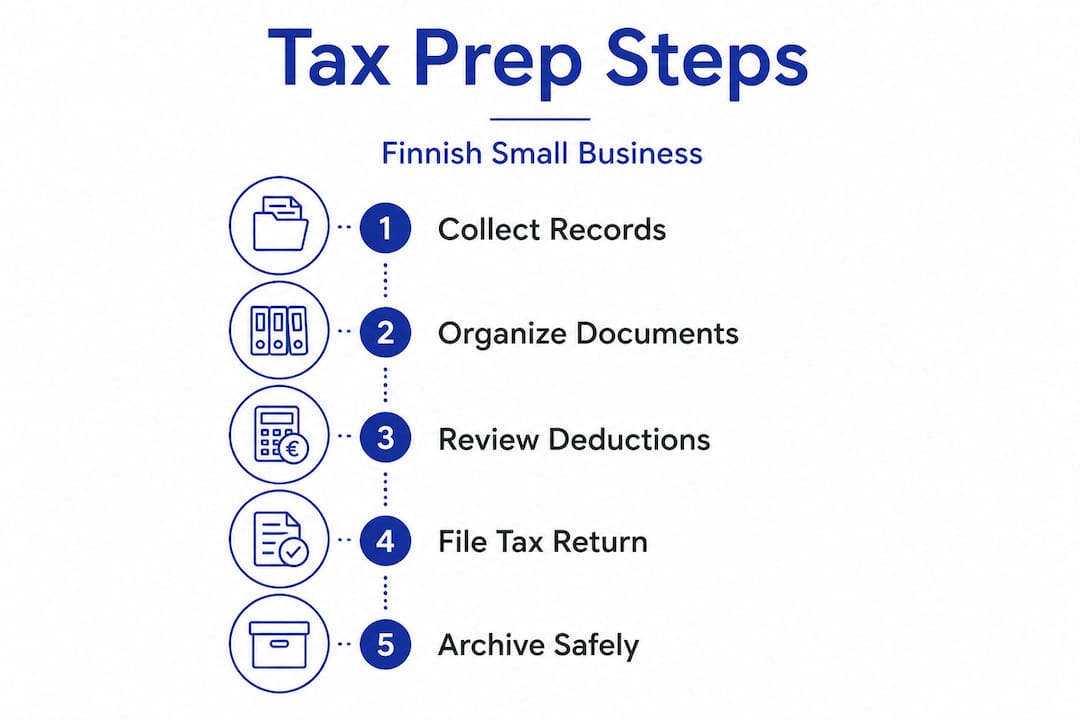
Vero's instructions are clear: you should prepare figures in bookkeeping form before you begin your tax return. This means your accounts must be in order before you open MyTax or pick up a paper form. Following bookkeeping best practices throughout the year makes this step far less stressful.
Documents you will need:
- Annual bookkeeping records and profit and loss statement
- All sales invoices and purchase invoices
- VAT receipts and VAT calculation summaries
- Bank statements for all business accounts
- Records of any assets purchased or sold
- Documentation for any loans or financing
- Receipts for travel, meals, or other deductible expenses
- Any relevant contracts or agreements
Systems and access you will need:
- A verified login for the MyTax (OmaVero) system via Suomi.fi identification
- Your business ID (Y-tunnus) to hand
- Accounting software records exported or printed for reference
The table below outlines the key documents, systems, and tasks by business type:
| Requirement | Self-employed (toiminimi) | Limited company (Oy) |
|---|---|---|
| Bookkeeping records | Single-entry or double-entry | Double-entry (mandatory) |
| Tax return form | MyTax or paper form 5 | Form 6B (mandatory) |
| Financial statements | Income and expense summary | Full financial statements |
| VAT records | Required if VAT-registered | Required |
| Supporting documents | Invoices, receipts | Invoices, receipts, board minutes |
| Filing system | MyTax or paper | MyTax or paper |
If you are just starting out, the bookkeeping basics guide for Finnish small businesses is a practical reference for getting your records into shape.
Pro Tip: Keep both digital and physical copies of all key documents, stored securely and separately. Cloud storage with a local backup gives you protection against loss or technical failure, and makes retrieval straightforward if Vero requests supporting evidence.
Step-by-step process for preparing your tax return in Finland
Gathering your documents is step one. Now, here is how to actually prepare and file your business tax return in a logical sequence that reduces errors and saves time.
The business tax return must be filed every year, and your reporting must follow VAT rules precisely. Missing a year, even one with minimal activity, can result in penalties. Here is the step-by-step process:
- Prepare your bookkeeping figures. Close your accounts for the financial year and produce a profit and loss statement. Confirm that all income and expenses are recorded and categorised correctly.
- Check your VAT treatment. Identify which income and expenses are subject to VAT and which are exempt. Confirm your VAT registration status and whether the small-scale exemption applies to you.
- Choose the correct return form. Self-employed individuals typically use MyTax or paper form 5. Limited liability companies and cooperatives must use Form 6B and fill out detailed sections covering income, deductions, assets, and liabilities.
- Input your figures, excluding VAT where required. Report income and expenses net of VAT unless instructed otherwise. Double-check each figure against your bookkeeping records before entering it.
- Verify for errors before submitting. Review totals, check that the correct form has been used, confirm VAT has been excluded where required, and ensure all supporting documents are attached or available.
The table below compares the process for the two most common business types:
| Step | Self-employed (toiminimi) | Limited company (Oy) |
|---|---|---|
| Financial statements | Income and expense summary | Full statutory accounts |
| Form used | Form 5 or MyTax | Form 6B (mandatory) |
| Complexity | Lower, fewer sections | Higher, detailed schedules |
| Deadline | April (check Vero annually) | Four months after financial year end |
| Attachments | Receipts, invoices | Financial statements, board minutes |
Maintaining bookkeeping workflow clarity throughout the year makes each of these steps faster and more accurate. Strong records mean fewer corrections and less time spent searching for figures at filing time.

Pro Tip: File your return every year, even if your business had no activity and no revenue. Finnish tax compliance requires annual filing regardless of activity level, and failing to do so triggers penalty fees that are entirely avoidable.
VAT and deduction rules: navigating common pitfalls
With your return started, it is vital to get VAT, deductions, and key exceptions right to avoid costly mistakes. VAT is one of the areas where small business owners most frequently make errors, often without realising it until Vero raises a query.
The rule is straightforward in principle: report income and expenses without VAT for tax purposes, and VAT input deductions are only allowed on VAT-liable activities. In practice, this means you must separate your VAT figures carefully in your bookkeeping before you begin filling in your return.
Input VAT cannot be deducted where purchases are not for VAT-liable business activity or are partially for private use. This is a firm rule, and Vero enforces it. If you use a vehicle for both business and personal journeys, for example, you may only deduct the business proportion of the VAT.
Additionally, small-scale VAT-exempt businesses are not entitled to input VAT deductions at all. If your annual turnover falls below the small-scale exemption threshold, you are outside the VAT system and cannot reclaim input VAT on your purchases.
Common VAT and deduction mistakes to avoid:
- Deducting input VAT on purchases used partly or wholly for personal purposes
- Claiming input VAT when your business is below the VAT registration threshold
- Reporting gross income (including VAT) rather than net income on your tax return
- Failing to keep receipts and records that document the business purpose of purchases
- Deducting entertainment expenses without checking whether they qualify under Finnish rules
- Mixing personal and business expenses in the same account, making separation difficult
"Input VAT deductions are only permitted where the purchase directly relates to VAT-liable business activity. Purchases for private use, or for activities outside the scope of VAT, do not qualify for deduction." Vero guidance on deducting VAT on purchases.
Reviewing smart deduction strategies for Finnish businesses can help you identify which expenses genuinely qualify and how to document them correctly, reducing the risk of disallowed deductions.
Pro Tip: Always document the specific business purpose for every VAT-deducted purchase at the time of purchase. A brief note on the receipt or in your accounting system is far more reliable than trying to reconstruct the reason months later during a tax review.
Extra deductions and incentives: making the most of R&D and entrepreneur reliefs
Beyond the basics, many business owners can increase their deductions and relief with specialist incentives that are easy to overlook. Knowing what is available and planning for it before the tax year ends can make a meaningful difference to your tax liability.
For self-employed individuals, entrepreneur deductions are handled automatically by Vero. You do not need to make a separate claim, which removes one potential source of error. However, you should still verify that your income has been reported correctly, as the automatic calculation depends on accurate figures from you.
For businesses investing in research and development, the incentives are significant. R&D-related incentives offer a combined extra deduction that can reach up to 95% on qualifying costs, combining a 50% base deduction with an additional 45% on eligible R&D expenditure. This is a substantial benefit for businesses that qualify, but it requires careful documentation.
Documentation needed for R&D incentive claims:
- Written description of the R&D project and its objectives
- Records of all eligible costs, including staff time, materials, and external services
- Evidence that the activity qualifies as research or development under Vero's definitions
- Invoices and contracts with any external R&D service providers
- Internal records showing how costs were allocated to the R&D project
Statistic: The combined R&D deduction can reach up to 95% of qualifying costs (50% base deduction plus 45% additional), making it one of the most valuable incentives available to Finnish businesses investing in innovation.
Beyond R&D, review essential Finnish tax tips to ensure you are not missing other available reliefs, such as deductions for home office use, vehicle expenses, or professional development costs.
Pro Tip: Plan your deduction eligibility before the tax year ends, not after. Eligibility for incentives such as the R&D deduction begins with having the right records in place during the year. Retrospective documentation is harder to substantiate and may not satisfy Vero's requirements.
Final checks, common errors, and deadlines
After maximising your deductions, it is time to verify your return and ensure compliance through the final steps. Rushing this stage is where many business owners make avoidable mistakes that cost time and money to correct.
Review steps before submission:
- Confirm all income figures match your bookkeeping records exactly.
- Check that you have used the correct form for your business type.
- Verify that all figures are reported net of VAT where required.
- Ensure all supporting documents are attached or stored and available.
- Review any automatically pre-filled figures in MyTax for accuracy.
- Check that any deductions claimed are supported by documentation.
Deadlines vary by business type and financial year end. Self-employed individuals typically face an April deadline, while limited companies must file within four months of their financial year end. Check Vero's current deadlines each year, as they can change.
"Late filing of a tax return will result in a penalty fee. The fee applies even if you intend to submit a correction at a later date. Penalties increase the longer the delay continues." Vero guidance on penalties for self-assessed taxes.
Late filing can trigger penalty fees that accumulate over time, even if the error was unintentional. A missed deadline of even a few days can result in a fee that far outweighs the inconvenience of filing on time. Small errors, such as an unchecked figure or a missing attachment, can also prompt Vero to request clarification, delaying your assessment and potentially triggering interest charges.
Staying on top of business tax compliance throughout the year, rather than scrambling at deadline time, is the most reliable way to avoid these costs.
What most guides miss about Finnish tax preparation
Before you move to action, here is one perspective that almost every business owner wishes they had heard earlier. Most guides focus on the mechanics of filing: which form to use, which figures to enter, and which deadlines to meet. That information is necessary, but it addresses only the final stage of a process that should run all year.
The real source of tax stress for most Finnish small business owners is not the tax return itself. It is the months of disorganised records, unreconciled accounts, and unfiled receipts that precede it. When you treat tax preparation as a single annual event rather than an ongoing workflow, you create the conditions for errors, missed deductions, and last-minute panic.
We have seen this pattern repeatedly. A business owner spends three weeks in March trying to reconstruct their income and expenses for the previous year, discovers they cannot find receipts for significant purchases, and ends up either missing deductions or filing late. The forms are not the problem. The habits are.
Building an ongoing bookkeeping workflow that keeps your records current throughout the year transforms tax preparation from a stressful event into a straightforward administrative task. Monthly reconciliation, regular receipt scanning, and quarterly reviews of your VAT position mean that when April arrives, your figures are already ready.
There is also a planning dimension that many guides overlook entirely. Decisions made in October or November, such as whether to make a capital purchase, invest in R&D, or adjust your salary as a company owner, can have a significant impact on your tax liability. Those decisions require current, accurate financial information. If your bookkeeping is six months behind, you cannot make informed choices.
Pro Tip: Schedule a mid-year financial review, ideally in June or July, to assess your year-to-date income, expenses, and VAT position. This gives you time to act on any planning opportunities before the year ends, rather than discovering them too late during filing.
Next steps: get expert support for your Finnish business
You now know the essentials of Finnish business tax preparation. If you want to go further, or simply save time and reduce risk, professional support can make a significant difference to your tax routine and your peace of mind.
At Finovate, we work with Finnish small businesses to handle bookkeeping, VAT reporting, payroll, and tax preparation so that you can focus on running your business. Our expert accounting services cover everything from day-to-day bookkeeping to annual tax returns, ensuring you stay compliant and never miss a deadline. For freelancers and light entrepreneurs, our invoicing solutions make it easy to manage your income and tax obligations without the administrative burden. Speak to our team today to find out how we can support your business through every stage of the tax year.
Frequently asked questions
Do I need to file a business tax return if I had no revenue this year?
Yes. Self-employed tax returns must be filed every year regardless of business activity, and failing to do so can result in penalty fees.
Can I deduct all VAT on my purchases as a small business?
No. Input VAT may only be deducted for purchases that relate directly to VAT-liable business activities, and only if your business is VAT-registered.
What happens if I file my business taxes late?
Late-filing penalties apply immediately and increase the longer you delay, even if you plan to submit a correction afterwards.
Do I need to claim the entrepreneur deduction separately?
No. The entrepreneur deduction is handled automatically by Vero for self-employed filings, so no separate claim is required.
How do I qualify for R&D tax deductions?
You must keep written documentation of all qualifying R&D expenses and meet Vero's eligibility criteria. R&D combined deduction requires documentation of qualifying expenses, so maintaining thorough records throughout the year is essential.