

TL;DR:
- Many Finnish entrepreneurs miss out on deductions due to confusion over eligible expenses and proper documentation.
- Understanding VAT rules, depreciation, and maintaining accurate records are essential to maximize tax benefits and ensure compliance in Finland.
Many Finnish entrepreneurs leave money on the table every year, not through carelessness, but through genuine confusion about what qualifies as a deductible expense. Getting business deductions explained properly is not just a compliance exercise. It has a direct impact on how much of your revenue stays in your business. From VAT rules to depreciation schedules, the Finnish tax system rewards those who understand the detail and punishes those who guess. This guide covers the key principles, common pitfalls, and practical steps you need to claim your deductions with confidence in 2026.
Table of Contents
- Key takeaways
- What makes a business expense deductible in Finland
- VAT on business purchases: what you can and cannot claim
- Depreciation and capital asset deductions
- Documenting expenses and avoiding common pitfalls
- R&D deductions and 2026 legislative updates
- My perspective on getting deductions right
- How Finovate can help you claim every deduction you are entitled to
- FAQ
Key takeaways
| Point | Details |
|---|---|
| Know what qualifies | Only expenses incurred wholly and exclusively for business purposes are deductible under Finnish tax law. |
| VAT exceptions matter | Business entertainment VAT is non-deductible; always confirm eligibility before claiming input VAT. |
| Small assets, immediate relief | Purchases under €1,200 with a lifespan under three years can often be deducted fully in the same year. |
| Documentation is non-negotiable | Without valid invoices, driving logs, and asset registers, deductions will be rejected regardless of legitimacy. |
| R&D incentives are worth exploring | Eligible Finnish businesses can claim a 50% additional deduction on qualifying R&D costs in 2026. |
What makes a business expense deductible in Finland
Understanding business deductions starts with one core principle: the expense must be incurred to acquire or maintain business income. Finnish tax law does not leave room for ambiguity here. If an expense serves a personal purpose, or even a mixed purpose without clear separation, it is unlikely to qualify.
The range of eligible business expenses is broader than many entrepreneurs realise. Common deductible categories include:
- Rent and workspace costs: Office rent, shared workspace fees, and a proportionate share of home office costs if your home is your primary place of business.
- Raw materials and stock: Any goods or materials purchased directly for producing your product or service.
- Personnel costs: Employee salaries, employer social contributions, and subcontracted labour costs are all deductible when properly documented.
- Marketing and advertising: Website costs, social media advertising, printed materials, and event sponsorships all qualify.
- Professional services: Accountant fees, legal advice, consultancy, and translation services directly related to your business.
The Finnish Tax Administration expects amounts to be reasonable and proportionate. An unusually large payment to a related party, for example, may be questioned. The principle is that a third party would accept the same amount under the same circumstances.
The tax impact of getting this right is real. Every euro you legitimately deduct reduces your taxable income, which in turn reduces the income tax or corporate tax you owe. For a small business operating on tight margins, that difference can be significant across a full financial year.
Pro Tip: Keep a simple spreadsheet or accounting tool updated monthly. Catching deductible expenses as they occur is far easier than reconstructing records at year end.
VAT on business purchases: what you can and cannot claim
VAT deductions follow their own set of rules, and this is where many Finnish entrepreneurs make costly errors. The general principle is that input VAT is deductible for purchases made for your VAT-liable business activities. However, several important exceptions apply.
Business entertainment is the most common trap. VAT on expenses incurred for hosting clients at restaurants, events, or hospitality venues is non-deductible, regardless of the business purpose. Staff entertainment is treated differently. VAT on staff events may be fully deductible within reasonable limits, but documentation must clearly distinguish the nature of the event.
Vehicle VAT is another area requiring caution. The rules around deducting VAT on car purchases and running costs are genuinely complex, and the proportion you can claim depends on the vehicle's business use versus personal use. Experts recommend seeking professional advice before claiming vehicle VAT to avoid costly errors.
Other common exceptions worth knowing:
- Hotel breakfast costs are typically not deductible for VAT purposes.
- International transactions may involve reverse charge VAT mechanisms, which require separate accounting treatment.
- Mixed-use purchases must have their VAT deduction apportioned correctly between business and personal use.
One rule applies across all VAT deductions: you must hold a valid VAT invoice to support every claim. The invoice must include the supplier's VAT number, the buyer's details, a description of the goods or services, and the VAT amount. Without a compliant invoice, the deduction will be denied.
Pro Tip: When in doubt about whether a purchase qualifies for VAT deduction, request a proper VAT invoice regardless. Having the documentation in place costs nothing, and you can always choose not to claim it.
Depreciation and capital asset deductions
Not every business purchase is deductible in full during the year you buy it. This is where understanding the difference between revenue expenditure and capital expenditure matters.
Business purchases under €1,200 with a useful lifespan of less than three years, or total small asset purchases under €3,600 in a year, can be deducted immediately. Anything above these thresholds must be capitalised and depreciated over its useful life.
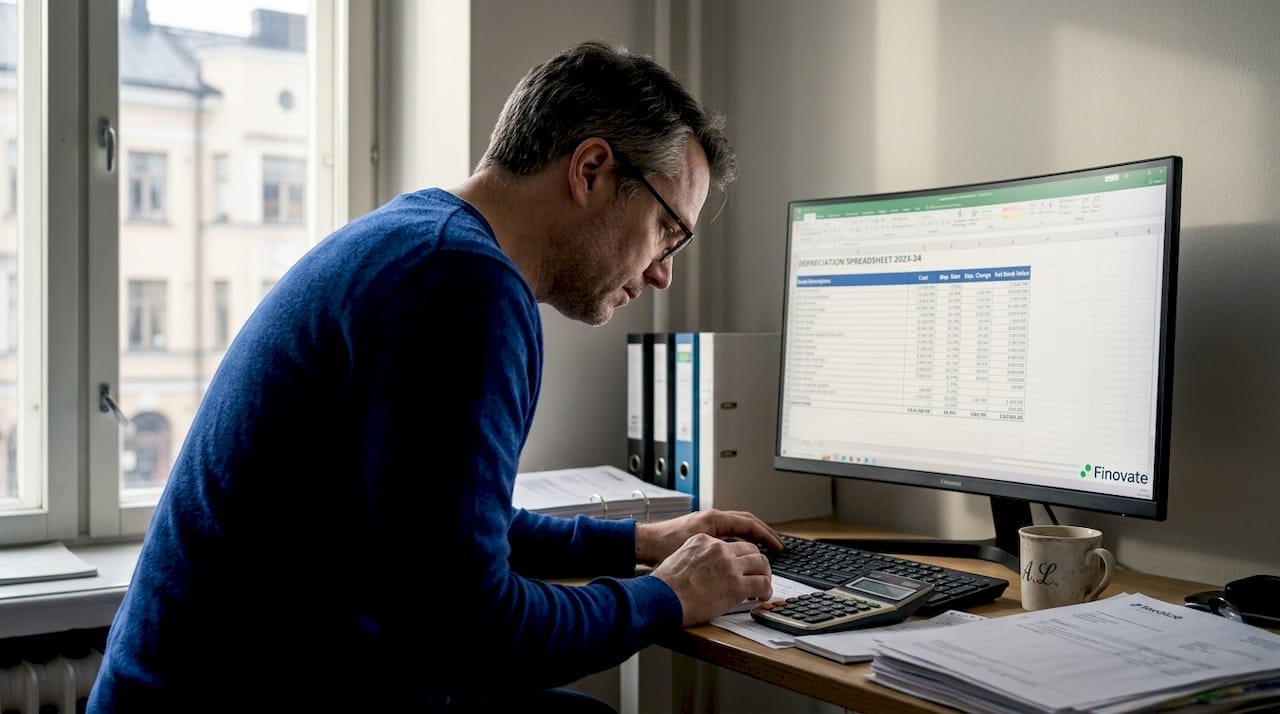
The most common depreciation method in Finnish bookkeeping is linear depreciation, which spreads the asset's cost evenly across its estimated life. Here is how that looks in practice:
| Asset type | Estimated useful life | Annual depreciation (€10,000 asset) |
|---|---|---|
| IT equipment and computers | 3 years | €3,333 per year |
| Office furniture | 5 years | €2,000 per year |
| Business vehicle | 5 years | €2,000 per year |
| Machinery and equipment | 10 years | €1,000 per year |
The steps for managing capital asset deductions correctly are as follows:
- Record the full cost of the asset in your accounts on the date of purchase.
- Determine the appropriate useful life based on the asset type and your actual usage.
- Calculate the annual depreciation charge and record it each financial year.
- Maintain an asset register showing each item, its purchase date, cost, accumulated depreciation, and net book value.
- Review the asset register annually and adjust for any disposals or write-downs.
Careful documentation of depreciation schedules is not just a compliance requirement. It also gives you a clearer picture of your business's financial health and helps you plan for future asset replacement costs.
Documenting expenses and avoiding common pitfalls
Knowing which expenses qualify is only half the challenge. The other half is making sure your records are good enough to withstand scrutiny from the Finnish Tax Administration.
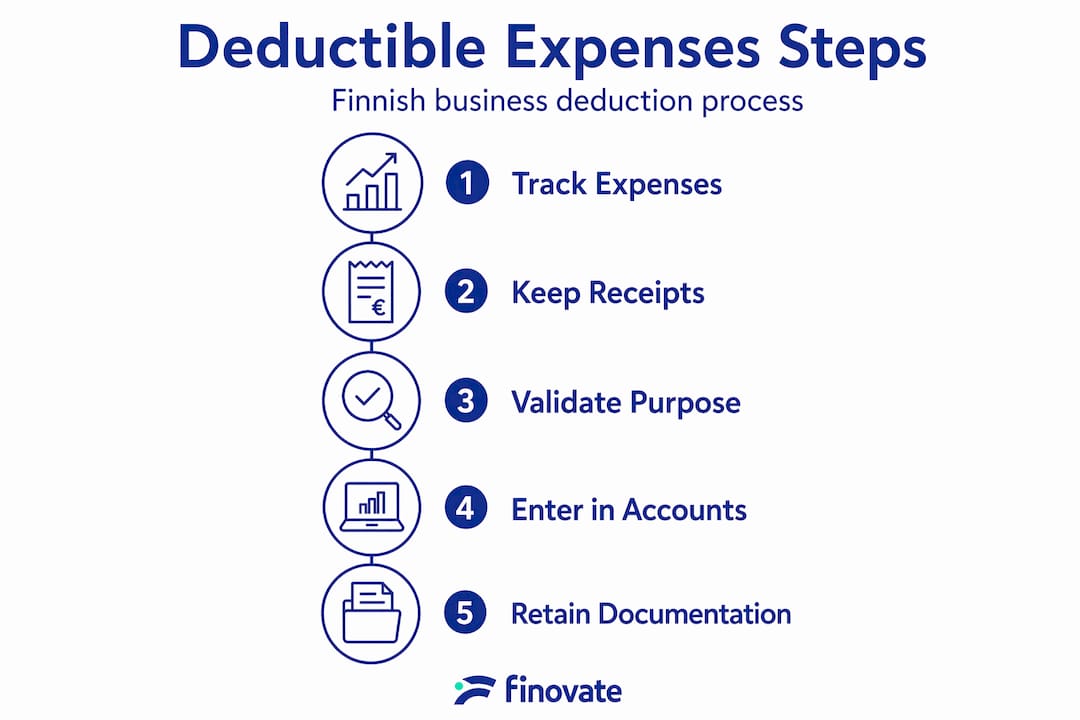
The most frequent reason deductions are rejected is not that the expense was illegitimate. It is that the documentation was missing or insufficient. Several practical measures will protect you.
Keep every receipt, invoice, and bank statement related to business expenditure. Digital copies are accepted, but they must be legible and stored securely. For mileage, a compliant driving log (ajopäiväkirja) is mandatory. Without a proper driving log, your mileage deductions will be automatically denied, regardless of how genuine those journeys were. Retroactive records are unlikely to be accepted, so the log must be maintained in real time.
Separating personal and business finances is equally important. Running personal purchases through a business account, even accidentally, creates confusion and risk. A dedicated business account and business credit card are worth the small administrative effort.
Some of the most commonly missed deductions among Finnish entrepreneurs include:
- Bank service fees: Fully deductible and often overlooked, these add up meaningfully over a year.
- Software subscriptions: Accounting tools, project management software, cloud storage, and communication platforms are all deductible.
- Professional development: Courses, books, and conferences directly relevant to your business are allowable.
- Home office costs: A proportionate share of rent, utilities, and broadband can be claimed if you work from home.
Pro Tip: Review your bank statement at the end of each month specifically looking for small recurring costs. Many entrepreneurs are surprised by how much they have been paying and not claiming.
R&D deductions and 2026 legislative updates
Finland offers meaningful incentives for businesses investing in research and development, and these are worth understanding if any part of your business involves developing new products, services, or processes.
The current framework includes several layers of support:
- A 50% additional deduction on eligible R&D costs, with a minimum qualifying expenditure of €5,000 and a maximum deductible amount of €500,000 per year.
- A further 45% bonus deduction for businesses that show year-on-year growth in qualifying R&D expenditure.
- A 150% deduction available for R&D costs incurred through qualifying subcontracted arrangements.
To claim these incentives, your R&D activities must meet the statutory definition of research or development, and you must maintain documentation that supports the nature, scope, and cost of the work. Casual product improvement or general business development does not qualify. The work must have a clear innovation or technical advancement element.
Beyond R&D, stay alert to legislative changes affecting deductions more broadly. Finnish tax law is updated regularly, and tax compliance requirements for 2026 include updated reporting thresholds and revised guidance on certain expense categories. Reviewing these changes with an accountant at the start of each year is a sound habit.
My perspective on getting deductions right
I have worked with Finnish entrepreneurs across a wide range of industries, and one pattern comes up again and again. The businesses that struggle most with deductions are not the ones making deliberate errors. They are the ones who assume their expenses are obvious enough that detailed records are unnecessary.
In my experience, the Finnish Tax Administration does not penalise honest businesses harshly. But they do require proof. I have seen perfectly legitimate deduction claims denied simply because the entrepreneur could not produce the invoice or had not kept a mileage log. The tax benefit was real. The documentation was not.
What I have learned is that getting deductions right is a habit, not a task you do once a year. The entrepreneurs who maximise their tax benefits are usually the ones who maintain clean books throughout the year, not just in the weeks before filing.
My honest recommendation is to consult a qualified accountant before you think you need one. Most of the costly mistakes I see could have been avoided with a single early conversation about which expenses qualify and how to document them. That advice pays for itself.
— Busayo
How Finovate can help you claim every deduction you are entitled to
Staying on top of your deductions while running a business is genuinely demanding. Finovate provides accounting and tax services specifically designed for Finnish entrepreneurs and small business owners, covering everything from bookkeeping and VAT reporting to payroll and tax preparation.
Whether you are a freelancer looking for a simple way to manage invoicing and expenses, or a growing SME that needs dedicated VAT support and financial reporting, Finovate has a service level to match. Our monthly invoicing service is built for entrepreneurs who want accurate records and compliant tax filings without the administrative burden. For businesses with more complex needs, our Pro invoicing service offers enhanced support. We take the complexity out of Finnish tax compliance so you can focus on your business.
FAQ
What expenses are deductible for Finnish entrepreneurs?
Expenses incurred to acquire or maintain business income are deductible, including rent, raw materials, personnel costs, marketing, and professional services fees.
Can I deduct VAT on all business purchases in Finland?
No. While input VAT is generally deductible for business use, VAT on business entertainment is non-deductible, and vehicle VAT is subject to complex restrictions based on personal and business use split.
How do I claim mileage deductions in Finland?
You must maintain a compliant driving log (ajopäiväkirja) recording each journey's date, purpose, start and end points, and distance. Without this, mileage deductions are denied automatically.
What is the R&D tax incentive available in Finland in 2026?
Eligible businesses can claim a 50% additional deduction on qualifying R&D costs between €5,000 and €500,000, plus a 45% growth bonus for increased year-on-year R&D expenditure.
Do small asset purchases need to be depreciated?
Not always. Purchases under €1,200 with a useful life under three years, or total annual small purchases under €3,600, can generally be deducted in full in the year of purchase.