

TL;DR:
- Finnish SMEs can legally reduce taxes through strategic planning, incentives, and timely expense management.
- Key incentives include R&D super deductions, accelerated depreciation, and green investment credits.
- Professional support and thorough record-keeping enhance compliance and maximize tax savings.
Many Finnish small and medium-sized business owners assume that tax planning is something reserved for large corporations with dedicated finance teams. That assumption is costing them money. With Finland's corporate income tax rate rising from 20% to 22% in 2026, the margin for inaction is shrinking. The good news is that Finnish tax law contains a range of incentives, deductions, and structural options specifically accessible to SMEs. This article walks you through the key strategies, tools, and practical steps to reduce your tax liability legally and confidently.
Table of Contents
- Understanding the benefits of tax planning for Finnish SMEs
- Key tax incentives and deductions for Finnish businesses
- Navigating VAT, compliance and tax structures in Finland
- Practical steps to implement effective tax planning
- The uncomfortable truth about tax planning for Finnish SMEs
- Explore accounting solutions tailored for Finnish SMEs
- Frequently asked questions
Key Takeaways
| Point | Details |
|---|---|
| Proactive planning pays | SMEs in Finland can reduce tax bills and improve cash flow by planning ahead and using legal incentives. |
| Leverage deductions and credits | A range of R&D, green investment and depreciation deductions help lower effective tax rates below headline figures. |
| Compliance shapes results | Choosing the right structure and ensuring compliance affects tax outcomes as much as managing income and expenses. |
| Get professional support | Accountants and advisors help SMEs optimise incentives, handle documentation and avoid penalties. |
Understanding the benefits of tax planning for Finnish SMEs
Tax planning is not about finding loopholes. It is about making deliberate, informed decisions that align your business activities with the opportunities already built into Finnish tax law. When done consistently, it produces measurable improvements in cash flow, compliance, and long-term financial stability.
Consider a straightforward example. A sole trader who invoices €80,000 annually but fails to claim all allowable deductions may pay thousands more in tax than a peer with identical revenue who plans carefully. The difference is not income. It is preparation.
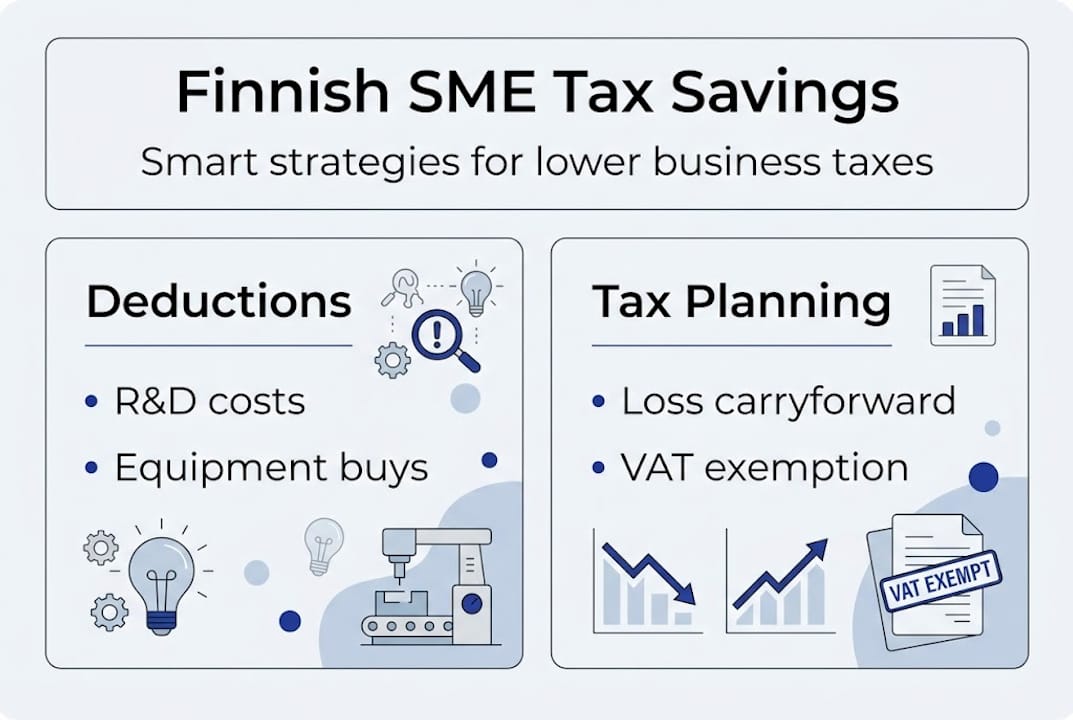
As verosuunnittelu guidance from leading Finnish advisors confirms, proactive planning is entirely legal and widely recommended for businesses of all sizes. The Finnish Tax Administration itself outlines how tax planning for SMEs optimises liabilities by utilising deductions, incentives, and timing strategies.
The core benefits of structured tax planning include:
- Improved cash flow through better timing of income recognition and expense claims
- Reduced tax liability by accessing all eligible deductions and credits
- Penalty avoidance through accurate documentation and timely prepayments
- Strategic decision-making informed by tax consequences before major purchases or restructuring
- Access to incentives such as R&D credits and green investment reliefs
Proactive tax planning is not a luxury for Finnish SMEs. It is a core part of sound financial management, particularly as the 2026 rate increase adds pressure to already tight margins.
For SMEs new to structured planning, reviewing essential tax tips for Finnish entrepreneurs is a practical starting point. Understanding the accountant benefits of professional support can also clarify how much value a qualified adviser adds beyond simple compliance.
Key tax incentives and deductions for Finnish businesses
Finland has built a genuinely competitive set of incentives for businesses that invest, innovate, and grow. Knowing which ones apply to your situation is where real savings begin.
The most significant incentive for qualifying businesses is the R&D super deduction. According to Business Finland, businesses can claim a 50% general R&D deduction plus an additional 45% on qualifying wages and services, with a minimum threshold of €5,000 and a maximum of €500,000. This alone can substantially reduce taxable income for technology, manufacturing, and service businesses investing in development.
Here is a summary of the main incentives available:
| Incentive | Details | Who benefits most |
|---|---|---|
| R&D super deduction | 50% general + 45% additional | Tech, manufacturing, R&D-active SMEs |
| Accelerated depreciation | 50% on machinery (2020 to 2025) | Capital-intensive businesses |
| Group contributions | Even profits/losses across group | SME groups with subsidiaries |
| Loss carryforward | Up to 10 years | Businesses in early or volatile phases |
| Green investment credit | Tax credit for qualifying green assets | Businesses investing in sustainability |
| Share option exemption | Tax relief for unlisted company options | Start-ups and growth-stage SMEs |
To qualify for R&D deductions, your expenditure must meet specific criteria. Review the R&D deduction criteria published by the Finnish Tax Administration to confirm eligibility before filing.
For SMEs structured as limited companies (Oy), the loss carryforward provision is particularly valuable. Losses can be carried forward for up to ten years, which means a difficult trading year does not have to result in permanent tax disadvantage.
Pro Tip: If your business owns machinery or equipment, check whether accelerated depreciation still applies to your assets. Claiming 50% depreciation in the first year significantly reduces your taxable profit and improves near-term cash flow.
For business owners drawing income from their company, reviewing capital income optimisation strategies can further reduce the overall effective tax rate across both corporate and personal income.
Navigating VAT, compliance and tax structures in Finland
Choosing the right business structure and understanding your VAT obligations are two of the most consequential decisions for any Finnish SME. Both affect how much tax you pay and how much administrative work you carry.

On VAT, the rules are clear. Businesses with turnover below €20,000 nationally, or below €100,000 EU-wide, qualify for VAT exemption. This simplifies compliance considerably and reduces the administrative burden for micro and small businesses operating below these thresholds.
For businesses above the threshold, VAT registration is mandatory. Understanding the corporate tax guide for Finland helps clarify how VAT interacts with your overall tax position, including deductible input VAT on business purchases.
Regarding business structure, the two most common forms for SMEs are:
- Tmi (toiminimi, sole trader): Simpler to set up and administer, but all income is taxed as personal income, which can result in higher effective rates at elevated earnings.
- Oy (osakeyhtiö, limited company): Subject to corporate income tax (rising to 22% in 2026), but allows income splitting between salary and dividends, which can reduce overall tax liability when managed correctly.
A key compliance checklist for Finnish SMEs includes:
- Maintain accurate records of all income and deductible expenses throughout the year
- Submit prepayment tax (ennakkoverot) estimates on time to avoid interest charges
- File VAT returns on the correct schedule (monthly, quarterly, or annually depending on turnover)
- Keep documentation for all claimed deductions, including receipts and contracts
- Review double tax treaty provisions if you conduct business across EU borders
Pro Tip: If you are unsure whether your business structure is still optimal, an annual review with a qualified accountant is worthwhile. Many SMEs outgrow their initial structure without realising the tax implications.
For a deeper look at obligations and timelines, the tax compliance essentials guide covers the 2026 requirements in detail. You can also explore accounting methods relevant to Finnish entrepreneurs to ensure your bookkeeping approach supports accurate tax reporting.
Practical steps to implement effective tax planning
Knowing the theory is one thing. Putting it into practice requires a clear sequence of actions, consistent habits, and the right professional support.
Here is a structured approach we recommend for Finnish SMEs:
- Review your current tax liabilities at the start of each financial year. Understand what you paid last year and why.
- Identify applicable incentives based on your business activities, such as R&D, green investment, or capital expenditure.
- Time income and expenses strategically. Where possible, defer income to the following tax year or accelerate deductible expenses into the current year.
- Engage a qualified tax adviser to review your prepayment estimates and ensure they reflect your actual expected liability.
- Maintain organised records throughout the year. Do not leave documentation to the last moment before filing.
Common mistakes that Finnish SMEs make include:
- Underestimating prepayment tax, leading to interest charges at year end
- Failing to claim all allowable deductions due to poor record keeping
- Delaying structural decisions (such as incorporating) until after the tax year closes
- Overlooking loss carryforward provisions after a difficult trading period
As verosuunnittelu experts confirm, proactive legal optimisation improves both cash flow and business decision-making. Consulting an accountant for nuances like prepayments helps avoid penalties that erode the very savings you are trying to achieve.
Pro Tip: Set a quarterly tax review in your calendar. Thirty minutes every three months reviewing your income, expenses, and prepayment position is far less costly than a surprise underpayment at year end.
For SMEs wanting to understand the full scope of professional support available, the tax advisor role article explains what a qualified adviser actually does. A solid bookkeeping guide for Finnish SMEs is also worth reading to build the record-keeping habits that support effective planning.
For further context on what verosuunnittelu (tax planning) means in practice, the verosuunnittelu overview from Finnish accounting specialists provides a clear explanation.
The uncomfortable truth about tax planning for Finnish SMEs
Most SMEs do not under-plan because tax planning is genuinely difficult. They under-plan because they believe it is not worth their time, or that the savings will be marginal. Both assumptions are wrong.
The reality is that R&D super deductions and other incentives can push effective tax rates well below the headline 22% rate for businesses that qualify. Yet many eligible SMEs never claim them, simply because they did not know to ask.
There is also a competitive dimension that rarely gets discussed. Businesses that plan their taxes effectively retain more capital. That capital funds hiring, investment, and growth. Over three to five years, the compounding effect of consistent tax optimisation is significant. Businesses that leave planning to later are not just paying more tax today. They are funding their competitors' growth.
We also see a pattern where SMEs assume their current accountant is handling this automatically. Often, compliance and planning are separate conversations. Compliance means filing correctly. Planning means filing strategically. You need both. Reviewing your SME bookkeeping workflow is a good starting point for identifying where planning gaps exist.
Explore accounting solutions tailored for Finnish SMEs
Understanding your tax planning options is the first step. Acting on them is where the real value lies. We support Finnish SMEs with practical, tailored financial management services that connect directly to the strategies covered in this article.
Whether you need structured bookkeeping to support deduction claims, a reliable invoicing service pro for light entrepreneurs, or dedicated accounting for delivery partners and gig workers, we have solutions built for your situation. Our accounting and tax services cover everything from VAT registration to annual tax planning reviews. Reach out to us to discuss how we can help your business retain more of what it earns.
Frequently asked questions
What is the main reason to plan taxes as a Finnish SME?
Tax planning allows SMEs to legally minimise liabilities, optimise cash flow, and access incentives built into Finnish tax regulations. The Finnish Tax Administration confirms that planning optimises liabilities through deductions, incentives, and timing strategies.
What are the key tax incentives for Finnish SMEs in 2026?
2026 incentives include R&D deductions, green investment credits, accelerated depreciation, and share option tax exemptions for unlisted companies. Business Finland confirms that R&D deductions include a 50% general rate plus 45% additional on qualifying expenditure.
How does VAT exemption work for small businesses in Finland?
Businesses below €20,000 national or €100,000 EU turnover qualify for VAT exemption, reducing paperwork and administrative costs. The Finnish Tax Administration provides full details on VAT exemption thresholds for small businesses.
Should I use a professional accountant for tax planning?
Professional accountants help SMEs leverage deductions and incentives, navigate documentation, and avoid late payment penalties. As verosuunnittelu specialists advise, consulting an accountant for prepayment nuances is essential to avoid costly errors.
Are there any risks in tax planning for SMEs?
Risks include missing deadlines, misinterpreting deductions, or overlooking documentation requirements, all of which professional guidance can mitigate. Accountants experienced in prepayment planning help ensure your position is accurate and penalty-free throughout the year.