

Keep your accounting books, chart of accounts and annual financial statements for at least 10 years and keep supporting vouchers, invoices and transaction correspondence for at least 6 years. That split comes directly from the Accounting Act (1336/1997). The one rule that matters more than any other: every figure in your financial statements must trace back to a specific original voucher, on demand.
- A long retention period applies to ledgers, chart of accounts, and financial statements
- A shorter retention period applies to invoices, receipts, bank statements, contracts, and correspondence
- Non-negotiable: an unbroken audit trail from voucher to ledger entry, verified by the Finnish Tax Administration's audit guidance
Key Takeaways
The single most important compliance step is maintaining an auditable trail linking every ledger entry to its original voucher, invoice or bank record.
| Point | Details |
|---|---|
| Keep books for 10 years | Ledgers, chart of accounts and financial statements must be retained for 10 years from year end. |
| Keep vouchers for 6 years | Invoices, receipts, bank statements and correspondence need at least 6 years of retention. |
| Prioritise the audit trail | Every figure must trace back to a specific voucher; this matters more than any single retention date. |
| Meet three digital storage tests | Electronic records need authenticity of origin, content integrity and lasting legibility. |
| Get expert help with compliance | Finovate manages bookkeeping, payroll, VAT filings and audit-pack preparation so records stay trace-ready year round. |
Where to check the official rules
- Accounting Act (1336/1997): the statutory basis for retention periods and audit trail obligations
- Finnish Tax Administration audit guidance: what auditors expect and how to deliver records electronically
- Kirjanpitolautakunta guidance: clarifications on retention splits and consolidation materials
Check these directly if your situation involves OSS/IOSS cross-border sales, foreign subsidiaries, or any other unusual structure.
Table of Contents
- What financial, tax and payroll documents must you keep?
- How long do you need to keep business records?
- What are the rules for storing records electronically?
- What do tax auditors ask to see, and how should you send it?
- How should you organise, index and dispose of old records?
- What does a practical retention checklist look like?
- How can Finovate help with your recordkeeping compliance?
- Frequently asked questions
- Sources
What financial, tax and payroll documents must you keep?
Most compliance gaps we see at Finovate aren't about ignorance of the law. They're about incomplete filing. A business keeps its invoices but loses the bank reconciliation that proves those invoices were actually paid. Here's the fuller picture, grouped by category:
- Accounting books and ledgers: general ledger, subsidiary ledgers, chart of accounts, opening and closing balances
- Financial statements and reports: annual accounts, management reports, notes to the accounts
- Vouchers and receipts: every document that justifies a ledger entry, matched by a unique reference
- Sales and purchase invoices: including credit notes and any correction invoices
- Bank statements and reconciliation evidence: monthly statements plus the workpapers showing they tie to the ledger
- Payroll records and employment contracts: payslips, salary calculations, holiday pay records, contracts and amendments
- VAT records: VAT invoices, VAT return calculations, and OSS/IOSS filings where you sell across EU borders
- Contracts and commercial agreements: including any change orders or amendments signed later
- Minutes and corporate records: board decisions, shareholder resolutions, and any documents referenced in those minutes
Two categories SMEs consistently under-retain: internal reconciliation workpapers (the calculations behind a bank tie-out, not just the statement itself) and contract amendments that change price or scope after signing. Both matter enormously if a dispute or audit ever asks "why does this figure differ from the original agreement?"
Pro Tip: Give every voucher a unique reference number that also appears in the ledger entry it supports. This two-way link is what an auditor checks first, and it costs you nothing beyond a naming convention.
How long do you need to keep business records?
The Accounting Act sets two clear minimums, and professional accounting board guidance confirms exactly which documents fall where.
10 years, counted from the end of the financial year:
- Accounting books, ledgers and the chart of accounts
- Annual financial statements and the list of ledgers used
- Consolidation workpapers, including foreign subsidiary accounting materials needed to prepare group accounts.
6 years, counted from the end of the year the financial year ended:
- Sales and purchase vouchers, invoices and receipts
- Bank statements and transaction correspondence
- Supporting VAT documentation tied to specific transactions
These are legal floors, not ceilings. Conservative retention beyond the statutory minimum is sensible advice where a limitation period runs longer than the accounting minimum, where you've sold commercial property (VAT adjustment periods can stretch well past six years), or where you've received EU or public funding that carries its own audit window. Transfer pricing documentation is another common exception; tax authorities in multiple jurisdictions can request it years after the transaction.
If any of your accounting materials sit with an overseas parent, subsidiary, or service provider, check that Finnish-accessible copies exist. Foreign entities registered for VAT in Finland must be able to produce records domestically when the Tax Administration asks, and "our records are in another country" is not an accepted delay.
What are the rules for storing records electronically?
Finnish law lets you store almost everything digitally, but three conditions apply, and each one has a practical test behind it.
Authenticity of origin means you can prove who issued a document and that it hasn't been altered since receipt. Integrity of content means the substance of the record is unchanged from creation to the day an auditor opens it. Legibility means the file opens in a readable format for the full retention period, not just today.
In practice, that means:
- Storing invoices as PDF/A or another stable, searchable format rather than proprietary files that may become unreadable
- Keeping a change log for any document that gets edited, converted or migrated between systems
- Using tamper-evident storage or version control so a file's history is visible, not just its current state
- Retaining metadata that proves issuer identity where the original format doesn't carry it inherently
You can change file formats over time (migrating from one accounting system to another, for example) as long as the audit trail travels with the file. Bookkeeping materials may be stored digitally provided the Tax Administration can access them without undue delay, which rules out storage locations or formats that create friction at exactly the moment you need speed.
Pro Tip: Test your backup restore process at least once a year, not just your backup schedule. A backup nobody has successfully restored is a false sense of security, not a control.
What do tax auditors ask to see, and how should you send it?
A Finnish tax audit typically requests the same core set of documents:
- Annual accounts and the general ledger for the periods under review
- Underlying vouchers, invoices and receipts referenced in those ledgers
- VAT returns and the calculations behind them
- Payroll records and employment contracts, where staff costs are in scope
- Reconciliation schedules linking bank statements to the ledger
Auditors accept several delivery methods: remote read-only access to your accounting system, secure electronic transfer, or physical delivery for older paper archives. Whichever you choose, electronic records must allow the auditor to establish a clear transaction history from statement to voucher. Revoke remote access once the audit closes.
Before an audit ever starts, run this quick self-check:
- Pick five random ledger entries and trace each to its source voucher
- Confirm every voucher references a bank statement line where payment applies
- Check that your VAT return figures reconcile to the underlying invoice totals
Pro Tip: Do this trace exercise quarterly, not just before an audit. It surfaces gaps while they're still fixable, rather than during a live audit when they're a liability.
How should you organise, index and dispose of old records?
A retention schedule only works if your filing system makes it obvious what to keep and what's safe to destroy. Structure folders by financial year, then document type, then voucher ID. That three-level taxonomy means anyone, not just the person who filed it, can locate a specific transaction in seconds.
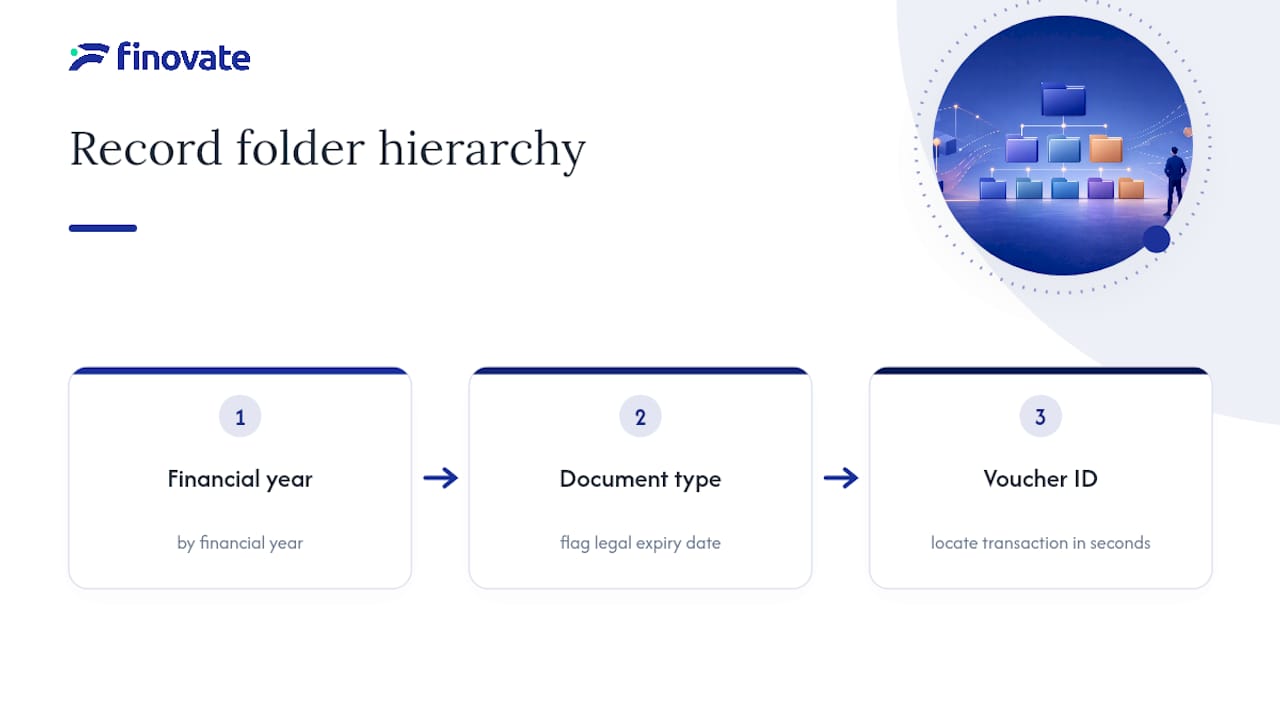
Build a simple retention calendar: flag each document category with its legal expiry date at the point of filing, not years later when nobody remembers the original date. Most modern accounting and document management systems support automated retention flags and archive rules, so a document quietly moves to "eligible for disposal" status without manual tracking.
When something genuinely reaches the end of its retention period, dispose of it properly. Shred paper records rather than binning them. For digital files, use secure wipe or cryptographic deletion rather than a simple file delete, which often leaves recoverable traces.

Pro Tip: Keep a disposal register that logs what was destroyed, when, by whom, and under what authorisation. If a disposed record is ever questioned, this register is your proof that destruction was lawful and scheduled, not evasive.
What does a practical retention checklist look like?
Turn this into action today: identify which categories currently have gaps, digitise any paper records still exposed to fire or water damage, set retention flags in your file system, and test that your backups actually restore.
Common mistakes that cost SMEs the most
The recurring failure I see isn't missing documents. It's documents that exist but can't be linked to anything. An invoice with no voucher reference, payroll files kept in a format nobody can export five years later, a ledger that can't be pulled from an old accounting system after a software switch. Two quick wins fix most of this in a single afternoon: standardise your voucher numbering today, and export a full ledger backup in a plain, readable format right now, not when you next change systems.
At Finovate, we build client accounts around exactly this discipline, because it's the difference between a routine audit and a stressful one.
How can Finovate help with your recordkeeping compliance?
Finovate is the alternative to piecing together compliance yourself from scattered spreadsheets and folders. We run your bookkeeping, payroll and VAT filings so the audit trail is built correctly from the first entry, not reconstructed under pressure later.
Our team handles ongoing bookkeeping with proper voucher indexing, prepares and files VAT returns through MyTax, manages payroll records to the retention standards this guide covers, and can assemble a full audit pack on request if the Tax Administration comes calling. If you run a smaller operation, our accounting service for light entrepreneurs applies the same discipline at a scale that fits a single-person business.
If you're unsure whether your current filing system would survive an audit, get in touch through Finovate and ask about a records health check. We'll tell you plainly where the gaps are and what it takes to close them.
Frequently asked questions
Do I need to keep paper originals, or is a digital scan enough? A digital copy is legally sufficient for most records provided it meets the authenticity, integrity and legibility tests described above. Some property-related VAT documents and certain contracts are worth keeping in original form as a precaution, even where digital storage is technically permitted.
What happens if I can't produce a requested record during an audit? Missing documentation can result in disallowed deductions, adjusted tax assessments, or penalties, depending on what the record was meant to prove. This is exactly why the audit trail matters more than simply having files somewhere.
Does this recordkeeping requirements guide apply the same way to a sole trader as a limited company? The core retention periods under the Accounting Act apply broadly, though the volume and complexity of records (payroll, VAT, consolidated accounts) scales with business size and structure.
How does OSS/IOSS affect what I need to retain? If you sell across EU borders, you need VAT records and OSS/IOSS filing evidence retained for the same period as your other VAT documentation, with particular attention to the destination country's invoicing rules.
This article is general information, not a substitute for advice from a qualified financial advisor. Consult a qualified financial professional about your own circumstances before acting on anything here.
Sources
- How long accounting records should be retained for? – Finrepo
- Accounting Act (1336/1997) – Finlex
- Vero
- Kirjanpitolautakunta: kirjanpitoaineiston säilyttämisestä