

TL;DR:
- Effective expense tracking prevents lost deductions and enhances financial clarity for small businesses.
- Consistently recording, categorising, and reconciling expenses ensures accurate tax reporting and informed decision-making.
Running a business without a reliable business expense tracking tutorial to follow is like trying to balance your accounts with half the numbers missing. Many entrepreneurs lose thousands each year not through overspending, but through poor record-keeping that obscures where money is actually going. Missed deductions, audit risks, and inaccurate profit figures are the direct consequences. This guide walks you through every stage of expense tracking, from setting up the right foundations to using your data for smarter financial decisions and tax compliance.
Table of Contents
- Key takeaways
- Getting started with business expense tracking
- How to track business expenses step by step
- Common expense tracking mistakes to avoid
- Using expense data for decisions and tax compliance
- My honest take on expense tracking discipline
- How Finovate can support your expense management
- FAQ
Key takeaways
| Point | Details |
|---|---|
| Separate finances first | Open a dedicated business account before tracking anything to eliminate confusion and reduce audit risk. |
| Record expenses in real time | Logging costs as they occur prevents lost receipts and incomplete records that complicate bookkeeping. |
| Categorise consistently | Using clear, consistent expense categories reduces misclassification errors and strengthens your tax position. |
| Reconcile every month | Monthly bank reconciliation catches errors early and keeps your year-end accounting manageable. |
| Retain records for seven years | Keeping receipts and documentation for seven years protects you during tax audits and late filing scenarios. |
Getting started with business expense tracking
Before you log a single receipt, you need the right structure in place. Skipping this step is the most common reason small business owners find themselves buried in disorganised paperwork at year-end.
Separate your finances
The single most important step is opening a dedicated business bank account. Using dedicated business accounts for all income and expenses eliminates the confusion that arises when personal and business transactions are mixed. It also significantly reduces your audit risk, because tax authorities can clearly see business activity without having to sift through your personal spending.
Choose your tracking method
You broadly have two options: manual tracking or digital tracking. Manual methods include spreadsheets or paper ledgers, which cost nothing but require consistent discipline. Digital methods range from dedicated expense management apps to full accounting software. For most small business owners, a digital approach pays for itself quickly in time saved and errors avoided.
Here is a comparison to help you decide:
| Method | Best for | Key benefit | Main limitation |
|---|---|---|---|
| Spreadsheet | Sole traders, very low volume | Free, fully customisable | Time-consuming, error-prone |
| Expense tracking app | Mobile-first business owners | Receipt scanning, categorisation | Monthly subscription cost |
| Accounting software | Growing SMEs | Full financial picture, tax reports | Steeper learning curve |
| Outsourced bookkeeping | Busy entrepreneurs | Zero admin burden | Ongoing professional fee |

Documents you must keep
Good bookkeeping best practices require you to retain specific documents. The essentials are:
- Receipts and invoices for every business purchase
- Bank and credit card statements
- Mileage logs if you use a vehicle for business
- Payroll records and contractor payment confirmations
- Any expense claims submitted by employees
Setting up clear folders, whether physical or digital, for each category from the outset saves hours of searching later.
How to track business expenses step by step
With your foundations in place, you can follow a consistent process for capturing and recording every business cost as it occurs.
-
Capture receipts immediately. The moment you make a purchase, photograph the receipt or save the digital confirmation. Booking expenses in real time avoids lost receipts and incomplete records that make bookkeeping far harder later. Most modern expense apps let you scan a paper receipt in seconds using your phone camera.
-
Record the full details. For each expense, log the date, amount, supplier, category, and business purpose. This level of detail matters for tax compliance. Every business expense deduction must be backed by adequate documentation showing amount, date, place, and business purpose, or it risks being disallowed during an audit.
-
Categorise as you go. Assign each expense to a category such as travel, office supplies, professional services, or marketing. Do this at the point of recording rather than in bulk at month-end. Bulk categorisation leads to guesswork and misclassification.
-
Automate where possible. Modern expense apps using AI can scan receipts, extract key data, and sync with accounting systems automatically. This eliminates a significant portion of manual data entry and reduces human error.
-
Track mileage with a dedicated log. If you use a vehicle for business, maintain a contemporaneous mileage log. Mileage logs must show dates, destinations, and the business purpose of each trip. Estimates are not acceptable documentation and will not hold up under scrutiny.
-
Reconcile monthly. At the end of each month, compare your recorded expenses against your bank and credit card statements. Monthly reconciliation catches missing or misclassified transactions before they compound into a year-end problem.
Pro Tip: Set a recurring 30-minute calendar appointment on the first business day of each month solely for reconciliation. Treating it as a fixed appointment rather than a flexible task means it actually gets done.
Common expense tracking mistakes to avoid
Even business owners with good intentions make errors that undermine their financial records. Recognising these pitfalls in advance helps you build habits that protect your business.
-
Mixing personal and business expenses. This is the most damaging habit you can develop. Once personal costs appear in business records, untangling them wastes hours and creates questions during tax assessments.
-
Delaying expense entry. Leaving receipts to pile up and entering them weekly or monthly increases the chance of losing documentation and making errors. Real-time entry is significantly more reliable.
-
Misclassifying expense categories. Placing costs in vague categories, or consistently using an "other" category, increases your audit risk and obscures your actual spending patterns. Misclassifying expenses into general categories increases scrutiny from tax authorities and complicates legitimate deductions.
-
Discarding small receipts. Many business owners assume small purchases do not need documentation. While there are some thresholds where bank statements with notes may suffice, the safest habit is to retain everything. Digitising receipts using standardised templates ensures all mandatory fields are captured consistently.
-
Ignoring periodic reviews. Expense tracking is not a set-and-forget activity. Without regular reviews, errors accumulate silently.
Consistent, small habits in expense tracking will protect your business far more effectively than an annual rush before the tax deadline. The goal is accuracy built daily, not corrected once a year.
Pro Tip: Use a dedicated email folder for digital receipts. Forward every email confirmation, subscription renewal, and supplier invoice there immediately. It takes two seconds and creates a searchable archive that is far more reliable than memory.
Using expense data for decisions and tax compliance
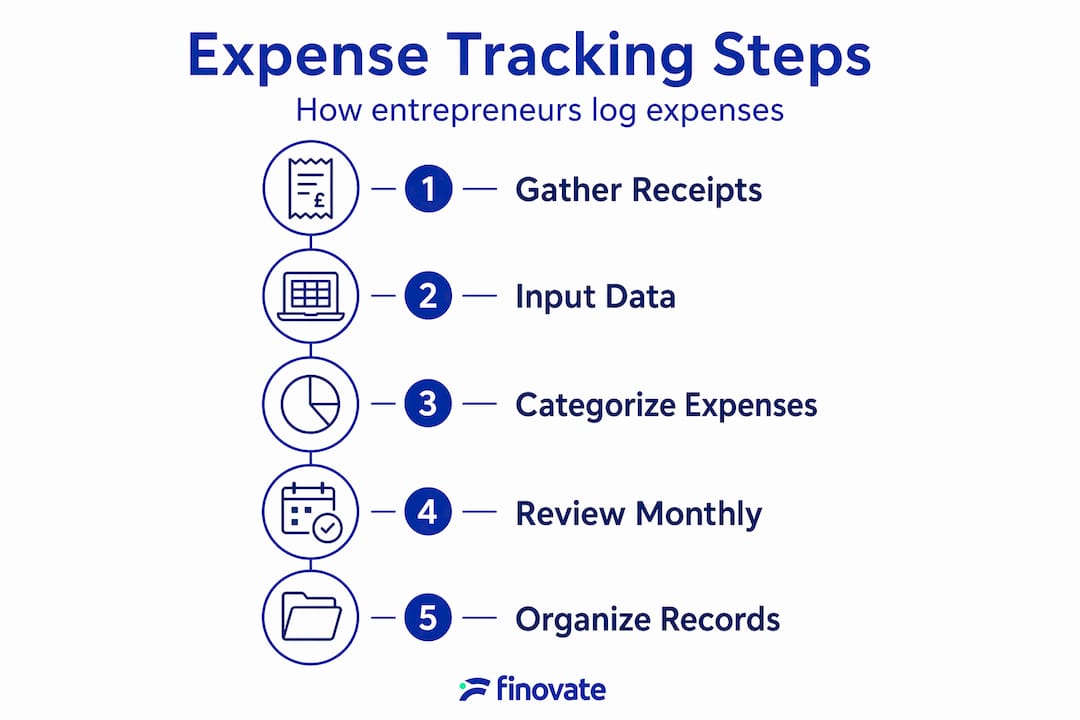
Tracking expenses is only half the work. The other half is using that data intelligently to reduce your tax liability and make better business decisions.
Generating financial reports
Most accounting software and expense tools can produce spending reports by category, time period, or project. Reviewing these reports quarterly helps you spot which cost areas are growing unexpectedly and where you can reduce spending without affecting operations.
| Report type | What it shows | How often to review |
|---|---|---|
| Expense by category | Where money is going across each cost type | Monthly |
| Profit and loss summary | Income versus total expenses for the period | Monthly |
| Tax deduction summary | All deductible costs grouped by tax line | Quarterly |
| Year-on-year comparison | Spending trends versus the previous year | Annually |
Tax compliance and documentation
Organised expense records are the foundation of an accurate tax return. Understanding deductible expenses in Finland and mapping your tracked costs to the correct tax categories reduces errors and maximises your legitimate deductions. When records are already categorised and reconciled, tax preparation becomes a matter of hours rather than days.
For documentation retention, you should keep receipts for seven years to cover tax audits, complex cases, and any potential late filing scenarios. Digital copies are acceptable provided they are clearly readable.
The benefits of well-maintained records extend beyond tax filing:
- You can respond to any tax authority query quickly and confidently
- You have clear evidence to support every deduction you claim
- You can identify unprofitable projects or clients based on actual cost data
- Your financial statements are reliable enough to support loan applications or investor conversations
For a detailed walkthrough of tax preparation steps, the Finovate guide on tax preparation for Finnish businesses covers the documentation requirements and timelines you need to follow.
My honest take on expense tracking discipline
I have worked with many entrepreneurs over the years, and the pattern I see repeatedly is this: the business owners who struggle most with expense tracking are not disorganised people. They are busy people who believed they would sort it out later. Later rarely comes at a convenient time.
What I have learned is that a consistent system, even an imperfect one, outperforms a theoretically perfect system that nobody maintains. I have seen businesses using a simple spreadsheet with a daily five-minute update outperform businesses using sophisticated software that only gets opened in a panic before the tax deadline.
The habit matters more than the tool. Pick a method you will actually use every day. If that means a notes app on your phone rather than a premium subscription you resent opening, use the notes app. Upgrade when the volume genuinely demands it.
I have also found that the entrepreneurs who build expense tracking into their weekly routine, rather than treating it as an accounting task, develop a completely different relationship with their business finances. They start making real-time decisions based on actual data. They know their margins. They spot problems months before those problems become crises.
The upfront effort of building the system is about two to three hours. The ongoing maintenance is minutes per day. The long-term return, in tax savings, reduced stress, and better decisions, is genuinely significant.
— Busayo
How Finovate can support your expense management
Knowing how to track expenses is the first step. Having the right professional support in place is what turns that knowledge into a system that works month after month without slipping.
At Finovate, we provide accounting and bookkeeping services designed specifically for entrepreneurs and small businesses in Finland. Our bookkeeping service keeps your expense records accurate, categorised, and audit-ready throughout the year, not just at tax time. For businesses that also need invoicing support, our monthly invoicing service connects your income and expense tracking in one place, giving you a cleaner financial picture with less administrative effort. Whether you need help setting up your initial tracking system or want ongoing professional support, our team is ready to help you build something that actually works for your business.
FAQ
What is the best way to track business expenses?
The most reliable approach is to record expenses immediately using a dedicated expense tracking app or accounting software, categorise each cost at the point of entry, and reconcile your records against bank statements every month.
How long should I keep business receipts?
You should retain receipts and supporting documentation for seven years to cover tax audits, complex cases, and late filing scenarios. Digital copies are acceptable provided they remain clearly readable.
Can I claim expenses without a receipt?
For smaller purchases, tax authorities may accept bank statements with notes as supporting documentation, but this varies. The safest approach is to retain receipts for all business expenses, digital or physical.
How do I avoid mixing personal and business expenses?
Open a separate business bank account and use it exclusively for business transactions. This single step eliminates the confusion that arises from mixed accounts and makes your records far cleaner for tax purposes.
What happens if I misclassify business expenses?
Misclassifying expenses into vague or incorrect categories increases your audit risk, may result in disallowed deductions, and complicates your financial reporting. Consistent, accurate categorisation from the outset is far easier than correcting errors later.