

TL;DR:
- Finnish SMEs must implement structured bookkeeping, compliant e-invoicing, and timely statutory reporting to ensure legal compliance and avoid penalties.
- Using appropriate software and establishing regular workflows help prevent errors, late filings, and audit risks while maintaining efficient financial management.
SME accounting procedures are the structured systems and processes that small and medium enterprises use to manage financial records, invoicing, and statutory reporting accurately and on time. For Finnish business owners, getting these procedures right is not optional. The Finnish Patent and Registration Office (PRH) enforces filing deadlines, the Tax Administration monitors VAT compliance, and public sector customers now expect structured e-invoices compliant with European Standard EN16931. Poor procedures lead to late filing fees, rejected invoices, and disrupted cash flow. This guide covers what you need to know in 2026.
What are the core SME accounting procedures Finnish businesses must implement?
Sound accounting processes for SMEs begin with consistent bookkeeping. Every financial transaction must be recorded promptly, categorised correctly, and reconciled against bank statements at least monthly. This is not simply good practice. It is a legal obligation under Finnish accounting law, and it forms the foundation for every other financial procedure your business depends on.
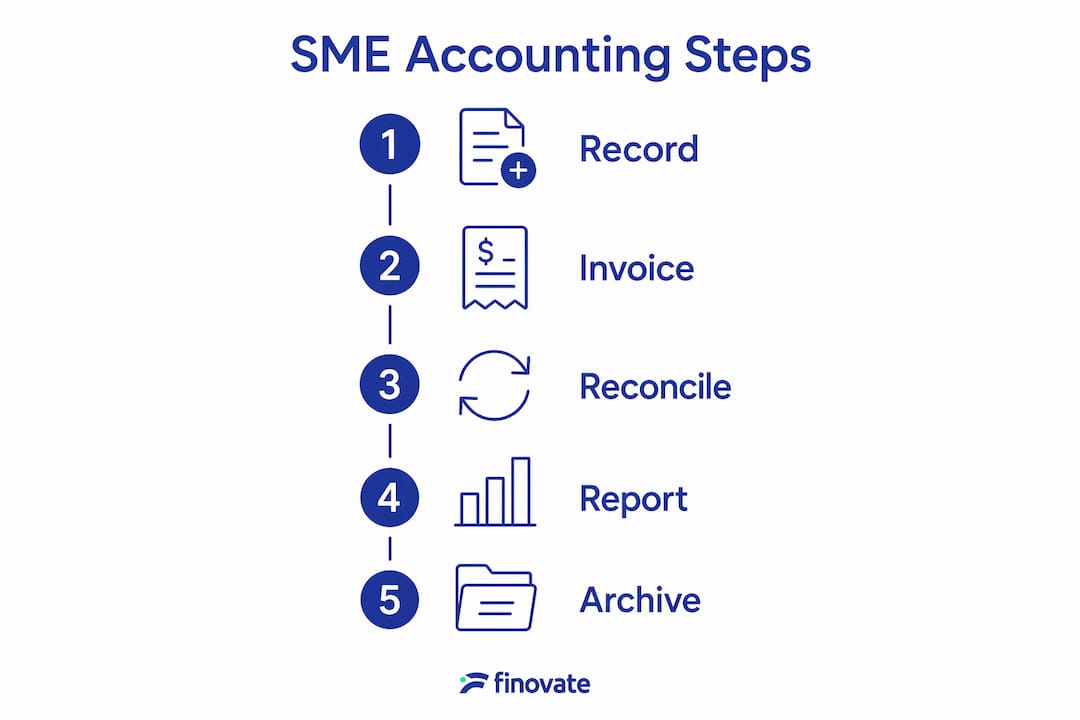
The core procedures every Finnish SME should have in place include:
- Transaction recording: Log every income and expense entry with the correct date, amount, and category. Use accounting software that supports Finnish VAT codes to reduce manual errors.
- Invoice management: Issue invoices that meet statutory content requirements, including your VAT identification number, order or contract references, and correct VAT rates.
- Monthly closing: Reconcile accounts, review outstanding receivables, and confirm payroll entries at the end of each month. This prevents year-end bottlenecks.
- Statutory reporting: Submit VAT returns on time, file income tax declarations, and register annual financial statements with PRH within the required deadlines.
- Document archiving: Retain all financial records, including original structured invoice files, for the statutory retention period.
Accounting software is central to all of these steps. Platforms that support Finvoice and TEAPPSXML formats, and that integrate directly with the Tax Administration's filing portals, reduce manual work and the risk of errors significantly. You can find a practical overview of Finnish accounting rules to complement these fundamentals.
Pro Tip: Set up a recurring calendar reminder for the 12th of each month to complete your previous month's reconciliation. Monthly discipline removes the pressure of a frantic year-end close.
How can SMEs in Finland manage invoicing to meet regulatory requirements?
Invoicing is where many Finnish SMEs encounter their first compliance problem. 73% of invoices to Finnish state entities now meet the EU EN16931 standard, which means the bar for public sector invoicing is already high. If your business supplies goods or services to government bodies, a PDF invoice sent by email will be rejected outright.
Here is a step-by-step approach to compliant invoicing for Finnish SMEs:
- Choose a compliant format. Use Finvoice 3.0, TEAPPSXML, or Peppol BIS Billing 3.0. These are the formats accepted by Finnish public sector buyers and increasingly required by large private sector customers.
- Include all mandatory data fields. Every invoice must carry your business ID, VAT number, the buyer's order or contract number, a posting reference, invoice date, payment terms, and itemised VAT amounts.
- Send through an approved channel. Use an e-invoicing operator or the free Handi Supplier Portal if you do not yet have integrated accounting software.
- Automate where possible. Structured e-invoicing enables automation of financial administration, cutting processing time and reducing the manual entry errors that cause payment delays.
- Archive original files. Save the original XML invoice file, not just a PDF copy. The Tax Administration requires access to original structured files during audits.
The table below summarises the main invoice formats used in Finland and their typical use cases:
| Format | Standard | Typical use case |
|---|---|---|
| Finvoice 3.0 | EN16931 compliant | Finnish domestic B2B and public sector |
| TEAPPSXML | Finnish national format | Large Finnish corporates and public buyers |
| Peppol BIS Billing 3.0 | EN16931 compliant | Cross-border EU invoicing and public procurement |
Pro Tip: Never convert a structured XML invoice to PDF before sending. An invoice lacking compliance will be rejected and require a corrected resubmission, delaying your payment by days or weeks.
What steps should Finnish SMEs take for statutory reporting and year-end compliance?
Statutory reporting is the area where procedural gaps become financially painful. Finnish private limited companies must file financial statements with PRH within 8 months of the financial year-end. Miss that window and the fees escalate quickly.
The late filing fee structure is tiered:
- 150 EUR if the filing is up to 2 months late
- 300 EUR if the filing is 2 to 4 months late
- 600 EUR if the filing is more than 4 months late or not filed at all
Since 2025, PRH enforcement has become noticeably stricter. PRH now sends formal notices before issuing fee decisions, which means you will receive a warning, but the fee follows swiftly if you do not act. Tens of thousands of Finnish companies have already faced this process.
Calendar-driven accounting is the single most effective way to avoid year-end bottlenecks and missed PRH filing deadlines. Monthly closing cycles keep your records accurate and your accountant prepared well before the statutory deadline arrives.
The practical steps to stay compliant are straightforward. Complete a month-end close every month without exception. Review your balance sheet quarterly to catch discrepancies early. Engage your accountant or bookkeeping service at least two months before your filing deadline to allow time for corrections. Looking ahead, Finnish legislation is moving towards fully digital financial statement filings by 2027 to 2028, so building digital-first habits now will serve you well. Our compliance tips for Finnish SMEs offer additional guidance on meeting these obligations.
Which tools and workflows best support accounting processes for SMEs in Finland?
The right tools make the difference between accounting that runs smoothly and accounting that creates problems. Finnish SMEs benefit most from software that handles e-invoicing, bookkeeping, VAT reporting, and payroll within a single integrated environment.

| Feature | What to look for | Why it matters |
|---|---|---|
| E-invoicing support | Finvoice 3.0, TEAPPSXML, Peppol BIS | Prevents invoice rejections from public sector buyers |
| VAT reporting | Direct integration with Tax Administration | Reduces manual filing errors and missed deadlines |
| Document archiving | Structured file retention for 6 to 10 years | Meets statutory requirements for Tax Administration audits |
| Payroll integration | Automated salary calculations and reporting | Keeps payroll aligned with bookkeeping records |
Beyond software, workflow discipline matters just as much. A monthly review cycle, where you reconcile accounts, approve outstanding invoices, and archive documents, removes the risk of year-end surprises. SME bookkeeping workflow strategies that include structured monthly closing steps are consistently more reliable than ad hoc approaches.
Archiving deserves particular attention. Original structured invoice files in Finvoice or TEAPPSXML format must be retained for 6 to 10 years and made accessible to the Tax Administration on request. Storing only PDF copies does not satisfy this requirement. This is a common oversight that creates audit risk.
Pro Tip: Integrate your invoicing software with your bookkeeping platform so that every sent invoice posts automatically to the correct ledger account. This eliminates double entry and keeps your data hygiene consistent from day one.
What common mistakes do Finnish SMEs make with accounting procedures?
The most frequent accounting errors Finnish SMEs make are not dramatic. They are small, repeated oversights that accumulate into serious compliance problems. Recognising them early is the most cost-effective form of financial management.
The most common pitfalls include:
- Inaccurate categorisation: Posting expenses to the wrong account distorts your profit and loss statement and creates discrepancies that are time-consuming to unwind during an audit.
- Missing invoice data fields: Omitting an order number or posting reference from an invoice sent to a public sector buyer will result in rejection. The correction process delays payment and damages your relationship with the buyer.
- Ignoring monthly closing: Businesses that skip monthly reconciliation often discover errors only at year-end, when fixing them requires significant time and professional fees.
- Late statutory filings: Late fees apply cumulatively for continuing violations, meaning a single missed deadline can result in multiple fee decisions if the filing remains outstanding.
- Retaining PDFs instead of XML files: As noted above, this creates audit exposure that many SMEs do not discover until it is too late.
The solution to most of these problems is a combination of good software and regular professional oversight. Internal staff can handle day-to-day bookkeeping entries, but a qualified accountant should review records quarterly and lead the year-end preparation. This division of responsibility keeps costs manageable while protecting you from the risks that come with purely self-managed accounting.
Pro Tip: Run a monthly three-way check: compare your bank statement, your accounts receivable ledger, and your issued invoices. Any gap between these three sources signals a recording error that needs attention before it compounds.
Key takeaways
Effective SME accounting procedures in Finland require consistent bookkeeping, compliant structured e-invoicing, and calendar-driven statutory reporting to avoid penalties and maintain financial accuracy.
| Point | Details |
|---|---|
| Structured e-invoicing is mandatory | Use Finvoice 3.0, TEAPPSXML, or Peppol BIS to avoid invoice rejections from public sector buyers. |
| PRH filing deadline is 8 months | File financial statements within 8 months of year-end or face tiered late fees up to 600 EUR. |
| Monthly closing prevents year-end problems | Reconcile accounts and review records every month to keep filings accurate and on schedule. |
| Archive original XML files | Retain structured invoice files for 6 to 10 years; PDF copies do not satisfy Tax Administration requirements. |
| Professional support reduces risk | Combining internal bookkeeping with quarterly accountant reviews protects against costly errors and missed deadlines. |
Why I believe most Finnish SMEs underestimate their accounting procedures
Working with Finnish SMEs, I have noticed a consistent pattern. Business owners invest heavily in their product or service, then treat accounting as an afterthought managed in a spreadsheet until something goes wrong. The PRH enforcement increase since 2025 has changed that calculation for many, but the lesson should not require a fee notice to land.
What strikes me most is how much structured e-invoicing has shifted the conversation. Before EN16931 compliance became a practical requirement for public sector contracts, invoicing was informal and flexible. Now, the format of your invoice directly affects whether you get paid. That is a meaningful change, and SMEs that have adopted compliant systems early are genuinely more efficient. Their invoice processing is faster, their records are cleaner, and their year-end preparation takes a fraction of the time.
My honest view is that the SMEs struggling most with accounting procedures are not struggling because the rules are complicated. They are struggling because they have not built accounting into their operational rhythm. A business that closes its books monthly, archives correctly, and files on time is not doing anything extraordinary. It is simply treating financial management as a core business function rather than an annual obligation. That mindset shift, more than any software choice, is what separates well-run SMEs from those that receive letters from PRH.
— Busayo
How Finovate supports Finnish SMEs with accounting and compliance
Running a business in Finland means managing bookkeeping, VAT, payroll, and statutory filings alongside everything else. Finovate provides Finnish SMEs with the full range of financial management services, from monthly bookkeeping and e-invoicing compliance to VAT management and payroll processing.
Our team understands Finnish statutory requirements, PRH deadlines, and the structured e-invoicing standards that matter for your business. Outsourcing your accounting procedures to Finovate reduces your administrative burden and gives you confidence that your records are accurate and your filings are on time. Whether you are a growing limited company or a light entrepreneur, we have a service package designed for your needs. Visit Finovate's accounting services to see how we can support your business in 2026.
FAQ
What are SME accounting procedures in Finland?
SME accounting procedures are the structured methods Finnish small and medium enterprises use to record transactions, manage invoicing, file VAT returns, and submit annual financial statements to PRH and the Tax Administration.
What happens if a Finnish company files its financial statements late?
Late filing fees are tiered: 150 EUR for up to 2 months late, 300 EUR for 2 to 4 months late, and 600 EUR for filings more than 4 months overdue or not submitted at all. PRH has actively enforced these fees since 2025.
Does Finland require structured e-invoicing for SMEs?
Structured e-invoicing compliant with EN16931 is required for invoicing Finnish public sector customers. Formats accepted include Finvoice 3.0, TEAPPSXML, and Peppol BIS Billing 3.0. PDF invoices sent by email do not meet this requirement.
How long must Finnish SMEs retain invoice records?
Original structured invoice files must be retained for 6 to 10 years and must be accessible to the Tax Administration on request. Retaining only PDF copies does not satisfy this statutory obligation.
Can a Finnish SME send invoices without accounting software?
Yes. The Finnish government's Handi Supplier Portal allows SMEs to produce and send compliant e-invoices to public sector buyers at no cost, making it a practical option for businesses that have not yet adopted integrated accounting software.