

TL;DR:
- Payroll errors are common among SMEs, leading to penalties and reputational damage.
- Using digital tools and early integrations helps ensure compliance and reduces errors.
- For cross-border employees, verifying permits and residency status is critical to avoid costly mistakes.
Payroll errors are far more common than most business owners realise. Research shows that 84% of SMEs experience payroll errors, and 40% face financial penalties as a direct result. For small and medium-sized businesses in Finland, the stakes are particularly high. Finnish payroll obligations are governed by strict reporting requirements, real-time data submission rules, and a complex web of employment legislation. This guide will walk you through the essentials of payroll processing in Finland, from understanding your basic legal obligations to managing cross-border employees, choosing the right tools, and avoiding the costly mistakes that catch so many SMEs off guard.
Table of Contents
- Understanding the basics of payroll processing in Finland
- Common payroll pitfalls and how to avoid them
- Choosing the right payroll methods: in-house, software, or outsourcing?
- Payroll complexities for international and cross-border employees
- Why automation and integration are the future of payroll for Finnish SMEs
- Streamline your payroll: professional solutions for Finnish SMEs
- Frequently asked questions
Key Takeaways
| Point | Details |
|---|---|
| Payroll compliance is critical | Failing to report or make errors can result in serious penalties for Finnish SMEs. |
| Automation reduces risk | Using payroll software or outsourcing decreases both errors and overall compliance costs. |
| Incomes Register rules apply broadly | Most employers must report earnings in real time, except casual payers below €1,500 per year per employee. |
| International hires need special attention | Proper documentation and classification are essential to avoid misclassification and compliance issues when hiring cross-border staff. |
| Integrated solutions offer long-term value | Combining payroll automation with industry-specific requirements helps SMEs stay ahead and remain compliant. |
Understanding the basics of payroll processing in Finland
Before you can manage payroll efficiently, you need a clear picture of what Finnish law actually requires from you as an employer. Many business owners underestimate the administrative detail involved, especially when they are hiring their first employees or transitioning from sole trader status to a registered employer.
Your core employer obligations
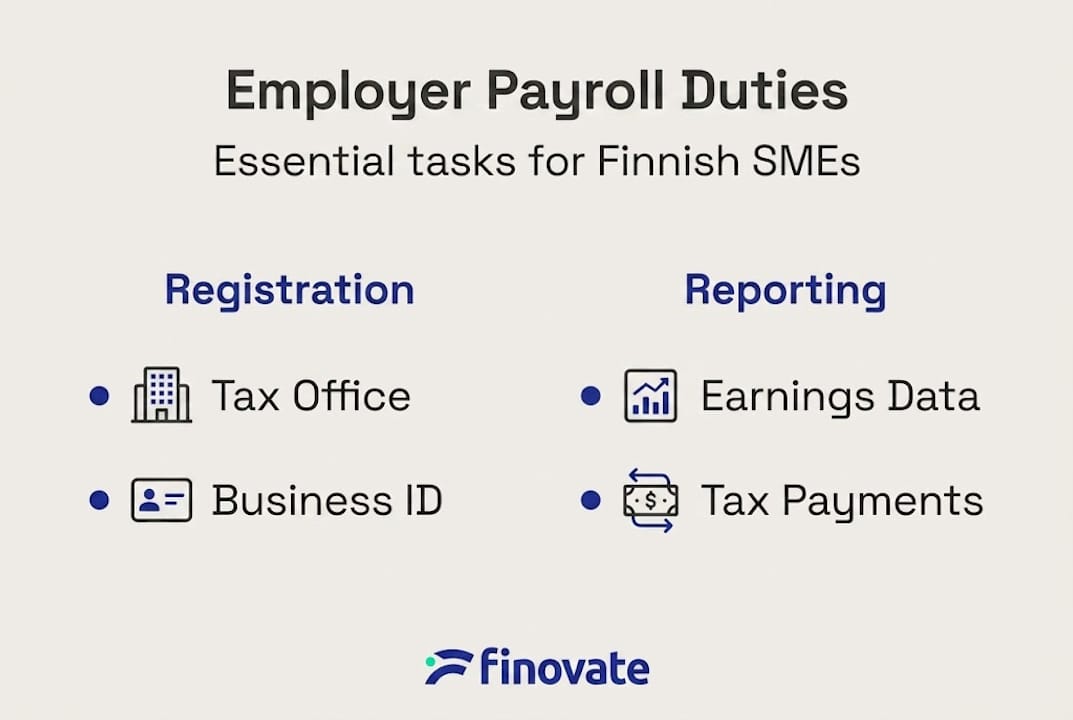
Every employer in Finland must register with the Finnish Tax Administration and, where applicable, with the Finnish Business Information System (YTJ). Once registered, your payroll obligations become ongoing and time-sensitive. The two most important reporting tools you will use are the Incomes Register and MyTax.
According to Finnish Tax Administration guidance, earnings payment reports must be submitted per payment date, while the employer's separate report is due monthly. Notably, even registered employers who have no wages to pay in a given month must still submit a "no wages payable" report. Casual employers, however, are exempt from this requirement if they pay less than €1,500 per year per employee.
Understanding the distinction between a casual employer and a registered employer is essential. If you pay wages to a single employee that exceed €1,500 in a calendar year, you automatically become a registered employer with full monthly reporting obligations. Many small businesses fall into penalties simply because they were unaware of this threshold.
Key terms you need to know
- Incomes Register: A national real-time database where all wage and salary data must be reported
- Earnings payment report: Submitted within five days of each wage payment
- Employer's separate report: A monthly summary covering employer contributions, submitted by the fifth day of the following month
- MyTax: The Finnish Tax Administration's online portal for managing tax and payroll submissions
- Palkka.fi: A free payroll calculation tool provided by the Finnish Tax Administration, particularly useful for smaller employers
Keeping up with payroll management strategies from the outset will save you significant time and reduce the risk of errors accumulating over time. It is also worth familiarising yourself with the broader accounting rules in Finland, as payroll sits at the intersection of employment law and financial reporting.
Pro Tip: If you are a small employer just starting out, Palkka.fi is a free, government-provided tool that calculates withholding taxes and employer contributions automatically. It feeds directly into the Incomes Register, reducing manual data entry and the risk of submission errors.
Good small business bookkeeping practices will also support your payroll process. When your bookkeeping is accurate and up to date, payroll reconciliation becomes far simpler and audit-ready at any point.
Common payroll pitfalls and how to avoid them
Understanding the rules is one thing. Consistently following them under the pressure of running a business is another challenge entirely. Finnish SMEs encounter a predictable set of payroll mistakes, and knowing what they are puts you in a much stronger position to avoid them.
The most frequent payroll errors
- Late submission of earnings payment reports. The five-day reporting window after each wage payment is strict. Missing it, even by a day, can trigger a late-filing penalty from the Finnish Tax Administration.
- Incorrect tax withholding rates. Applying the wrong withholding percentage, often because an employee's tax card has not been updated or requested, leads to underpayment or overpayment of tax. Both outcomes create administrative work and potential liability.
- Failing to submit the employer's separate report. Even when no wages are paid in a month, registered employers must still submit this report. Many owners forget this obligation during quiet trading periods.
- Misclassifying employment relationships. Treating an employee as a self-employed contractor, or vice versa, carries serious consequences. Misclassification affects pension contributions, holiday pay, and tax withholding obligations.
- Not updating employee information. When employees change their tax cards, addresses, or banking details, delays in updating payroll records create errors that can take months to untangle.
"84% of small and medium-sized businesses experience payroll errors, and 40% face financial penalties as a result. Manual payroll processes remain common among 31% of SMEs, and outsourcing costs can exceed £2,000 per month for businesses that delay action." SME payroll compliance challenges
These figures are striking. They confirm that payroll errors are not an edge case. They are a mainstream problem affecting the majority of SMEs. The financial and reputational cost of repeated errors compounds quickly. Penalties accumulate, employees lose confidence in the payroll process, and the time spent correcting mistakes diverts attention from core business activities.
How to reduce your risk
The most effective step you can take is to move away from manual processes. Spreadsheets and paper-based records leave too much room for human error. Digital payroll tools, whether standalone software or integrated accounting platforms, automate the calculations and submission timelines that cause the most problems.
Knowing how to avoid bookkeeping mistakes is directly relevant here, as payroll errors often originate from poor bookkeeping discipline. Reviewing payroll service examples from businesses similar to yours can also help you benchmark your current approach and identify gaps.
Choosing the right payroll methods: in-house, software, or outsourcing?
Once you understand the risks, the next practical question is how to structure your payroll process. There are three main routes available to Finnish SMEs, and the right choice depends on your business size, the complexity of your workforce, and your growth plans.
Comparing your options
| Method | Cost | Compliance reliability | Time investment | Best suited for |
|---|---|---|---|---|
| In-house manual | Low upfront | Low | High | Sole traders, 1 to 2 employees |
| Payroll software | Medium | High | Medium | 3 to 20 employees |
| Fully outsourced | Higher ongoing | Very high | Low | 10+ employees or complex payrolls |
In-house manual payroll
This approach works for very small businesses with one or two employees and straightforward pay structures. The main advantage is cost. You are not paying for software licences or professional fees. However, the compliance risk is significant. Manual processes rely entirely on the owner's knowledge of current rules, which change regularly. One missed update to employer contribution rates or a forgotten report can result in penalties that far exceed what professional support would have cost.
Payroll software
Software solutions automate the most error-prone steps: calculating withholding taxes, generating pay slips, and submitting reports to the Incomes Register. Many platforms integrate directly with MyTax and Palkka.fi, which means your submissions happen in real time without manual intervention. Global surveys confirm that outsourcing and software cut compliance costs and errors significantly for SMEs, even where Finland-specific benchmarks are limited.
Fully outsourced payroll
Outsourcing your payroll to a specialist firm removes the compliance burden from your team entirely. A qualified provider handles all reporting, tax withholding, and employer contributions on your behalf. This is particularly valuable if your payroll is complex, if you employ workers on different contract types, or if you are scaling quickly. The cost is higher than software alone, but the time savings and compliance assurance often justify the investment.
Pro Tip: Even if you plan to keep payroll in-house initially, set up your MyTax and Palkka.fi integrations from the start. Retrofitting these connections later, when your team is larger and your payroll more complex, is time-consuming and creates gaps in your reporting history.
The decision between hiring an accountant and managing payroll internally often comes down to the volume and complexity of your payroll. If you are unsure, consider the outsourcing bookkeeping benefits as a useful reference point for weighing cost against compliance assurance.
Key factors to consider when choosing
- Number of employees and contract types
- Frequency of wage payments (weekly, bi-weekly, monthly)
- Whether you employ seasonal or part-time workers
- Your internal capacity to stay current with Finnish payroll legislation
- Your plans for growth over the next 12 to 24 months
Payroll complexities for international and cross-border employees
Employing workers from outside Finland, or Finnish residents who work across borders, introduces a separate layer of compliance requirements. This is an area where errors are particularly costly, and where specialist advice is often essential.

Key documentation and compliance requirements
| Requirement | Details |
|---|---|
| Work permit | Required for non-EU employees before work begins |
| A1 certificate | Confirms which country's social security legislation applies |
| Tax residency status | Employees staying more than six months become resident taxpayers |
| PE (permanent establishment) status | Foreign employers may have reporting obligations if a PE exists in Finland |
Step-by-step compliance process for international employees
- Verify the work permit before the employee starts. Non-EU nationals require a valid permit, and employing someone without one carries serious legal consequences.
- Obtain the A1 certificate. This document, issued by the employee's home country, confirms that social security contributions are being paid there and prevents double contributions.
- Determine tax residency. Finnish Tax Administration guidance confirms that employees staying over six months become resident taxpayers, subject to Finnish income tax on their worldwide income.
- Assess permanent establishment risk. If a foreign employer has a fixed place of business in Finland, or if an employee habitually concludes contracts on the employer's behalf, a permanent establishment may exist. This triggers Finnish reporting and tax obligations for the foreign company.
- Register and report correctly. Foreign employers with a PE in Finland must register with the Finnish Tax Administration and submit payroll reports via the Incomes Register, just as domestic employers do.
The risk of misclassification
Misclassifying an employee as an independent contractor is one of the most expensive payroll mistakes a Finnish SME can make. The Finnish Tax Administration takes misclassification seriously. If an employment relationship is reclassified after the fact, the employer becomes liable for unpaid employer contributions, holiday pay, and potentially back taxes, all with interest and penalties added.
For tax tips for international staff and a broader view of your obligations, it is worth reviewing the relevant guidance alongside your tax compliance for cross-border payroll responsibilities. When in doubt, consult a specialist before you hire, not after a problem arises.
Why automation and integration are the future of payroll for Finnish SMEs
We work with Finnish SMEs across a wide range of industries, and we consistently observe the same pattern. Business owners invest in a payroll tool or hire a bookkeeper, but they stop short of full integration. They still manually transfer data between systems, still rely on reminders to submit reports, and still treat payroll as a separate function from their broader financial management. That approach is increasingly unsustainable.
The real competitive advantage in payroll does not come from simply switching from manual to digital. It comes from integrating payroll automation with real-time reporting tools and, crucially, with your industry's collective bargaining agreements (CBAs). CBAs govern pay rates, overtime rules, and holiday entitlements across many Finnish sectors. Failing to incorporate these into your payroll system means you are always one step behind, manually checking rates that should be applied automatically.
Finnish Tax Administration tools like MyTax and Palkka.fi are designed to support real-time reporting and reduce errors, but they work best when connected to your payroll workflow from the outset. SMEs that build these integrations early gain a structural advantage. Their payroll runs faster, their compliance record is cleaner, and their finance team spends less time on corrections.
Our view is that effective payroll management in 2026 is not about choosing the cheapest option. It is about building a system that scales with your business without requiring a costly overhaul every time you add five employees or enter a new employment category.
Pro Tip: Set up your payroll integrations from day one, even if you currently have only one or two employees. Retrofitting integrations later is expensive, time-consuming, and creates gaps in your compliance history that can attract scrutiny.
Streamline your payroll: professional solutions for Finnish SMEs
Managing payroll alone is one of the most time-consuming and risk-laden tasks a Finnish SME owner can take on. The reporting deadlines are tight, the rules change regularly, and the penalties for errors are real. You do not have to navigate this alone.
At Finovate, we provide accounting and payroll services tailored specifically to Finnish SMEs. Whether you need ongoing payroll processing, support with Incomes Register submissions, or a complete financial management solution, our team of accounting and payroll specialists is ready to help. We also offer invoicing solutions that integrate seamlessly with payroll, including our Invoicing Service Pro and Invoicing Service Monthly packages, giving you a holistic view of your business finances in one place. Get in touch today to find the right solution for your business.
Frequently asked questions
What is the Incomes Register, and why is it important for Finnish payroll?
The Incomes Register is a national real-time database where Finnish employers must report all wage and salary data promptly to remain compliant. Employers must submit an earnings payment report per payment date and a monthly employer's separate report, making it the central pillar of Finnish payroll compliance.
Are small or 'casual' employers exempt from payroll reporting obligations in Finland?
Casual employers paying under €1,500 per year per employee are generally exempt from Incomes Register reporting, but all registered employers, even those with no wages to pay in a given month, must still submit a monthly report.
What is the biggest payroll compliance risk for Finnish SMEs?
The primary risk is failing to report to the Incomes Register accurately or on time. Research confirms that 84% of SMEs face payroll errors and 40% face financial penalties, making timely and accurate reporting the single most important compliance priority.
How can Finnish SMEs lower payroll errors and compliance costs?
Adopting digital payroll tools or outsourcing to a specialist provider are the most effective steps. Evidence shows that outsourcing and software reduce both compliance costs and error rates significantly for SMEs, often paying for themselves through penalty avoidance alone.
What must Finnish businesses do when employing cross-border workers?
They must verify work permits and A1 certificates, and correctly determine tax residency status. Finnish Tax Administration guidance confirms that misclassification risks are high and that employees staying over six months in Finland become resident taxpayers subject to full Finnish income tax obligations.