

Managing payroll in Finland presents substantial challenges for small and medium-sized businesses due to complex regulations and strict deadlines. Payroll mistakes affect 10-15% of Finnish SMEs annually, leading to costly fines and compliance issues. This guide provides step-by-step instructions to streamline your payroll process, ensure regulatory compliance, and avoid expensive errors that can impact your business operations.
Table of Contents
- Payroll prerequisites and preparation
- Payroll compliance requirements in Finland
- Step-by-step payroll process guide
- Choosing and implementing payroll software
- Common payroll compliance mistakes and troubleshooting
- Payroll outsourcing considerations
- Expected outcomes and success metrics
- Streamline your payroll management with expert support
- Frequently asked questions
Key takeaways
| Point | Details |
|---|---|
| Essential prerequisites | Register as an employer with Finnish Tax Administration and collect valid employee tax cards before processing payroll. |
| Compliance obligations | Withhold income tax accurately, calculate 20-25% employer social security contributions, and remit payments monthly. |
| Process automation benefits | Payroll software reduces errors by up to 50% whilst saving significant processing time for small businesses. |
| Common mistakes | Outdated tax cards and late tax payments cause most compliance issues and penalties for Finnish SMEs. |
| Outsourcing considerations | Professional payroll services cost €50-150 monthly and reduce errors by approximately 30% for businesses lacking dedicated staff. |
Payroll prerequisites and preparation
Successful payroll management begins with proper preparation and documentation. Before processing your first payroll run, you must register as an employer with the Finnish Tax Administration. This registration establishes your legal obligation to withhold taxes and make social security contributions.
Collecting accurate employee information forms the foundation of compliant payroll processing. You need valid tax cards from each employee that specify their withholding percentages and any additional deduction requirements. Employee contracts must clearly detail salary amounts, payment schedules, and benefit arrangements. Bank account information must be verified to ensure timely salary payments without delays or errors.
Pro Tip: Create a standardised onboarding checklist requiring new employees to submit their tax card, signed contract, and bank details before their start date to prevent payment delays.
Understanding Finnish labour laws affecting payroll is essential for compliance:
- Minimum wage requirements vary by industry and collective agreements
- Working time regulations govern overtime calculations and compensation
- Holiday pay accrual rules determine annual leave entitlements
- Sick leave policies impact payroll processing during absences
- Notice period requirements affect final salary calculations
Verifying all employee data before processing payroll prevents costly mistakes. Double-check that tax card percentages match current rates and that salary amounts align with signed contracts. Incomplete or inaccurate information leads to payment errors, unhappy employees, and potential regulatory violations.
Our accounting products and monthly invoicing service help Finnish businesses maintain accurate financial records. For comprehensive support, explore our accounting for limited companies or browse our accounting blog posts for practical guidance. Get started with expert accounting services tailored to your business needs.
Payroll compliance requirements in Finland
Finnish payroll compliance demands strict adherence to tax withholding and social security obligations. Income tax withholding must match the percentages specified on each employee's tax card exactly. Tax cards change when employees update their personal circumstances, so maintaining current copies is critical for accurate withholding.

Employer social security contributions represent a significant payroll cost, typically ranging between 20-25% of gross salaries. These contributions fund pension insurance, health insurance, unemployment insurance, and other statutory programmes. Calculating these amounts correctly ensures compliance whilst avoiding underpayment penalties or overpayment losses.
Remittance deadlines require monthly payments to tax authorities by specific dates. Missing these deadlines triggers late payment penalties and interest charges that accumulate quickly. Setting up automated payment schedules prevents missed deadlines and maintains good standing with tax authorities.
Key compliance requirements:
- Submit employer-specific income tax reports monthly or quarterly depending on business size
- File annual tax reconciliation statements by 31 January following the tax year
- Provide employees with annual salary and tax statements by the end of January
- Maintain payroll documentation for six years to satisfy audit requirements
- Update employee records immediately when tax cards or personal details change
Recordkeeping obligations extend beyond basic payment records. You must retain copies of tax cards, employment contracts, salary calculations, tax remittance receipts, and social security contribution records. These documents prove compliance during tax audits and resolve any disputes about payments or withholding.
Finnish labour laws govern minimum wage compliance, working time limits, and holiday pay calculations. Industry-specific collective agreements often impose additional requirements that supersede general labour law provisions. Understanding which collective agreement applies to your business ensures proper salary calculations and benefit provisions.
Explore our payroll compliance tools and read our tax tips for entrepreneurs for detailed guidance on meeting regulatory obligations efficiently.
Step-by-step payroll process guide
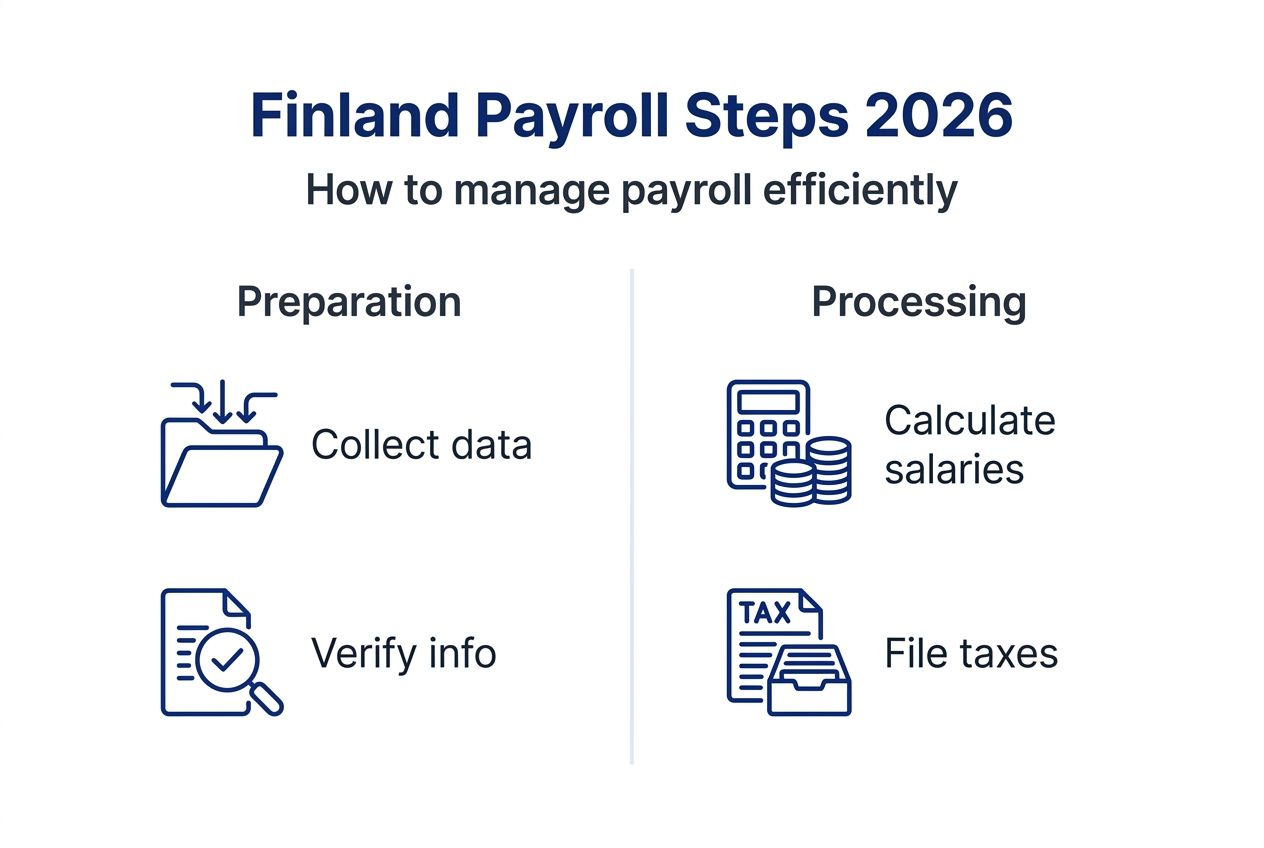
Executing payroll correctly requires following a systematic process each pay period. This structured approach minimises errors and ensures timely, accurate payments to employees and tax authorities.
- Collect current employee data by verifying that tax cards, salary rates, and bank details remain accurate and up to date for all staff members.
- Calculate gross pay based on employment contracts, accounting for regular salaries, overtime hours, bonuses, and any agreed allowances or benefits.
- Compute statutory deductions including income tax withholding according to tax card percentages and employee social security contributions where applicable.
- Determine employer contributions by calculating social security payments, pension insurance, and other mandatory employer costs based on gross salaries.
- Process net salary payments by transferring funds to employee bank accounts on the agreed payment date without delays or errors.
- Submit tax reports by filing monthly or quarterly employer income tax declarations with the Tax Administration before deadlines.
- Remit tax payments by transferring withheld taxes and employer contributions to authorities by the specified due dates.
- Update payroll records by documenting all calculations, payments, and filings in your accounting system for audit trail purposes.
Pro Tip: Process payroll three business days before the payment date to allow time for bank transfers and resolve any issues before employees expect their salaries.
Maintaining detailed payroll records supports compliance and simplifies year-end reporting. Your documentation should include:
| Record Type | Retention Period | Purpose |
|---|---|---|
| Tax cards | 6 years | Verify withholding calculations |
| Salary calculations | 6 years | Support audit requests |
| Payment receipts | 6 years | Prove salary and tax payments |
| Tax reports | 6 years | Demonstrate filing compliance |
| Employment contracts | 6 years after termination | Validate salary agreements |
Automating payroll calculations reduces human error and saves substantial processing time. Even small businesses benefit from basic payroll software that handles tax calculations and generates required reports automatically.
Discover helpful resources in our payroll process articles and consider our monthly invoicing service for streamlined financial management. We also offer online store setup services for businesses expanding their operations.
Choosing and implementing payroll software
Payroll software transforms manual calculations into automated processes that reduce errors and save time. Finnish SMEs have several robust options designed specifically for local compliance requirements and tax regulations.
Popular Finnish payroll software solutions include Procountor, Netvisor, and Fennoa, each offering features tailored to different business sizes and needs. These platforms automate tax calculations, generate required reports, and maintain audit trails automatically.
Selection criteria for payroll software:
- Finnish compliance features including automatic tax calculations and regulatory updates
- Integration capabilities with existing accounting systems and banking platforms
- User interface simplicity for staff without extensive payroll expertise
- Cost structure matching your business size and processing volume
- Customer support quality and availability in Finnish or English
- Scalability to accommodate business growth and additional employees
| Approach | Monthly Cost | Error Rate | Time Required | Best For |
|---|---|---|---|---|
| Manual processing | €0 | High | 4-6 hours | Micro businesses (1-3 employees) |
| Payroll software | €30-100 | Low | 1-2 hours | Small businesses (4-20 employees) |
| Full outsourcing | €50-150 | Very low | 30 minutes | Businesses prioritising compliance |
Pro Tip: Request free trials from multiple payroll software providers and process one month's payroll in each system before committing to ensure the interface suits your workflow.
Implementing new payroll software requires careful planning and staff training. Start by migrating employee data carefully, verifying that all information transfers correctly. Run parallel payroll calculations for the first month, comparing software output against manual calculations to confirm accuracy.
Automation benefits extend beyond error reduction. Software maintains complete audit trails automatically, generates employee payslips instantly, and produces tax reports in the correct format for authorities. These features save hours of administrative work each month.
Explore our accounting and payroll software solutions or discover our software for limited companies. Learn about Odoo payroll integration for comprehensive business management.
Common payroll compliance mistakes and troubleshooting
Payroll errors create costly problems for Finnish SMEs, from regulatory penalties to employee dissatisfaction. Understanding common mistakes helps you implement preventive measures and troubleshooting strategies.
Incorrect or outdated tax cards cause the most frequent payroll errors. When employees fail to provide updated tax cards after life changes like marriage or additional income sources, withholding calculations become inaccurate. This leads to underpayment or overpayment of taxes, requiring corrections and potentially causing employee tax bills at year end.
Approximately 20% of payroll runs incur errors due to outdated employee data, causing delays and inaccuracies that frustrate staff and increase administrative burden.
Late payment of taxes triggers penalties and interest charges that accumulate quickly. Missing monthly remittance deadlines by even one day results in penalty fees that reduce your business profitability unnecessarily. Setting up automated payment schedules eliminates this risk entirely.
Common mistakes and solutions:
- Outdated employee information: Implement quarterly data verification reviews requiring employees to confirm current details
- Incorrect social security calculations: Use verified payroll software that updates contribution rates automatically when regulations change
- Missing payment deadlines: Schedule tax remittances one week before due dates to accommodate banking delays
- Insufficient documentation: Create digital filing systems that automatically store payroll records for the required six years
- Misclassified workers: Clarify employment status with legal advice to avoid treating employees as contractors incorrectly
Failure to update employee data promptly impacts payroll accuracy significantly. When staff members change addresses, bank accounts, or tax circumstances without informing payroll administrators, payments fail or withholding becomes incorrect. Requiring immediate notification of changes prevents these issues.
Problems from insufficient documentation retention become apparent only during tax audits. When authorities request historical payroll records and you cannot produce them, penalties apply even if original calculations were correct. Maintaining organised digital archives satisfies retention requirements effortlessly.
Regular data updates, scheduled payments, and software usage solve most payroll problems before they occur. Investing time in preventive measures costs far less than fixing compliance violations after the fact.
Read our tax tips for Finnish entrepreneurs for additional guidance on avoiding common mistakes.
Payroll outsourcing considerations
Outsourcing payroll transfers responsibility to specialist providers who handle all calculations, filings, and payments on your behalf. This approach suits businesses without dedicated payroll expertise or those prioritising compliance assurance over direct control.
Outsourcing costs typically range between €50-150 monthly for small and medium-sized Finnish businesses. This investment covers all payroll processing, tax filing, and regulatory compliance activities. Whilst higher than software costs, outsourcing eliminates the need for internal payroll expertise and reduces error risks substantially.
Professional payroll services reduce errors by approximately 30% compared to manual in-house processing. Providers specialise in Finnish tax regulations and update their systems immediately when laws change, ensuring continuous compliance without requiring your attention.
Outsourcing advantages:
- Compliance expertise from professionals who specialise in Finnish payroll regulations
- Time savings allowing business owners to focus on core operations instead of administrative tasks
- Error reduction through systematic processes and quality controls
- Regulatory updates handled automatically without internal training requirements
- Audit support from providers who maintain documentation and assist during tax reviews
| Feature | In-House Software | Outsourcing | Manual Processing |
|---|---|---|---|
| Monthly cost | €30-100 | €50-150 | €0 |
| Internal time | 1-2 hours | 30 minutes | 4-6 hours |
| Compliance risk | Low | Very low | High |
| Control level | High | Medium | High |
| Scalability | Good | Excellent | Poor |
Potential drawbacks include reduced direct control over payroll timing and processes. Some businesses prefer handling payroll internally to maintain immediate access to data and complete oversight of employee payments. Communication delays occasionally occur when working with external providers, though reputable services minimise these issues.
Outsourcing suits very small businesses with limited payroll expertise particularly well. When you have fewer than ten employees and lack accounting staff, outsourcing provides professional payroll management without hiring specialists. Businesses experiencing rapid growth also benefit from outsourcing's scalability.
Less control and possible communication delays represent the main concerns. You depend on the provider's schedule for processing payroll and must coordinate employee changes through their systems rather than making immediate updates yourself.
Explore our payroll outsourcing services to discover how professional support can simplify your payroll management whilst ensuring compliance.
Expected outcomes and success metrics
Implementing effective payroll management delivers measurable improvements across multiple business areas. Tracking specific metrics helps you evaluate success and identify areas requiring additional attention.
Significant reduction in payroll errors and fines represents the most immediate benefit. Businesses transitioning from manual processes to software or outsourcing typically see error rates drop by 50% or more within the first quarter. This reduction directly decreases penalty payments and employee payment corrections.
On-time monthly tax submissions become consistent when you implement systematic payroll processes. Meeting every deadline eliminates late payment penalties and maintains good standing with tax authorities. This reliability also improves your business reputation and reduces stress around compliance obligations.
Key success indicators:
- Zero late payment penalties for tax remittances over consecutive quarters
- Error rate below 2% measured by payment corrections required
- Processing time reduced by 60% compared to previous manual methods
- Employee satisfaction scores improving due to consistent, accurate payments
- Audit readiness demonstrated by complete documentation for six-year retention period
- Tax filing accuracy confirmed by absence of correction requests from authorities
Time savings of up to 60% through automation or outsourcing free business owners to focus on growth activities instead of administrative tasks. Hours previously spent on manual calculations, tax research, and form completion become available for customer service, product development, or strategic planning.
Better accuracy in employee payments improves staff satisfaction and retention. When employees receive correct salaries on predictable schedules without errors requiring correction, their trust in your business operations increases. This reliability contributes to positive workplace culture and reduces turnover.
Legal compliance through thorough recordkeeping for six years protects your business during tax audits. Maintaining organised documentation proves your calculations, withholding, and payments meet regulatory requirements. This preparation transforms audits from stressful events into straightforward verification processes.
Discover more about achieving these outcomes through our accounting success metrics resources and expert guidance.
Streamline your payroll management with expert support
Managing payroll effectively requires expertise, time, and attention to constantly changing regulations. Finovate offers tailored accounting, tax, and payroll services designed specifically for Finnish small and medium-sized businesses seeking reliable, compliant solutions.
Our professional support eliminates payroll complexity whilst ensuring accuracy and regulatory compliance. Whether you need comprehensive payroll processing, bookkeeping assistance, or specialised invoicing services, our experienced team handles the details so you can focus on growing your business.
Explore our range of services including monthly invoicing, bookkeeping, and complete payroll management tailored to your specific needs. We help Finnish businesses save time, reduce errors, and maintain compliance effortlessly through expert support and modern tools.
Discover how expert accounting & tax services simplify your financial management. Try our monthly invoicing service or upgrade to professional invoicing solutions for comprehensive support.
Frequently asked questions
How can I ensure payroll compliance with Finnish tax regulations?
Ensure payroll compliance by collecting valid tax cards from all employees and updating them immediately when circumstances change. Withhold income tax according to tax card percentages exactly and calculate employer social security contributions accurately. Submit monthly tax reports by deadlines and remit payments promptly to avoid penalties. Maintain comprehensive payroll documentation for six years to satisfy audit requirements and demonstrate regulatory adherence.
What are the benefits of using payroll software for a small Finnish business?
Payroll software reduces processing errors by up to 50% through automated calculations that eliminate manual mistakes. The software updates tax rates automatically when regulations change, ensuring continuous compliance without manual research. Processing time decreases by 60% compared to manual methods, freeing hours for business development activities. Automatic recordkeeping maintains audit trails effortlessly, satisfying six-year documentation retention requirements without additional administrative burden.
When should a Finnish SME consider outsourcing payroll?
Outsourcing suits businesses with fewer than ten employees who lack dedicated payroll expertise or accounting staff. Companies experiencing rapid growth benefit from outsourcing's scalability without hiring additional internal resources. Outsourcing costs between €50-150 monthly whilst reducing errors by approximately 30% and ensuring continuous regulatory compliance. The approach trades some direct control for professional expertise, making it ideal when compliance assurance outweighs the need for immediate internal oversight.
How often must I submit payroll tax reports in Finland?
Most Finnish employers submit monthly payroll tax reports to the Tax Administration, though very small businesses may qualify for quarterly filing. Monthly reports typically require submission by the 12th day following the month being reported. Annual reconciliation statements consolidate the year's payroll activity and require filing by 31 January of the following year. Missing these deadlines triggers late filing penalties and interest charges that accumulate quickly.
What records must I maintain for payroll compliance?
Maintain all payroll records for six years following the relevant tax year to satisfy Finnish legal requirements. Essential documents include employee tax cards, employment contracts, salary calculations, payment receipts, and tax remittance confirmations. Social security contribution records and employer-specific income tax reports also require six-year retention. Organised digital archives simplify compliance whilst ensuring audit readiness and protecting your business during tax authority reviews.