
TL;DR:
- Finnish small businesses benefit from clear guidance and digital tools that simplify tax compliance and planning. They must manage corporate income tax, self-employment income tax, and VAT, with specific rates and registration requirements depending on turnover and business structure. Staying organized, utilizing flexible filing options, and working with professionals help optimize deductions and ensure timely, accurate submissions.
Finnish tax rules for small businesses are far more manageable than most owners expect. The Finnish Tax Administration has invested heavily in digital tools and clear guidance, meaning that with the right knowledge, you can stay compliant and plan effectively without drowning in paperwork. This guide walks you through the core tax categories, VAT obligations, critical deadlines, and deductions available to Finnish small businesses. By the end, you will have a clear picture of what you owe, when you owe it, and how to keep more of what you earn.
Table of Contents
- Key business tax types in Finland
- Understanding VAT: rates, registration and filing
- Deadlines, returns and electronic filing
- Deductions and optimising business expenses
- Our perspective: what most guides miss about Finnish business tax
- Get expert support for your business taxes
- Frequently asked questions
Key Takeaways
| Point | Details |
|---|---|
| Corporate tax clarity | Finnish limited companies pay a 20% corporate income tax on taxable profits. |
| VAT basics | You must register for VAT if business turnover exceeds €20,000 annually under EU SME rules. |
| Deadlines and filing | Know key dates: Companies file returns four months after their period, self-employed by April 1, mostly via MyTax. |
| Maximise deductions | Deduct business-purpose expenses and carried losses; keep records for interest limits and compliance. |
| Digital compliance advantages | Filing electronically in Finland streamlines tax reporting and minimises risks for small businesses. |
Key business tax types in Finland
Finland operates three main tax categories that affect small businesses: corporate income tax, self-employed (private trader) income tax, and value added tax (VAT). Understanding how each one applies to your business structure is the starting point for sound tax planning.
Corporate income tax (CIT) applies to limited liability companies (Oy). The corporate income tax rate for limited liability companies in Finland is 20% on taxable profit. This flat rate is competitive by European standards and makes financial forecasting relatively straightforward for Oy owners.
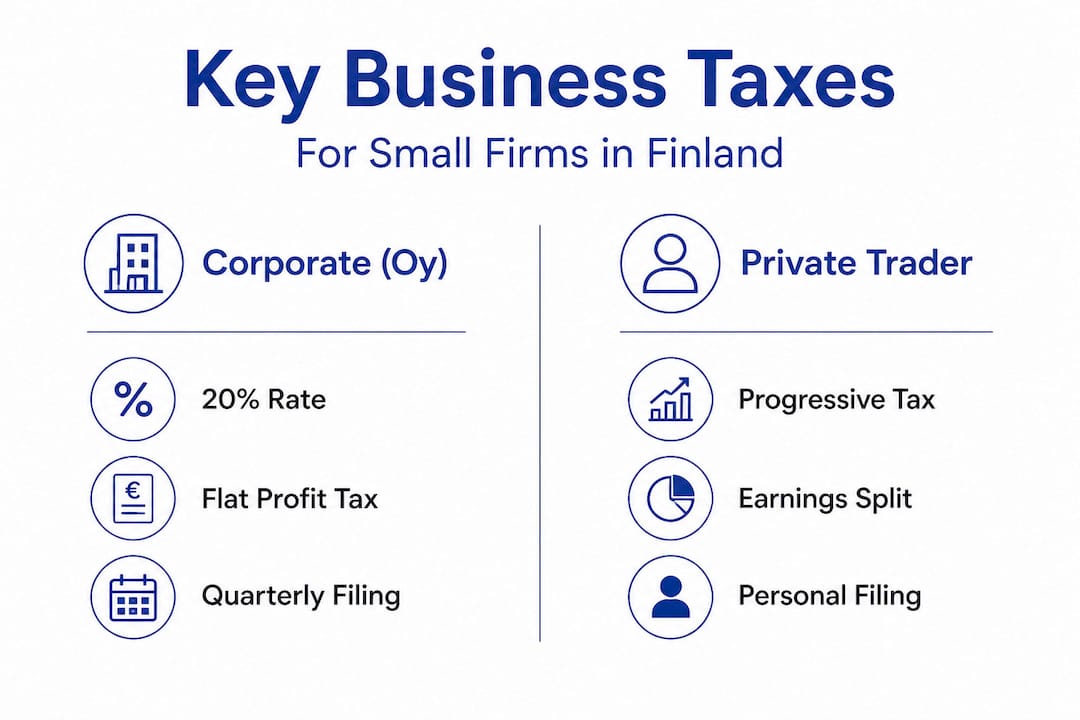
Self-employed individuals face a different structure. Business income for private traders in Finland is divided into earned income, which is taxed at progressive rates, and capital income, which is taxed at 30% up to €30,000 and 34% above that threshold. This split means your effective tax rate depends significantly on how much of your business income is classified as capital income versus earned income, which is worth planning carefully each year.
VAT is a consumption tax collected on behalf of the state. The VAT standard rate in Finland is 25.5%, with reduced rates of 14% and 10%, and certain zero-rated and exempt categories also apply. Knowing which rate applies to your goods or services is essential before you set your prices.
If you are still deciding on your business structure, reviewing the process for registering as a private trader can help you understand the implications before you commit. It is also worth reading up on essential tax tips to build good habits from day one.
Tax type comparison
| Tax type | Who pays | Rate | Key feature |
|---|---|---|---|
| Corporate income tax | Limited liability companies (Oy) | 20% flat rate | Applied to taxable profit |
| Earned income tax | Self-employed (private traders) | Progressive rates | Based on municipal and state scales |
| Capital income tax | Self-employed (private traders) | 30% / 34% | 34% applies above €30,000 |
| VAT | Businesses above €20,000 turnover | 25.5% / 14% / 10% | Collected and remitted to Tax Administration |
Key points to remember about Finnish business tax types:
- Limited companies pay a flat 20% CIT on profits, making tax liability predictable
- Private traders must actively manage the earned/capital income split to optimise their tax position
- VAT is separate from income tax and requires its own registration, filing, and record-keeping
- Some businesses are subject to all three categories simultaneously
Understanding VAT: rates, registration and filing
VAT is one of the most operationally demanding tax obligations for small businesses. Getting it right from the start saves you from costly corrections and potential penalties later.

Finland's VAT system uses three main rates. The standard VAT rate of 25.5% applies to most goods and services. The 14% reduced rate covers food, animal feed, restaurant services, and certain other categories. The 10% rate applies to items such as books, medicine, passenger transport, and accommodation. Some supplies, including healthcare, educational services, and financial services, are exempt from VAT entirely.
VAT registration threshold
VAT registration is required when your annual turnover exceeds €20,000. Under the EU SME scheme introduced in 2025, businesses whose turnover remains below €20,000 in both the current and prior year are exempt. This threshold gives genuine flexibility to micro-businesses and sole traders who are still building their client base.
VAT filing frequencies
| Annual turnover | Filing frequency |
|---|---|
| Up to €30,000 | Annual filing option available |
| €30,001 to €100,000 | Quarterly filing option available |
| Above €100,000 | Monthly filing required |
How to register for VAT in Finland
- Confirm that your turnover exceeds €20,000 or that voluntary registration is appropriate for your situation
- Log in to the MyTax portal (OmaVero) at vero.fi using your online banking credentials or mobile certificate
- Complete the business registration form (Y-form) or submit a change notification if already registered
- Specify the VAT filing period that matches your turnover level
- Receive your VAT registration confirmation and begin issuing VAT-compliant invoices
For a detailed walkthrough of the process, our VAT registration guide covers each step clearly. You should also review VAT compliance essentials to understand ongoing obligations once registered. Keeping accurate records from day one is critical, and our guidance on bookkeeping for VAT explains how to structure your records correctly.
Pro Tip: Even if your turnover is below €20,000, voluntary VAT registration can benefit you if your clients are VAT-registered businesses. You can reclaim input VAT on your purchases, which reduces your costs. This is particularly valuable if you invest in equipment, software, or professional services.
Deadlines, returns and electronic filing
Missing a tax deadline in Finland triggers late filing penalties and interest charges. The good news is that the Finnish Tax Administration has made digital filing straightforward, and once you know the key dates, staying on track is manageable.
Core filing deadlines
The tax return for limited companies is due four months after the end of the accounting period. So if your financial year ends on 31 December, your return is due by 30 April. Self-employed individuals using Form 5 must submit by 1 April each year, regardless of when their business income was earned.
VAT deadlines are tied to your chosen filing period:
- Monthly filers: Return and payment due by the 12th of the following month
- Quarterly filers: Return and payment due by the 12th of the month following the quarter end
- Annual filers: Return due by the end of February in the following year
Steps to stay compliant with filing deadlines
- Note your accounting period end date and calculate your return due date immediately
- Set calendar reminders at least four weeks before each deadline
- Gather all income, expense, and VAT records well in advance of filing
- Log in to MyTax and complete the relevant return form online
- Submit and pay any tax due by the stated deadline to avoid interest charges
- Keep confirmation receipts from each submission for your records
Filing electronically via MyTax is increasingly the norm in Finland, and the portal is designed to guide you through each step clearly. Paper filing is still technically possible but is now the exception rather than the rule.
Important points about filing obligations:
- Even if your business had no activity during the year, you must still submit a return showing no activities
- Inactive businesses that fail to file can receive automatic penalty assessments
- MyTax stores your previous returns, making year-on-year comparisons straightforward
- If you use an accounting firm, they can file on your behalf using a power of attorney
Pro Tip: Set up digital calendar reminders for every tax deadline at the start of each financial year. Include both the filing date and a preparation date two to three weeks earlier. This gives you time to resolve any discrepancies without rushing. You can find a summary of key dates on our tax filing schedules page.
Deductions and optimising business expenses
Reducing your taxable income through legitimate deductions is one of the most effective ways to manage your tax bill. Finnish tax law allows a broad range of business expenses, provided they are genuinely incurred for business purposes and properly documented.
What you can deduct
Deductible expenses include all costs incurred for business purposes. Losses can be carried forward for up to ten years and offset against future profits. Interest deductions are subject to limits: you can deduct up to €500,000 in full, plus 25% of your EBITDA (earnings before interest, taxes, depreciation, and amortisation). For payments to non-group entities, the limit rises to €3 million. These rules are designed to prevent excessive interest deductions from eroding the tax base.
Typical deductible expenses for Finnish small businesses include:
- Office costs: Rent, utilities, cleaning, and maintenance of business premises
- Equipment and technology: Computers, phones, software subscriptions, and machinery
- Travel expenses: Business travel, accommodation, and mileage for work-related journeys
- Professional services: Accounting, legal advice, consultancy fees, and audit costs
- Marketing and advertising: Website costs, social media advertising, printed materials, and event sponsorship
- Training and development: Courses, seminars, and professional memberships relevant to your business
- Insurance: Business liability, professional indemnity, and property insurance premiums
- Salaries and employer contributions: Wages paid to employees, including pension and social security contributions
Common mistakes that lead to missed deductions include failing to keep receipts, mixing personal and business expenses in the same account, and not claiming home office costs when working from home is a genuine part of your business operations. Our guide to deductible expenses strategies provides practical advice on maximising your claims correctly.
Pro Tip: Keep a dedicated business bank account and credit card from day one. This single habit makes it far easier to identify deductible expenses at year end, reduces the risk of mixing personal and business costs, and speeds up your bookkeeping considerably.
Loss carry-forward in practice
If your business makes a loss in a given year, you do not lose that tax benefit permanently. You carry the loss forward and offset it against profits in future years, for up to ten years. This is particularly relevant for start-ups that invest heavily in the early years before reaching profitability. Recording and tracking losses accurately in your accounts is essential to ensure you claim this relief correctly.
Our perspective: what most guides miss about Finnish business tax
Most tax guides focus on rates and deadlines, which are important, but they often overlook the practical realities that actually cause problems for small business owners. We want to share what we consistently see in practice.
The biggest shift in recent years has been the quality of digital tools available. MyTax is genuinely well-designed, and businesses that engage with it regularly find compliance far less stressful than those who treat it as an annual chore. The system sends reminders, stores historical data, and flags inconsistencies before you submit. Using it proactively, rather than reactively, changes the experience entirely.
The quarterly and annual VAT filing options are significantly underused. Many small businesses default to monthly filing without realising they qualify for a less frequent schedule. Quarterly or annual filing reduces the administrative burden considerably, freeing up time for actual business activities. If your turnover qualifies, it is worth switching.
Voluntary VAT registration is another area where many small businesses miss out. If you are below the €20,000 threshold but your clients are VAT-registered, registering voluntarily allows you to reclaim input VAT on your own purchases. For businesses investing in equipment or services, this can represent a meaningful cost saving. Most generic guides mention the threshold but do not explore the voluntary registration angle in enough depth.
Finally, good record-keeping throughout the year is not just about compliance. It gives you real-time visibility into your financial position, makes deduction claims more accurate, and reduces the time and cost of year-end accounting. We recommend reviewing smart bookkeeping practices to build a system that supports both compliance and business decision-making.
The businesses that handle Finnish tax most confidently are not necessarily the ones with the most complex structures. They are the ones that stay organised, use the available digital tools, and seek professional input when they face decisions that carry real financial consequences.
Get expert support for your business taxes
Navigating Finnish business tax is far more manageable with the right support alongside you. Whether you are filing your first VAT return, optimising deductions, or planning your tax position for the year ahead, working with experienced professionals reduces errors, saves time, and gives you confidence that your compliance is in order.
At Finovate, we provide tailored accounting and tax services for small businesses and light entrepreneurs across Finland. From bookkeeping and VAT filing to payroll processing and business advisory, we handle the financial administration so you can focus on growing your business. Our pro invoicing services are designed for light entrepreneurs who need a reliable, professional solution, and our accounting for delivery partners service supports those working in the gig economy. Get in touch with us today to discuss how we can support your specific tax and accounting needs.
Frequently asked questions
What is the corporate tax rate for Finnish small businesses?
The corporate income tax rate for limited liability companies in Finland is 20% on taxable profit, applied as a flat rate regardless of profit size.
How do VAT registration and filing work for small businesses?
VAT registration is required when annual turnover exceeds €20,000; once registered, businesses can file quarterly or annually depending on their turnover level.
When are tax returns due for businesses and self-employed?
Limited companies file returns four months after the accounting period ends, while self-employed individuals must submit Form 5 by 1 April each year.
What expenses can Finnish small businesses deduct?
You may deduct all business-purpose costs, carry forward losses for up to ten years, and claim interest deductions subject to the €500,000 plus 25% EBITDA limit.
Does every business need to file if there was no activity?
Yes. Even inactive businesses must submit a return electronically through MyTax showing no activities, as failure to file can result in automatic penalty assessments.