

TL;DR:
- Registering as a private trader in Finland requires meeting age, residency, and legal criteria.
- The process involves preparing key business details and online registration to receive a Business ID.
- Tax and registration obligations depend on turnover and employment plans, with alternatives like light entrepreneurship available.
Registering as a private trader (toiminimi) in Finland is one of the most straightforward ways to start a business, yet many aspiring entrepreneurs find the process confusing. Which registrations are mandatory? What fees apply? Who is actually eligible? These questions create real uncertainty, and getting them wrong can delay your launch or create compliance problems down the line. This guide walks you through every requirement, from eligibility and documentation to tax registrations and practical alternatives, using verified information from official Finnish sources so you can move forward with confidence.
Table of Contents
- Who can register as a private trader: eligibility and requirements
- What information and materials you need before registering
- How to register your private trader business step by step
- Tax registrations and compliance for private traders
- Alternative: Light entrepreneurship for testing business ideas
- What most guides miss: practical lessons from Finnish entrepreneurs
- Finovate can help your business registration and accounting
- Frequently asked questions
Key Takeaways
| Point | Details |
|---|---|
| Check eligibility before starting | Confirm age, residency, and legal status to avoid wasted registration effort. |
| Prepare all required details | Gather company name, address, and business description for smoother registration. |
| Use YTJ for efficient registration | Registering online via YTJ is faster and less expensive than paper forms. |
| Understand tax compliance | Know which VAT, prepayment, employer, and pension registrations apply to your business. |
| Consider light entrepreneurship | If you’re testing a business idea or anticipate low turnover, light entrepreneurship may be a cost-effective option. |
Who can register as a private trader: eligibility and requirements
Before you invest time preparing documents, it is worth confirming that you actually meet the eligibility criteria. The rules are set by Finnish law and administered by the Patent and Registration Office (PRH).
According to the PRH eligibility criteria, you must be at least 18 years old to register independently, though individuals aged 15 to 17 may register with a guardian's consent. You must not be declared bankrupt, and your legal competency must not be restricted by a court order. These conditions exist to protect both the entrepreneur and potential creditors.
Residency requirements vary depending on your background:
- EEA residents: Citizens and residents of European Economic Area countries can register without additional permits.
- Non-EEA residents: You must obtain a permit from the PRH before registering. This is a critical step that is often overlooked.
- Special exceptions: Individuals holding temporary protection status, such as those arriving from Ukraine under EU temporary protection directives, may qualify under specific exemptions.
Here is a quick overview of the core eligibility criteria:
| Criterion | Requirement |
|---|---|
| Minimum age | 18 years (15+ with guardian consent) |
| Bankruptcy status | Must not be declared bankrupt |
| Legal competency | Must not be court-restricted |
| EEA residency | Eligible without additional permit |
| Non-EEA residency | PRH permit required |
It is worth noting that the vast majority of people considering this path will meet these requirements without difficulty. If you are unsure about your residency status or legal standing, consulting a professional before filing saves time and prevents rejections.
What information and materials you need before registering
Once eligible, preparing all necessary information upfront simplifies registration and avoids costly delays. Gathering the right details before you open the registration form makes the entire process faster and reduces the risk of errors.
Here is what you will need:
- Company name: Choose a name that is unique and not already registered. You can check name availability through the YTJ business information system before filing.
- Registered address: This is the official address of your business. It can be your home address or a separate business address.
- Contact details: A valid email address and phone number for official correspondence.
- Line of business description: A clear, accurate description of your planned commercial activities. This does not need to be exhaustive, but it must reflect what you actually intend to do.
- Payment for the registration fee: The registration fee is approximately 75 euros for electronic filing. Paper-based submissions cost more and take longer to process.
Here is a comparison between electronic and paper registration:
| Method | Approximate fee | Processing time | Recommended |
|---|---|---|---|
| Electronic (YTJ online) | ~75 euros | Faster | Yes |
| Paper form | Higher | Slower | No |
Once your registration is processed, you will receive a Business ID (Y-tunnus). This is your unique identifier for all tax, invoicing, and official correspondence in Finland. Keep it accessible as you will use it constantly.
Pro Tip: Spend time on your company name before filing. Once registered, changing it requires a new notification and an additional fee. Check the YTJ database thoroughly and consider how the name will appear on invoices and marketing materials.
For a broader overview of the process, the business registration overview on our blog covers related considerations worth reviewing before you file.
How to register your private trader business step by step
With all materials at hand, let's walk through the actual registration, both online and offline, to ensure every requirement is met.
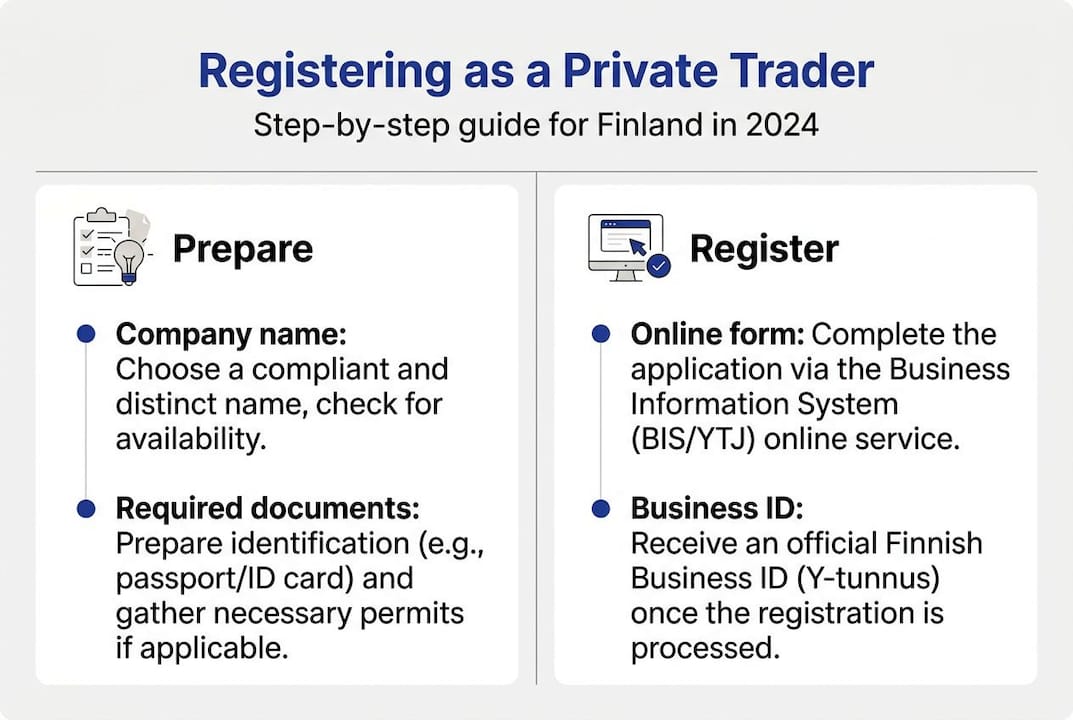
The primary route is through the YTJ online service. Filing a start-up notification (perustamisilmoitus) via ytj.fi simultaneously registers your business with the PRH Trade Register and the Tax Administration, which is efficient and reduces duplication.
Follow these steps:
- Visit ytj.fi and select the option to establish a private trader (toiminimi).
- Log in using your Finnish online banking credentials or a mobile certificate.
- Complete the start-up notification form with your company name, address, business description, and contact details.
- Select your registrations: You can register with the Trade Register, the Tax Administration, or both in a single submission.
- Pay the registration fee electronically during the process.
- Submit the form and wait for confirmation. You will receive your Business ID (Y-tunnus) once processing is complete.
Important: Registration with the Tax Administration is always recommended, even if Trade Register registration is optional for your situation. Without it, you cannot legally collect VAT or operate under a recognised business identity.
Trade Register registration is mandatory if you are required to file financial statements under the Accounting Act, or if you are a non-EEA resident without a PRH permit. For others, it is optional but provides significant legal benefits: your business name receives formal protection, you gain access to enterprise mortgages, and your business gains credibility with clients and suppliers.
Pro Tip: Even if Trade Register registration is technically optional for you, we strongly recommend it. Name protection alone is worth the fee, particularly if you plan to grow the business or operate in competitive sectors. Review the full business start-up steps to understand all implications before deciding.
Tax registrations and compliance for private traders
After registration, focusing on tax compliance ensures operational legality and access to deductions. Finland has several distinct tax registrations, and knowing which apply to you prevents penalties and missed opportunities.

Here is a summary of the key tax registrations:
| Registration | Threshold / Condition | Mandatory or optional |
|---|---|---|
| VAT (arvonlisävero) | Turnover above €20,000/year | Mandatory above threshold |
| Prepayment tax register | Any self-employment income | Strongly recommended |
| Employer register | Hiring employees | Mandatory if hiring |
| YEL pension insurance | Work income ≥ €9,208/year (2026) | Mandatory if threshold met |
Key points to understand:
- VAT registration is mandatory above €20,000 annual turnover. Registering voluntarily below this threshold can be beneficial because it allows you to reclaim VAT on business purchases, which reduces your operating costs.
- Prepayment tax (ennakkoperintärekisteri) means clients pay you the full invoice amount without withholding tax. Without it, clients may be required to withhold a portion of your payment, which creates cash flow complications.
- Employer registration is required the moment you hire even one employee, whether full-time or part-time.
- YEL pension insurance is legally required if your annual work income meets or exceeds the 2026 minimum threshold. Ignoring this obligation carries financial penalties.
For more detailed guidance, our articles on tax tips for Finnish entrepreneurs and Finnish business tax compliance cover these areas thoroughly.
Alternative: Light entrepreneurship for testing business ideas
For those who want to try business without full registration, light entrepreneurship might be a more flexible starting point.
Light entrepreneurship (kevytyrittäjyys) allows you to invoice clients through a third-party service without registering a business yourself. The invoicing service handles tax withholding and social contributions on your behalf, charging a service fee, typically around 5%, from each invoice.
Notably, approximately 63% of Finnish businesses are registered as toiminimi, reflecting how popular sole trader structures are. However, light entrepreneurship serves a different purpose: it suits those testing an idea, working on occasional projects, or earning below €30,000 annually.
Here is how the two options compare:
| Feature | Private trader (toiminimi) | Light entrepreneurship |
|---|---|---|
| Business ID (Y-tunnus) | Yes | No |
| Tax deductions | Full range available | Limited |
| Registration required | Yes | No |
| Service fee | None | ~5% per invoice |
| Best for | Established or growing business | Testing ideas, low turnover |
Advantages of light entrepreneurship:
- No upfront registration cost or administrative burden
- Immediate ability to invoice clients legally
- Suitable for freelancers or project-based work
Trade-offs to consider:
- No Business ID, which limits credibility with larger clients
- Fewer tax deductions compared to a registered toiminimi
- Less control over your business finances and branding
If you are considering this route, our light entrepreneurship services page explains how we support clients at this stage.
What most guides miss: practical lessons from Finnish entrepreneurs
Finally, let's share hard-won lessons and practical insights rarely covered by official guides.
Most official resources focus on the mechanics of registration and understandably so. But the decisions that affect your business most are often the ones that feel optional at the time. Trade Register registration is a perfect example. Many new entrepreneurs skip it because it is not always mandatory, but this choice has real consequences.
Without Trade Register registration, your business name has no legal protection. Another entrepreneur can register an identical or similar name and you have no formal grounds to object. For a business you intend to grow, this is a significant risk that a modest registration fee would have prevented.
We also see non-EEA entrepreneurs underestimate the PRH permit requirement. Skipping this step does not just delay registration; it can invalidate your business activity entirely until resolved. If you are in this category, treat the PRH permit process as your first priority, not an afterthought.
Another overlooked area is the prepayment tax register. Joining it signals to clients that you are a legitimate operator and simplifies invoicing. It is a small administrative step with a disproportionately positive impact on how professional your business appears.
Finally, the 'test with light entrepreneurship first' approach is genuinely sound advice for many people. But do not let it become a reason to delay proper registration indefinitely. Once your income consistently approaches €20,000 annually, the tax deductions and legal protections of a registered toiminimi outweigh the simplicity of light entrepreneurship. Our guidance on accounting best practices can help you make this transition smoothly.
Finovate can help your business registration and accounting
If the registration process feels overwhelming, professional help can make legal compliance faster and easier.
At Finovate, we work with private traders and light entrepreneurs across Finland, helping them set up correctly from day one. Whether you need support with your initial registration, ongoing bookkeeping, or tax compliance, our services are designed to fit your stage of business. Our invoicing service for private traders and accounting help for light entrepreneurs are practical, affordable, and built around Finnish requirements. Visit finovate.fi to explore our full range of accounting and tax services and find the right support for your business journey.
Frequently asked questions
What documents do I need to register as a private trader?
You need a verified company name, a registered address, a business description, and a completed start-up notification filed via the YTJ online service.
Can non-Finnish residents register as a private trader?
EEA residents can usually register without additional steps, but non-EEA residents require a PRH permit before filing, with limited exceptions for those holding temporary protection status.
Is registration with the Trade Register mandatory?
It is mandatory in specific cases such as when financial statements are required under the Accounting Act, but it is strongly recommended for all traders due to the name protection and legal credibility it provides.
What tax registrations should I be aware of as a private trader?
You should register for VAT above €20,000 annual turnover, prepayment tax, employer status if you hire staff, and YEL pension insurance if your work income meets the 2026 threshold of €9,208 per year.
What is light entrepreneurship and when should I consider it?
Light entrepreneurship lets you invoice clients through a service without formal registration, making it suitable for testing business ideas or managing low turnover below €30,000 annually.