

TL;DR:
- Finnish payroll requires strict adherence to reporting deadlines and precise recordkeeping.
- Employers must handle complex contributions, taxes, and compliance with evolving regulations.
- Outsourcing payroll helps ensure accuracy, saves time, and keeps businesses compliant.
Managing payroll in Finland is one of the most detail-intensive responsibilities you face as a business owner. Between reporting deadlines, employer contributions, and ever-changing collective bargaining agreement terms, even experienced entrepreneurs can find themselves tripped up. A single missed deadline or miscalculated deduction can trigger penalties, damage staff trust, and create unnecessary financial strain. This guide walks you through the full payroll process in a structured, practical way, so you can meet your legal obligations with confidence and avoid the most common and costly errors.
Table of Contents
- Understanding your payroll obligations in Finland
- Step-by-step payroll processing: Key actions and timelines
- Employer contributions, taxes, and payments explained
- Common mistakes and compliance pitfalls to avoid
- Benefits of outsourcing payroll and choosing the right provider
- The practical truth about Finnish payroll: What most guides miss
- Expert payroll help for Finnish SMEs
- Frequently asked questions
Key Takeaways
| Point | Details |
|---|---|
| Report wages promptly | All wage payments must be reported to the Incomes Register within 5 days to avoid penalties. |
| Understand your obligations | Employers need to track different contribution rates, taxes, and deadlines based on staff and business size. |
| Meet payment deadlines | All employer contributions and withheld taxes are due by the 12th of the following month via MyTax. |
| Avoid common mistakes | Frequent errors include missing reports, wrong rates, and overlooking collective agreements. |
| Consider outsourcing benefits | Outsourcing payroll can save time, improve accuracy, and reduce audit risk for Finnish SMEs. |
Understanding your payroll obligations in Finland
Now that you understand why payroll mistakes matter, let's clarify your legal obligations and what you need to get right from the start.
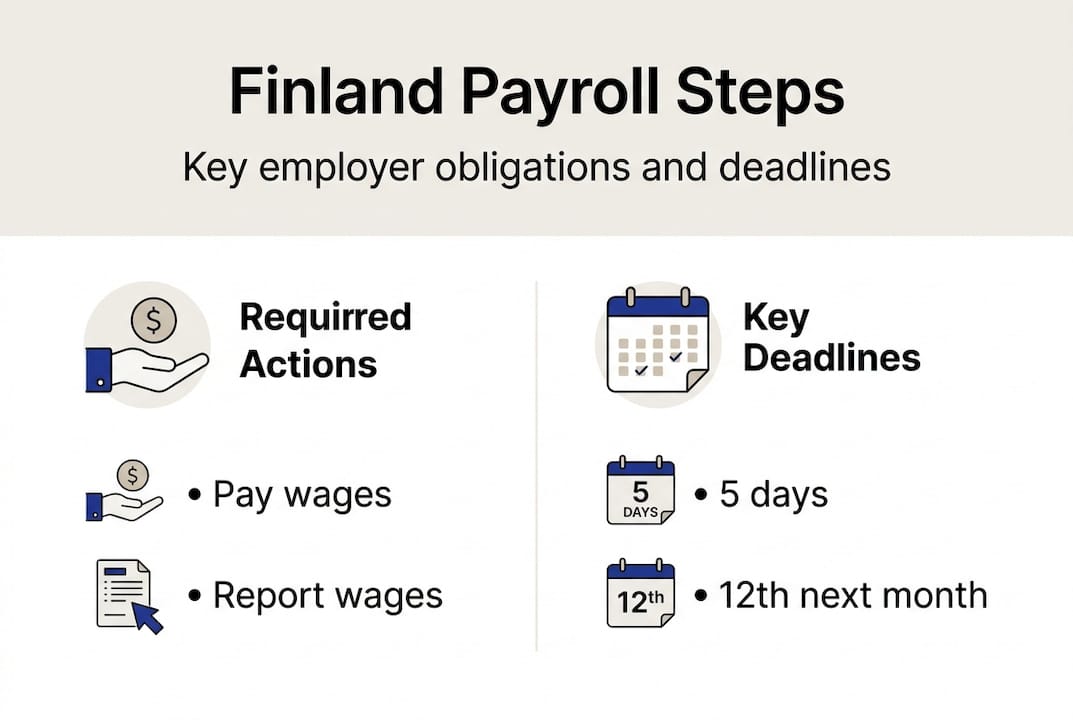
Every employer in Finland must report wage data to the Incomes Register (Tulorekisteri), a centralised national database managed by the Finnish Tax Administration. The official wage reporting guidelines confirm that all wage data must be submitted within 5 days of payment, and registered employers must file monthly even when no wages have been paid. This applies whether you employ one person or one hundred.
There are two main employer categories in Finland:
| Employer type | Registration requirement | Reporting frequency |
|---|---|---|
| Occasional employer | No mandatory registration | Per payment, within 5 days |
| Regular employer | Must register with Tax Administration | Monthly, even if no wages paid |
Understanding which category applies to your business is essential for effective payroll management. If you regularly pay wages, registering as an employer is not optional.
Key documentation you must maintain includes:
- Payslips for each employee for every pay period
- Records of all reported wage data submitted to the Incomes Register
- Evidence of employer contribution payments
- Employment contracts and any applicable collective bargaining agreement terms
- Records of holiday pay calculations and accruals
"Failing to report on time can result in late-filing penalties and increased scrutiny from the Tax Administration. Consistent, timely reporting is the foundation of compliant payroll."
Your financial reporting requirements extend beyond payroll alone, and payroll records feed directly into your broader bookkeeping compliance obligations. Keeping these records accurate and accessible protects you during audits and simplifies year-end reporting.
Step-by-step payroll processing: Key actions and timelines
With a firm grasp of your obligations, let's walk through the core activities you'll perform each payroll period.
Following a clear sequence each month reduces the chance of errors and keeps you ahead of deadlines. Here is the standard process for Finnish payroll:
- Calculate gross salary for each employee based on their contract, including any bonuses, overtime, or holiday pay due.
- Deduct income tax using the employee's personal tax card rate, obtained from the Tax Administration.
- Deduct the employee's pension share, which is set at 7.3% in 2026 for employees aged 17 to 52 and 63 or over.
- Calculate net pay and prepare a payslip for each employee.
- Pay wages to employees on the agreed payday.
- Report to the Incomes Register within 5 days of the payment date, submitting all required wage and deduction data.
- Pay withheld taxes and employer contributions by the 12th of the following month via MyTax.
A practical monthly timeline looks like this:
| Action | Deadline |
|---|---|
| Pay wages to employees | Agreed payday (e.g. last working day) |
| Report to Incomes Register | Within 5 days of payment |
| Pay withheld taxes and contributions | 12th of the following month |
| File monthly employer report (if registered) | By end of the reporting month |
For Finnish tax compliance essentials, sticking to this timeline is non-negotiable. The 5-day reporting rule applies regardless of whether it falls on a weekend or public holiday, so plan your payroll dates carefully.
Pro Tip: Set a recurring calendar reminder three days before your payroll date. This gives you time to resolve any last-minute issues before the 5-day reporting clock starts.
Employer contributions, taxes, and payments explained
Once payroll is processed, a critical next step is addressing the various employer contributions and timely payments.

As an employer in Finland, you are responsible for several social contributions on top of the wages you pay. These are not optional extras. They are legal obligations that fund employee pensions, healthcare, and social protection.
The main employer contributions for 2026 are:
- TyEL pension insurance: Average rate of 17.1% of gross wages, paid to the employee's chosen pension insurer
- Health insurance contribution: 1.91% of gross wages, paid via MyTax
- Unemployment insurance: 0.31% for wage sums up to EUR 2,509,500; 1.23% above that threshold
- Accident insurance: Varies by industry risk level; arranged through a private insurer
- Group life insurance: Typically arranged alongside accident insurance
The pension contribution rules also specify that the employee's own share is deducted from gross pay before the net salary is calculated, which means your payroll system must handle both sides of the pension contribution correctly.
Key figure: The combined employer cost per employee can add 20% or more on top of gross salary when all contributions are included. Factor this into your budgeting from day one.
All withheld taxes and contributions must be paid by the 12th of the month following the wage payment, using MyTax. Late payments attract interest charges and can trigger compliance reviews. For practical guidance on reducing your overall tax burden, our tax tips for entrepreneurs cover useful strategies.
Pro Tip: Use MyTax's pre-filled payment reference numbers to ensure contributions are correctly allocated. Incorrect references are one of the most common causes of payment disputes.
Common mistakes and compliance pitfalls to avoid
To ensure what you have built is robust, it's vital to avoid common traps and errors seen among Finnish SMEs.
Even well-organised businesses make payroll errors. The consequences range from financial penalties to strained employee relations. Here are the most frequent mistakes and how to avoid them:
- Missing the 5-day reporting deadline: This is the single most common error. Automate your Incomes Register submissions wherever possible.
- Applying incorrect contribution rates: Rates differ by employee age, payroll volume, and industry. The 2026 pension rates confirm that the employee share is unified at 7.3%, but employer rates still vary.
- Ignoring collective bargaining agreement terms: Many Finnish industries have CBAs that specify minimum wages, holiday bonuses, and overtime rules. Overlooking these can expose you to back-pay claims.
- Failing to register as a regular employer: If you pay wages consistently, you must register. Operating as an occasional employer when you are not is a compliance risk.
- Poor documentation practices: Without clear records, an audit becomes a crisis. Keep payslips, contracts, and contribution receipts for at least 10 years.
Additional areas that frequently cause problems include:
- Not updating employee tax cards at the start of each year
- Miscalculating holiday pay accruals under the Annual Holidays Act
- Failing to account for the unemployment insurance threshold of EUR 2,509,500
- Overlooking changes to CBA terms at the start of a new contract period
Reviewing payroll service case studies from similar Finnish businesses can highlight patterns you may not have considered. Our SME accounting services overview also outlines the support available when your internal processes need strengthening. For a full breakdown of employer compliance requirements, the Tax Administration's guidance is the most reliable source.
Pro Tip: Conduct a brief payroll audit at the end of each quarter. Check that rates, tax cards, and CBA terms are still current. Fifteen minutes of review can prevent months of correction work.
Benefits of outsourcing payroll and choosing the right provider
For many business owners, the solution to these frequent errors is working with trusted payroll professionals.
Outsourcing payroll to a qualified provider removes the burden of tracking deadlines, calculating contributions, and staying current with regulatory changes. Expert services can save time, reduce errors, and ensure compliance with complex and changing regulations. For growing businesses, this is often the most cost-effective choice.
The key advantages of professional payroll support include:
- Accuracy: Specialists apply the correct rates, thresholds, and CBA terms every time
- Time savings: You and your team focus on running the business, not chasing deadlines
- Regulatory expertise: Providers stay up to date with legislative changes so you do not have to
- Audit readiness: Well-maintained records mean you are always prepared for a Tax Administration review
- Scalability: As your team grows, a good provider scales with you without added internal complexity
When evaluating a payroll provider, ask the following:
- Do they have experience with Finnish payroll and the Incomes Register?
- What technology do they use, and does it integrate with your accounting system?
- How do they handle errors or late submissions?
- What is their pricing model, and are there hidden fees for additional reports?
Reviewing outsourcing payroll case studies gives you a realistic picture of what to expect. It is also worth ensuring your provider follows strong bookkeeping best practices and can support optimising bookkeeping workflow across your business.
Pro Tip: Ask any potential provider to walk you through a sample payroll report before signing a contract. This reveals their attention to detail and communication style before you commit.
The practical truth about Finnish payroll: What most guides miss
Stepping back from checklists and rules, it is worth reflecting on the real difference practical habits make.
Most business owners assume that once they have the right software in place, payroll becomes straightforward. In our experience, that is only partly true. Software handles calculations well, but it cannot catch a CBA update you did not know about, or flag that an employee's age has moved them into a different pension contribution bracket. Oversight is always required.
The most painful payroll errors we see are rarely dramatic. They are small, recurring mistakes. An outdated tax card used for three months. A holiday bonus calculated under last year's CBA terms. These accumulate quietly and surface at the worst possible moment, often during an audit or when an employee raises a query.
The businesses that manage payroll best share one trait: they have clear, documented processes and regular checkpoints, regardless of the tools they use. Following solid SME compliance strategies is not about complexity. It is about consistency. Build the habit of reviewing your payroll setup regularly, and the technology becomes a reliable assistant rather than a false safety net.
Expert payroll help for Finnish SMEs
If you want to save time and lower your risk, here is how expert support makes running payroll stress-free.
We work with Finnish entrepreneurs and SMEs every day to take the complexity out of payroll, bookkeeping, and tax compliance. Whether you need monthly payroll outsourcing or dedicated accounting for entrepreneurs, our services are built around your business needs.
Our team stays current with Finnish regulations, Incomes Register requirements, and contribution rate changes so you do not have to. From processing payslips to filing employer reports and handling MyTax payments, we manage the full payroll cycle on your behalf. Get in touch today to discuss a tailored solution and find out how we can keep your business compliant and your payroll running smoothly.
Frequently asked questions
What is the deadline for reporting wage data in Finland?
All payroll information must be reported to the Incomes Register within 5 days of the date wages are paid. This applies to all employers, regardless of size.
When must employer contributions and withheld taxes be paid?
They are due by the 12th of the following month after wages are paid and must be processed through MyTax using the correct payment references.
What are the main social contribution rates for employers in Finland in 2026?
In 2026, the average TyEL pension contribution is 17.1%, health insurance is 1.91%, and unemployment insurance ranges from 0.31% to 1.23% depending on total payroll volume.
How do contribution rates vary between companies?
Rates vary based on employee age, total payroll volume, company size, and industry-specific risk factors, so it is important to calculate each element individually.
Is it mandatory for Finnish SMEs to use a payroll provider?
No, but using a professional service can help avoid costly compliance errors. Expert services save time and reduce the risk of penalties from missed deadlines or incorrect calculations.