

TL;DR:
- Effective expense management involves systematically tracking, categorizing, and reviewing company spending to ensure profitability and compliance. Regular review, proper categorization, and digital tools tailored to Finnish standards help SMEs control costs and meet legal retention requirements. Consistent discipline and expert support are crucial for maintaining accurate records and avoiding costly year-end mistakes.
Effective business expense management is defined as the systematic process of tracking, categorising, and controlling all company spending to protect profitability and maintain regulatory compliance. For small business owners and entrepreneurs in Finland, knowing how to manage business expenses is not optional. It directly determines your cash flow, your tax position, and your ability to grow. This guide covers the practical tools, categorisation methods, budgeting strategies, and Finnish compliance requirements you need to take full control of your finances in 2026.
How to manage business expenses effectively
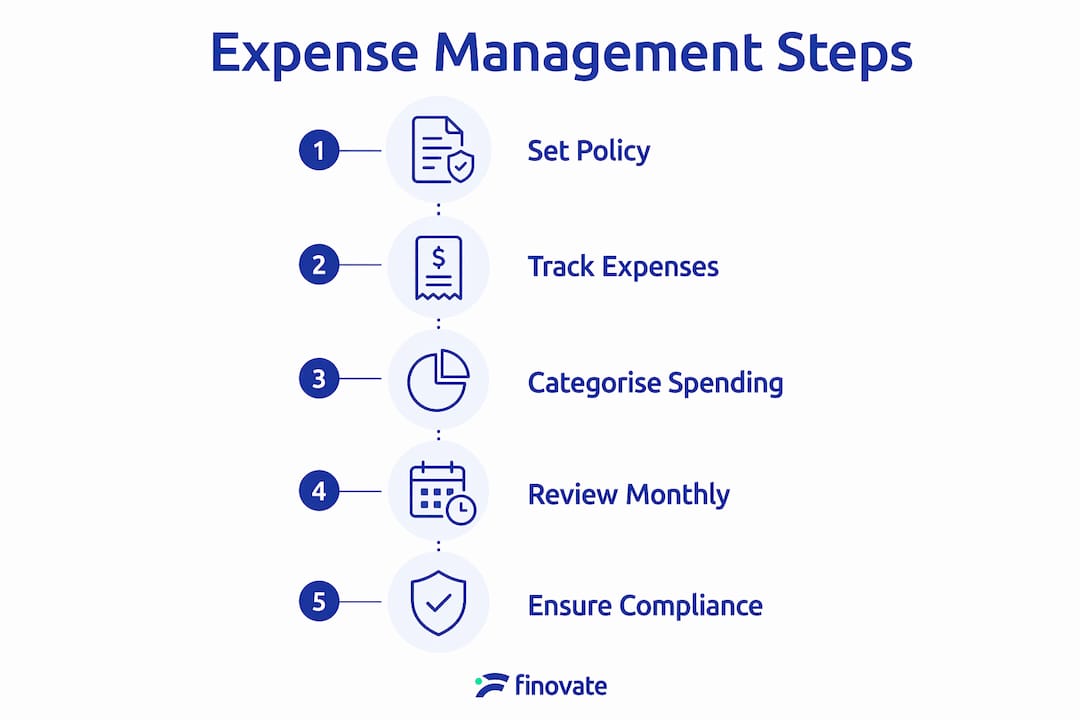
Setting an expense policy, categorising your spending, requiring documentation, and conducting periodic reviews are the four pillars of sound expense management. Each pillar addresses a different failure point. Without a policy, employees spend inconsistently. Without categorisation, you cannot see where money is going. Without documentation, you cannot claim deductions or survive an audit. Without reviews, problems compound silently until year-end.

Finnish SMEs face a specific challenge: the obligation to maintain accurate financial records under the Finnish Accounting Act, combined with the practical demands of running a lean operation. The good news is that the right combination of digital tools and clear internal processes makes this manageable, even for a sole trader or a team of five.
Monthly tracking with regular reconciliation helps you identify issues early rather than discovering them at year-end when corrective action is far more costly. Start with these four pillars and build from there.
What tools are essential for tracking business expenses?
Digital receipt capture and cloud-based expense management software simplify tracking and reduce errors significantly compared to manual methods. The right tools depend on your business size, transaction volume, and accounting platform.
Manual vs automated expense tracking
| Method | Advantages | Limitations |
|---|---|---|
| Manual (spreadsheets) | Low cost, full control | Time-consuming, error-prone, hard to scale |
| Cloud-based software | Automated categorisation, real-time data | Monthly subscription cost |
| Integrated accounting platforms | Syncs with invoicing, payroll, and VAT | Requires setup and staff training |
Using a dedicated business bank account and corporate cards separates personal and business spending from day one. This single habit reduces reconciliation errors and makes your bookkeeping far cleaner. Many Finnish entrepreneurs mix personal and business accounts early on, and it creates significant problems when VAT returns or tax filings are due.
For Finnish SMEs, cloud-based platforms that integrate with Finnish accounting standards are the most practical choice. Look for software that supports Finnish VAT codes, connects to your bank feed automatically, and allows mobile receipt scanning. You can explore how to choose accounting software suited to Finnish business requirements before committing to a platform.
Automating expense management reduces human error, saves time, and enables preset flags for unusual activity to prevent cost overruns. Integration with accounting systems also removes the manual step of re-entering data, which is where most errors occur.
Pro Tip: When selecting expense management software as a Finnish SME, prioritise platforms that support Finnish VAT reporting and connect directly to your bank via open banking. This removes the need for manual bank statement imports and cuts monthly reconciliation time considerably.
How to categorise and prioritise business expenses
Categorising expenses helps identify overspending areas and supports better budget allocation across your business. Without clear categories, you cannot compare this month's spending to last month's, and you cannot forecast accurately.
Common expense categories relevant to Finnish SMEs include:
- Fixed costs: Rent, insurance, software licences, and loan repayments
- Variable costs: Raw materials, freelancer fees, delivery costs, and utilities
- Personnel costs: Salaries, employer contributions, and occupational health expenses
- Marketing and sales: Advertising spend, trade fair attendance, and promotional materials
- Travel and subsistence: Business travel, accommodation, and meal allowances within Finnish tax guidelines
- Professional services: Accounting, legal advice, and consulting fees
Tagging expenses by client, project, or department assists in forecasting and budget reviews. If you run multiple projects simultaneously, this tagging practice tells you which projects are profitable and which are consuming resources without adequate return. A construction subcontractor in Tampere, for example, might discover that one client consistently generates 30% more expense per euro of revenue than others. That insight only emerges from disciplined categorisation.
Prioritising expenses against your strategic goals is the next step. Fixed costs that keep the business operational are non-negotiable. Variable costs tied to revenue-generating activities deserve protection. Discretionary spending, such as subscriptions that are rarely used or travel that could be replaced with a video call, is where you find the most immediate savings.
For a deeper look at which costs qualify as tax-deductible, Finovate's guide on deductible expenses in Finland provides clear, practical guidance aligned with Finnish tax rules.
What are the best practices for budgeting and expense reviews?
Conducting regular expense audits reveals inefficiencies such as duplicate charges, unused subscriptions, and outdated contracts. A budget without a review process is just a wish list. The review is what gives the budget its power.
Follow these steps to conduct an effective monthly expense review:
- Export all transactions from your accounting software or bank feed for the period.
- Compare actual spend to budget in each category and note every variance above 10%.
- Investigate anomalies such as duplicate invoices, charges from cancelled suppliers, or unexpected increases in recurring costs.
- Check subscriptions against a master list of active services. Cancel anything not used in the past 60 days.
- Review approval records to confirm that all expenditure above your threshold was properly authorised.
- Update your forecast for the next period based on what you have learned.
Setting clear monthly or departmental budgets gives your team a spending framework. Without defined limits, even well-intentioned employees can overspend on travel, equipment, or supplies. Approval thresholds, for example requiring manager sign-off on any purchase above €200, add a practical checkpoint without creating excessive bureaucracy.
Variance review by category enables you to trace overspending to specific decision points such as contracts or approval thresholds. This turns your monthly review from a passive reporting exercise into active cost governance. You can find further guidance on financial management tips that support this kind of structured approach.
Pro Tip: Involve your team in the review process. When employees understand the budget and see the results of their spending decisions, compliance improves naturally. Pair this with automated approval workflows in your expense software to reduce the administrative burden on managers.
How can finnish smes meet bookkeeping compliance requirements?
Finnish law requires retention of accounting documents for 6–10 years depending on the document type, ensuring compliance and audit readiness. Non-compliance carries real risk, including fines, tax reassessments, and personal liability for company directors.
Document retention periods in finland
| Document Type | Retention Period |
|---|---|
| Financial statements and annual reports | 10 years |
| General ledger and journal entries | 10 years |
| Sales and purchase invoices | 6 years |
| Receipts and expense vouchers | 6 years |
| Contracts and agreements | 6 years after contract end |
Invoices, receipts, contracts, and ledgers must all be preserved in a format that remains readable and retrievable throughout the retention period. Digital storage is fully acceptable under Finnish law, provided the documents are backed up securely and can be produced on request.
The risks of poor documentation go beyond regulatory penalties. If you cannot substantiate a VAT deduction or a business expense claim, the tax authority can disallow it. That means paying tax on income you already spent. Organised documentation is therefore both a legal obligation and a direct financial protection.
Delegating bookkeeping to a qualified professional or using specialised software removes the burden of remembering these requirements. Finovate's guide on bookkeeping best practices for Finnish businesses explains how to structure your records correctly from the outset.
Which cost-cutting strategies reduce expenses without harming operations?
Training employees on expense policies and clear spending guidelines creates company-wide financial discipline and reduces non-compliance. Cost reduction works best when it is systematic rather than reactive.
Practical cost-cutting strategies for Finnish SMEs include:
- Cancel unused subscriptions. Review all recurring software and service charges quarterly. Unused SaaS tools are one of the most common sources of silent waste in small businesses.
- Renegotiate supplier contracts. Many suppliers will offer better terms to a loyal customer who asks. Annual contract reviews often yield 5–15% savings on services such as telecoms, insurance, and office supplies.
- Set approval thresholds. Require written authorisation for purchases above a defined limit. This single control prevents a large proportion of unplanned spending.
- Automate expense alerts. Configure your accounting software to flag transactions above a set amount or in unusual categories. Early detection prevents small anomalies from becoming large problems.
- Consolidate suppliers. Buying from fewer suppliers often unlocks volume discounts and reduces the administrative cost of managing multiple vendor relationships.
Variance analysis over expense categories traces costs to contracts, subscriptions, or approval rules, enhancing cost control beyond mere tracking. This approach focuses on governance and strategic expenditure reduction rather than simply recording what has already been spent. For a structured walkthrough of tracking methods, Finovate's expense tracking tutorial covers the practical steps in detail.
Key takeaways
Effective business expense management requires consistent tracking, clear categorisation, regular audits, and full compliance with Finnish document retention law to protect profitability and cash flow.
| Point | Details |
|---|---|
| Use dedicated accounts and tools | Separate business and personal finances from day one to simplify reconciliation and reduce errors. |
| Categorise and tag every expense | Group costs by type, project, or department to identify overspending and improve budget forecasting. |
| Review budgets monthly | Compare actual spend to budget, investigate variances, and cancel unused subscriptions each month. |
| Meet Finnish retention requirements | Retain invoices and receipts for 6 years and financial statements for 10 years to stay audit-ready. |
| Apply systematic cost-cutting | Renegotiate contracts, set approval thresholds, and automate alerts to reduce spend without disrupting operations. |
The discipline gap: what most finnish smes get wrong
Running a small business in Finland means wearing many hats, and financial oversight is often the one that gets set aside when things get busy. From what I have seen working with Finnish entrepreneurs, the most common failure is not a lack of knowledge. It is a lack of consistency.
Business owners often understand the importance of tracking expenses and setting budgets. What they struggle with is maintaining the discipline to review those budgets monthly, update their categories as the business changes, and act on what the numbers are telling them. The result is that expense management becomes a year-end scramble rather than an ongoing practice.
The combination that works is straightforward: automate the data capture, but keep a human in the review loop. Software can flag anomalies and categorise transactions, but it cannot tell you whether a particular cost still makes strategic sense. That judgement requires a person who understands the business.
My strongest advice to Finnish SME owners is this: treat your monthly expense review as a fixed appointment, not an optional task. Block one hour in your calendar at the end of each month. Use that time to look at your numbers, ask hard questions, and make decisions. Over a year, those twelve hours will save you far more than they cost.
When the complexity grows beyond what you can manage alone, bring in a professional. The cost of good advisory support is almost always less than the cost of the mistakes it prevents.
— Busayo
How Finovate supports finnish smes with expense management
Managing business expenses well requires the right systems, clear processes, and a firm grasp of Finnish compliance requirements. Finovate provides bookkeeping, tax planning, payroll processing, and business advisory services tailored specifically for Finnish small businesses and entrepreneurs.
Whether you need help setting up a compliant bookkeeping system, preparing VAT returns, or reviewing your expense policies, Finovate's team brings the expertise to do it accurately and efficiently. We work with sole traders, limited companies, and light entrepreneurs across Finland to keep finances in order and tax obligations met on time. Explore Finovate's full range of accounting and tax services to find the right support for your business.
FAQ
What is business expense management?
Business expense management is the process of tracking, categorising, and controlling all company spending to protect profitability and meet regulatory requirements. It includes setting policies, capturing receipts, reconciling accounts, and conducting regular reviews.
How often should i review my business expenses?
Reconciliation and review should happen weekly or monthly to maintain financial accuracy. Monthly reviews are the minimum recommended frequency for Finnish SMEs to catch anomalies and control costs effectively.
What documents must finnish businesses retain for tax purposes?
Finnish law requires retention of financial statements and ledgers for 10 years, and invoices, receipts, and contracts for 6 years. Documents must remain readable and retrievable throughout the retention period.
What is the best way to cut business costs without affecting operations?
The most effective methods are cancelling unused subscriptions, renegotiating supplier contracts annually, and setting approval thresholds for purchases. These controls reduce spending without disrupting day-to-day business activity.
Do i need separate bank accounts for my business in finland?
Using a dedicated business bank account is strongly recommended. It separates personal and business transactions, simplifies VAT reconciliation, and reduces errors in your financial records.