

TL;DR:
- Choosing software that fits your business size and growth is essential for efficiency and compliance.
- Cloud SaaS platforms dominate Finnish SMEs, offering quick setup, AI automation, and local tax features.
- Prioritize integration, scalability, and usability over cost to ensure your accounting system supports future growth.
Choosing the right accounting software is one of the most practical decisions you will make as a Finnish small business owner or entrepreneur. The market is full of options, from simple spreadsheet tools to powerful cloud platforms and enterprise resource planning systems, and picking the wrong one can cost you time, money, and compliance headaches. This guide cuts through the noise. We walk you through a clear framework for evaluating your options, break down the main software categories, offer a direct comparison of the most relevant types, and match specific tools to your business stage. By the end, you will know exactly what to look for and where to start.
Table of Contents
- How to choose the right accounting software for your business
- Overview of main types of accounting software
- Head-to-head comparison: SaaS vs ERP vs custom solutions
- Situational recommendations: Matching software to your business
- Why software selection should focus on integration and growth
- Explore accounting software and solutions for Finnish businesses
- Frequently asked questions
Key Takeaways
| Point | Details |
|---|---|
| Match software to stage | Select software based on your current business size and complexity for best results. |
| Prioritise usability and scalability | Focus on software that integrates well and can grow with your business, not just the cheapest option. |
| Cloud SaaS leads for SMEs | Cloud-based SaaS options are dominant and provide speed, AI-driven accuracy, and substantial time savings for Finnish SMEs. |
| Specialised tools for unique needs | Consider industry-specific, payroll, or project accounting tools if your business has specialised requirements. |
| Test before you commit | Always trial usability and compatibility to avoid costly software mismatches. |
How to choose the right accounting software for your business
With the challenge clear, let's start by understanding how to evaluate your software needs. The best accounting software is not the most feature-rich or the most affordable. It is the one that fits your business stage, your sector, and the way your team actually works.
Business size and complexity matter most. A sole trader issuing ten invoices per month has entirely different needs from a growing company managing payroll for fifteen employees, reconciling VAT across multiple product lines, and integrating with an online shop. Trying to use enterprise software at the micro stage wastes money. Using a basic spreadsheet at the growth stage creates gaps and compliance risks.
When evaluating any software option, weigh up these core criteria:
- Usability: Can you and your team learn it quickly without extensive training?
- Integrations: Does it connect with your bank, invoicing tool, payroll system, and Finnish Tax Administration (Vero) reporting requirements?
- Scalability: Will it still serve you when your turnover doubles or your team grows?
- Price versus value: Is the monthly subscription justified by the time and errors it saves?
- Local compliance: Does it support Finnish VAT reporting, OmaVero integration, or e-invoicing standards?
The Finnish market offers a clear staged approach to software selection. Choose by business stage: micro and simple businesses often start with Fennoa or Holvi, growing SMBs benefit from Procountor or Netvisor, and complex organisations or those needing ERP functionality turn to Lemonsoft or Visma. This staged model is logical, and we recommend it as a starting point.
Pro Tip: Always trial software before committing to a paid plan. Most Finnish SaaS platforms offer free trial periods of two to four weeks. Use this time to test real transactions, not just the demo data. Authentic testing reveals usability problems that polished marketing materials rarely show.
The selection process should also account for the sector you operate in. A freelance consultant has different invoicing and project tracking needs from a retail business or a construction firm. Explore accounting services for small businesses to understand how service requirements differ by business type before committing to any platform.
Starting simple and upgrading as your business grows is almost always the wiser path. Over-investing in software complexity at an early stage diverts budget and attention away from the business itself. The key is choosing a platform that allows you to expand its functionality without switching providers entirely.
Overview of main types of accounting software
Now that you know how to evaluate options, let's break down the key categories. Understanding the different types helps you immediately rule out what does not fit and focus on what does.
Types of accounting software include spreadsheets, commercial off-the-shelf (COTS), cloud-based SaaS, ERP systems, custom software, and specialised types such as general ledger tools, industry-specific platforms, payroll software, invoicing tools, and project accounting systems. Each serves a distinct need.
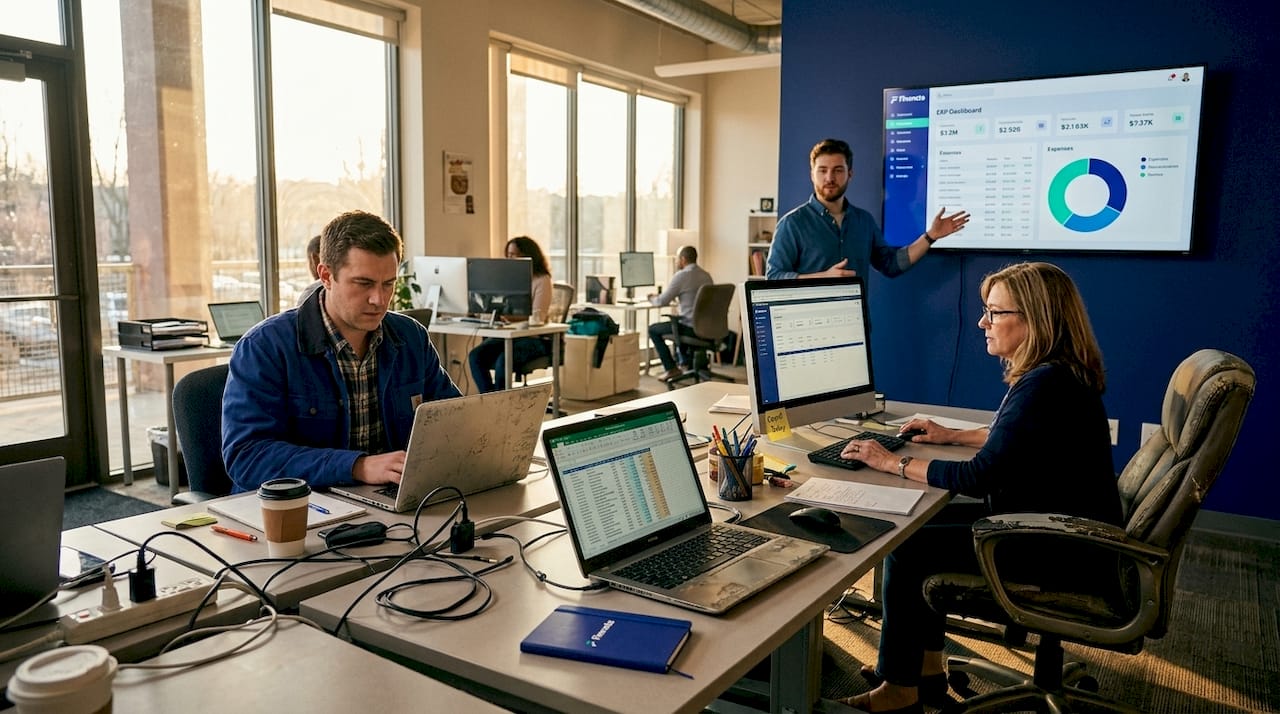
Spreadsheets (such as Microsoft Excel or Google Sheets) are the most basic option. They are free or low-cost, highly flexible, and familiar to most users. However, they carry significant risks: manual data entry is error-prone, there is no automation, and they offer no real-time bank integration. They are suitable only for the very smallest microbusinesses with minimal transactions.
Commercial off-the-shelf (COTS) software refers to packaged accounting programs installed locally on a computer. These were the standard for years but have largely been replaced by cloud alternatives for Finnish SMEs. They can still be useful where internet connectivity is unreliable, but they lack the live data access and remote collaboration that modern businesses require.
Cloud-based SaaS platforms are now the dominant choice for Finnish small businesses and entrepreneurs. These tools run entirely online, update automatically, and typically offer monthly subscriptions. Examples popular in Finland include Procountor, Netvisor, Fennoa, and Holvi. They integrate with banking APIs, support Finnish e-invoicing standards, and handle VAT reporting more reliably than manual tools.
ERP systems (Enterprise Resource Planning) combine accounting with inventory management, HR, project management, and more into a single platform. Lemonsoft and Visma are used in Finland for this purpose. They are powerful but require configuration, training, and a higher budget. They suit growing companies with multiple departments and complex operational workflows.
Custom-built software is developed specifically for a single business. It fits unique workflows precisely but carries the highest cost and longest development time. It is rarely appropriate for small businesses or startups.
Beyond these core types, there are important specialised categories:
- Industry-specific tools: Designed for sectors like construction, healthcare, or retail, with built-in features such as site costing or stock tracking.
- Payroll software: Focused on salary calculations, tax deductions, and reporting to Vero. Many Finnish businesses integrate standalone payroll tools with their main accounting platform.
- Invoicing tools: Lightweight platforms ideal for freelancers and light entrepreneurs who need to issue invoices without a full accounting suite.
- Project accounting tools: Track costs and revenues at a project level, useful for consultancies and agencies.
For professional service firms, matching the software type to your workflow is especially important. Explore accounting software for professional services and the related guidance on accounting software types for professional firms to identify the best category for your specific industry context.
Head-to-head comparison: SaaS vs ERP vs custom solutions
Having explored the categories, you will want to know how top options compare for performance and fit. This section offers a direct comparison across the three most decision-relevant software types for Finnish businesses: cloud SaaS, ERP systems, and custom solutions.
Cloud SaaS platforms are built for speed and accuracy. AI bookkeeping benchmarks show that tools like QuickBooks and Xero process transactions in 2.8 to 3.2 seconds with 96 to 97 per cent AI categorisation accuracy, reducing accounting errors by over 90 per cent and saving businesses more than 15 hours per month. The global cloud accounting market is growing at an 11.9 per cent CAGR, and cloud tools are now the dominant choice for SMEs worldwide. Finnish equivalents such as Procountor and Netvisor deliver similar benefits within a locally compliant framework.
ERP systems scale with operational complexity. They are the right choice when your business needs to connect accounting with inventory, HR, project management, and customer data in real time. The trade-off is investment: implementation costs are higher, setup takes longer, and training is more intensive. For businesses with ten or more employees and multiple revenue streams, the investment typically pays off through efficiency gains and reduced manual reconciliation.
Custom solutions are the most powerful in theory but the hardest to justify for most Finnish SMEs. Development costs are significant, maintenance requires ongoing technical support, and the risk of cost overruns is real. However, where your business has genuinely unique workflows that no existing platform serves, a custom build may be the only practical option.
Here is a summary comparison to help you visualise the key decision factors:
| Feature | Cloud SaaS | ERP system | Custom solution |
|---|---|---|---|
| Setup time | Days | Weeks to months | Months to years |
| Monthly cost | Low to moderate | Moderate to high | High (build + maintain) |
| Scalability | Good for SMEs | Excellent for complex firms | Excellent but costly |
| Finnish VAT compliance | Built-in | Configurable | Requires custom build |
| AI automation | High (96-97% accuracy) | Moderate | Depends on build |
| Best for | Freelancers, small firms | Growing SMEs, multi-dept | Unique workflows only |
Key advantages and limitations at a glance:
- SaaS tools offer the fastest time to value and the lowest barrier to entry for most Finnish entrepreneurs.
- ERP systems are justified when operational complexity genuinely demands integration across multiple business functions.
- Custom solutions carry the highest risk and cost and should only be considered when off-the-shelf options have been thoroughly tested and ruled out.
Pro Tip: When comparing SaaS platforms, check whether the tool supports Finnish e-invoicing (Finvoice standard) and OmaVero integration. These two features alone can save hours of manual compliance work each month. Explore cloud accounting options to understand how local compliance requirements shape platform choice.
For businesses moving from basic tools toward greater complexity, it is worth reading about ERP for complex businesses before investing. Similarly, if you believe custom development may be necessary, custom solutions for professional services provides a useful starting point for understanding what is involved.
Situational recommendations: Matching software to your business
Finally, let's translate your understanding into practical action with step-by-step recommendations. Your business stage and sector should drive your software selection. Below is a clear, scenario-based guide to help you make the right call.
Choose by business stage: for micro and simple businesses, Fennoa or Holvi are strong starting points. For growing SMBs, Procountor or Netvisor offer the right balance of features and scalability. For complex organisations requiring ERP-level functionality, Lemonsoft or Visma are the recommended Finnish market options. Usability, integrations, and scalability should always be prioritised over price alone.
| Business stage | Typical needs | Recommended tool type | Finnish examples |
|---|---|---|---|
| Freelancer / light entrepreneur | Invoicing, basic income tracking | Invoicing tool or simple SaaS | Holvi, Fennoa |
| Micro business (1-4 employees) | VAT, basic payroll, invoicing | Cloud SaaS | Fennoa, Procountor |
| Growing SMB (5-20 employees) | Full accounting, payroll, reporting | Cloud SaaS or COTS | Procountor, Netvisor |
| Complex / multi-dept business | Integrated operations, advanced reporting | ERP | Lemonsoft, Visma |
Follow these steps to make a confident software decision:
- Assess your current transaction volume and estimate how it will grow over the next two years. This tells you whether a simple tool will remain adequate or whether you need scalability built in from the start.
- List your non-negotiable integrations. Does the software connect with your bank, payroll provider, webshop, or CRM? Missing integrations mean manual work, which defeats the purpose.
- Verify Finnish compliance features. Confirm that the platform supports VAT reporting, Finvoice e-invoicing, and OmaVero filing. This is not optional in the Finnish market.
- Trial at least two options simultaneously. Run real invoices and transactions through each during the trial period. Compare the experience honestly.
- Check support quality. Finnish-language customer support and clear documentation matter when issues arise during VAT filing or payroll runs.
For freelancers and light entrepreneurs, an invoicing and payroll solution can be a cost-effective starting point before moving to a full accounting platform. As your business grows and payroll becomes more complex, dedicated payroll software for SMEs becomes a worthwhile consideration.
Pro Tip: Do not underestimate the value of your accountant's input in the software selection process. Many Finnish accounting firms, including ours, work regularly with specific platforms and can flag integration issues or compliance gaps that you would not discover until it is too late.
Why software selection should focus on integration and growth
There is a common pattern we see among Finnish small businesses: the initial software choice is made primarily on price. A cheaper tool saves money in the short term, but as the business grows, it becomes a bottleneck. Migrating data from one platform to another mid-year is disruptive, time-consuming, and often expensive when an accountant has to reconcile historical records manually.
Our view is straightforward. The most important criteria when selecting accounting software are integration capability and growth capacity. A tool that connects seamlessly with your bank, your invoicing workflow, your payroll provider, and Finnish tax systems saves far more in time and errors than the cheapest monthly subscription saves in fees.
Finland's SaaS adoption rate among SMEs has grown rapidly over the past three years. This is not coincidental. Finnish entrepreneurs are learning that well-integrated cloud accounting options reduce manual reconciliation, improve reporting accuracy, and allow their accountants to add more value through analysis rather than data entry. Plan for where your business will be in three years, not just where it is today. The right software should grow with you without forcing a disruptive migration.
Explore accounting software and solutions for Finnish businesses
Choosing the right software is only the first step. Having the right support behind it makes the difference between a smooth financial operation and a stressful compliance burden.
At Finovate, we work with Finnish businesses at every stage, from freelancers getting started with their first invoice to growing SMEs managing payroll and VAT. We offer professional invoicing services designed to reduce administrative friction, along with monthly invoicing solutions that scale with your business. Our full range of accounting software and services is built around Finnish compliance requirements and transparent pricing. If you are ready to take the next step, explore our service suite and speak with our team about what fits your business best.
Frequently asked questions
Which accounting software is most popular among Finnish small businesses?
Cloud-based SaaS platforms are the most widely used, with Procountor and Holvi particularly favoured by micro businesses and growing SMBs for their local integrations and ease of use.
How do cloud accounting tools improve accuracy and efficiency?
Cloud SaaS tools use AI to process transactions in under four seconds, achieving 96 to 97 per cent categorisation accuracy and reducing accounting errors by more than 90 per cent compared to manual methods.
Should I prioritise price when choosing accounting software?
Price should not be the primary factor. Usability, integrations, and scalability deliver more long-term value, as cheap tools often become limiting constraints as your business grows.
When is an ERP system appropriate for a Finnish SME?
ERP systems become appropriate when your business has multiple departments, complex operational workflows, or a need to integrate accounting with HR, inventory, and project management in a single platform.
How can I ensure software will scale as my business grows?
Choose a platform that offers flexible integrations with banking, payroll, and tax systems, and confirm with the provider that higher-tier plans are available to support increased transaction volumes and team size.