
TL;DR:
- Finnish law mandates single-entry bookkeeping for small sole traders below certain thresholds and double-entry for larger or non-calendar fiscal years.
- Business thresholds include €100,000 balance sheet, €200,000 turnover, and over 3 employees; exceeding two requires switching to double-entry.
- Proper selection, accurate implementation, and professional support ensure compliance, better financial insights, and growth opportunities.
Choosing the wrong accounting method for your Finnish business is not simply an administrative inconvenience. It can trigger compliance failures, incorrect tax assessments, and unnecessary financial stress. Finnish law is precise about which bookkeeping system applies to which type of business, and the rules are tied directly to your turnover, balance sheet, and employee numbers. This guide walks you through every practical step, from understanding your options to implementing your chosen method and staying compliant with reporting requirements. Whether you are a sole trader just starting out or a growing small business, the right approach to bookkeeping makes a genuine difference.
Table of Contents
- Understanding accounting options in Finland
- How to assess your business eligibility
- Implementing your chosen method
- Preparing financial statements and ensuring compliance
- What Finnish entrepreneurs often overlook about accounting choices
- Connect with trusted accounting services in Finland
- Frequently asked questions
Key Takeaways
| Point | Details |
|---|---|
| Know your thresholds | Assess your turnover, balance sheet and employee numbers to select the correct bookkeeping method. |
| Calendar year matters | If your financial year isn’t the calendar year, double-entry bookkeeping is required regardless of business size. |
| Compliance is essential | Failure to follow Finnish accounting rules can result in errors, penalties, and business risk. |
| Professional help pays off | Expert accountants help avoid costly mistakes and ensure your books meet Finnish legal and tax requirements. |
Understanding accounting options in Finland
Finnish entrepreneurs and small businesses primarily choose between single-entry and double-entry bookkeeping based on size thresholds defined in the Accounting Act. Understanding these two systems is the first step towards making a confident and legally sound decision.
Single-entry bookkeeping (in Finnish: yhdenkertainen kirjanpito) records only cash transactions. Income received and expenses paid are logged as they occur. It is simpler to maintain and is permitted only for sole traders (toiminimi) and self-employed persons who remain below specific financial thresholds. It uses a cash basis, meaning you record money when it physically moves, not when it is earned or owed.
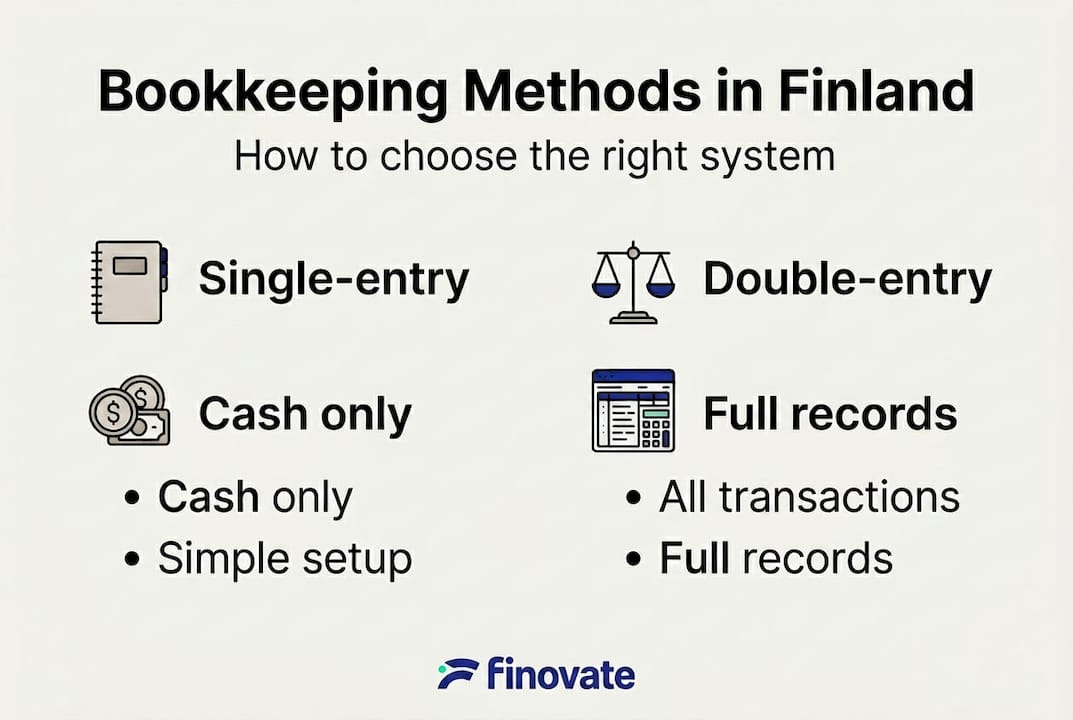
Double-entry bookkeeping (kahdenkertainen kirjanpito) records every transaction twice: once as a debit and once as a credit. This system follows the accruals basis, meaning income and expenses are recorded when they are earned or incurred, regardless of when cash changes hands. It provides a far more complete picture of your financial position. All limited companies (osakeyhtiö), general partnerships (avoin yhtiö), and limited partnerships (kommandiittiyhtiö) must always use double-entry on an accruals basis.
Here is a clear comparison of both systems:
| Feature | Single-entry | Double-entry |
|---|---|---|
| Recording method | Cash basis | Accruals basis |
| Complexity | Lower | Higher |
| Who can use it | Sole traders below thresholds | All companies; sole traders above thresholds |
| Financial statements required | Not always | Often required |
| Tax adjustment needed | Yes, for accruals | No additional adjustment |
The legal thresholds that determine eligibility for single-entry bookkeeping are set by Finnish law and apply specifically to sole traders (toiminimi). You must use double-entry if you exceed at least two of the following three criteria in the preceding financial year:
- Balance sheet total exceeds €100,000
- Annual turnover exceeds €200,000
- Average number of employees exceeds 3
There is also an important edge case. If your financial year does not align with the calendar year (1 January to 31 December), double-entry bookkeeping is mandatory regardless of size. This catches many entrepreneurs off guard, particularly those who set up mid-year and inadvertently create a non-standard financial year.
Understanding these distinctions early prevents costly corrections later. Many new sole traders assume single-entry is always the simpler and legally acceptable choice, but this is only true when all the relevant conditions are met.
How to assess your business eligibility
Now that you know the options, the next step is to determine which system applies to your specific situation. This is not a guessing exercise. Finnish law provides clear criteria, and you can work through them systematically.
Follow these steps to assess your eligibility:
-
Identify your business structure. If you operate as a limited company, partnership, or cooperative, double-entry is mandatory. No further assessment is needed. If you are a sole trader (toiminimi) or self-employed person, continue to step two.
-
Check your financial year. If your financial year is not the calendar year, double-entry is mandatory regardless of thresholds. If it is the calendar year, proceed to step three.
-
Measure your three key figures. Gather your balance sheet total, annual turnover, and average employee count from the preceding financial year.
-
Apply the two-out-of-three rule. According to Finnish tax authority guidance, double-entry becomes mandatory for a toiminimi if at least two of the following apply: balance sheet exceeds €100,000, turnover exceeds €200,000, or average employees exceed three. If you meet two or more of these, you must switch to double-entry.
-
Confirm your chosen method is sustainable. Even if you qualify for single-entry, consider whether your business is growing quickly. If you expect to exceed the thresholds within one or two years, starting with double-entry now avoids a disruptive transition later.
Here is a practical example to make this concrete. Imagine you are a sole trader in Helsinki. Your balance sheet total is €80,000, your annual turnover is €220,000, and you have two employees on average. You exceed the turnover threshold (€220,000 is above €200,000) but not the balance sheet or employee thresholds. Since only one out of three criteria is exceeded, you may still use single-entry bookkeeping. However, if your balance sheet grows to €110,000 next year, you will exceed two criteria and must switch.

The data table below summarises the bookkeeping criteria for sole traders:
| Threshold | Limit | Your figure | Exceeded? |
|---|---|---|---|
| Balance sheet total | €100,000 | €80,000 | No |
| Annual turnover | €200,000 | €220,000 | Yes |
| Average employees | 3 | 2 | No |
In this example, only one threshold is exceeded, so single-entry remains permitted.
Pro Tip: Review your thresholds at the end of every financial year, not just when you first set up. A business that qualifies for single-entry today may not qualify next year, and the obligation to switch applies from the following financial year.
Implementing your chosen method
Once you know which system fits your business, here is how to put it into action.
For single-entry bookkeeping:
-
Set up a cash receipts and payments journal. Record all income received and all expenses paid, with dates, amounts, and descriptions. This is your primary record.
-
Organise receipts and invoices. Every entry must be supported by a document. Store these in chronological order, either physically or digitally. Finnish law requires records to be kept for at least six years.
-
Align your records with the calendar year. Single-entry is only permitted when the financial year matches the calendar year. Ensure your books open on 1 January and close on 31 December.
-
Adjust to accruals for tax purposes. Single-entry bookkeeping uses cash basis but must be adjusted to an accruals basis when preparing your tax return. This means accounting for income earned but not yet received, and expenses incurred but not yet paid.
For double-entry bookkeeping:
-
Set up a chart of accounts. This is a structured list of all financial accounts your business uses, such as sales revenue, purchases, salaries, and assets. A professional accountant can help you design one suited to your industry.
-
Record every transaction with a debit and credit entry. Each transaction affects at least two accounts. For example, a sale recorded as income also increases your bank account balance.
-
Reconcile regularly. Match your book entries against your bank statements monthly. Discrepancies should be identified and corrected promptly. Timely reconciliation prevents errors from compounding.
-
Prepare for financial statements. Double-entry bookkeeping naturally supports the preparation of a balance sheet and income statement, which may be required depending on your size.
"Accurate and timely bookkeeping is not just a legal obligation. It is the foundation on which sound business decisions are made. Errors in your books translate directly into errors in your tax assessment."
Regardless of which method you use, professional support makes a significant difference. Reviewing bookkeeping best practices and seeking compliance and expert advice early in your business journey helps you avoid the most common and costly mistakes.
Pro Tip: Even if you are eligible for single-entry, using accounting software designed for Finnish businesses can automate much of the adjustment work needed for tax purposes. This saves time and reduces the risk of errors when submitting your tax return.
Preparing financial statements and ensuring compliance
Proper implementation leads to the next phase: ensuring compliance and reporting accurately to Finnish authorities.
Not every business must prepare formal financial statements (tilinpäätös), but many do. According to Finnish tax authority guidance, financial statements are required when a business's financial year does not match the calendar year, or when it has exceeded at least two of the following three limits for two consecutive years: balance sheet total above €350,000, annual turnover above €700,000, or average employees above ten. These statements must be prepared within four months of the end of the financial year.
The required content of financial statements typically includes:
- Income statement: A summary of revenues and expenses over the financial year, showing profit or loss.
- Balance sheet: A snapshot of assets, liabilities, and equity at the financial year-end.
- Notes to the accounts: Explanatory information required by law, such as accounting policies and details of significant items.
- Signature and date: The statements must be signed by the business owner or authorised representative.
"Submitting incomplete or late financial statements can result in penalties and increased scrutiny from the Finnish Tax Administration. Accuracy and timeliness are both essential."
Common mistakes that entrepreneurs make at this stage include:
- Forgetting to adjust cash-based records to accruals before preparing statements
- Missing the four-month deadline for statement preparation
- Omitting required notes to the accounts
- Failing to retain supporting documentation for the required six-year period
- Confusing the financial year-end with the tax return deadline
To verify your compliance, check the financial statement rules relevant to your business size and structure. If you are unsure whether your business has crossed the threshold requiring formal statements, compare your figures from the last two financial years against the limits above. If you have exceeded two out of three limits in both years, statements are required.
Timely and accurate financial reporting also supports your tax assessment. The Finnish Tax Administration uses your books and statements to calculate your taxable income. Errors or omissions in your records directly affect your tax liability, which is why getting this right from the start matters so much.
What Finnish entrepreneurs often overlook about accounting choices
Most conversations about accounting methods focus on compliance. Stay below the thresholds, use the permitted system, submit on time. That is all true and necessary. But there is a broader point that many entrepreneurs miss entirely.
The accounting method you choose shapes how clearly you can see your own business. Single-entry bookkeeping, while simpler, gives you a limited view. You see cash in and cash out, but you do not see outstanding invoices, unpaid liabilities, or the true value of your assets at any given moment. Double-entry, even when it is not legally required, gives you that clarity.
We have seen entrepreneurs choose single-entry purely to reduce costs or complexity, only to find themselves unable to answer basic questions about their financial position when applying for a loan or pitching to a potential partner. The choice that seemed simpler created a gap in their business intelligence.
Official guidance from the Finnish Tax Administration recommends professional help for new entrepreneurs, noting that tax assessments are based directly on your books. This is not a bureaucratic suggestion. It reflects the real risk that self-managed books, even when legally compliant, can contain errors that cost you money.
Investing in professional accountant services from the outset is not an overhead. It is a strategic decision. Businesses that work with qualified accountants consistently demonstrate stronger financial outcomes because their decisions are grounded in accurate, timely data. Choose your accounting method with both compliance and clarity in mind.
Connect with trusted accounting services in Finland
Understanding the rules is one thing. Putting them into practice confidently is another.
At Finovate, we support Finnish entrepreneurs and small businesses with the practical accounting and bookkeeping services they need to stay compliant and financially clear. Whether you are a light entrepreneur looking for a straightforward Invoicing Service Pro or a growing sole trader who needs structured accounting for entrepreneurs, we have packages designed to fit your situation. Our team understands Finnish tax law, threshold requirements, and reporting obligations. Visit Finovate today to explore our services and take the next step towards confident, compliant financial management.
Frequently asked questions
What is the difference between single-entry and double-entry bookkeeping in Finland?
Single-entry bookkeeping records only cash transactions and is permitted for small sole traders, while double-entry tracks both sides of every transaction and is required for larger entities and all registered companies.
How do I determine which bookkeeping system my Finnish business needs?
Check your annual turnover, balance sheet total, and employee count against the legal thresholds. If you exceed two out of three criteria (turnover above €200,000, balance sheet above €100,000, or more than three employees), double-entry is mandatory.
Can I use single-entry bookkeeping if my financial year is not the calendar year?
No. If your fiscal year differs from the calendar year, double-entry bookkeeping is mandatory regardless of your business size or turnover.
When are financial statements required for a Finnish small business?
Financial statements are required if you exceed the larger size limits (balance sheet above €350,000, turnover above €700,000, or more than ten employees) for two consecutive years, or if your financial year is not the calendar year. They must be completed within four months of the financial year-end.
Should I handle my bookkeeping myself or use a professional accountant?
Using a professional accountant is strongly advisable. Finnish tax assessments are based directly on your books, and official guidance recommends that new entrepreneurs arrange accounting support from the very start.