
TL;DR:
- Managing payroll in Finland requires strict adherence to deadlines, reporting obligations, and tax withholding rules that are essential to avoid penalties. Professional payroll services provide compliance, accuracy, and significant time savings, helping SMEs focus on growth rather than administrative burdens. Outsourcing payroll minimizes risks of fines, errors, and staff distrust, offering peace of mind and better business management.
Running a small business in Finland means wearing many hats, but few responsibilities carry as much legal weight as payroll. A single missed deadline or an incorrect tax withholding can trigger penalties from Finnish tax authorities without warning. Income Register reporting must be made within five calendar days after the payment date, and employers must withhold income tax according to the employee's tax card when wages exceed 1,500 EUR. This guide explains why professional payroll solutions protect your business, save you time, and reduce your financial risk in a way that DIY approaches simply cannot match.
Table of Contents
- The complexity of payroll compliance in Finland
- What can go wrong: The risks of DIY payroll
- The benefits of professional payroll services
- How to choose the right payroll provider in Finland
- What most guides miss: The invisible costs of ignoring payroll expertise
- Streamline payroll with trusted Finnish experts
- Frequently asked questions
Key Takeaways
| Point | Details |
|---|---|
| Payroll compliance is strict | Finnish rules demand exact and timely payroll reporting to avoid penalties. |
| DIY payroll risks are real | Errors and late corrections can result in fines and lost time for SMEs. |
| Professionals offer peace of mind | Expert payroll services reduce the burden, ensure compliance, and free owners to focus on growth. |
| Provider selection is crucial | Choosing the right expert with local knowledge safeguards your business from costly mistakes. |
The complexity of payroll compliance in Finland
Finnish payroll is not simply a matter of calculating salaries and transferring funds. It is a carefully regulated process tied to statutory reporting obligations, precise deadlines, and correct tax-card-based withholding. For small business owners, understanding the full scope of these requirements is essential before deciding how to manage payroll.
Payroll in Finland is tightly tied to employer reporting obligations, particularly Income Register (Tulorekisteri) submissions and tax-card-based withholding. This is precisely what makes professional handling so valuable for compliance. When you pay wages, you are not just settling a debt with your employee. You are also initiating a reporting chain that involves the Finnish Tax Administration, pension institutions, and social insurance providers. Missing any step in that chain creates exposure.
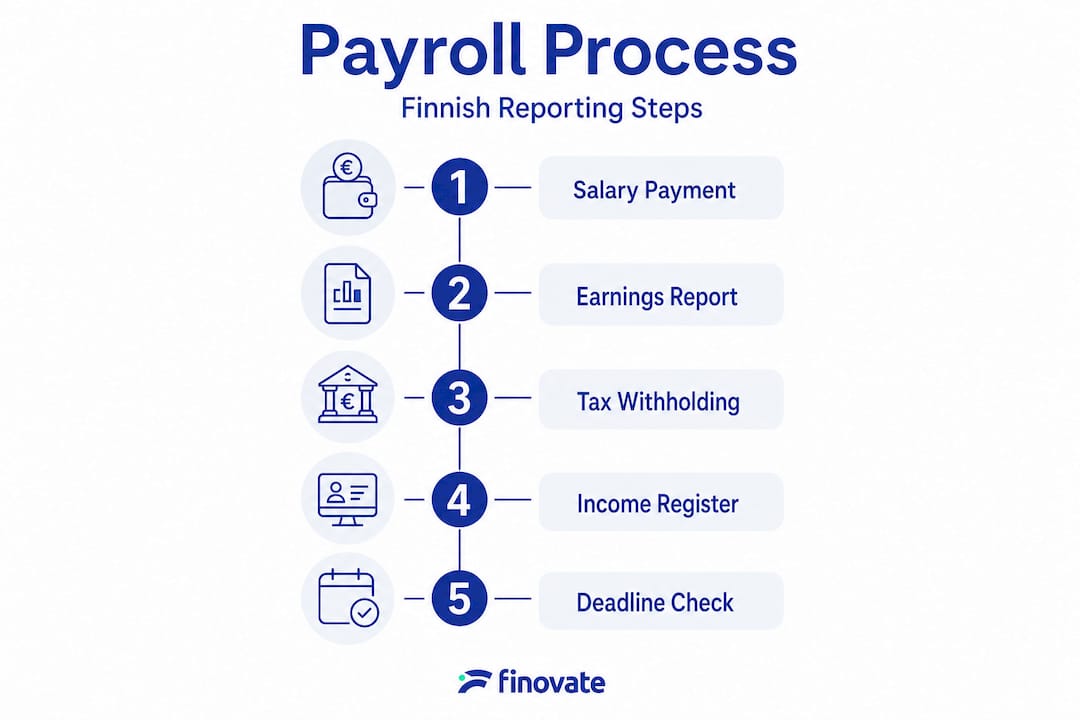
Good effective payroll management is built on knowing your deadlines. Here is a summary of the key obligations Finnish employers face:
| Obligation | Deadline | Authority |
|---|---|---|
| Income Register earnings report | Within 5 calendar days of payment | Tulorekisteri |
| Employer's social security contribution | Monthly, by the 12th | Finnish Tax Administration |
| Withholding tax payment | Monthly, by the 12th | Finnish Tax Administration |
| Annual payroll summary | January of the following year | Finnish Tax Administration |
| Pension insurance reporting | Monthly, varies by provider | Pension insurer |
These deadlines are firm. The five-day rule for Income Register reporting, in particular, catches many new employers off guard. If your payroll day falls on a Thursday, your report must reach the Income Register by the following Tuesday at the latest.
Understanding these rules sits at the heart of accounting rules and best practices for any Finnish business. Common pitfalls for SMEs include:
- Delayed submissions to the Income Register, often because the process is manual and the owner is occupied with core business tasks
- Incorrect withholding amounts due to outdated or misread tax cards
- Missing corrective reports when errors are spotted after the original submission
- Failure to report employer's social security contributions separately from the earnings report
- Confusing net salary with gross salary when calculating what to report
Each of these mistakes creates administrative work at best and financial penalties at worst. The structure of Finnish payroll compliance is precise by design, and the system is not built to forgive oversights from busy business owners.
What can go wrong: The risks of DIY payroll
Having laid out the compliance challenge, it is worth illustrating just how costly and stressful poor payroll handling can be. The risks go beyond simple fines. They affect your relationship with employees, your cash flow, and your business reputation.
Common mistakes in in-house payroll include a typo in bank account or personal identity details, applying the wrong withholding percentage because an employee failed to submit an updated tax card, missing the five-day Income Register deadline because of a public holiday miscalculation, and failing to report a benefit in kind such as a company car or meal benefit. These are not hypothetical errors. They happen regularly in businesses where the owner handles payroll alongside a dozen other daily tasks.

Errors in Finnish earnings payment data require corrective reporting via the Income Register, and replacement reporting can trigger late-filing penalties under specific timing rules. This means the act of fixing an error is itself subject to penalties if it is not done promptly and correctly.
Here is a comparison of what DIY and professional payroll typically look like in practice:
| Factor | DIY payroll | Professional payroll |
|---|---|---|
| Time spent per pay run | 2 to 5 hours | Minimal, handled externally |
| Risk of late submissions | High, especially during busy periods | Low, managed by trained professionals |
| Penalty exposure | Significant | Minimal |
| Staff satisfaction | Variable, errors affect trust | Consistent and accurate |
| Audit readiness | Often poor | High, with organised documentation |
| Scalability | Difficult as headcount grows | Straightforward to scale |
When you need to correct an error in the Income Register, the process involves these steps:
- Identify the specific error in the original earnings report
- Log in to the Income Register online service or use your payroll software's reporting function
- Submit a complete replacement report covering the entire reporting period, not just the corrected field
- Verify that the replacement report has been accepted and recorded
- Adjust any payroll records internally to reflect the correction
- Notify the affected employee if the error impacted their net pay or annual income summary
This is not a quick fix. It requires attention to detail and knowledge of the Income Register's specific replacement reporting rules. That is why access to payroll service examples from experienced providers can be genuinely instructive before you decide on your approach.
Pro Tip: Keep a payroll audit folder for each pay period. Store the original report confirmation, any corrections, correspondence with tax authorities, and copies of employee tax cards. If you are ever reviewed, this documentation shows that you acted responsibly and promptly.
Finnish Tax Administration guidance states that a late-filing penalty may be imposed when a replacement report is submitted late. The penalty amount depends on the nature and timing of the correction. Repeated late corrections are treated more seriously than first-time errors.
The benefits of hiring an accountant for payroll specifically include access to professionals who already know these correction procedures and can act immediately when an issue arises.
The benefits of professional payroll services
Now that the pitfalls of DIY payroll are clear, it is worth focusing on what professional payroll actually delivers. The advantages are practical, measurable, and directly relevant to Finnish SMEs.
Professional handling is valuable for compliance with Income Register submissions and tax-card-based withholding. But the benefits go further than just meeting deadlines. When payroll is managed by specialists, you gain consistency, accountability, and a structured process that works even when you are on holiday or dealing with a business crisis.
Professional payroll services for Finnish SMEs typically offer:
- Automatic Income Register submissions filed within the five-day window every pay period
- Tax-card verification at the start of employment and each January when updated cards are issued
- Error checking before reports are submitted, catching problems before they become penalties
- Employer contribution calculations covering pension, unemployment insurance, accident insurance, and group life insurance
- Payslip generation in a format employees can understand and retain
- Direct communication with authorities on your behalf when clarification is needed
- Year-end payroll summaries prepared accurately for tax filing purposes
- Proactive alerts when Finnish legislation changes affect payroll calculations
These services translate directly into hours returned to you each month. For a business owner managing a team of five to twenty people, professional payroll can save anywhere from ten to forty hours annually. Those are hours you can redirect to sales, customer service, product development, or simply having a clearer head.
Accounting services for Finnish SMEs that include payroll management provide a joined-up approach where payroll records feed directly into your bookkeeping, reducing duplication and the risk of discrepancies between your accounts and your tax filings.
Pro Tip: When speaking to a potential payroll provider, ask specifically how they handle mid-year tax card updates. This is a common area where errors occur, and a strong provider will have a clear, tested process for it.
Outsourcing for cost savings is often the motivation that brings SMEs to professional services, but the compliance protection is frequently the reason they stay.
How to choose the right payroll provider in Finland
With the benefits made clear, the next question is how to find a provider who genuinely delivers on Finnish compliance and SME support. Not all payroll services are equal, and choosing the wrong partner can create almost as many problems as managing payroll in-house.
Follow these steps to shortlist and evaluate potential providers:
- Confirm Finnish regulatory experience. Ask how long the provider has been handling payroll under Finnish law and whether they work specifically with SMEs or primarily with large corporations.
- Verify Income Register integration. Your provider should submit directly to the Tulorekisteri using approved software, not manually or through workarounds.
- Check their error correction process. Ask how they handle a discovered mistake and how quickly they can submit a replacement report.
- Request references from comparable businesses. A provider experienced with a ten-person retail business may not suit a growing tech startup, and vice versa.
- Review their communication standards. You should have a named contact, a clear response time commitment, and access to your payroll records whenever you need them.
- Understand their fee structure. Some providers charge per employee, others charge a flat monthly fee. Clarify what is and is not included.
When reviewing providers, look for these must-have features as a minimum:
- Direct Income Register integration with submission confirmation provided to you
- Real-time support for urgent queries, particularly around correction deadlines
- Proactive error identification before submissions are filed
- Updated knowledge of Finnish employment law and payroll regulations
- Clear processes for onboarding new employees and offboarding leavers
- Secure handling of personal data in compliance with GDPR
It is important to note that responsibility for corrections lies with the employer, even when a third party is handling your payroll. Outsourcing payroll reduces your risk significantly but does not transfer your legal accountability to the provider. This makes it essential to choose a partner you trust, and to review their work with reasonable regularity.
A strong bookkeeping guide for Finnish SMEs will reinforce that payroll records must align with your financial accounts. Your payroll provider and your bookkeeper should ideally be in close communication, or be the same firm.
What most guides miss: The invisible costs of ignoring payroll expertise
Most articles on payroll for small businesses focus on the obvious risks: missed deadlines, incorrect withholding, and penalties. These are real and important. But there is a layer of cost that rarely gets discussed, and it is the one that quietly damages Finnish SMEs over time.
When a business owner manages payroll themselves, the visible cost appears low. There is no monthly service fee, no external invoice to pay. What is invisible is the cumulative drain on time, focus, and emotional energy. An owner spending three hours on payroll every month is not just losing three hours of productive time. They are also spending cognitive energy on a task that carries significant stress, because the consequences of getting it wrong are serious.
Errors in payroll do not only attract fines. They affect employees directly. A wrong net payment, a delayed payslip, or an incorrect annual income summary creates distrust. Staff notice these errors. In a small team, payroll reliability is a signal of how well the business is managed overall. Repeated issues can contribute to staff turnover, which is itself a major cost.
There is also the audit dimension. Finnish tax authorities have the right to review payroll records, and a business with disorganised or incomplete documentation faces a significantly harder audit process. The stress and time involved in responding to an audit when your records are not in order can far exceed the cost of professional payroll for several years running.
We see this regularly in our work with Finnish SMEs. Owners come to us after managing payroll themselves for two or three years, often triggered by a penalty notice or a stressful audit request. Looking back at their tax prep for small businesses, the hidden costs of that period almost always outweigh the fees they would have paid a professional.
Our honest advice: treat professional payroll not as an expense to minimise, but as risk management. The monthly fee buys you accuracy, compliance, peace of mind, and the freedom to focus on growing your business.
Streamline payroll with trusted Finnish experts
Finovate provides tailored payroll, bookkeeping, and accounting solutions designed specifically for Finnish small businesses. Whether you are managing your first hire or scaling a growing team, we handle Income Register submissions, tax-card-based withholding, and employer contribution calculations so you can focus on running your business with confidence.
If you need flexible invoicing support alongside payroll, our Invoicing Service Pro and monthly invoicing solutions are built for Finnish SMEs at every stage. We combine these services into a joined-up approach that keeps your finances organised and your compliance secure. Contact Finovate today to arrange a consultation and take the first step towards stress-free payroll.
Frequently asked questions
What does Finnish payroll compliance require from small business owners?
Finnish SMEs must submit earnings reports to the Income Register within five days of salary payment and withhold taxes as stated on employee tax cards. Employer contributions to pension and social insurance must also be reported and paid on time.
What penalties can result from payroll filing mistakes in Finland?
Replacement reporting can trigger late-filing penalties under specific timing rules, meaning even the act of correcting an error can attract a fine if not completed within the required window.
Why is professional payroll considered valuable for Finnish SMEs?
Professional handling ensures compliance with Income Register obligations and tax-card-based withholding, while relieving business owners of the time and stress involved in managing complex local rules independently.
Is outsourcing payroll a legal requirement for Finnish businesses?
No, Finnish businesses are not legally required to outsource payroll, but many choose professional services to navigate the complexity of employer obligations and reduce the risk of penalties.
How do I correct an error in my Finnish payroll report?
You must submit a replacement report via the Income Register as soon as the error is identified, as delays in correction can result in a late-filing penalty being imposed.