

TL;DR:
- Finnish entrepreneurs must file formal annual accounts only if their business exceeds certain size thresholds for two consecutive years.
- Proper bookkeeping methods and timely preparation help avoid penalties and improve business decision-making.
Filing annual accounts means submitting formal financial statements to comply with Finnish accounting and taxation law, giving your business a clear and verifiable financial record. For entrepreneurs and small business owners in Finland, understanding why file annual accounts matters is not just about avoiding penalties. The Finnish Accounting Act, known as Kirjanpitolaki, sets out specific thresholds that determine whether your business must produce a formal tilinpäätös (annual accounts) or simply maintain bookkeeping records. Getting this right protects your business, supports your tax returns, and builds credibility with banks and partners.
Why file annual accounts: who must do it in Finland?
The annual accounts filing obligation in Finland is not universal. It applies only when a business crosses specific financial and staffing thresholds under the Kirjanpitolaki. Knowing where you stand is the first step to staying compliant.
Under the Finnish Accounting Act, the filing obligation arises only if a micro-entity exceeds at least two of three thresholds for two consecutive financial years. Those thresholds are:
- Balance sheet total: exceeds €450,000
- Net turnover: exceeds €900,000
- Average number of employees: exceeds 10
Two consecutive years matter here. Exceeding thresholds in a single year does not trigger the obligation. This gives smaller businesses a degree of protection against sudden compliance burdens during a strong trading year.
Most sole traders (toiminimi) below these thresholds are only required to maintain bookkeeping records and submit an annual tax return using Form 5. They do not need to produce a formal tilinpäätös. This distinction is critical. Bookkeeping and formal annual accounts are not the same thing, and confusing them can lead to either unnecessary work or, worse, non-compliance.
Pro Tip: Check your figures against all three thresholds at the end of each financial year. If you are approaching two of them, start preparing for formal filing requirements before the second year closes.
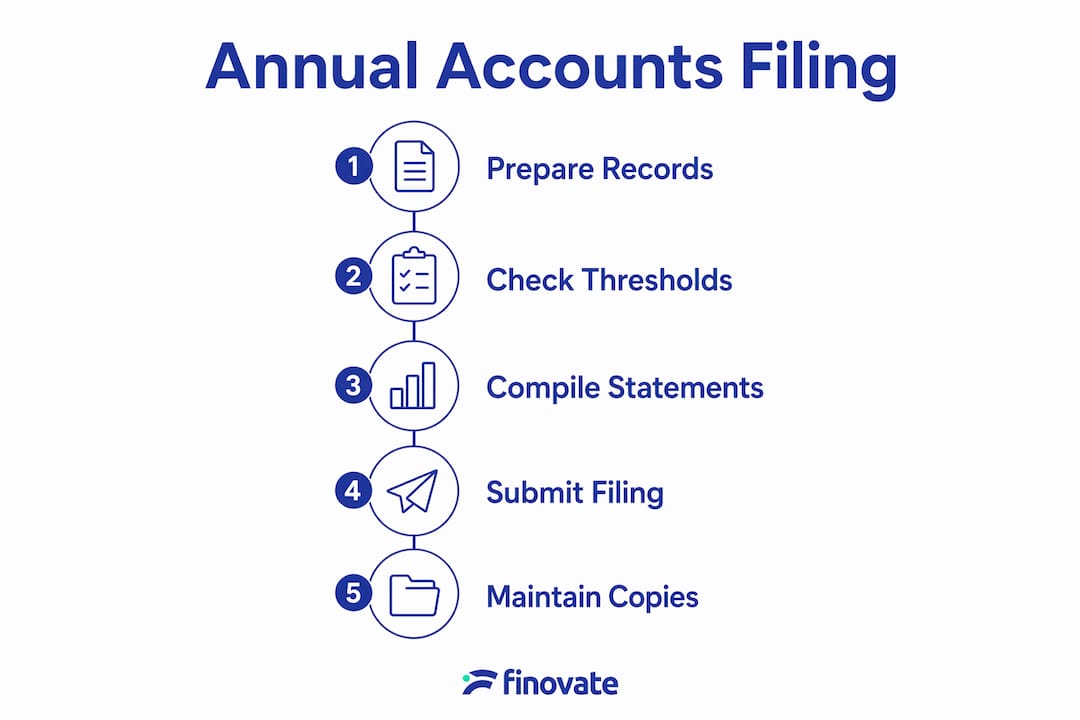
What is the difference between bookkeeping and formal annual accounts?
The method of bookkeeping your business uses depends directly on its size. Finnish law recognises two distinct approaches, and the one that applies to you determines your filing obligations.

Single-entry bookkeeping (yhdenkertainen kirjanpito) is permitted when your turnover is under €200,000, your balance sheet is under €100,000, and you employ no more than three people. This simplified method records income and expenses in a straightforward cash-based format. It is well suited to freelancers, light entrepreneurs, and very small sole traders.
Double-entry bookkeeping (kahdenkertainen kirjanpito) is required for businesses that exceed those smaller thresholds. It records every transaction in two accounts simultaneously, providing a fuller picture of financial position. Businesses using double-entry bookkeeping and exceeding the micro-entity thresholds must then produce formal annual accounts.
| Feature | Single-entry bookkeeping | Double-entry bookkeeping |
|---|---|---|
| Turnover limit | Under €200,000 | No upper limit |
| Balance sheet limit | Under €100,000 | No upper limit |
| Employee limit | Up to 3 | Any number |
| Annual accounts required | No (tax return only) | Yes, if micro-entity thresholds exceeded |
| Complexity | Low | Moderate to high |
Formal annual accounts must include a balance sheet, a profit and loss statement, and accompanying notes. These documents give a complete picture of your financial position at year end. They also form the basis for accurate tax reporting, which means errors in your accounts can flow directly into errors on your tax return.
Pro Tip: Even if you are not legally required to produce formal annual accounts, preparing a simplified version voluntarily gives you a clearer view of your business performance and makes tax filing considerably easier.
What are the practical benefits of filing annual accounts?
The importance of filing accounts goes well beyond satisfying a legal requirement. Accurate annual accounts give you information you cannot get from a bank statement alone.
Accurate annual accounts provide vital insights for pricing, cash flow management, and business growth decisions. A business that knows its true cost base can price its services correctly. One that tracks cash flow patterns can plan for quieter months without running into trouble.
The benefits of annual accounts extend to your relationships with external stakeholders. Banks, investors, and potential business partners all assess your financial statements before making decisions. A well-prepared set of accounts signals that your business is managed responsibly. That credibility can be the difference between securing a loan and being turned down.
"Annual accounts are not just a compliance document. They are the clearest financial mirror your business has. Entrepreneurs who read them regularly make better decisions than those who file and forget."
Annual accounts also support long-term planning. When you can compare this year's figures against last year's, you spot trends early. A rising cost line, a shrinking margin, or a growing debtor balance all become visible. Catching these patterns early gives you time to act before they become serious problems. For Finnish entrepreneurs seeking financial report guidance, understanding what your accounts contain is as important as producing them.
- Cash flow visibility: Annual accounts reveal whether your business generates enough cash to cover its obligations throughout the year.
- Pricing accuracy: Knowing your true costs prevents underpricing, which is one of the most common reasons small businesses struggle financially.
- Funding access: Lenders and investors require formal accounts before approving credit or investment.
- Tax accuracy: Accounts prepared correctly reduce the risk of errors on your tax return and the scrutiny that follows.
- Business valuation: If you ever sell your business, accurate historical accounts are the foundation of any credible valuation.
What are the penalties for failing to file annual accounts on time?
Non-compliance carries real consequences. Finnish tax authorities and courts take late or missing filings seriously, and the risks extend beyond financial penalties.
- Legal penalties. Finnish law allows authorities to impose fines on businesses that fail to meet their filing obligations. Repeated failures can escalate the severity of sanctions.
- Tax discrepancies and audits. Missing or inaccurate accounts increase the likelihood of errors on your tax return. Tax authorities may then initiate an audit, which is time-consuming and stressful.
- Reputational damage. Stakeholders, including banks, suppliers, and clients, may view late filings as a sign of poor financial management. That perception can affect your ability to win contracts or negotiate credit terms.
- Financing complications. Late filing damages lender and investor confidence. Banks routinely check filing histories before approving business loans. A gap in your records raises immediate questions.
- Loss of limited liability protection. In some business structures, persistent non-compliance can expose directors or owners to personal liability for business debts.
The consequences of not filing accounts on time compound over time. A missed deadline one year makes the following year harder, because you are then managing two sets of obligations simultaneously. Staying current is always easier than catching up.
How can small businesses simplify the annual accounts filing process?
Preparation throughout the year is the single most effective way to reduce the stress of annual accounts filing. Leaving everything until the deadline creates errors, missed deductions, and unnecessary costs.
Organised bookkeeping throughout the year simplifies annual accounts preparation, reducing errors and last-minute workload. The businesses that find filing easiest are those that treat their accounts as a live document, not an annual chore.
- Maintain records monthly. Reconcile your bank statements, categorise expenses, and file receipts every month. Do not leave this until december.
- Use digital accounting tools. Accounting software suited to your business size automates many routine tasks and reduces the chance of manual errors.
- Know your deadlines. The annual tax return for sole traders in Finland uses Form 5. Missing this deadline triggers penalties that are entirely avoidable.
- Understand what you owe. Review your quarterly tax obligations alongside your annual filing requirements to avoid surprises.
- Engage professional support early. An accountant who knows your business can prepare your accounts faster and more accurately than a rushed self-filing attempt at year end.
Pro Tip: Set a recurring calendar reminder for the first week of each month to update your bookkeeping records. Thirty minutes a month saves hours at year end.
For entrepreneurs managing accounts across different business structures, understanding the Finnish accounting rules that apply to your specific situation is worth the time investment. Small businesses that understand their obligations rarely face penalties. Those that do not often pay more than just the fine.
Key takeaways
Filing annual accounts is a legal requirement for Finnish businesses that exceed two of three micro-entity thresholds for two consecutive years, and a financial management tool that every entrepreneur benefits from understanding.
| Point | Details |
|---|---|
| Filing thresholds | Obligation arises when two of three thresholds are exceeded for two consecutive years. |
| Bookkeeping method matters | Single-entry suits very small businesses; double-entry is required above set limits. |
| Benefits beyond compliance | Accounts support pricing, cash flow planning, and access to funding. |
| Penalties are real | Late or missing filings trigger fines, audits, and damage to lender confidence. |
| Year-round preparation | Monthly bookkeeping reduces errors and makes annual filing straightforward. |
Annual accounts as a business tool, not a burden
I have worked with many Finnish entrepreneurs who treat their annual accounts as something to get through rather than something to use. That approach costs them more than they realise. The businesses I see struggle most are not the ones with the most complex finances. They are the ones that file their accounts without reading them.
The annual accounts necessity goes beyond satisfying the tax authority. When you sit with your balance sheet and profit and loss statement and actually read them, you see your business clearly. You see where money is going, where it is being made, and where the gaps are. That information is worth more than the time it takes to produce the documents.
The misconception I encounter most often is that formal filing only matters once a business gets large. The truth is the opposite. The habits you build when your business is small, monthly reconciliation, clean records, and timely submissions, are the habits that make growth manageable. Entrepreneurs who wait until they are forced to file properly often find the catch-up process painful and expensive. Starting early, even voluntarily, is always the better choice.
— Busayo
How Finovate supports Finnish entrepreneurs with annual accounts
Filing your annual accounts correctly requires more than good intentions. It requires accurate records, knowledge of Finnish accounting law, and time you may not have.
Finovate provides bookkeeping, tax preparation, payroll, and business advisory services tailored to entrepreneurs and small business owners in Finland. Whether you are a sole trader deciding which bookkeeping method applies to you, or a growing business approaching the micro-entity thresholds, Finovate's team can guide you through every step. Visit Finovate's accounting services to see how professional support reduces risk and keeps your business compliant. For light entrepreneurs and self-employed individuals, Finovate also offers a specialist accounting service designed around your specific needs.
FAQ
Do I have to file annual accounts as a sole trader in Finland?
Most sole traders below the micro-entity thresholds only need to maintain bookkeeping and submit Form 5 as their annual tax return. Formal annual accounts are required only if you exceed two of three thresholds for two consecutive years.
What are the thresholds that trigger the annual accounts filing obligation?
The three thresholds under the Finnish Accounting Act are a balance sheet total of €450,000, net turnover of €900,000, and an average of 10 employees. You must exceed at least two of these for two consecutive years before the obligation applies.
What does a formal set of annual accounts include?
Formal annual accounts must include a balance sheet, a profit and loss statement, and accompanying notes. These documents together provide a complete picture of your business's financial position at the end of the financial year.
What happens if I miss the annual accounts filing deadline?
Late or missing filings can result in legal fines, increased scrutiny from tax authorities, and damage to your credibility with lenders and business partners. Repeated non-compliance can escalate the severity of penalties.
Can I use single-entry bookkeeping for my Finnish business?
Single-entry bookkeeping is permitted if your turnover is under €200,000, your balance sheet is under €100,000, and you employ no more than three people. Businesses above these limits must use double-entry bookkeeping.