

TL;DR:
- Finnish entrepreneurs must file quarterly VAT returns and prepayment taxes every three months through OmaVero. Missing deadlines incurs penalties starting at 5 percent of taxes due and accrues interest, risking financial and legal consequences. Proper planning and timely submission support cash flow and compliance, especially for small businesses and light entrepreneurs.
Quarterly tax filing is the process by which entrepreneurs and small business owners in Finland submit their VAT returns and prepayment taxes to the Finnish Tax Administration every three months. The formal term used by Finnish authorities is neljännesvuosittainen veroilmoitus, though most business owners simply refer to it as quarterly filing. Understanding what is quarterly tax filing, and doing it correctly, protects you from penalties, keeps your cash flow predictable, and satisfies your legal obligations under Finnish tax law. The Finnish Tax Administration's online portal, OmaVero, is the primary platform for submitting these returns. Many new entrepreneurs find the process manageable once they understand the deadlines and requirements.
What are the quarterly tax filing deadlines in Finland?
For businesses on a quarterly VAT reporting cycle, the filing deadline falls on the 12th day of the second month after each quarter ends. That means your Q1 return (january through march) is due by 12 may. Q2 (april through june) is due by 12 august. Q3 (july through september) is due by 12 november. Q4 (october through december) is due by 12 february of the following year.
Missing these dates carries real financial consequences. Late VAT filing triggers a penalty starting at 5% of the tax due, with a minimum charge of 5 € and a cap of 15,000 €. Interest accrues on top of that, typically in the range of 7–11%. These costs add up quickly, and repeated late filings can damage your standing with the Finnish Tax Administration.
| Quarter | Period covered | Filing deadline | Late penalty |
|---|---|---|---|
| Q1 | January – March | 12 may | 5% of tax due (min 5 €) + interest |
| Q2 | April – June | 12 august | 5% of tax due (min 5 €) + interest |
| Q3 | July – September | 12 november | 5% of tax due (min 5 €) + interest |
| Q4 | October – December | 12 february (next year) | 5% of tax due (min 5 €) + interest |
Pro Tip: Set a calendar reminder two weeks before each deadline. This gives you time to gather invoices, reconcile your accounts, and correct any errors before the 12th arrives.
Who must file quarterly taxes in Finland?
VAT registration and filing frequency in Finland depend on your annual turnover. Businesses with turnover below 50,000 € per year are generally eligible to file VAT quarterly rather than monthly. Businesses above that threshold must file monthly. The lower threshold for mandatory VAT registration is 10,000 € in annual turnover. Below that figure, VAT registration is optional.
The rules for light entrepreneurs depend on whether you hold a Business ID. Light entrepreneurs operating through invoicing services without a Business ID have their taxes handled automatically by the service provider. Those who hold a Business ID must manage their own VAT and prepayment tax filings actively. This distinction matters because the responsibility for compliance shifts entirely to you the moment you register a Business ID.
One rule applies to every registered business without exception: you must file even if you had no turnover during the quarter. A zero return is still a return. Failing to submit it triggers the same penalties as missing a return with tax due.
Key filing requirements at a glance:
- Annual turnover above 10,000 € requires VAT registration.
- Turnover below 50,000 € qualifies for quarterly VAT filing.
- Turnover above 50,000 € requires monthly VAT filing.
- Prepayment tax must be filed and paid quarterly regardless of turnover level.
- Light entrepreneurs with a Business ID manage their own filings.
- A nil return must be submitted for quarters with zero income.
Pro Tip: If your turnover is close to the 50,000 € threshold, review your figures at the start of each quarter. Crossing the threshold mid-year means switching to monthly filing, and missing that switch creates compliance risk.
For a fuller picture of tax responsibilities for entrepreneurs, including how Business ID obligations work in practice, Finovate's guide covers the topic in detail.
How to file quarterly taxes: step by step
Filing quarterly taxes in Finland follows a clear sequence. Work through these steps for each quarter to stay accurate and on time.
-
Gather your records. Collect all sales invoices, purchase invoices, and receipts for the quarter. Accurate bookkeeping and invoicing are the foundation of a correct VAT return. Errors in your records produce errors in your filing.
-
Calculate your VAT. Add up the VAT you charged on sales (output VAT). Then add up the VAT you paid on business purchases (input VAT). The difference is what you owe or what you can reclaim.
-
Log in to OmaVero. The Finnish Tax Administration's OmaVero portal is where you submit both your VAT return and your prepayment tax declaration. The interface is in Finnish and Swedish, so use the language you are most comfortable with or work with an accountant.
-
Submit your VAT return. Enter your output VAT, input VAT, and net tax due. Double-check the figures before submitting. OmaVero confirms receipt immediately.
-
Review and update your prepayment tax. OmaVero lets you adjust prepayment amounts to match your expected income for the quarter. If your income has changed significantly since your last assessment, update the figure. Overpaying ties up cash you could use in the business. Underpaying creates a tax debt at year end.
-
Pay any tax due. Transfer the VAT and prepayment tax amounts to the Finnish Tax Administration's bank account by the deadline. Payment must clear by the 12th, not just be initiated.
-
File a nil return if needed. If you had no sales or purchases in the quarter, log in to OmaVero and submit a zero return. Do not skip this step.
Common pitfalls to avoid include mixing personal and business expenses in your accounts, forgetting to include all sales channels in your VAT calculation, and leaving the filing to the last day without a buffer for technical issues.
Pro Tip: Keep a dedicated folder, physical or digital, for each quarter's invoices. Sorting documents as they arrive takes minutes. Sorting them the night before the deadline takes hours.

For a detailed walkthrough of the full process, Finovate's step-by-step tax filing guide covers each stage with practical examples.
What are the benefits of quarterly tax filing?
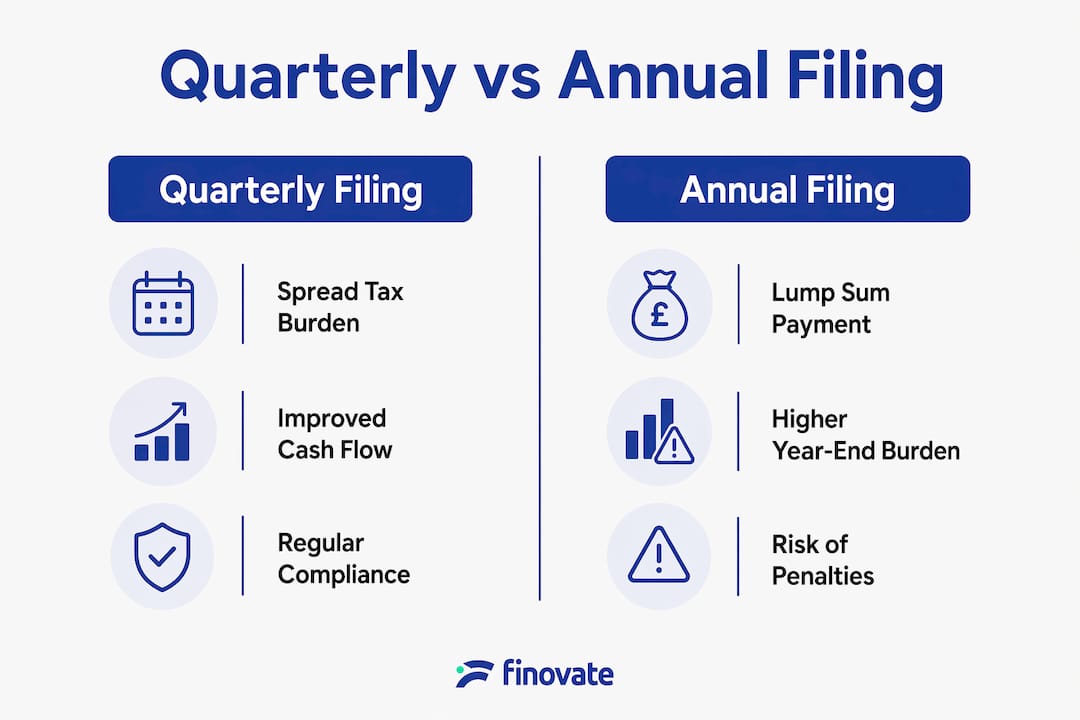
Quarterly estimated taxes spread your tax liability across the year rather than concentrating it at year end. Breaking payments into quarters reduces the risk of a large, unexpected tax bill in december or january. For a small business with variable income, that predictability is genuinely valuable.
Compliance is the most direct benefit. Submitting returns on time avoids the 5% late penalty and the associated interest charges. Over a full year, those savings are meaningful, particularly for businesses operating on tight margins. Timely filing also maintains a clean record with the Finnish Tax Administration, which matters if you ever apply for business credit or grants.
Quarterly filing also supports better financial planning. When you calculate your VAT and prepayment tax every three months, you get a regular, accurate picture of your taxable income. That information feeds directly into your budgeting decisions. You know what you owe, what you have earned, and what you can spend.
| Factor | Quarterly filing | Annual filing |
|---|---|---|
| Cash flow impact | Spread evenly across the year | Large lump sum at year end |
| Penalty risk | Lower, with four clear deadlines | Higher if year-end payment is missed |
| Financial visibility | Updated every three months | Updated once per year |
| Planning accuracy | High, with regular income data | Lower, relying on estimates |
| Compliance burden | Four submissions per year | One submission, but higher stakes |
Treating tax as a continuous process rather than a year-end task is the single most effective habit Finnish entrepreneurs can develop. It removes the stress of annual surprises and keeps your finances in order throughout the year.
For practical strategies on managing tax obligations around quarterly cycles, Finovate's planning guide offers specific approaches for small businesses.
Key takeaways
Quarterly tax filing in Finland requires four annual submissions through OmaVero, with deadlines on the 12th of may, august, november, and february, and late penalties starting at 5% of tax due.
| Point | Details |
|---|---|
| Core definition | Quarterly filing means submitting VAT and prepayment tax to the Finnish Tax Administration every three months. |
| Key deadlines | Returns are due on 12 may, 12 august, 12 november, and 12 february each year. |
| Who must file | Any VAT-registered business, including those with zero turnover in the quarter, must submit a return. |
| Penalty risk | Late filing triggers a 5% penalty (minimum 5 €, capped at 15,000 €) plus interest of 7–11%. |
| Main benefit | Quarterly payments spread tax liability evenly, reducing year-end financial pressure and supporting cash flow. |
Quarterly filing: what I have learned working with Finnish entrepreneurs
Working with entrepreneurs across Finland, I have noticed one pattern that separates those who manage quarterly filing confidently from those who dread it. The confident ones treat the 12th of each filing month as a fixed point in their business calendar, the same way they treat payroll or rent. They do not wait for a reminder. They have already set aside the tax amount throughout the quarter.
The entrepreneurs who struggle tend to view quarterly filing as an interruption rather than a routine. They scramble for invoices, underestimate what they owe, and sometimes miss the deadline entirely. The penalty is rarely catastrophic on its own, but the stress and the accumulated interest are entirely avoidable.
My practical advice is straightforward. Maintain a tax compliance calendar with all four deadlines marked at the start of the year. Review your prepayment tax estimate in OmaVero at the start of each quarter, especially if your income has shifted. And never assume a quiet quarter means no filing obligation. A nil return takes five minutes to submit and costs nothing. Missing it costs you money and credibility.
Light entrepreneurs with a Business ID often underestimate how much active management their tax position requires. Clear guidance on filing responsibility is not optional for this group. It is the difference between compliance and an avoidable penalty.
The Finnish tax system is not designed to catch you out. It is designed to be predictable. Work with that predictability rather than against it.
— Busayo
Finovate's services for quarterly tax compliance
Quarterly tax filing does not have to consume your time or create uncertainty about whether you have done it correctly. Finovate provides invoicing and accounting services built specifically for Finnish entrepreneurs, covering VAT return preparation, prepayment tax management, and filing support through OmaVero.

We handle the calculations, track the deadlines, and flag any adjustments needed to your prepayment tax before each quarter closes. You stay informed without having to manage the detail yourself. Whether you are a sole trader, a light entrepreneur with a Business ID, or a growing small business, our monthly invoicing service keeps your quarterly filings accurate and on time. For businesses that want expert advisory support alongside filing assistance, our pro invoicing service includes tax planning guidance tailored to your income and business structure. Contact Finovate to discuss which service fits your situation.
FAQ
What is quarterly tax filing in Finland?
Quarterly tax filing is the submission of VAT returns and prepayment tax declarations to the Finnish Tax Administration every three months through OmaVero. It applies to VAT-registered businesses with annual turnover below 50,000 €.
When are the quarterly tax filing deadlines in 2026?
The four deadlines are 12 may (Q1), 12 august (Q2), 12 november (Q3), and 12 february 2027 (Q4). Returns and payments must both clear by each date.
What happens if I miss a quarterly filing deadline?
A late filing penalty of 5% of the tax due applies immediately, with a minimum charge of 5 € and a cap of 15,000 €. Interest of approximately 7–11% also accrues on any unpaid amount.
Do I need to file if I had no income in the quarter?
Yes. VAT-registered businesses must submit a nil return even if they had zero turnover during the quarter. Failing to do so triggers the same penalties as missing a return with tax due.
Can light entrepreneurs use quarterly filing?
Light entrepreneurs who operate without a Business ID have taxes handled by their invoicing service provider. Those who hold a Business ID must manage their own quarterly VAT and prepayment tax filings directly through OmaVero.