

TL;DR:
- Finnish entrepreneurs must accurately file their taxes by selecting the correct form—Form 5 for sole traders and Form 6B for limited companies—and verifying pre-populated data in the MyTax portal.
- Gathering complete documentation, including business IDs, invoices, bank statements, and mileage logs, is essential to avoid errors and penalties during the process.
- Effective tax planning entails claiming automatic deductions like the entrepreneur deduction and maintaining detailed records for reimbursements, while ensuring timely VAT and correction filings.
Tax filing step by step is the systematic process entrepreneurs use to accurately report income, claim deductions, and meet Finnish tax obligations on time. For small business owners in Finland, the process differs significantly depending on your legal entity. A sole trader operating as a Toiminimi files using Form 5, while a limited company (Osakeyhtiö) uses Form 6B. Understanding which form applies to you, what documents you need, and how to use the MyTax portal at vero.fi determines whether your filing is accurate, compliant, and completed without penalties.
What documents are needed for tax filing in Finland?
Before you begin the step-by-step tax preparation process, you need the right registrations and records in place. Filing without complete documentation leads to errors, delays, and potential penalties from the Finnish Tax Administration (Verohallinto).
Registrations and identifiers you need:
- Your Y-tunnus (Finnish business ID), issued when you registered your company through the Business Information System (YTJ)
- VAT registration confirmation, if your annual turnover exceeds EUR 15,000
- Personal tax card or prepayment tax decision, relevant for Toiminimi owners
- Access credentials for the MyTax portal at vero.fi
Financial documents to gather:
- All sales invoices issued during the tax year
- Purchase receipts and expense documentation
- Bank statements covering the full financial year
- Payroll records, if you have employees
- Mileage logs and travel expense records for reimbursement claims
- Loan agreements and interest payment statements
The bookkeeping format you use also matters. Single-entry bookkeeping is permitted for Toiminimi owners with turnover under EUR 200,000, while Osakeyhtiö requires double-entry bookkeeping and annual financial statements. This distinction affects how you organise your records before filing. Gathering everything before you log into MyTax saves considerable time and reduces the risk of submitting incomplete returns.
| Prerequisite | Details |
|---|---|
| Y-tunnus | Finnish business ID required for all tax filings |
| VAT registration | Mandatory if annual turnover exceeds EUR 15,000 |
| Sales invoices | All issued invoices for the tax year |
| Bank statements | Full-year statements to verify income and expenses |
| Mileage logs | Required to support tax-free reimbursement claims |
| MyTax access | Login credentials for vero.fi portal |
How to complete your Finnish tax return accurately
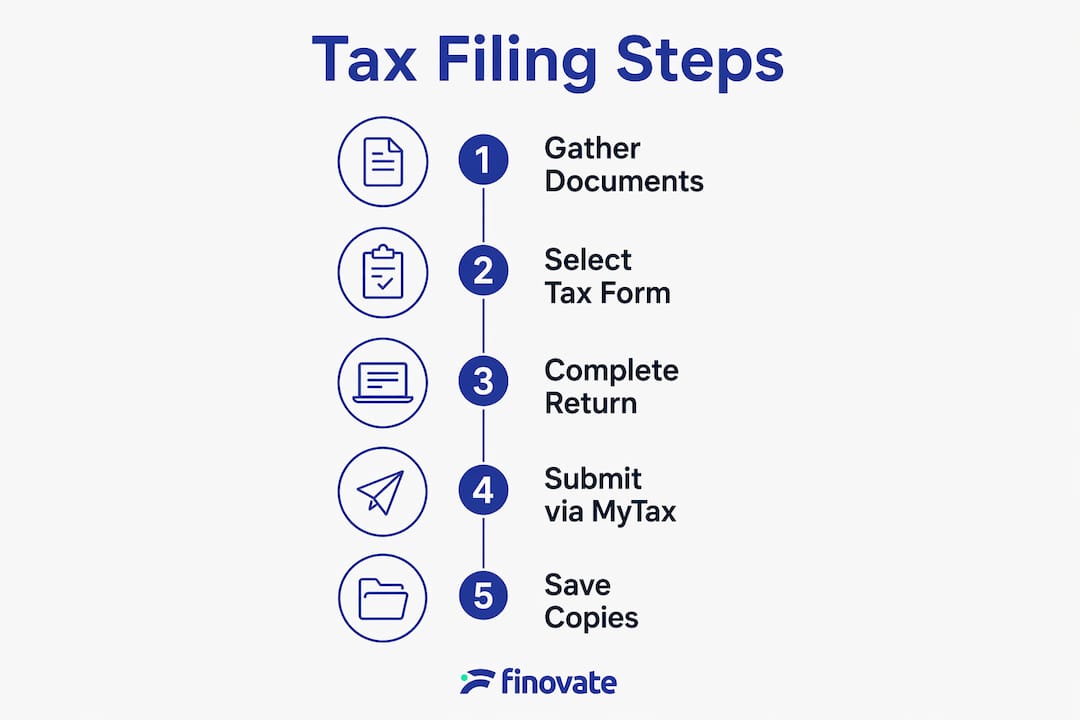
The actual tax filing process follows a clear sequence. Working through each step in order reduces the chance of errors and makes the submission process far less stressful.
-
Log in to MyTax at vero.fi. Use your Finnish online banking credentials or a mobile certificate to access your account securely.
-
Select the correct tax return form. Toiminimi owners file using Form 5 (business income for self-employed persons). Osakeyhtiö owners file the corporate tax return using Form 6B. Selecting the wrong form is one of the most common tax filing mistakes, and it requires correction before the deadline.
-
Review pre-populated data. MyTax pre-populates prior data from previous filings and third-party sources such as banks and employers. Review every pre-filled field carefully. Pre-populated figures are not always current or complete, and submitting them without review can result in under-reporting or over-reporting income.
-
Enter your business income. Report all revenue generated during the tax year. For Toiminimi, this is your net business income after deducting allowable expenses. For Osakeyhtiö, this is the company's taxable profit before applying the flat 20% corporate income tax rate.
-
Enter deductible business expenses. Include all documented costs directly related to your business activity. Common deductible items include office rent, equipment, software subscriptions, professional services, and travel costs. Keep all receipts, as Verohallinto may request supporting documentation.
-
Report VAT figures if applicable. If you are VAT-registered, confirm that your VAT returns for the period are consistent with the income and expense figures on your tax return.
-
Apply relevant deductions. The 5% entrepreneur deduction is applied automatically by Verohallinto for Toiminimi owners, but you should verify it appears correctly on your return. Additional deductions such as mileage allowances require manual entry.
-
Check all figures and submit. Cross-reference your entries against your bookkeeping records before submitting. Once submitted, you receive a confirmation reference number. Keep this for your records.
Pro Tip: Before submitting, print or save a PDF copy of your completed return. If Verohallinto contacts you with a query, having the exact version you submitted makes responding far quicker.
The tax filing process for Toiminimi owners is generally simpler because the business income flows directly to personal taxation. Osakeyhtiö filing involves an additional layer of corporate tax calculation before any salary or dividend distribution is considered.

What tax deductions do Finnish entrepreneurs commonly miss?
Reducing your tax liability legally starts with knowing which deductions exist and which ones require action on your part. Several valuable reliefs go unclaimed each year simply because entrepreneurs are unaware of them.
The 5% entrepreneur deduction is applied automatically by Verohallinto for self-employed Toiminimi owners. This means you do not need to apply for it separately, but you should confirm it appears on your return. Missing it in your review could mean accepting an incorrectly calculated tax bill.
Tax-free reimbursements such as mileage allowances and daily travel allowances are among the most tax-efficient methods available to entrepreneurs. These payments are deductible for the company and tax-free for the recipient. Many business owners overlook these entirely or fail to keep the travel logs required to support the claims.
Commonly missed deductions for Finnish entrepreneurs:
- Mileage allowances for business travel (requires a detailed travel log with dates, destinations, and purpose)
- Daily allowances for overnight business trips
- Home office deduction, calculated based on the proportion of your home used for business
- Professional development costs, including courses, books, and training relevant to your business
- Equipment and technology purchases, including computers, phones, and software
- Pension insurance contributions (YEL) paid during the year
For Osakeyhtiö owners, the distinction between salary and dividend taxation is particularly significant. Dividends from Osakeyhtiö are lightly taxed up to a certain threshold, making them a more tax-efficient extraction method than salary above that level. Understanding this balance is part of effective step-by-step tax preparation.
Effective tax planning for entrepreneurs involves maximising automatic deductions and reimbursements before salary or dividend distributions are considered. Addressing these in the right order can reduce your overall tax burden substantially.
You can also find a broader overview of legal tax reduction methods that apply across small businesses internationally, many of which align with Finnish practice.
How do VAT returns work during the tax filing process?
VAT filing is a separate obligation from your annual income tax return, but it runs in parallel and must be consistent with your annual figures. Getting VAT right is a core part of any complete tax filing guide for Finnish entrepreneurs.
VAT registration is required once your annual turnover exceeds EUR 15,000. Below this threshold, registration is optional but may be beneficial if your clients are VAT-registered businesses. VAT filing frequency depends on your turnover. New registrants typically file monthly, but businesses with lower sales volumes can apply to Verohallinto for quarterly or annual reporting.
Key VAT compliance points:
- Monthly VAT returns are due by the 12th of the second month following the reporting period
- Quarterly returns are due by the 12th of the second month after the quarter ends
- Annual VAT filers submit by the end of February following the tax year
- Payments must be made by the same deadline as the return submission
- Late VAT filing leads to penalties, though submitting the missing return usually cancels the penalty
If you discover an error in a previously submitted VAT return, you must file a corrective return. The corrective return must fully replace the original return for the same period and include a clear explanation of the reason for the correction. Partial amendments are not accepted. Filing corrections promptly limits the risk of further penalties and keeps your compliance record clean.
All VAT returns are submitted through MyTax. The portal stores your filing history, making it straightforward to cross-reference previous periods when preparing corrections or annual summaries.
What are the most common tax filing errors to avoid?
Even experienced business owners make avoidable mistakes during the filing process. Recognising these errors in advance is the most reliable way to prevent them.
Common mistakes in the Finnish tax filing process:
- Selecting the wrong tax return form (Form 5 versus Form 6B)
- Failing to review pre-populated MyTax data before submission
- Missing the entrepreneur deduction because it was not verified on the return
- Submitting VAT returns late due to poor diary management
- Claiming deductions without supporting documentation
- Failing to maintain a mileage log, which invalidates travel reimbursement claims
Late filing carries financial consequences. Verohallinto issues late-filing penalties that increase the longer a return remains outstanding. Filing an incomplete return on time is generally preferable to filing a complete return late, as corrections can be submitted after the deadline.
Pro Tip: Set calendar reminders at least four weeks before each tax deadline. This gives you time to gather documents, review figures, and resolve any discrepancies without rushing. Early preparation consistently produces more accurate returns.
If your situation involves complex deductions, multiple income streams, or an Osakeyhtiö structure, professional accounting support removes the risk of costly errors. Finovate provides SME accounting support in Finland, covering tax preparation, VAT filing, and bookkeeping for businesses at every stage.
Key takeaways
Accurate tax filing in Finland requires choosing the correct legal entity form, gathering complete financial records, verifying pre-populated MyTax data, and claiming all eligible deductions before submission.
| Point | Details |
|---|---|
| Choose the correct form | Toiminimi uses Form 5; Osakeyhtiö uses Form 6B. Selecting the wrong form requires correction. |
| Verify MyTax pre-fills | Pre-populated data is not always accurate. Review every field before submitting. |
| Claim the entrepreneur deduction | The 5% deduction is automatic for Toiminimi but must be confirmed on your return. |
| Keep mileage and travel logs | Without a detailed log, mileage reimbursement claims cannot be supported. |
| File VAT returns on time | Late VAT submission triggers penalties; corrective returns must fully replace the original. |
My perspective on tax filing for Finnish entrepreneurs
Having worked with Finnish entrepreneurs across Toiminimi and Osakeyhtiö structures, the single most consistent finding is this: the business owners who find tax filing straightforward are the ones who treat it as a year-round process rather than an annual event.
The MyTax portal is genuinely well-designed. It pre-fills a significant amount of data, and for straightforward Toiminimi filings, the process can be completed in under an hour if your bookkeeping is current. The problem is that most entrepreneurs arrive at filing time with incomplete records, missing receipts, and no mileage log. That is when a one-hour task becomes a two-day ordeal.
The deductions area is where I see the most money left on the table. The entrepreneur deduction is automatic, but mileage allowances and daily travel allowances require deliberate record-keeping throughout the year. Many entrepreneurs I speak with have done qualifying business travel but cannot claim it because they never kept a log. That is a straightforward loss that proper preparation eliminates entirely.
For Osakeyhtiö owners, the salary versus dividend question deserves attention before the tax year ends, not after. The tax efficiency threshold between these two extraction methods shifts depending on your profit level, and getting the balance right before year-end is far more effective than trying to adjust it retrospectively.
My honest recommendation: spend thirty minutes in January setting up a simple expense tracking system and a mileage log. By the time filing season arrives, you will have everything you need.
— Busayo
How Finovate supports your tax filing in Finland
Filing taxes accurately takes time, knowledge, and attention to detail that many business owners simply cannot spare during a busy trading year. Finovate provides accounting, bookkeeping, VAT filing, and tax preparation services specifically for Finnish entrepreneurs and small businesses. Whether you operate as a Toiminimi or an Osakeyhtiö, we handle the detail so you can focus on running your business. Our team keeps your records current throughout the year, prepares your returns accurately, and flags deductions you might otherwise miss. Contact Finovate's tax and accounting team to discuss how we can support your next filing.
FAQ
What is the difference between Form 5 and Form 6B in Finland?
Form 5 is the tax return for self-employed sole traders (Toiminimi), reporting business income directly to personal taxation. Form 6B is the corporate tax return for limited companies (Osakeyhtiö), subject to Finland's flat 20% corporate income tax rate.
When is the tax return deadline for Finnish entrepreneurs?
The annual tax return deadline for Toiminimi owners is typically in April, while Osakeyhtiö companies must file within four months of the end of their financial year. Exact dates are confirmed annually by Verohallinto and displayed in MyTax.
How do I correct a mistake on a submitted Finnish tax return?
You can submit a corrected return through MyTax. For VAT returns, the corrective return must fully replace the original for the same period and include the reason for the correction. For income tax returns, amendments can be submitted directly through the MyTax portal.
Is the entrepreneur deduction applied automatically in Finland?
Yes. The 5% entrepreneur deduction is applied automatically by Verohallinto for Toiminimi owners. You do not need to apply separately, but you should verify it appears correctly on your pre-populated return before submission.
Do I need an accountant to file taxes in Finland?
You are not legally required to use an accountant, but professional support reduces errors and ensures you claim all eligible deductions. Osakeyhtiö structures in particular benefit from professional tax preparation due to the complexity of corporate returns and dividend taxation rules.