
TL;DR:
- Finnish sole traders must report all income and expenses accurately to tax authorities through Form 5 by April 30 each year. Proper bookkeeping, whether single-entry or double-entry, is essential for correct tax calculations and compliance, with record retention required for six years. Proactive income reporting throughout the year ensures accurate tax payments and avoids costly mistakes during tax season.
Income reporting is defined as the systematic recording and submission of all business revenues, expenses, and net profit to tax authorities for the purpose of accurate taxation and financial accountability. For Finnish sole traders, known as toiminimi, this process is governed by Verohallinto (the Finnish Tax Administration) and the Kirjanpitolaki (Accounting Act). Getting it right is not optional. Accurate income reporting determines your tax liability, shapes your advance tax payments, and protects you during any audit. Whether you run a one-person consultancy or a small retail operation, understanding your obligations is the foundation of sound financial management.
What are the income reporting requirements for sole traders in Finland?
Finnish sole traders operate under clear, legally defined reporting obligations. These requirements apply regardless of your industry or annual turnover, though the complexity of your filing scales with the size of your business.
The core process works as follows:
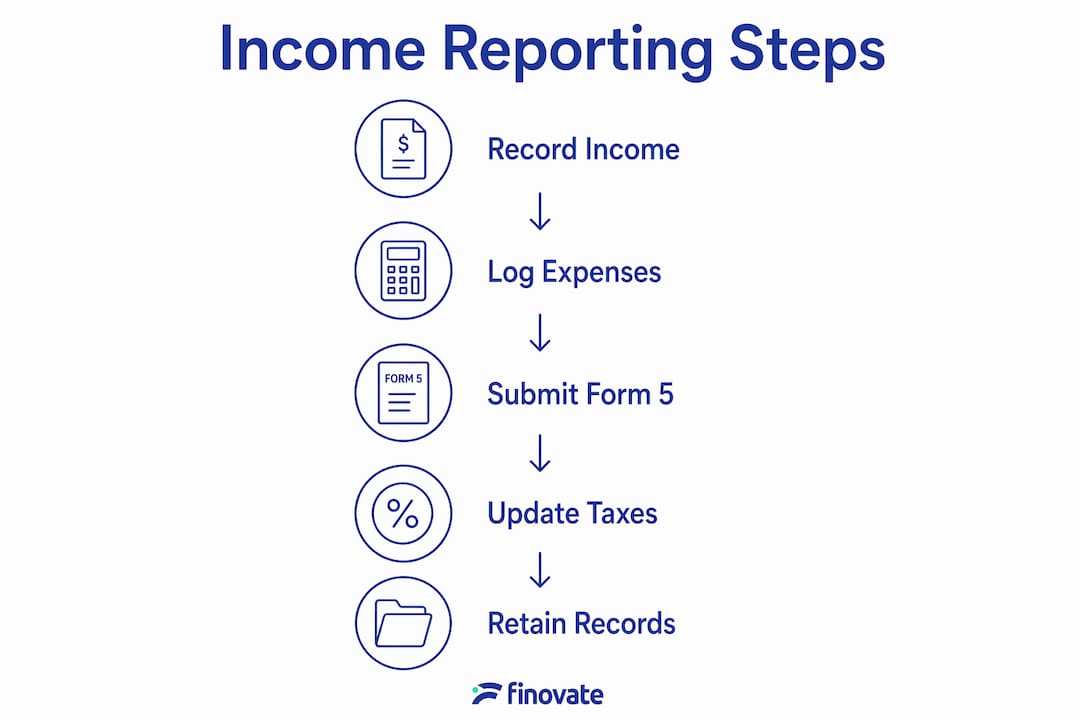
- Record all business income and expenses throughout the financial year using either single-entry or double-entry bookkeeping, depending on your business size.
- Calculate your net profit by subtracting allowable business expenses from your total revenue.
- File Form 5 via the OmaVero portal by 30 April each year. Sole traders must file this annual business tax return reporting revenue, expenses, and net profit.
- Pay advance taxes (ennakkovero) throughout the year based on your estimated profit. These are calculated using progressive municipal and state tax rates.
- Update your advance tax estimate if your income changes significantly during the year. Underestimating leads to a tax bill at year end; overestimating ties up cash unnecessarily.
The OmaVero portal is Verohallinto's online service for all tax filings and payments. You log in using Finnish bank credentials or a mobile certificate, which makes the process accessible even without an accountant.
Pro Tip: If your income increases significantly mid-year, update your advance tax estimate in OmaVero immediately. Waiting until April means paying a lump sum with potential interest charges.

One threshold worth knowing: if your annual turnover exceeds €20,000, you typically become liable for Value Added Tax (ALV). At that point, VAT reporting becomes part of your regular obligations alongside income reporting.
Which bookkeeping methods support income reporting?
The bookkeeping method you use directly determines how you gather the data for your tax return. Finnish law under Kirjanpitolaki gives small sole traders a genuine choice, and the right method depends on your business size.
| Bookkeeping method | Eligibility conditions | Key benefit |
|---|---|---|
| Single-entry (muistiinpanomenetelmä) | Turnover below €200,000, balance sheet under €100,000, and 3 or fewer employees for two consecutive years | Reduced administrative complexity |
| Double-entry bookkeeping | Required if you exceed any two of the above thresholds | Full financial picture, required for larger businesses |
Single-entry bookkeeping is allowed when turnover stays below €200,000, the balance sheet remains under €100,000, and the business employs three or fewer people. This simplified method reduces the administrative burden considerably for micro-businesses. Double-entry bookkeeping, by contrast, records every transaction twice and gives a more complete view of your financial position. It is mandatory once you grow beyond those thresholds.
Regardless of which method you use, you must retain all bookkeeping documents for a minimum of six years, and annual accounts for ten years. Verohallinto can request these records during an audit, so organised record-keeping is not merely good practice. It is a legal requirement.
Digital accounting software makes both methods far more manageable. Platforms that integrate directly with Finnish tax authority systems can automate VAT returns, generate invoices, and export data in the correct format for OmaVero.
Pro Tip: Even if you qualify for single-entry bookkeeping, consider using digital bookkeeping tools that categorise transactions automatically. The time saved during tax season is significant.
How does income reporting connect to tax filing and payment?
The link between your bookkeeping records and your tax return is direct. Every figure you enter in Form 5 derives from your bookkeeping data. This is why accurate, up-to-date records matter throughout the year, not just in april.
Here is how the process connects in practice:
- Business revenue recorded in your books becomes the gross income figure on Form 5.
- Allowable expenses such as equipment, travel, and professional services reduce your taxable income.
- Net profit is the figure on which your personal income tax is calculated, using progressive municipal and state rates.
- VAT (ALV) is reported separately. If turnover exceeds €20,000, the business registers as VAT liable, and the VAT paid on purchases is deducted from VAT collected on sales.
- Advance taxes (ennakkovero) paid during the year are offset against your final tax assessment. Income reporting accuracy directly impacts these advance tax calculations, requiring careful estimation and regular updating.
One aspect that surprises many new sole traders: you cannot pay yourself a formal salary. Sole traders withdraw money as private draws, which are not taxed at the point of withdrawal. Instead, income tax is paid on the total business profit at year end. This means your personal living costs do not reduce your taxable income, and you need to plan your cash flow accordingly.
The tax filing process via OmaVero is straightforward once your bookkeeping is in order. You enter income and expense totals, confirm your VAT figures if applicable, and submit. Verohallinto then calculates your final tax assessment and adjusts for any advance taxes already paid.
What are common pitfalls and practical tips for income reporting?
Knowing the rules is one thing. Applying them without costly mistakes is another. Several recurring issues affect Finnish sole traders, and most are avoidable with the right habits.
- Missing the 30 April deadline. Form 5 must be submitted by 30 April. Late filing triggers penalty interest and can delay your tax assessment. Set a calendar reminder in february to begin gathering your records.
- Confusing personal and business finances. Mixing personal and business transactions is the single most common bookkeeping error. Open a dedicated business bank account from day one. It makes income reporting far cleaner and reduces the risk of disallowed deductions.
- Claiming incorrect deductions. Only expenses directly related to your business activity are deductible. Home office costs, for example, are deductible only under specific conditions. When in doubt, check with Verohallinto or a qualified accountant.
- Failing to prepare formal financial statements when required. Most sole traders do not need to prepare full annual financial statements unless they exceed at least two of three thresholds: a €450,000 balance sheet, €900,000 turnover, or 10 employees for two consecutive years. Below those thresholds, keeping your bookkeeping records and submitting Form 5 is sufficient.
- Underreporting income. Omitting income, even unintentionally, leads to back taxes, interest, and potential penalties. All revenue, including cash payments and foreign income, must be reported.
Pro Tip: Review your bookkeeping records monthly rather than quarterly. Errors are far easier to correct when the transaction is recent.
The importance of income reporting extends beyond compliance. Accurate records give you a clear picture of your profitability, help you plan for tax payments, and make it easier to apply for business loans or grants. Lenders and grant bodies routinely request financial statements, and well-maintained books make that process straightforward.
For freelancers and light entrepreneurs, the same principles apply. Income reporting for freelancers follows the same OmaVero process, though some may operate through a light entrepreneur invoicing service rather than registering a full toiminimi. Understanding invoicing etiquette and keeping clear records of every payment received is equally critical in that model.
Key takeaways
Accurate income reporting is the foundation of tax compliance for Finnish sole traders, requiring timely Form 5 submission, correct bookkeeping, and proactive advance tax management.
| Point | Details |
|---|---|
| File Form 5 by 30 April | Submit your annual business tax return via OmaVero each year without exception. |
| Choose the right bookkeeping method | Single-entry is permitted below €200,000 turnover, €100,000 balance sheet, and 3 employees. |
| Retain records for six years | Keep all bookkeeping documents for at least six years to satisfy audit requirements. |
| Update advance tax estimates promptly | Revise your ennakkovero estimate in OmaVero whenever your income changes materially. |
| Separate personal and business finances | A dedicated business account prevents errors and protects your deductions. |
Why income reporting deserves more attention than most sole traders give it
Most entrepreneurs I work with treat income reporting as an annual chore, something to deal with in april and forget about for the rest of the year. That approach costs them money and causes unnecessary stress.
The reality is that income reporting is a continuous process. The quality of your tax return in april is entirely determined by the quality of your bookkeeping in january, june, and october. Sole traders who maintain clean, monthly records consistently pay the correct amount of tax, claim every legitimate deduction, and avoid the panic that comes with reconstructing a year's worth of transactions in a hurry.
There is also a planning dimension that gets overlooked. Your reported net profit determines your advance tax payments for the following year. If you underreport or misclassify income, you distort that calculation and create a cash flow problem down the line. Proactive income reporting, done well throughout the year, gives you accurate data to make real business decisions.
My honest advice: do not wait until you have a problem to take your bookkeeping seriously. The entrepreneurs who manage their finances well are not necessarily the ones with the highest turnover. They are the ones who know their numbers.
— Busayo
How Finovate supports Finnish entrepreneurs with income reporting
Managing income reporting alongside running a business is demanding. Finovate provides accounting and tax services designed specifically for Finnish sole traders and small businesses, covering bookkeeping, VAT returns, tax preparation, and advance tax planning.
Whether you are filing your first Form 5 or looking to bring more structure to your financial management, we can help you stay compliant and in control. Our team understands the specific requirements of Verohallinto and Kirjanpitolaki, so you do not have to navigate them alone. Contact Finovate to discuss how we can support your reporting needs.
FAQ
What is income reporting for a sole trader in Finland?
Income reporting is the process of recording all business revenues and expenses and submitting them to Verohallinto via Form 5 through the OmaVero portal. It determines your personal income tax liability for the year.
When is the income reporting deadline in Finland?
The annual business tax return (Form 5) must be filed by 30 April each year. Missing this deadline results in penalty interest on any tax owed.
Do all sole traders need to prepare annual financial statements?
Most sole traders do not. Full financial statements are only required if a business exceeds at least two of three thresholds: a €450,000 balance sheet, €900,000 turnover, or 10 employees for two consecutive years.
How do advance taxes relate to income reporting?
Advance taxes (ennakkovero) are paid throughout the year based on your estimated profit. Accurate income reporting ensures these estimates are correct, avoiding a large tax bill or overpayment at year end.
Can freelancers use the same income reporting process?
Yes. Freelancers and light entrepreneurs follow the same OmaVero reporting process as registered sole traders. The key obligation is to record all income received and report it accurately in the annual tax return.