

TL;DR:
- A financial audit is an independent review that confirms an organization’s financial statements fairly reflect its financial position. It helps build trust among investors, lenders, and regulators by reducing information risk and ensuring compliance with accounting standards.
A financial audit is defined as an independent, systematic examination of an organisation's financial statements to provide reasonable assurance they are fairly presented in accordance with recognised accounting frameworks such as GAAP or IFRS. The audit reduces information risk and increases confidence for investors, lenders, and regulators who rely on accurate financial reporting. For business owners and finance professionals, understanding what a financial audit involves, who performs it, and what it can and cannot confirm is the foundation of sound financial governance. This guide covers the financial audit definition, the main types, the process from start to finish, and the practical implications for your business.
What is a financial audit and why does it matter?
A financial audit is an independent verification that an entity's financial statements provide a true and fair view of its financial position and performance. The auditor's role is to examine evidence, not to manage the business or guarantee its future viability. The audit opinion confirms current statement fairness, not future success.

The four core documents examined in a financial audit are the balance sheet, income statement, cash flow statement, and statement of changes in equity. Each document is assessed for accuracy and compliance with the applicable accounting standard. Together, they give stakeholders a complete picture of the organisation's financial health.
Audits are mandatory for publicly held companies as of 2026, while private companies often undergo them voluntarily to satisfy lender covenants or investor requirements. The process is more intensive and costly than a review or compilation, which is why understanding its scope matters before you begin.
What are the main types of financial audits?
Different audit types serve different objectives, and confusing them leads to misaligned expectations. The three types most relevant to business owners and finance professionals are:
- Financial statement audit. An external, independent auditor examines whether the financial statements are free from material misstatement. This is the most common type and the one required by regulators and lenders. The auditor issues a formal opinion upon completion.
- Internal audit. Conducted by an in-house team or outsourced specialists, internal audits focus on ongoing risk management, operational controls, and process improvement. The internal auditor reports to management or the audit committee, not to external stakeholders. This type runs continuously rather than annually.
- Forensic audit. Triggered by suspected fraud, misconduct, or legal disputes, a forensic audit investigates specific transactions or periods in detail. The findings are often used as evidence in legal proceedings. Scope is narrower but far more intensive than a standard financial statement audit.
The key distinctions are independence, scope, and objective. External financial audits prioritise stakeholder assurance. Internal audits prioritise control improvement. Forensic audits prioritise evidence gathering. Knowing which type applies to your situation shapes how you prepare and what outcome you should expect.
For Finnish SMEs, the practical audit requirements differ from those of large listed companies, and understanding the distinction early saves time and cost.
How does the financial audit process work?
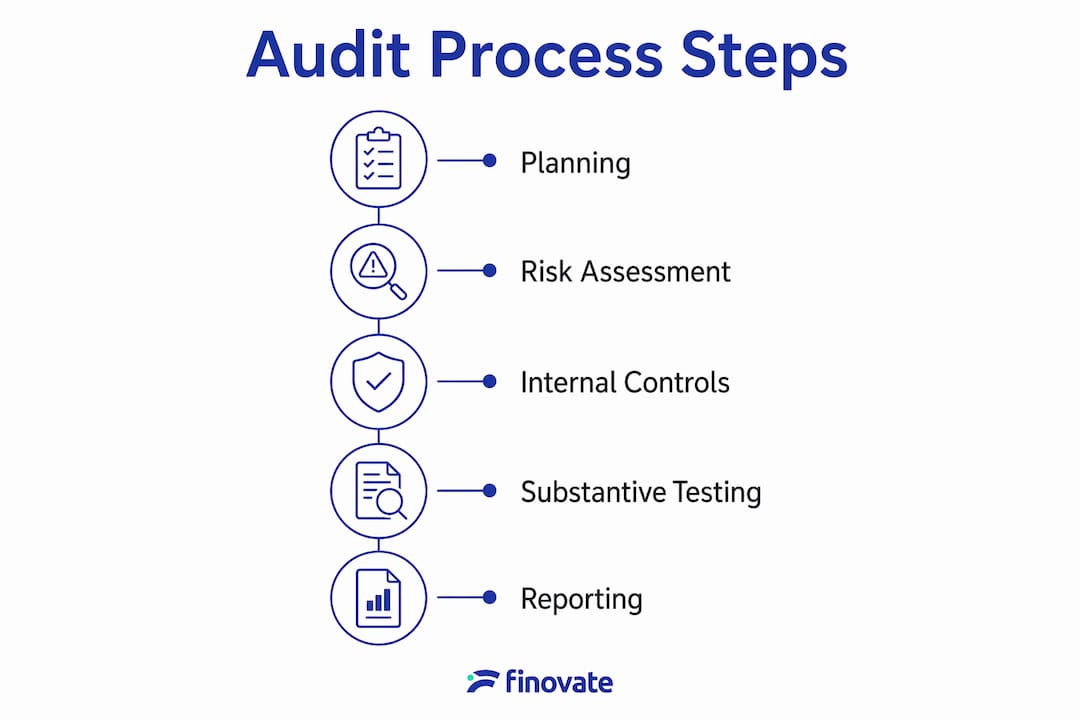
The financial audit process follows a structured sequence of stages. Each stage builds on the previous one, and skipping any step increases the risk of a qualified or adverse opinion.
- Planning and risk assessment. The auditor gains an understanding of the business, its industry, and its accounting policies. They identify areas of significant risk, such as revenue recognition or related-party transactions, and design procedures to address them.
- Evaluation of internal controls. The auditor assesses whether the organisation's internal controls are designed and operating effectively. Strong internal controls reduce the scope of substantive testing needed, which lowers cost and shortens the timeline.
- Substantive testing. The auditor tests individual transactions, account balances, and disclosures using sampling techniques. Not every transaction is tested. This is why audits provide reasonable assurance rather than absolute certainty.
- Document review, physical inspections, and interviews. Core audit procedures include inspecting physical assets such as inventory, reviewing contracts and bank statements, and interviewing key staff about processes and controls.
- Audit reporting. The auditor issues a written report containing their opinion. The opinion may be unqualified (clean), qualified, adverse, or a disclaimer of opinion, depending on the findings.
Pro Tip: Prepare a complete "Provided by Client" (PBC) list before the auditor arrives. This is an organised schedule of every document and reconciliation the auditor will request. Businesses that submit a thorough PBC list at the outset consistently experience shorter audit timelines and lower fees.
Professional judgement shapes every stage. The auditor decides which risks warrant deeper testing and which controls are reliable enough to reduce substantive work. This is why the relationship between your finance team and the auditor matters as much as the documentation itself.
Why are financial audits important for businesses?
The primary purpose of an audit is to close the information gap between management and the stakeholders who rely on financial reporting. Management prepares the statements; the auditor independently verifies them. That independence is what gives the opinion its value.
The practical benefits extend well beyond regulatory compliance:
- Investor and lender confidence. Audited financial statements reduce perceived risk for banks and investors, which can lower the cost of borrowing and improve access to capital.
- Improved internal controls. External auditors identify weaknesses in financial record-keeping and reporting processes. Acting on their recommendations strengthens the business operationally.
- Regulatory compliance. Many industries and jurisdictions require audited accounts. Failing to comply can result in penalties or loss of operating licences.
- Contractual obligations. Loan agreements, shareholder agreements, and grant conditions frequently require annual audited accounts as a condition of continued funding.
Financial reports that carry an independent audit opinion carry significantly more weight in negotiations, whether with a bank, a potential acquirer, or a new investor. The audit does not just confirm the past. It builds the credibility that supports future decisions.
Audits also surface operational insights that management may not see from inside the business. An auditor reviewing your accounts payable process may identify duplicate payments or control gaps that cost real money. That kind of finding has direct commercial value.
Common misconceptions about financial audits
The most widespread misconception is that an audit guarantees the financial statements are 100% accurate. Auditors use sampling techniques, so they do not test every transaction. The standard they work to is reasonable assurance, not absolute certainty. Clients who expect a clean audit to mean zero errors will be disappointed.
A second misconception is that the auditor's job is to detect fraud. Fraud detection is a possible outcome, not the primary objective. The auditor's role is to verify that the financial statements are fairly presented, not to police management behaviour. A forensic audit is the appropriate tool when fraud is specifically suspected.
A third misunderstanding concerns preparation. Many business owners assume the auditor will organise the documentation. In practice, the client is responsible for providing reconciled trial balances, supporting schedules, and a complete PBC list. Lack of preparation extends timelines and increases costs significantly.
Pro Tip: Review your internal controls before the audit begins. Weak controls increase the auditor's substantive testing workload, which adds time and cost. Addressing obvious gaps in advance, such as missing approval signatures or unreconciled accounts, reduces the scope of work the auditor needs to perform.
Understanding these limits does not reduce the audit's value. It sets realistic expectations and helps you prepare in a way that makes the process efficient for everyone involved.
Key takeaways
A financial audit provides independent, reasonable assurance that financial statements are fairly presented, and that assurance is what makes audited accounts credible to investors, lenders, and regulators.
| Point | Details |
|---|---|
| Financial audit definition | An independent examination confirming financial statements are fairly presented per GAAP or IFRS. |
| Three main audit types | Financial statement, internal, and forensic audits each serve distinct objectives and levels of independence. |
| Audit process stages | Planning, internal control evaluation, substantive testing, and reporting form the standard sequence. |
| Reasonable assurance, not certainty | Auditors use sampling, so they confirm fairness, not absolute accuracy across every transaction. |
| Preparation reduces cost | A complete PBC list and reconciled trial balances shorten timelines and lower audit fees. |
My view on getting audits right
I have worked with business owners at every stage, from first-time audits to complex multi-entity reviews, and the pattern is consistent. The businesses that find audits stressful are almost always the ones that treat preparation as the auditor's problem. They hand over a folder of unsorted invoices and expect the process to run smoothly. It never does.
The businesses that get genuine value from audits approach them differently. They treat the auditor as a professional reviewer, not an adversary. They prepare documentation in advance, reconcile accounts before the fieldwork begins, and ask questions when findings arise. That collaborative approach produces cleaner opinions, faster turnarounds, and, more usefully, a set of management letter points that actually improve the business.
My advice for SMEs in particular: do not wait until the auditor requests something to start organising your records. Build that discipline into your monthly accounting compliance routine throughout the year. By the time the audit arrives, your trial balance should already reconcile, your supporting schedules should already exist, and your internal controls should already be documented. The audit then becomes a confirmation exercise rather than a scramble.
For larger businesses, the internal audit function is worth investing in properly. An internal audit team that reports independently to the audit committee, and that operates with a genuine risk-based mandate, reduces external audit costs and catches control weaknesses before they become material findings. That is a return on investment that shows up directly in the audit fee and indirectly in the quality of the financial statements.
— Busayo
How Finovate supports your audit readiness
Audit preparation starts long before the auditor arrives. Accurate bookkeeping, reconciled accounts, and well-organised financial records throughout the year are what make the process manageable.

Finovate provides accounting and financial management services for businesses in Finland, including bookkeeping, payroll processing, tax preparation, and invoicing. These services keep your financial records audit-ready at all times, not just in the weeks before fieldwork begins. Whether you are a sole trader preparing for a first audit or an established business managing annual compliance, Finovate's monthly invoicing service gives you the organised, accurate documentation that auditors expect. Get in touch with the Finovate team to discuss how we can support your financial management and audit preparation.
FAQ
What is the financial audit definition?
A financial audit is an independent, systematic examination of an organisation's financial statements to provide reasonable assurance they are fairly presented in accordance with accounting standards such as GAAP or IFRS.
Who performs a financial audit?
External financial audits are performed by independent, qualified auditors or audit firms. Internal audits are conducted by in-house teams or outsourced specialists who report to management or the audit committee.
What is the difference between a financial audit and an internal audit?
A financial audit is conducted by an external, independent party to provide assurance to stakeholders. An internal audit is conducted by or for management to improve internal controls and risk management on an ongoing basis.
What are the main steps in a financial audit?
The main steps are planning and risk assessment, evaluation of internal controls, substantive testing using sampling, document review and interviews, and issuance of the audit report with the auditor's opinion.
Does a financial audit guarantee that financial statements are error-free?
No. Auditors use sampling techniques, so an audit provides reasonable assurance, not absolute certainty, that financial statements are free from material misstatement.