

TL;DR:
- Financial reports are essential decision-making tools that reveal your business’s financial health and help prevent crises.
- Regularly reviewing income statements, balance sheets, and cash flow statements improves cash management, resource allocation, and stakeholder trust.
Most entrepreneurs treat financial reports as something they produce because they have to, not because they want to. That instinct is understandable but costly. Understanding why use financial reports goes far beyond satisfying tax obligations or impressing your accountant. These documents are decision-making tools that tell you whether your business is genuinely healthy, where your money is going, and what risks are approaching before they become crises. This guide will show you exactly what each report reveals, how to read the numbers that matter, and how to make financial reporting a habit that actively supports your growth.
Table of Contents
- Key takeaways
- Why use financial reports: the three core statements
- Benefits of using financial reports for decision-making
- How to analyse financial statements effectively
- Applying financial reports in daily business management
- My perspective on why entrepreneurs undervalue financial reports
- How Finovate helps you stay on top of your finances
- FAQ
Key takeaways
| Point | Details |
|---|---|
| Reports drive decisions | Financial reports give you the data to make informed choices about spending, investment, and growth. |
| Profit does not equal cash | Your income statement can show a profit while your bank account runs dry without proper cash flow monitoring. |
| Regular review matters | Reviewing reports monthly or quarterly helps you spot trends and warning signs before they escalate. |
| Ratios reveal the full picture | Key financial ratios on liquidity, profitability, and efficiency tell you more than raw numbers alone. |
| Reporting builds credibility | Lenders and investors rely on well-maintained financial reports to assess your business before committing funds. |
Why use financial reports: the three core statements
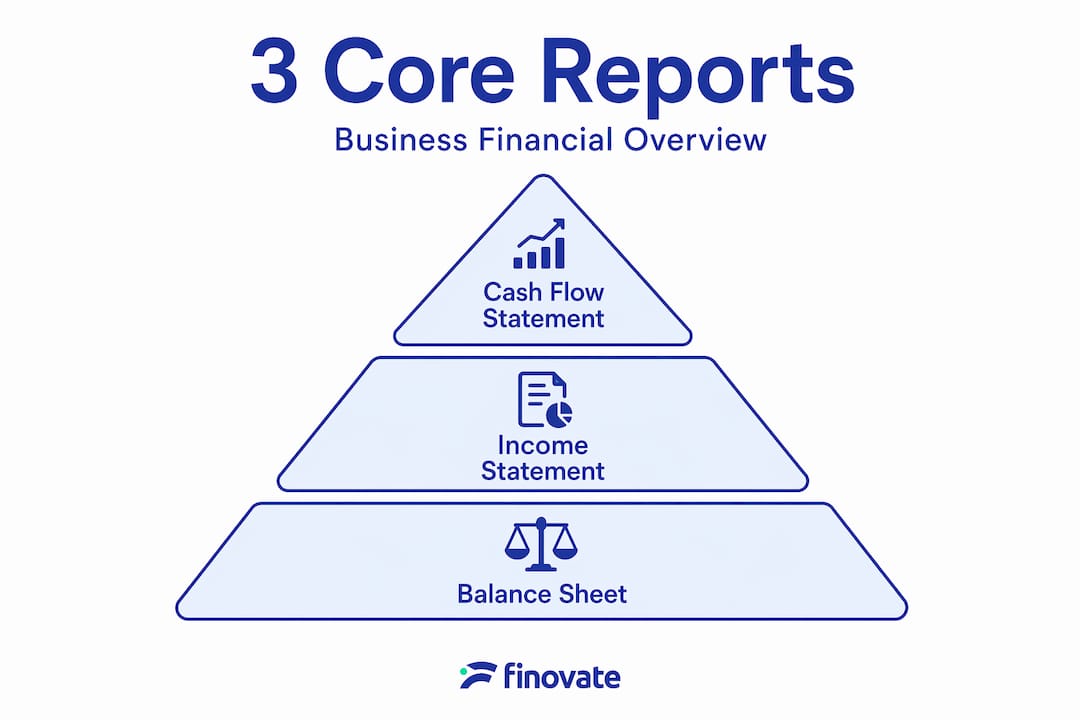
Financial statements provide decision-useful information about your business's financial position, performance, and how that position is changing over time. There are three reports that every entrepreneur needs to understand.
The income statement
The income statement, sometimes called the profit and loss account, shows your revenues and expenses over a set period, whether that is a month, a quarter, or a full year. It tells you whether you are profitable. What it does not tell you is whether you actually have cash available. That distinction matters enormously.
The balance sheet
The balance sheet is a snapshot taken at a single point in time. It lists your assets (what your business owns or is owed), your liabilities (what your business owes others), and your equity (the net value remaining for owners). A strong balance sheet signals financial stability to anyone reviewing your business from the outside.
The cash flow statement
The cash flow statement tracks the actual movement of money in and out of your business. Cash flow often does not match profits shown on the income statement, which is why this report exists separately. You can invoice a client in December and not receive payment until February. Your income statement records the revenue in December. Your cash flow statement records the cash in February. Those are very different realities.
| Report | What it shows | Key question answered |
|---|---|---|
| Income statement | Revenue, expenses, profit over a period | Is the business profitable? |
| Balance sheet | Assets, liabilities, equity at one moment | Is the business financially stable? |
| Cash flow statement | Actual cash in and out over a period | Does the business have enough cash to operate? |
The three statements interrelate closely. A sale on the income statement becomes a receivable on the balance sheet and eventually cash on the cash flow statement. Reading them together gives you a far more accurate picture than reading any one in isolation.
Pro Tip: If you review only one report, make it the cash flow statement. It is the hardest to manipulate and the most direct indicator of whether your business can meet its obligations this month.
Benefits of using financial reports for decision-making
The importance of financial reports is not theoretical. Here is what they concretely do for your business:
-
Spot inefficiencies and control costs. Comparing periods and analysing key ratios helps you identify where money is being spent without sufficient return. A rising cost-to-revenue ratio is a clear signal to investigate before margins erode completely.
-
Support budgeting and forecasting. You cannot build a credible budget from memory or instinct. Past income statements and cash flow patterns give you a factual baseline. Forecasts built on real data are far more useful for planning hiring, purchases, or expansion.
-
Avoid liquidity crises. 83% of businesses fail partly due to poor cash flow management linked to inadequate financial reporting. Reviewing your cash flow statement regularly means you see a shortfall coming weeks in advance, giving you time to act rather than react.
-
Improve resource allocation. When you can see which products, services, or projects generate the most margin, you can direct your time and money accordingly. Without financial data, those decisions are guesswork.
-
Build credibility with lenders and investors. Lenders and investors rely on financial reports to assess your viability and risk profile before extending credit or capital. Well-maintained reports signal that you run a well-managed business, which directly affects the terms you are offered.
Pro Tip: When approaching a bank for a business loan in Finland, prepare at least two years of financial statements in advance. Lenders will ask for them, and having them ready signals professionalism and readiness.
The benefits of financial reporting extend beyond the numbers themselves. Businesses that regularly review financial statements are significantly more likely to survive and grow, precisely because they are making decisions based on evidence rather than assumption. For practical guidance on managing these reports as a Finnish entrepreneur, the financial statements examples resource from Finovate offers helpful context.

How to analyse financial statements effectively
Knowing why use financial reports is one thing. Knowing how to analyse financial statements is where the real value comes from. The goal is not to memorise accounting theory but to develop a consistent reading habit and know which figures deserve your attention.
Review regularly, not just annually
Monthly reviews catch problems early. Quarterly reviews reveal trends. Annual reviews are too infrequent to prevent damage. Regular monthly, quarterly, or annual reporting improves financial management and strengthens stakeholder confidence. Set a recurring time in your calendar specifically for reading your financial reports.
Key ratios to track
Financial ratios convert raw numbers into meaningful comparisons. Here are the ones most relevant for small business owners:
- Current ratio (current assets divided by current liabilities): Indicates whether you can cover short-term obligations. A ratio above 1.5 is generally healthy.
- Gross profit margin (gross profit divided by revenue, expressed as a percentage): Shows how efficiently you deliver your product or service before overhead.
- Net profit margin (net profit divided by revenue): Reveals what you actually keep after all costs.
- Accounts receivable days (receivables divided by daily revenue): Tells you how long it takes clients to pay. A rising number signals a collection problem.
- Debt-to-equity ratio (total liabilities divided by equity): Indicates how much of the business is financed by debt versus owner investment.
No single ratio tells the whole story. Read them together and compare them against your own previous periods as well as industry benchmarks where available.
Avoiding common pitfalls
One of the most frequent mistakes entrepreneurs make is focusing on a single impressive number, usually revenue, while ignoring margins and cash flow. Revenue growth that outpaces cash collection can push a profitable business into insolvency. Another common mistake is reviewing reports in isolation, without comparing them to a prior period. A loss this quarter only becomes meaningful when you know whether it is worse or better than last quarter.
Financial reporting reveals profitability patterns over time and helps you spot early warning signs or opportunities. That is only possible if you are reviewing consistently and comparing periods systematically. For more on managing profitability as a Finnish SME, the financial management tips article from Finovate covers this in detail.
Applying financial reports in daily business management
Understanding the role of financial reports in business is most powerful when that understanding shapes how you actually run your operations. Reports are not something to review once a year before filing taxes. They belong in your regular management rhythm.
Consider building a monthly review into your management routine. This means setting aside time to read your income statement, check your cash flow position, and glance at your balance sheet for any unusual shifts. You do not need to be an accountant to do this. You need to know which numbers matter for your business and what changes in those numbers typically signal.
Financial reports also support your compliance and legal obligations. Consistent financial reporting supports transparency, accountability, and legal compliance, reducing risk across the board. In Finland, maintaining accurate records is both a legal requirement and a practical necessity for tax preparation. The reporting requirements for Finnish SMEs outlines what businesses need to maintain to stay compliant.
Technology has also changed what is possible here. Automation can reduce time spent on manual data collection by over 2,000 hours annually, freeing finance teams to focus on analysis rather than data entry. For a small business owner wearing many hats, this kind of efficiency is not a luxury. It is a practical way to stay on top of your finances without losing time you do not have.
Finally, well-maintained financial reports build trust with everyone who has a stake in your business. Partners, suppliers, and potential investors all form opinions about your business based on how clearly and consistently you can present your financial position.
My perspective on why entrepreneurs undervalue financial reports
I have worked with many small business owners who come to us having never read their own balance sheet. Not because they are careless, but because no one explained to them that these reports are actually useful beyond compliance.
In my experience, the business owners who struggle most with financial decisions are not those who lack ambition or intelligence. They are the ones relying on their bank balance as their primary financial indicator. That number tells you where you are right now. It tells you nothing about where you are heading.
What I find consistently is that once entrepreneurs begin reading their cash flow statement and income statement together, their decision-making changes noticeably. They stop making spending decisions based on a good month and start building reserves ahead of predictable slow periods. They spot clients who consistently pay late and take action before it creates a cash problem.
The fear around financial statements is largely a literacy issue, not a complexity issue. These documents follow a logical structure, and with modest guidance, most business owners can read them confidently within a few reviews. My advice is simple: start with the cash flow statement, review it monthly, and build from there. The accounting rules and best practices in Finland are also worth understanding as context for how these reports fit into your legal obligations.
Do not wait for an accountant to tell you something is wrong. The reports will tell you first, if you read them.
— Busayo
How Finovate helps you stay on top of your finances
Understanding the importance of financial reports is the first step. Keeping those reports accurate, timely, and compliant is an ongoing responsibility, and that is where professional support makes a measurable difference.

At Finovate, we support Finnish entrepreneurs and small business owners with bookkeeping, tax preparation, payroll, and business advisory services. We help you maintain the financial records you need to make confident decisions and meet your obligations without stress. For entrepreneurs managing invoicing and cash flow, our monthly invoicing service is designed to simplify the process so you can focus on the work itself. If you need a more advanced solution, the invoicing service Pro offers enhanced features for growing businesses. Explore all our accounting services and see how we can support your financial management needs.
FAQ
What are the main types of financial reports?
The three core financial reports are the income statement, the balance sheet, and the cash flow statement. Each answers a different question about your business's financial health and they should be read together.
Why is cash flow different from profit?
Profit is recorded when a sale is made, while cash flow reflects when money actually arrives in your account. A business can be profitable on paper but still run out of cash if clients pay late or expenses fall due before income arrives.
How often should I review my financial reports?
Monthly reviews are recommended for cash flow statements and income statements, with quarterly balance sheet checks. Consistent regular reporting significantly improves financial management and reduces the risk of unpleasant surprises.
Do small businesses in Finland need to produce financial reports?
Yes. Finnish law requires businesses to maintain accounting records and produce financial statements annually. The specific requirements vary by business structure, but accurate bookkeeping and regular reporting are mandatory for compliance and tax purposes.
What financial ratios are most useful for small business owners?
The current ratio, gross profit margin, and accounts receivable days are among the most practical starting points. They give you a clear view of liquidity, profitability, and how efficiently your business is collecting revenue.