

TL;DR:
- Auditing for SMEs involves independent examination of financial statements to ensure accuracy and compliance. Proper preparation, especially managing the PBC list and documentation, helps streamline the process and reduce costs. Audits strengthen financial controls and credibility, providing value beyond just fulfilling legal requirements.
Auditing for SMEs is defined as the independent examination of a company's financial statements by a qualified auditor to provide assurance that the accounts are accurate, complete, and compliant with applicable regulations. For small and medium-sized business owners in Finland, a statutory audit is not simply a legal formality. It is a process that strengthens financial oversight, builds credibility with banks and investors, and surfaces risks before they become costly problems. This guide covers the standards that apply, how to prepare, the challenges you are likely to face, and the concrete benefits that go well beyond compliance.
How does auditing for SMEs differ from large company audits?
Auditing standards for SMEs follow the same International Standards on Auditing (ISAs) that apply to larger organisations, but the practical application differs considerably. Smaller businesses present a different risk profile, and auditors must adapt their methods accordingly.
The most significant difference lies in materiality thresholds. Smaller businesses have lower materiality thresholds, often tied to revenue or profit, which leads to more granular transaction testing rather than high-level reconciliations. This means your auditor will examine individual transactions in greater detail than they would at a larger firm.
Internal controls present a second key difference. Many SMEs operate with limited segregation of duties, meaning one person may handle both payments and reconciliations. Because of this, auditors rely more on substantive testing of transactions and balances rather than testing the controls themselves. The practical result is that your auditor will request larger samples of invoices, bank statements, and ledger entries.
The regulatory context in 2026 has also shifted. The Financial Reporting Council (FRC) has introduced measures to ensure SME audits are proportionate and appropriate to the complexity of smaller businesses. These directives support risk-based approaches and encourage the use of technology to improve audit efficiency. For Finnish SMEs, this is a positive development. It means auditors are expected to focus their effort where risk is genuinely highest, rather than applying a one-size-fits-all checklist.
Key differences to understand before your audit begins:
- Materiality thresholds are set lower for SMEs, so more transactions fall within scope.
- Substantive testing replaces control testing when internal controls are limited or informal.
- Judgment areas such as going concern receive heightened scrutiny.
- Documentation expectations are higher than many SME owners anticipate.
- Risk-based approaches are now encouraged by the FRC to keep audits proportionate.
Understanding these differences helps you set realistic expectations and prepare the right evidence from the outset. You can also review Finnish SME accounting procedures for further context on how these standards interact with local requirements.
How should you prepare your SME for an audit?
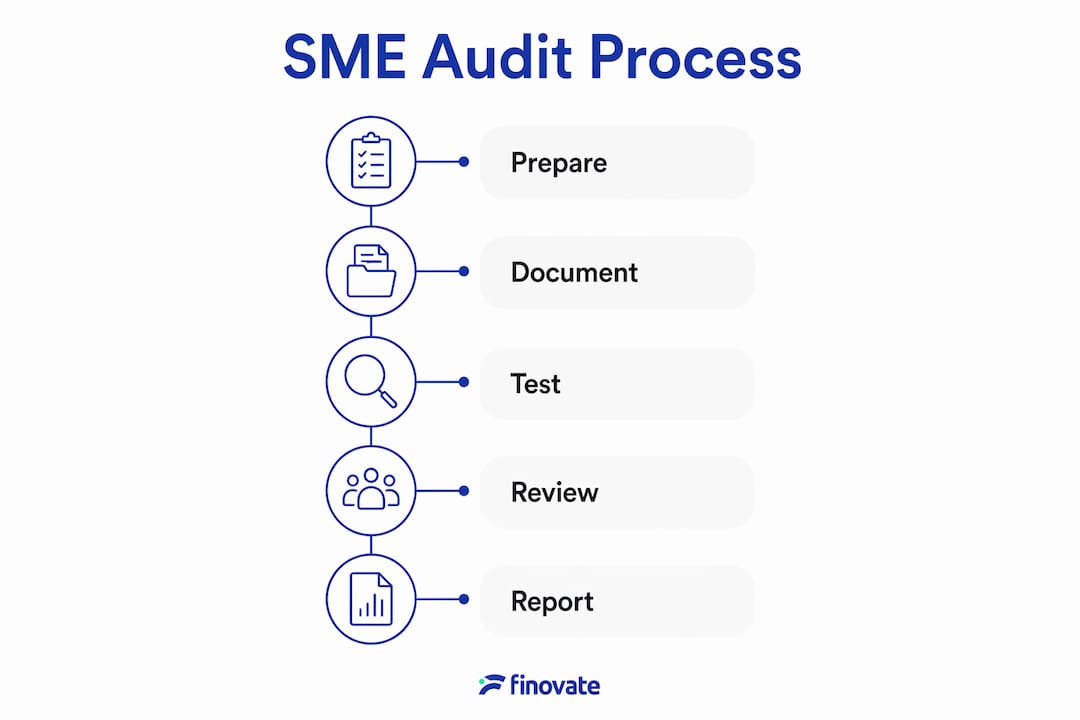
Preparation is the single biggest factor in determining how smoothly your audit runs. A disorganised approach leads to delays, additional queries, and higher professional fees. A structured approach keeps the process on track.

The starting point is the Prepared by Client (PBC) list. Managing the PBC list is often the main bottleneck in SME audits. Agreeing on this list before your year-end and confirming completeness saves time and avoids follow-up queries. The PBC list sets out every document your auditor will need, and you should treat it as a project plan rather than an afterthought.
Follow these steps to prepare effectively:
- Agree the PBC list before year-end. Sit down with your auditor before the financial year closes and confirm exactly which documents they require. This prevents surprises once fieldwork begins.
- Prepare balance sheet reconciliations. Every balance sheet line should be supported by a reconciliation that ties the closing balance back to source documents such as bank statements, invoices, or contracts.
- Compile your general ledger reports. Your auditor will use these to select samples for testing. Ensure the ledger is complete and free of unexplained entries.
- Prepare cash flow forecasts for going concern. Auditors require documented evidence for going concern assumptions, including cash flow forecasts and sensitivity analyses. If your business has faced financial pressure, prepare stress-testing documents as well.
- Build a clear audit trail. Treat documentation as an audit trail problem, ensuring every piece of evidence links clearly to the relevant line in your financial statements. Auditors should be able to trace any figure from the accounts back to source without asking you for help.
- Respond promptly to queries. Delays in responding to auditor queries are one of the most common causes of extended timelines. Assign one person internally to manage audit communications.
Pro Tip: Start opening balance testing early. Early testing of opening balances flags high-risk areas before main fieldwork begins, reducing the chance of cascading delays later in the audit.
Good preparation also reduces the cost of your audit. Auditors charge for time, and time spent chasing missing documents is time you pay for. Treat the PBC list as a checklist you complete before your auditor arrives, not a shopping list you fill in as they ask.
What are the most common challenges SMEs face during audits?
Even well-run businesses encounter difficulties during an audit. Knowing the most common challenges in advance gives you the opportunity to address them before they cause delays.
The expectations gap is the most frequently cited issue. Open communication of audit scope and requirements reduces this gap significantly. Many SME owners are surprised by the volume of documentation their auditor requests. This is not a sign that something is wrong. It reflects the substantive testing approach that auditors must use when internal controls are limited.
Common challenges and how to address them:
- Incomplete documentation. Missing invoices, unsigned contracts, or unreconciled balances create delays. Conduct an internal review of your PBC list two weeks before fieldwork starts.
- Going concern scrutiny. If your business has had a difficult trading period, your auditor will examine going concern in detail. Prepare a well-documented cash flow forecast and a written management assessment.
- High transaction volumes. When controls are weak, auditors review larger samples of transactions. Organise your records by account and date so samples can be pulled quickly.
- Late responses to queries. Assign a single point of contact for audit communications. This prevents queries from sitting unanswered in multiple inboxes.
- Disorganised filing systems. Digital filing with clear folder structures reduces the time your team spends locating documents. Cloud-based accounting software such as Xero or Procountor makes this considerably easier for Finnish SMEs.
Pro Tip: Treat your audit preparation as a year-round activity. Maintain your accounting compliance practices throughout the year rather than scrambling at year-end. Businesses that do this consistently report shorter audit timelines and fewer follow-up queries.
Technology also plays a role in reducing audit friction. The FRC's 2026 directives specifically encourage auditors to use technology to improve efficiency. If your accounting software can export structured data directly, share this with your auditor early. It reduces manual work on both sides.
What are the benefits of an SME audit beyond compliance?
An audit is not simply a box-ticking exercise. Audits strengthen credibility with stakeholders and identify risks and process improvements that directly support management decisions. Finnish SME owners who approach audits with this mindset extract considerably more value from the process.
The benefits fall into four clear categories:
- Stronger financial controls. The audit process identifies weaknesses in your internal processes. An auditor who finds that one person controls both payments and bank reconciliations will flag this. Addressing it reduces your fraud risk.
- Improved credibility with lenders and investors. Audited accounts carry significantly more weight than unaudited ones when you apply for a bank loan or seek investment. Finnish banks routinely request audited financial statements as part of credit assessments.
- Management insights. Auditors often identify inefficiencies, unusual patterns, or areas of financial risk that management has not noticed. These observations, typically shared in a management letter, are genuinely useful for planning.
- Support for strategic decisions. Clarified financial information helps you make better decisions about pricing, hiring, and investment. You can also review financial reporting requirements to understand how audited statements feed into broader reporting obligations.
The importance of auditing for small businesses is often underestimated until a business faces a credit application, a potential acquisition, or a dispute with a tax authority. At that point, having a clean set of audited accounts is a material advantage.
Key takeaways
Auditing for SMEs is an independent financial examination that delivers compliance assurance, stronger controls, and credibility with lenders, investors, and tax authorities.
| Point | Details |
|---|---|
| Standards are adapted for SMEs | Auditors use lower materiality thresholds and substantive testing due to limited internal controls. |
| PBC list is the audit foundation | Agree your Prepared by Client document list before year-end to avoid delays and additional queries. |
| Going concern needs documentation | Prepare cash flow forecasts and stress-testing evidence before fieldwork begins. |
| Early preparation reduces cost | Year-round record-keeping shortens audit timelines and lowers professional fees. |
| Audits add value beyond compliance | Audited accounts strengthen credibility with banks and surface process improvements for management. |
Why I think SME owners underestimate the audit process
Most SME owners I speak with treat the audit as something that happens to them rather than something they participate in. That mindset creates unnecessary stress and, frankly, unnecessary cost.
The businesses that handle audits most efficiently are the ones that treat the PBC list as a live document throughout the year. They file documents as transactions occur, not in a rush during the two weeks before fieldwork. When their auditor arrives, the evidence is already organised and linked to the accounts. The audit moves quickly, queries are minimal, and the management letter that follows is genuinely useful rather than a list of things that went wrong.
The other shift worth making is in how you view your auditor. They are not there to find fault. They are there to provide independent assurance, and the best audits are genuinely collaborative. When you communicate openly about areas of uncertainty, such as a going concern question or an unusual transaction, your auditor can address it efficiently. When you withhold information or delay responses, the process drags and costs more.
Finland's regulatory environment for SMEs is well-structured, and the FRC's 2026 proportionality measures are a genuine improvement. Use them. Work with your auditor to focus effort on the areas of real risk, and push back, politely, if you feel the scope is disproportionate to your business size. A good auditor will welcome that conversation.
— Busayo
How Finovate helps Finnish SMEs stay audit-ready
Staying audit-ready throughout the year is far easier with the right accounting support in place.
Finovate provides accounting and tax services tailored specifically for Finnish SMEs, covering bookkeeping, VAT, payroll, and tax planning. Our team understands the documentation standards that auditors expect and can help you maintain clean, well-organised records that hold up under scrutiny. Whether you are preparing for your first statutory audit or looking to reduce the time and cost of your annual process, we are here to help. Contact Finovate to discuss how we can support your audit readiness and financial compliance.
FAQ
What is auditing for SMEs?
Auditing for SMEs is the independent examination of a small or medium-sized business's financial statements by a qualified auditor. The process provides assurance that the accounts are accurate and compliant with applicable regulations.
Do all Finnish SMEs need a statutory audit?
Not all Finnish SMEs are legally required to have a statutory audit. The obligation depends on the size of the company, based on thresholds for turnover, balance sheet total, and number of employees set out in Finnish company law.
How long does an SME audit typically take?
The timeline varies depending on the size and complexity of the business and the quality of documentation provided. Well-prepared SMEs with organised records and a completed PBC list typically complete fieldwork within one to two weeks.
What documents does an auditor typically request from an SME?
Auditors typically request balance sheet reconciliations, general ledger reports, cash flow forecasts, bank statements, and supporting invoices. The full list is agreed in advance through the Prepared by Client document.
How can an SME reduce the cost of its audit?
The most effective way to reduce audit cost is to prepare thoroughly before fieldwork begins. Maintaining organised records year-round, completing the PBC list before year-end, and responding promptly to auditor queries all reduce the time your auditor spends on the engagement.