

TL;DR:
- Finnish small businesses must prepare accurate financial statements based on their size and thresholds.
- Most sole traders below certain limits only file an annual tax return, while larger ones must produce full statements.
Financial reporting for small businesses in Finland means preparing accurate, compliant financial statements, including the balance sheet, income statement, and tax returns, to meet obligations set by the Finnish Tax Administration and the Finnish Patent and Registration Office (PRH). This financial reporting guide for small businesses covers every stage of the process, from choosing the right bookkeeping method to filing on time. Finnish law sets clear thresholds that determine exactly which reports you must prepare, and a 2026 update to digital reporting standards means the rules have recently changed. Getting this right protects your business from penalties and gives you reliable numbers to make sound decisions.
What financial reports must small businesses prepare in Finland?
The reports you must prepare depend on your business size and the legal thresholds you cross. Most sole traders operate well below the limits that trigger full financial statements, but you still carry specific obligations.
Sole traders and simplified bookkeeping
Most sole traders do not need to prepare formal financial statements unless they exceed micro-entity thresholds. Accurate bookkeeping combined with an annual tax return is sufficient for the majority. Sole traders file using Form 5 with the Finnish Tax Administration.
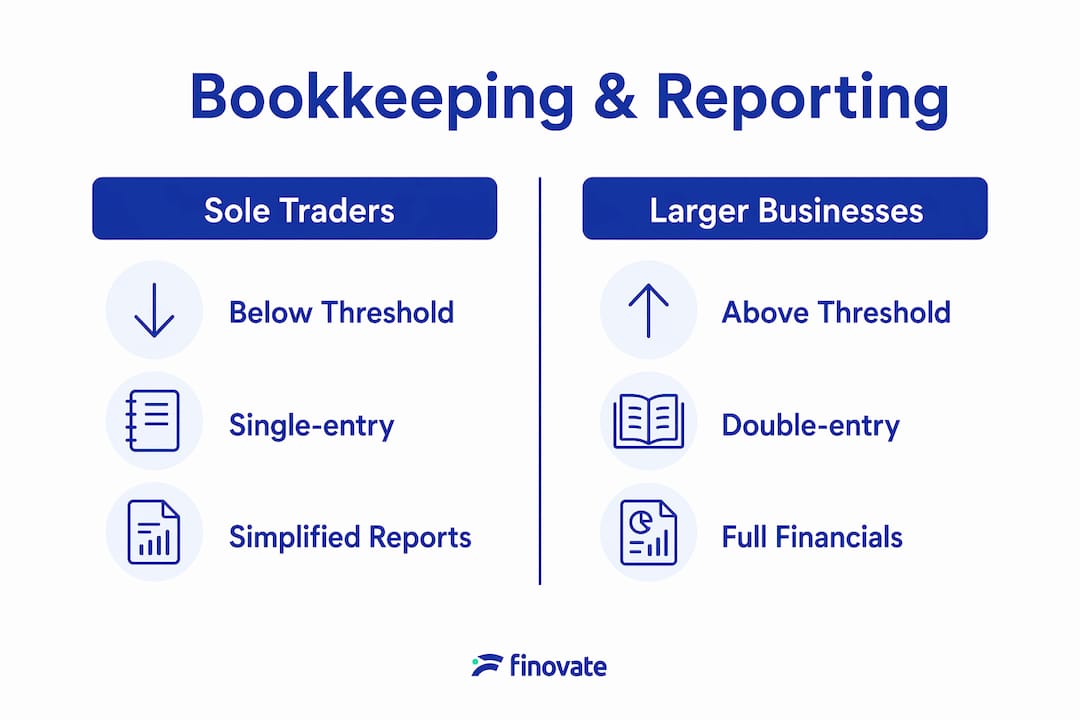
Simplified single-entry bookkeeping applies when your turnover stays below €200,000, your balance sheet stays below €100,000, and you employ fewer than 3 people. This is a significant reduction in administrative burden. It means you record income and expenses without the full double-entry system required of larger entities.
When full financial statements become mandatory
Crossing two of three thresholds for two consecutive years triggers the obligation to prepare full financial statements. Those thresholds are turnover of €900,000, a balance sheet of €450,000, or 10 employees. The two-year rule prevents a sudden reporting burden on fast-growing businesses.
Full financial statements must include:
- Balance sheet — a snapshot of assets, liabilities, and equity at the financial year end
- Income statement — a record of revenue and expenses over the accounting period
- Notes to the accounts — supplementary disclosures that give context to the figures
- Filing confirmation — submission to the PRH where required by company form
Notes to the accounts provide crucial context that complements the balance sheet and income statement. They are required under the Finnish Accounting Act to give a true and fair view of the business.
| Business type | Bookkeeping method | Financial statements required |
|---|---|---|
| Sole trader below thresholds | Single-entry | Annual tax return (Form 5) only |
| Sole trader above thresholds | Double-entry | Balance sheet, income statement, notes |
| Limited company (Oy) | Double-entry | Full statements filed with PRH |
| General partnership | Double-entry | Full statements, partner disclosures |
How to maintain compliant bookkeeping for your small business
Compliant bookkeeping starts with choosing the right method and then maintaining an unbroken chain of records from every receipt through to your final statements. Proper bookkeeping requires this unbroken chain as the foundation of any audit trail.

Choosing between single-entry and double-entry bookkeeping
Single-entry bookkeeping records each transaction once, either as income or an expense. It suits sole traders under the €200,000 turnover threshold and is far less time-consuming. Double-entry bookkeeping records every transaction twice, as a debit and a credit, and is mandatory once you exceed the simplified thresholds or operate as a limited company.
Practical steps to keep your records accurate
Follow these steps to maintain records that satisfy Finnish accounting standards:
- Collect and file every document. Store receipts, invoices, bank statements, and contracts as they arrive. Finnish law requires you to retain accounting records for six years after the end of the financial year.
- Reconcile your bank account monthly. Match every transaction in your accounting records against your bank statement. Discrepancies caught early are far easier to correct.
- Issue and record invoices promptly. Record sales invoices when issued and purchase invoices when received. Delays cause gaps that are difficult to reconstruct at year end.
- Separate personal and business finances strictly. Finnish tax law requires a clear separation of personal and business finances for verifiable, compliant accounting. Open a dedicated business bank account from day one.
- Review your VAT position each period. If your turnover exceeds €15,000 per year, you must register for VAT with the Finnish Tax Administration and file periodic VAT returns.
Pro Tip: If you use accounting software, set up automatic bank feeds so transactions import daily. This removes manual data entry and reduces the risk of missed entries.
Small business owners consistently underestimate the strategic value of clear, consistent bookkeeping as a foundation for sound financial decisions. Your records are not just a compliance tool. They show you which products are profitable, when cash flow tightens, and whether you can afford to hire.
How to prepare and file your financial reports
Preparing financial reports is a process with a clear sequence. Rushing it at year end creates errors. Keeping your books current throughout the year makes the final preparation straightforward.
Month-by-month routine
- Record all income and expenses as they occur, not in batches at year end
- Reconcile your bank account at the end of each month
- File VAT returns on time, typically quarterly for most small businesses
- Review outstanding invoices and chase overdue payments before they age
Year-end preparation steps
- Close your accounting period and verify that all transactions are recorded
- Reconcile all balance sheet accounts, including bank, trade debtors, and trade creditors
- Prepare your income statement and balance sheet from your verified records
- Draft the notes to the accounts if full statements are required
- Have the statements reviewed and signed before submission
Pro Tip: Set a firm internal deadline two weeks before the statutory filing deadline. This gives you time to correct any errors without rushing.
Once you sign and finalise your financial statements, altering source documents or accounting entries for that period is prohibited under Finnish law. Any corrections must be made in the current period accounts. This rule makes accuracy before signing critical.
| Filing obligation | Authority | Typical deadline |
|---|---|---|
| Annual tax return (Form 5) | Finnish Tax Administration | April of the following year |
| Financial statements (Oy) | PRH | Within two months of AGM |
| VAT returns | Finnish Tax Administration | 12th of the following month |
| Employer contributions | Finnish Tax Administration | Monthly, by the 12th |
From 1 january 2026, companies filing digital financial statements must use the updated SBR taxonomy introduced by the PRH. This update improves regulatory compliance and data comparability under Finnish Accounting Standards. If you use accounting software to generate digital filings, confirm with your provider that their system supports the new taxonomy.
Common financial reporting mistakes and how to avoid them
Most reporting errors come from habits formed early in a business's life that were never corrected. Recognising them is the first step to fixing them.
- Mixing personal and business finances. This is the single most common error. It makes it impossible to produce accurate accounts and creates problems during a tax audit. Use a separate business account and business card for every transaction.
- Failing to retain documents. Finnish law requires a six-year retention period for accounting records. Losing receipts or invoices means you cannot substantiate your deductions if the Tax Administration queries them.
- Incomplete notes to the accounts. Micro and small entities have reduced disclosure requirements, but notes must still include applied accounting principles, significant contingencies, and related party transactions. Omitting these is a compliance failure.
- Updating books only at year end. Leaving all bookkeeping to december creates a high risk of missing transactions and makes reconciliation extremely difficult. Monthly updates are the minimum standard.
- Ignoring the 2026 taxonomy update. Companies filing digital statements that have not updated their software to the new PRH taxonomy will face submission errors. Check your software's compatibility now, not in december.
- Misunderstanding the two-year threshold rule. Exceeding a reporting threshold in one year does not automatically trigger full statement obligations. You must exceed two of the three thresholds for two consecutive years. Misreading this rule leads to unnecessary administrative work or, conversely, under-reporting.
The hidden cost of bookkeeping mistakes extends beyond fines. Inaccurate records lead to poor business decisions, missed tax deductions, and failed loan applications. Prevention is far cheaper than correction.
Key takeaways
Compliant financial reporting for Finnish small businesses requires matching your bookkeeping method to your legal thresholds and filing accurate statements with the right authorities on time.
| Point | Details |
|---|---|
| Know your thresholds | Sole traders under €200,000 turnover use single-entry bookkeeping and file Form 5 only. |
| Full statements trigger at scale | Exceeding two of three thresholds for two consecutive years requires a balance sheet, income statement, and notes. |
| 2026 taxonomy update applies | Digital financial statement filers must use the updated PRH SBR taxonomy from 1 january 2026. |
| Separate finances from day one | Finnish tax law requires strict separation of personal and business finances for compliant accounting. |
| Never alter signed statements | Corrections to a finalised period must be made in current period accounts, not retrospectively. |
Why I think most small businesses get financial reporting backwards
Most small business owners treat financial reporting as a year-end chore. They spend eleven months ignoring their books and then scramble in december and january to reconstruct what happened. I have seen this pattern repeatedly, and it always costs more than it should, in time, in accountant fees, and in missed deductions.
The businesses that handle reporting well do something different. They treat bookkeeping as a weekly discipline, not an annual event. They reconcile monthly, review their numbers quarterly, and arrive at year end with almost nothing left to do. Their financial statements are accurate because their records were accurate all year.
The 2026 PRH taxonomy update is a good example of why proactive habits matter. Businesses that embraced digital reporting early will transition to the new taxonomy without disruption. Those who have been filing paper records or using outdated software will face a harder adjustment.
My advice is to understand your legal thresholds clearly and build your bookkeeping system around them from the start. If you are a sole trader well below the €200,000 turnover threshold, single-entry bookkeeping is entirely sufficient. Do not over-engineer your accounting. But do keep it current, keep it clean, and keep personal finances completely separate. When you are ready to scale, the records you have built will make that transition far easier.
— Busayo
How Finovate supports Finnish small businesses with accounting
Running a small business in Finland means managing VAT filings, payroll, annual tax returns, and bookkeeping obligations alongside everything else. Finovate provides professional accounting and tax services designed specifically for Finnish sole traders, micro-enterprises, and growing small businesses.
Finovate handles bookkeeping, VAT, and payroll so you can focus on running your business rather than reconciling accounts. The team stays current with Finnish regulatory requirements, including the 2026 PRH taxonomy update, so your digital filings meet the latest standards. Whether you need support with your annual tax return, help setting up compliant bookkeeping from scratch, or ongoing financial management, Finovate offers a service level that fits your business. You can also explore specialist accounting for light entrepreneurs if you operate as a light entrepreneur in Finland.
FAQ
What financial reports does a sole trader in Finland need to file?
Most sole traders file an annual tax return using Form 5 with the Finnish Tax Administration. Full financial statements are only required if you exceed two of three thresholds, turnover €900,000, balance sheet €450,000, or 10 employees, for two consecutive years.
What is the bookkeeping threshold for simplified accounting in Finland?
Sole traders with turnover below €200,000, a balance sheet below €100,000, and fewer than 3 employees qualify for simplified single-entry bookkeeping. This removes the need to prepare a full balance sheet or income statement.
What changed in Finnish financial reporting from 2026?
From 1 january 2026, companies filing digital financial statements must use the updated SBR taxonomy introduced by the PRH. This change improves data comparability and regulatory compliance across Finnish financial reporting.
How long must I keep accounting records in Finland?
Finnish law requires you to retain accounting records for six years after the end of the financial year. This applies to receipts, invoices, bank statements, and all supporting documents.
Can I correct a mistake in a signed financial statement?
No. Once financial statements are finalised and signed, you cannot alter source documents or accounting entries for that period. Any corrections must be recorded in the current period's accounts.