

TL;DR:
- Advisory adds external judgment, expertise, and risk assessment to support growth during key business inflection points. Selecting the right advisory model, maintaining a small dedicated board, and embedding advisors into leadership processes enhance decision quality and strategic clarity. Structured advisory relationships, aligned with specific KPIs and growth stages, transform financial data into proactive insights to accelerate business expansion.
Advisory accelerates growth by adding external judgement, execution risk assessment, and domain expertise to your leadership team, while preserving your decision rights entirely. The question is not whether to use advisory support, but when and in what form.
Engage advisory when you are entering a new market, preparing for institutional capital, scaling operations, executing a product pivot, or managing margin pressure. At each of these inflection points, internal perspective alone tends to be insufficient. The most common outcomes from well-structured advisory are strategic clarity, capital readiness, and operational scaling.
Key outcomes advisory typically delivers:
- Strategic clarity: External advisors surface blind spots and challenge assumptions your internal team may be too close to question.
- Capital readiness: Advisors with investor networks and fundraising experience compress the time between preparation and close.
- Operational scaling: Advisory support on systems design and process architecture reduces the risk of growth outpacing your infrastructure.
- Risk and governance: Advisors help you identify execution risk before it becomes a crisis.
For fast-growing private companies, the optimal advisory board size is consistently reported as 3–5 members to maintain agility and focused strategic guidance. Larger panels tend to slow decisions rather than sharpen them.
Table of Contents
- What exactly is advisory, and how does it differ from a board of directors?
- How advisory roles drive growth across your business
- Which advisory option fits your current growth stage?
- How to structure an advisory board or engagement that actually works
- How do you measure the impact of advisory support?
- Common pitfalls that undermine advisory value
- How to choose the right advisors: a practical checklist
- What the evidence says about advisory best practice
- Key takeaways
- Advisory works best when you treat it as infrastructure, not insurance
- Useful sources for further reading
- Finovate supports Finnish business leaders with advisory built into your financial management
What exactly is advisory, and how does it differ from a board of directors?
The word "advisory" covers several distinct arrangements, and conflating them leads to the wrong engagement for your situation. The recognised industry term is strategic advisory, which encompasses advisory boards, retained advisory services, and growth advisors or fractional executives. Each has a different remit, a different cost structure, and a different relationship with your management authority.
| Model | Fiduciary duty? | Primary remit | Typical fit |
|---|---|---|---|
| Advisory board | No | Strategic counsel, challenge assumptions, open networks | Fast-growing private companies needing structured external perspective |
| Retained advisory service | No | Ongoing strategic and operational counsel, often including financial planning | SMEs needing embedded, recurring expert input |
| Growth advisor / fractional executive | No | Hands-on senior leadership on a fixed schedule (e.g. part-time CFO or CMO) | Companies that need C-level capability without a full-time hire |
| Project consultant | No | Defined deliverable within a fixed scope and timeline | One-off problems: market entry analysis, M&A due diligence |
| Board of directors | Yes | Governance, fiduciary oversight, shareholder accountability | Companies with formal governance obligations or institutional investors |
The critical distinction is between advisory and a board of directors. Directors carry legal fiduciary duties and hold decision rights. Advisory boards inform, not govern; they focus on signal clarity and execution amplification without governance authority. A growth advisor or fractional executive sits closer to operations, attending leadership meetings and stress-testing decisions in real time, rather than convening quarterly for a strategic review.
Consultants differ from advisors in one practical way: a consultant delivers a defined output and exits. An advisor stays engaged, builds context over time, and applies that context to successive decisions. For recurring growth challenges, the ongoing relationship almost always produces better results than a series of discrete projects.
How advisory roles drive growth across your business
Advisory accelerates growth through six concrete channels, not through vague strategic input. Understanding which channel applies to your situation helps you brief advisors precisely and measure their contribution.
Business advisory services are typically used to scale processes, optimise cash flow, and design strategic plans that make rapid growth sustainable. That scope maps directly onto the channels below.
- Strategic planning and prioritisation: Advisors help you narrow the option set. Growth companies routinely pursue too many initiatives simultaneously; an experienced advisor identifies which two or three moves will compound and which will dilute focus.
- Capital strategy and fundraising readiness: Advisors with investor relationships help you structure your narrative, prepare your data room, and approach the right capital sources at the right stage. This compresses fundraising timelines materially.
- Market entry sequencing: Entering a new geography or segment without local knowledge is expensive. Advisors with relevant market experience reduce the cost of that learning.
- Operational scaling and systems design: Rapid revenue growth without corresponding operational infrastructure creates margin erosion. Advisory support on process architecture and technology selection prevents this.
- Talent and leadership development: Senior advisors often help founders identify leadership gaps before they become execution failures, and can accelerate hiring through their networks.
- Risk and governance strengthening: Advisors surface regulatory, financial, and reputational risks that internal teams, under growth pressure, tend to underweight.
Advisory-first models convert historical accounting and financial data into proactive, predictive insights that help firms anticipate margin pressure and market shifts before they arrive. This is the practical difference between advisory that reacts to problems and advisory that prevents them. When your financial reporting is structured to feed advisory analysis, you gain a forward-looking planning capability rather than a backward-looking record.
Consider two brief illustrations. A manufacturing business preparing for a Series A engaged a fractional CFO eight months before its target raise. The advisor restructured the management accounts, introduced unit economics reporting, and coached the founding team on investor Q&A. The round closed three months ahead of the original timeline. Separately, a professional services firm experiencing margin compression brought in a retained advisor to review its pricing architecture and capacity model. Within two quarters, the firm had exited its three lowest-margin service lines and reallocated capacity to higher-value work, recovering several percentage points of gross margin.

Which advisory option fits your current growth stage?
The right advisory model depends on where you are in your growth journey, not on what sounds most prestigious. The table below maps growth stage to advisory type and typical remit.
| Growth stage | Advisory type | Typical remit | Alignment model |
|---|---|---|---|
| Pre-product / validation | Informal advisor network | Hypothesis testing, early customer introductions, founder coaching | Equity (small grant) |
| Early growth | Formal advisory board (3–5 members) | Strategic planning, market positioning, first hires | Equity or cash retainer |
| Scaling to institutional size | Fractional C-level + specialist retained advisors | Financial planning, capital strategy, operational systems, regulatory compliance | Cash retainer + milestone incentives |
| Exit / readiness | M&A and legal specialist advisors | Deal structuring, due diligence preparation, buyer introductions | Success fee or fixed project fee |
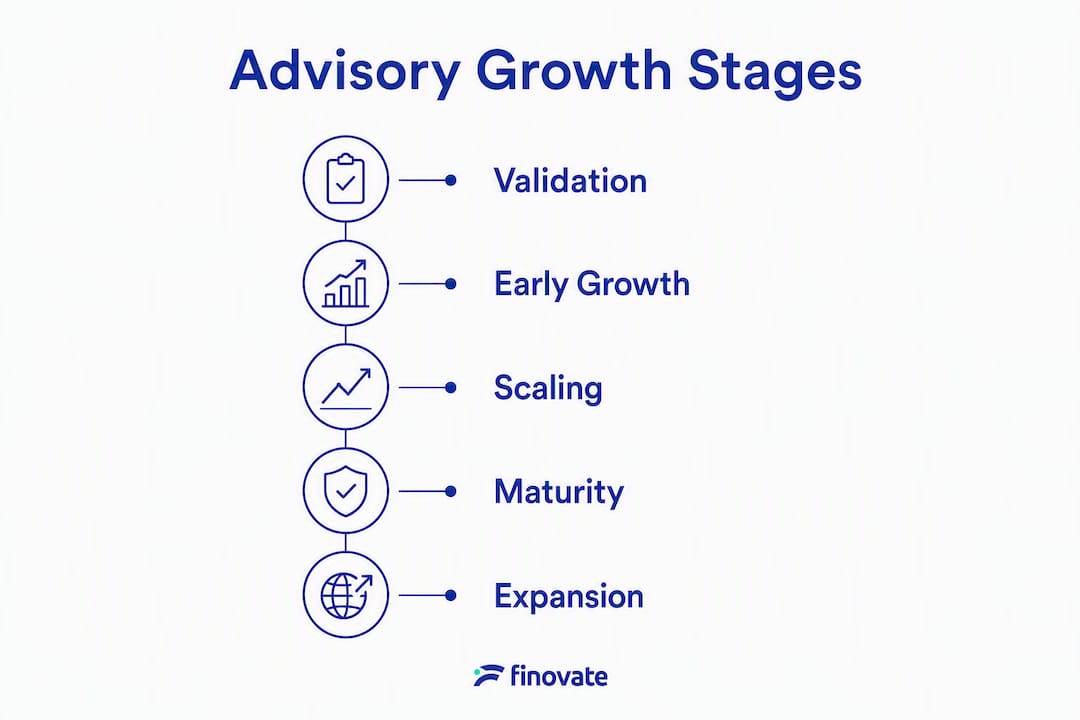
At the validation stage, a small informal network of two or three experienced founders or domain experts is usually sufficient. Formal governance structures at this point add overhead without adding proportionate value.
As you move into early growth, a formal advisory board with an explicit mandate and a regular meeting cadence becomes worthwhile. Specialist retained advisors, covering areas such as tax, regulatory compliance, or M&A, become relevant when the complexity of your situation exceeds what a generalist board can address. A tax advisor with sector-specific knowledge, for instance, can identify structural efficiencies that a generalist would miss entirely.
On compensation: equity works well at early stages when cash is constrained and you want advisors genuinely invested in your outcome. Cash retainers are more appropriate once you are generating revenue and want to avoid equity dilution. Milestone incentives align advisor effort with specific outcomes, such as a completed fundraise or a successful market entry, and are worth considering for high-stakes engagements.
How to structure an advisory board or engagement that actually works
Structure determines whether advisory adds value or becomes a distraction. The most common failure mode is not choosing the wrong advisors; it is designing an engagement with no clear mandate, irregular cadence, and no accountability for follow-through.
Composition rules of thumb:
- Keep the board at 3–5 members for fast-growing private companies. Fewer than three limits perspective diversity; more than five slows consensus and dilutes individual accountability.
- Seek complementary expertise, not overlapping credentials. If you already have financial depth internally, prioritise advisors with market, technical, or operational experience you lack.
- Include at least one advisor with direct experience of your next growth stage, whether that is institutional fundraising, international expansion, or exit.
Charter essentials:
- Scope: Define what the advisory board is and is not responsible for. Advisors counsel; management decides.
- Confidentiality: Require signed confidentiality agreements before any sensitive information is shared.
- Conflict disclosure: Advisors must disclose any commercial relationship with competitors, suppliers, or investors.
- Compensation: Specify the model (equity, cash, or hybrid), vesting schedule if applicable, and review period.
- Meeting cadence: Schedule meetings around your decision cycles, not the calendar. Quarterly is a common default, but monthly may be appropriate during a fundraise or a major operational change.
- Reporting format: Provide a concise brief before each meeting: current priorities, decisions pending, and specific questions for the advisors. This is not optional; it is what separates productive sessions from unfocused conversations.
Practical set-up checklist:
- Draft the advisory charter and have it reviewed by a solicitor.
- Identify and approach candidates with a clear written brief on the role.
- Conduct a pilot session before formalising the appointment.
- Onboard each advisor with a structured briefing pack covering your business model, financials, team, and strategic priorities.
- Assign an internal owner responsible for coordinating advisory meetings and tracking follow-up actions.
Pro Tip: Integrate advisors into your leadership rhythm by sharing board papers or management updates between formal meetings. Advisors who stay informed between sessions arrive at meetings ready to engage with current decisions, not catching up on context.
High-growth advisory is embedded: advisors participate in leadership meetings, stress-test decisions in real time, and help align teams to narrowed priorities. That level of integration requires deliberate design from the outset.

How do you measure the impact of advisory support?
Measuring advisory impact requires separating short-term decision quality from medium and long-term strategic outcomes. Both matter, but they operate on different timescales.
| Timeframe | Indicators | Review cadence |
|---|---|---|
| Short-term (under 3 months) | Decision quality (fewer reversals), meeting action completion rate, clarity of strategic priorities | Monthly |
| Medium-term (3– under 12 months) | Fundraising velocity, margin improvement, execution milestones met on schedule | Quarterly |
| Long-term (over 12 months) | Revenue growth rate vs. pre-advisory baseline, market position, leadership capability development | Annual |
Industry studies show that professional advice can add measurable long-term value to decision confidence and outcomes. The mechanism is consistent: advice improves the quality of decisions made under uncertainty, and better decisions compound over time.
Practically, document every advisory recommendation and assign an owner and a deadline. At each quarterly review, assess which recommendations were acted on, which were rejected and why, and what the outcome was. This creates an evidence base for evaluating whether your advisory arrangement is delivering value, and it gives advisors the feedback they need to improve their input.
A signal that advisory is working: your leadership team is making fewer reactive decisions and more planned ones. A signal it is not: advisory meetings produce interesting conversations but no change in behaviour or resource allocation.
Financial forecasting integrated with advisory input is one of the clearest ways to track whether strategic recommendations are translating into financial outcomes. When your forecast assumptions change as a result of advisory input, and those changes prove accurate, you have a concrete measure of advisory value.
Common pitfalls that undermine advisory value
Most advisory arrangements that fail do so for predictable reasons. Recognising these patterns early allows you to correct them before they become entrenched.
The specific pitfalls to watch for:
Irregular engagement. Advisory value accumulates through context. Advisors who meet only once or twice a year lack the situational awareness to give useful input on fast-moving decisions. Fix: schedule meetings in advance for the full year and treat them as non-negotiable.
Poor briefs. Advisors given no agenda and no specific questions default to general commentary. Fix: send a concise written brief at least five days before each meeting, covering current priorities and the specific decisions you want input on.
Advisors mediating internal conflict. When founders use advisory sessions to resolve disagreements between co-founders or leadership team members, the advisory board's strategic function is displaced. Fix: address internal conflict through direct conversation or a mediator; keep advisory sessions focused on external challenges.
Unclear compensation signals. An advisor compensated only in equity that vests over four years has a different incentive to one on a quarterly cash retainer. Misaligned compensation creates misaligned effort. Fix: match the compensation model to the outcome you want.
Scope creep into operations. Advisory boards are precision instruments: they amplify execution when management retains decision rights, but they undermine authority if they start to dictate operational choices. Fix: restate the advisory mandate at the start of each engagement year.
Red flags that an arrangement has become counter-productive: advisors are contacted only when there is a crisis; management regularly ignores advisory recommendations without explanation; the same strategic issues recur in successive meetings without resolution.
How to choose the right advisors: a practical checklist
Selection is where most founders underinvest. A rigorous selection process takes longer upfront but prevents costly mismatches.
-
Define the mandate before you search. Write a one-page brief describing the growth challenge you need advisory support for, the expertise gap you are filling, and the time commitment you expect. Candidates who cannot engage with a specific brief are unlikely to engage with specific decisions.
-
Assess domain experience. Has the candidate operated at the scale you are targeting, in your sector or an adjacent one? General business experience is less useful than specific pattern recognition from comparable situations.
-
Check regulatory and market fluency. For advisors covering financial, legal, or market-entry matters, verify that their knowledge is current and jurisdiction-specific. Outdated regulatory knowledge is worse than no knowledge.
-
Evaluate capital market credibility. If fundraising is a priority, ask for evidence of recent involvement in transactions at your target stage. Warm introductions to investors are only valuable if the advisor's relationships are current.
-
Request evidence of operating depth. Ask for two or three specific examples of decisions the candidate influenced and the outcomes that followed. Vague answers about "providing strategic direction" are a warning sign.
-
Sample interview questions to ask:
- "Describe a situation where your advice led to a decision being reversed. What happened?"
- "What is the most common mistake you see companies at our stage make, and how would you address it in our context?"
- "How do you typically work between formal meetings? What does your engagement look like day-to-day?"
- "What would make you step back from an advisory role?"
-
Run a paid pilot session. Before formalising any appointment, commission a single paid session focused on a real current challenge. Evaluate the quality of the input, the advisor's preparation, and how well they listen before they advise.
-
Check references directly. Speak to at least two founders or executives the candidate has advised previously. Ask specifically about reliability, the quality of their input under pressure, and whether they respected the boundary between counsel and decision-making.
-
Agree on a review clause. Build a six-month review into every advisory agreement. Both parties should be able to exit cleanly if the arrangement is not working.
What the evidence says about advisory best practice
The practitioner consensus on advisory is more specific than most guides acknowledge. Several recurring rules of thumb emerge from research and practitioner experience.
The 3–5 member advisory board size for fast-growing private companies is the most consistently cited structural recommendation. This represents a practical trade-off: enough diversity of perspective to surface blind spots, yet small enough to maintain accountability and move quickly.
Macro research modelling by CPA Australia suggests that broader access to professional advice can yield large aggregate economic benefits, reinforcing the systemic value of structured advisory beyond individual firm outcomes.
| Best practice | Evidence basis | Practical rule of thumb |
|---|---|---|
| Board size 3–5 members | Bradley practitioner research | Fewer than 3 limits diversity; more than 5 slows decisions |
| Meetings scheduled around decision cycles | Handle.ae practitioner guidance | Quarterly default; monthly during high-stakes periods |
| Concise management brief before each meeting | Handle.ae practitioner guidance | Maximum two pages; specific questions required |
| Advisors embedded in leadership rhythms | Size.vc practitioner research | Attend relevant leadership meetings, not only advisory sessions |
| Advisory-first financial models | Sohomoy industry analysis | Convert historical data into predictive planning inputs |
Finovate's advisory resources for Finnish SMEs apply these principles in a practical local context, with guidance tailored to the specific regulatory and market conditions that Finnish businesses face.
Key takeaways
Advisory accelerates growth most reliably when it is structured with an explicit mandate, a board of 3–5 members, and KPIs that connect advisory input to measurable business outcomes.
| Point | Details |
|---|---|
| Match advisory to your stage | Pre-product needs informal advisors; scaling to institutional size needs fractional executives and specialist retained advisors. |
| Keep the board small and mandated | 3–5 members for fast-growing private companies; define scope, cadence, and compensation before the first meeting. |
| Measure advisory against clear KPIs | Track decision quality short-term, fundraising velocity and margin improvement medium-term, and revenue growth long-term. |
| Avoid cosmetic arrangements | An advisory board with no explicit mandate and irregular meetings produces no growth benefit; mandate specificity is non-negotiable. |
| Finovate advisory support | Finovate provides business advisory and financial planning services for Finnish SMEs, helping founders convert financial data into growth decisions. |
Advisory works best when you treat it as infrastructure, not insurance
The conventional framing of advisory as a safety net for difficult moments misses its real value. Founders who engage advisors only during a crisis are using a planning tool reactively, which is the least efficient way to use it.
The more productive view is that advisory is part of your decision-making infrastructure. When advisors are embedded in your leadership rhythm, briefed consistently, and held to the same standard of follow-through as your internal team, the quality of decisions improves across the board, not just at inflection points.
What most articles understate is the cost of poor advisory design. A cosmetic board, an advisor with no current market knowledge, or an engagement with no accountability mechanism does not merely fail to add value. It consumes management time, creates a false sense of external oversight, and can delay the moment when a founder recognises they need genuinely useful input.
The practical pilot worth running in the next 30–90 days: identify one specific strategic decision you are currently deferring because of uncertainty. Commission a single paid advisory session with a candidate who has direct experience of that decision type. Evaluate the quality of the input against the brief you provided. That one session will tell you more about whether the advisor is right for your business than any amount of background research.
Advisory complements internal leadership; it does not replace it. The best advisory arrangements make your leadership team sharper, not more dependent.
Useful sources for further reading
- The role of advisory boards in scaling a competitive edge for private companies (Bradley) — practitioner research on board composition, the 3–5 member rule, and mandate design for private companies.
- The value of advice research report (CPA Australia) — macro research on the aggregate economic value of professional advice.
- Business advisory services: unlock growth for Finnish SMEs (Finovate) — Finovate's own practical guide to advisory for Finnish businesses, with local market context.
- Business advisory guide for Finnish SMEs in 2026 (Finovate) — deeper reading on advisory strategy tailored to current Finnish market conditions.
- Role of financial advisors for Finnish business owners (Finovate) — explains how financial advisors integrate with broader advisory support for Finnish entrepreneurs.
Finovate supports Finnish business leaders with advisory built into your financial management
For founders who want advisory support grounded in real financial data rather than general commentary, Finovate offers business advisory and consulting as part of its financial management services for Finnish SMEs. The practical advantage is that advisory input at Finovate is connected directly to your bookkeeping, financial projections, and reporting, so recommendations are based on your actual numbers, not assumptions.
This matters because the most common gap in advisory arrangements is the disconnect between strategic advice and financial reality. Advisors working from accurate, current financial data give better input. Advisors working from outdated or incomplete figures give confident-sounding advice that does not hold up in execution.
Finovate works with entrepreneurs, small and medium-sized businesses, and light entrepreneurs across Finland, providing accounting, payroll, VAT reporting, and advisory services under one engagement. If you are at a growth stage where you need both financial clarity and strategic input, that combination reduces the coordination cost of managing multiple providers separately.
To find out how Finovate's advisory and financial services can support your next growth stage, visit finovate.fi or explore the invoicing and operational services available for businesses ready to scale their financial operations.