

Financial forecasting is the process of predicting your business's future financial performance by combining historical data with current market conditions and strategic assumptions. It typically covers revenue, expenses, cash flow, and overall financial position, giving you a forward-looking picture of where your business is headed. Most small businesses forecast for one fiscal year, though the timeframe can range from a few weeks to several years depending on your stage and planning needs.
A solid forecast usually involves:
- Collecting historical financial statements and sales data
- Identifying the key drivers of your revenue and costs
- Setting explicit assumptions about future conditions
- Building projected income statements, balance sheets, and cash flows
- Testing scenarios to see how the numbers shift under different conditions
Why financial forecasting matters for your business
Moving from reactive to proactive financial management is the single most practical benefit forecasting delivers. Rather than discovering a cash shortfall when it arrives, you can see it coming weeks or months in advance and act accordingly.
The benefits extend well beyond cash flow awareness:
- Anticipate funding needs before they become urgent, giving you time to arrange credit or investment
- Allocate resources more deliberately, directing spending where it will have the greatest impact
- Manage risk by identifying periods of low liquidity or rising costs before they affect operations
- Support strategic decisions such as hiring, expanding, or launching a new product or service
- Improve credibility with lenders and investors, who expect to see realistic financial projections
For small business owners in the UK, forecasting also helps you plan around seasonal patterns, VAT payment dates, and Corporation Tax deadlines, all of which create predictable pressure on cash.
The four building blocks of a financial forecast
IBM describes four interconnected components that together form a complete financial forecast. Each builds on the one before it.
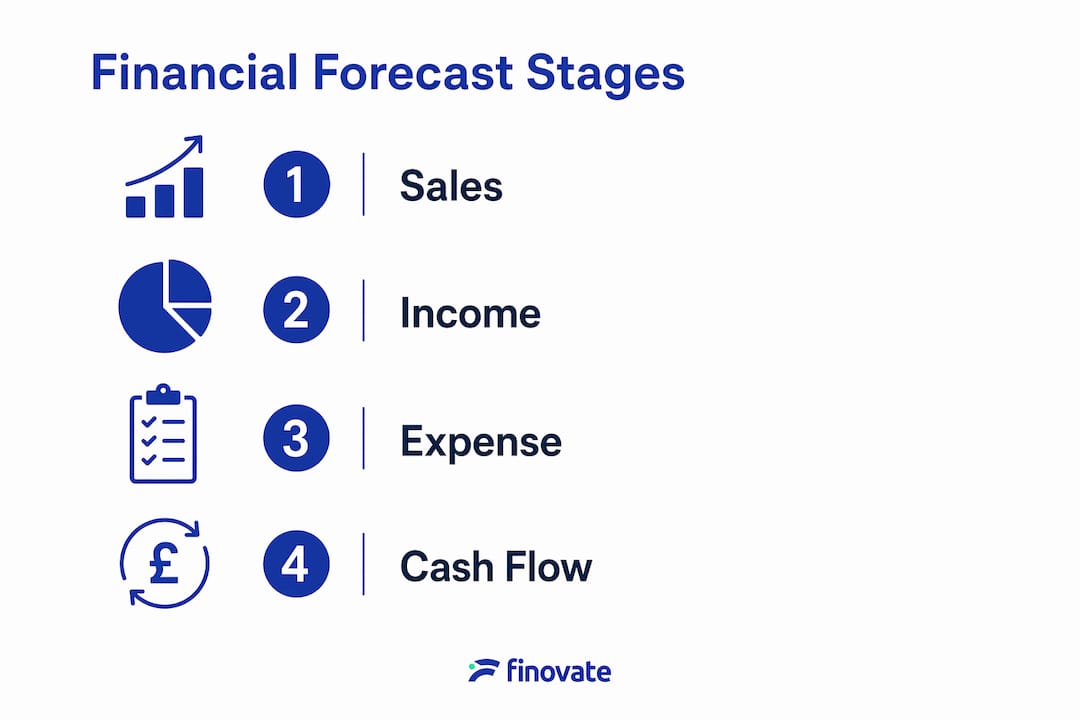
| Building block | What it covers |
|---|---|
| Sales forecasting | Predicted units sold, revenue by product or service line, and sales timing |
| Income forecasting | Expected revenues minus operating costs, taxes, and interest to project net profit |
| Cash flow forecasting | When cash actually enters and leaves the business, distinct from profit timing |
| Balance sheet forecasting | Future assets, liabilities, and equity at a given point in time |
Sales forecasting sits at the foundation. Once you have a credible revenue projection, income forecasting can follow, and those two outputs feed directly into your cash flow forecast. The balance sheet forecast draws on all three. A common mistake is treating cash flow as an afterthought. Even a profitable business can face serious difficulties if cash is unavailable to meet immediate obligations, so running cash balances deserve as much attention as the profit line.

What forecasting methods work best for small businesses?
Quantitative and qualitative methods are the two primary approaches, and most businesses use a combination of both.
Quantitative methods rely on historical figures and mathematical models. Common techniques include:
- Straight-line forecasting: projects future growth by extending a consistent historical rate forward
- Moving average: smooths out short-term fluctuations to reveal underlying trends in revenue or sales
- Simple linear regression: models the relationship between one variable (such as marketing spend) and revenue
- Driver-based forecasting: breaks the business into specific operational inputs, such as website traffic and conversion rates, and models each independently for greater accuracy
Qualitative methods draw on judgement rather than numbers alone. Market research, customer surveys, and expert opinion all fall into this category. They are particularly useful for new businesses with limited historical data, or when entering a new market where past figures offer little guidance.
Pro Tip: Driver-based forecasting tends to outperform simple trend extrapolation because it forces you to think about what actually drives your revenue, rather than assuming the past will repeat itself.
How does forecasting differ from budgeting and financial modelling?
These three concepts are closely related but serve distinct purposes, and confusing them leads to poor planning.
- Financial forecasting is predictive and dynamic. It estimates what will actually happen based on current data and trends, and should be updated regularly as conditions change.
- Budgeting is goal-oriented. A budget sets targets and spending limits for a defined period, reflecting what management wants to achieve rather than what is most likely to occur.
- Financial modelling takes forecast outputs and tests the impact of specific assumptions or decisions, such as what happens to profit margins if costs rise by 10%, or how a new hire affects cash flow over 12 months.
Forecasts and budgets work in tandem. Your forecast tells you what is likely; your budget sets the plan. When the two diverge significantly, that gap is a signal worth investigating. You can read more about building a business budget alongside your forecast to get the most from both tools.
How to create a financial forecast: key steps
A reliable forecasting process follows a clear sequence. Here is how to approach it practically:
- Gather your historical data. Pull together at least 12–24 months of income statements, balance sheets, and bank statements.
- Identify your key drivers. What actually determines your revenue? For a retailer, it might be footfall and average transaction value. For a consultant, it is billable days and day rate.
- Set your assumptions. Document what you expect to change: pricing, headcount, costs, market conditions. Be explicit rather than vague.
- Build your projections. Start with sales, then income, then cash flow, then the balance sheet.
- Run scenario analysis. Develop at least three versions: a base case, a best case with stronger growth, and a worst case with reduced revenue and higher costs. This helps you understand your cash position across a range of outcomes.
- Review and update regularly. A forecast that is never revisited quickly becomes irrelevant. Monthly or quarterly reviews keep it useful.
Which tools support financial forecasting?
Spreadsheet software, particularly Microsoft Excel and Google Sheets, remains the most widely used tool for small business forecasting. Both support the formulas and scenario modelling that most small businesses need. For businesses wanting more automation, cloud accounting platforms such as Xero and QuickBooks include built-in forecasting and cash flow projection features that connect directly to your live financial data. More advanced planning tools exist for larger organisations, but for most UK small businesses, a well-structured spreadsheet or a cloud accounting package covers the essentials.
What are the main challenges and limitations?
Forecasting is an estimate, not a guarantee. The most common pitfalls include:
- Over-reliance on historical data in markets that are changing quickly
- Optimism bias, where revenue projections are too ambitious and cost assumptions too conservative
- Ignoring cash timing, focusing on profit while overlooking when invoices are actually paid
- Infrequent updates, leaving the forecast out of step with current reality
- Single-scenario thinking, planning only for the most likely outcome and being unprepared for variance
Acknowledging these limitations does not make forecasting less useful. It makes it more honest, and therefore more reliable as a planning tool.
How UK small businesses and individuals apply forecasting in practice
UK small businesses face a specific set of financial pressures: quarterly VAT returns, annual self-assessment deadlines, and the timing of PAYE obligations all create cash flow events that benefit from advance planning. A freelance consultant, for example, might forecast monthly income based on confirmed contracts and expected new business, then map that against tax payment dates to avoid a cash shortfall in january or july.
A small retailer preparing for the Christmas trading period would use sales forecasting to estimate stock requirements and income forecasting to project whether the peak season covers slower months. For growing businesses, scaling a small business sustainably almost always depends on having a credible forecast to guide hiring and investment decisions. Managing business expenses alongside your forecast helps you keep both sides of the equation under control.
Financial forecasting in practice: two brief examples
A sole trader offering professional services builds a 12-month forecast by listing confirmed client contracts, estimating likely new business based on pipeline conversations, and projecting monthly expenses including software subscriptions, professional indemnity insurance, and accountancy fees. Running a worst-case scenario where two prospective clients do not convert reveals a cash shortfall in month four, prompting the trader to accelerate invoicing on an existing project.
A small product-based business uses driver-based forecasting, modelling website traffic, conversion rate, and average order value separately. When the owner considers a paid advertising campaign, the model shows clearly how much the conversion rate needs to improve to justify the spend before committing the budget.
Both examples share the same principle: forecasting turns a vague sense of financial direction into a specific, testable plan.
How Finovate can support your financial planning
At Finovate, we work with small business owners and individuals who want clearer control over their finances. Whether you need support with bookkeeping, tax planning, or building the financial foundations that make forecasting possible, we are here to help. Our invoicing service gives you predictable, structured billing that feeds directly into reliable cash flow projections. If your income fluctuates, our flexible invoicing option scales with you. Get in touch with the Finovate team to discuss how we can support your financial planning.
Key takeaways
Financial forecasting is the process of projecting future revenue, expenses, and cash flow using historical data, defined assumptions, and scenario testing to support sound business decisions.
| Point | Details |
|---|---|
| Forecasting covers four components | Sales, income, cash flow, and balance sheet projections form one connected picture. |
| Cash flow timing is critical | Profitable businesses can still face difficulties if cash is unavailable when obligations fall due. |
| Use at least three scenarios | A base, best, and worst case reveals your cash position across a realistic range of outcomes. |
| Forecasting differs from budgeting | Budgets set targets; forecasts estimate what will actually happen based on current data. |
| Update your forecast regularly | Monthly or quarterly reviews keep projections aligned with real business conditions. |