

TL;DR:
- Creating a business budget helps Finnish entrepreneurs improve cash flow control, prioritize spending, and reduce insolvency risks.
- Separating the budget, forecast, and variance analysis ensures adaptability and accuracy in financial planning.
A business budget is a financial plan that defines how your company allocates income, controls expenditure, and commits resources to strategic priorities. For Finnish entrepreneurs, this is not a formality. Bankruptcy filings in Finland reached their highest level since 1996, with over 3,900 companies filing in 2025. That figure reflects a systemic failure in financial planning, not just bad luck. Understanding why create business budgets matters is the first step toward protecting your business from becoming part of that statistic. A budget gives you the financial visibility to act before problems become crises.
Why create business budgets: the core reasons
A budget is not a wish list. Budgets serve as commitment tools that force business leaders to prioritise funding and measure what truly matters. This distinction separates businesses that grow deliberately from those that react to every financial surprise.
The practical benefits of budgeting fall into three categories:
- Prioritisation of spending. When you write down what you plan to spend and why, you are forced to make trade-offs. You cannot fund every idea simultaneously. A budget makes those choices explicit and deliberate rather than accidental.
- Accountability and performance measurement. A budget sets measurable targets. When actual results differ from the plan, you have a clear basis for asking why and deciding what to change. Without targets, there is no meaningful performance review.
- Cash flow control. Profit and cash are not the same thing. A business can show a profit on paper while running out of money because customers pay late. Budgeting with careful cash timing assumptions prevents this gap from becoming fatal.
Up to 25% of bankruptcies in Finland stem from companies not receiving payments on time. This means that even a profitable Finnish SME can fail if its budget does not account for when cash actually arrives. Budgeting for success requires treating cash timing as a first-order concern, not an afterthought.
Pro Tip: Build a separate cash flow projection alongside your profit and loss budget. Knowing when money arrives, not just whether it will arrive, is what keeps your business solvent.
How does budgeting link strategy to financial planning?
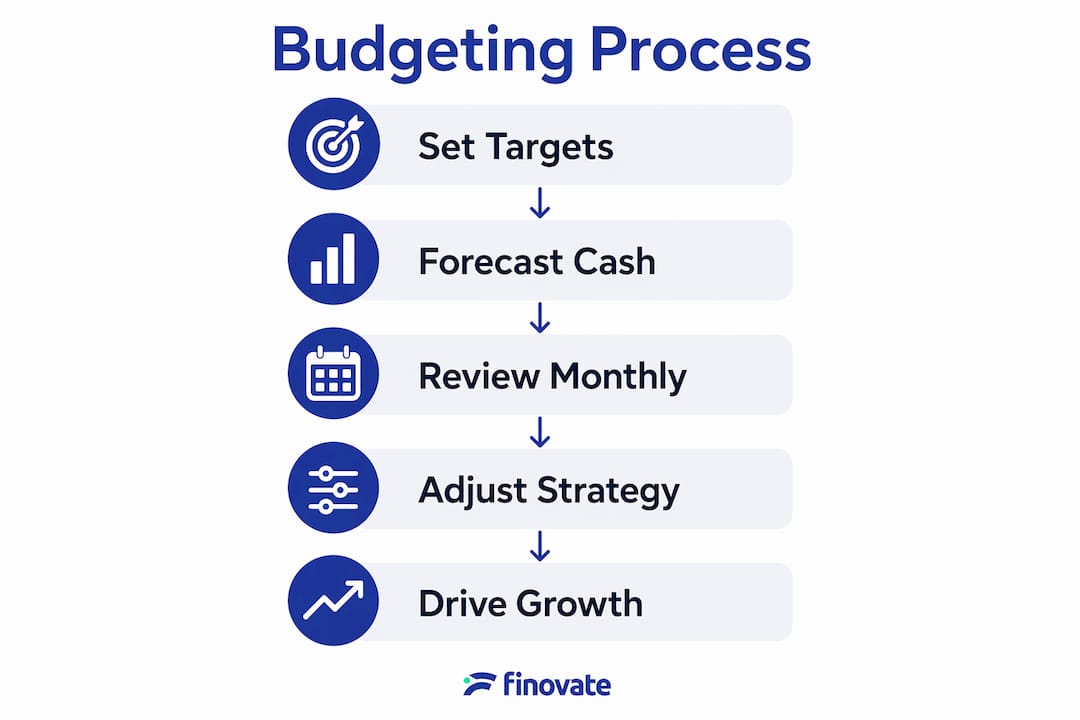
A budget translates your business strategy into financial commitments. If your strategy is to grow revenue by 20% this year, your budget must show where that growth comes from, what it costs to achieve, and which existing activities you will fund less as a result. Without this translation, strategy remains an aspiration rather than a plan.
Many small businesses make the mistake of combining three separate functions into one annual budget: setting targets, forecasting outcomes, and allocating resources. This creates confusion. Separating annual budgeting from rolling forecasts enhances flexibility and accuracy, keeping plans current and useful as market conditions change. The table below clarifies the distinction.
| Planning tool | Primary purpose | Update frequency |
|---|---|---|
| Annual budget | Set targets and commit resources | Once per year |
| Rolling forecast | Track current reality and reproject | Monthly or quarterly |
| Variance analysis | Identify gaps between plan and actual | Monthly |
The annual budget acts as a commitment framework, while rolling forecasts supply current updates on business reality. Together, they enable effective decision-making without waiting for the year-end review to discover that conditions changed six months ago.
Driver-based budgeting takes this further. Instead of building a budget line by line from last year's figures, you identify the key activity drivers of your business, such as number of clients, average order value, or production volume, and model costs and revenues from those drivers. This approach produces budgets that are easier to update, easier to audit, and far more useful when conditions shift.
Pro Tip: Identify your three to five most important business drivers before building your budget. Model your revenues and costs from those drivers rather than copying last year's numbers and adding a percentage.
What cash flow challenges do Finnish entrepreneurs face?
Finland has a specific payment culture problem that directly affects SME survival. Nearly 70% of Finnish companies report negative effects when payments exceed 30 days, and many payment term extensions are unagreed and legally non-compliant. For a small business with limited reserves, a single large invoice paid 60 or 90 days late can trigger a liquidity crisis.
The Finnish Entrepreneurs association has consistently highlighted this issue. Finnish SMEs face acute cash management challenges due to long payment delays, increasing bankruptcy risks that budgeting and contract compliance can help address. The data below summarises the key risk factors Finnish entrepreneurs must build into their budgets.
| Risk factor | Impact on SMEs | Budgeting response |
|---|---|---|
| Payment terms exceeding 30 days | Cash shortfall despite invoiced revenue | Model receivables at 45 to 60 days minimum |
| Illegal term extensions by clients | Unpredictable cash timing | Build a 10 to 15% cash contingency buffer |
| Rising bankruptcy rates in 2025 | Supply chain disruption from failed suppliers | Diversify suppliers and monitor credit risk |
Practical steps Finnish entrepreneurs should take when budgeting for cash flow:
- Assume conservative collection timings in your cash flow budget. If your payment terms are 14 days, budget for 30 to 45 days of actual collection time.
- Include a cash contingency reserve of at least one to two months of operating costs.
- Review your contracts for payment term compliance. Illegally extended terms are not just a financial risk; they are a legal issue under Finnish commercial law.
- Monitor your debtors list weekly, not monthly. Late payments compound quickly when left unaddressed.
Understanding payment term compliance requirements is as important as the budget itself. A well-constructed budget that assumes 14-day payment terms but receives 60-day payments will fail to protect your cash position.
How to implement effective budgeting practices
Effective budgeting is a management discipline, not a one-time document. The following steps give Finnish entrepreneurs a practical framework for building budgets that remain useful throughout the year.
-
Start with your key drivers. Identify the three to five metrics that most directly determine your revenue and costs. For a service business, this might be billable hours and average day rate. For a product business, it might be units sold and cost per unit. Build your budget from these drivers rather than from a spreadsheet of last year's figures.
-
Separate your budget from your forecast. Your annual budget sets the targets you are committing to. Your rolling forecast tracks where you are actually heading. Review your forecast monthly and update it based on real trading conditions. Incremental budgeting based on last year's data often fails to reflect changing reality; driver-based, activity-linked budgets provide accuracy and auditability.
-
Assign ownership. Every budget line should have a named owner who is accountable for performance against it. Without ownership, budget reviews become theoretical discussions rather than management conversations.
-
Build in variance analysis. Each month, compare actual results to your budget. When variances exceed 10%, investigate the cause. Do not simply accept the variance and move on. Understanding why a variance occurred is where the real management value lies.
-
Review your assumptions quarterly. Market conditions, supplier costs, and customer payment behaviour all change. A budget built on January assumptions may be misleading by April. Scheduled quarterly reviews keep your plan grounded in current reality.
Effective budgeting steps for SMEs go beyond spreadsheet mechanics. Governance, ownership, and review cadence determine whether a budget is a living management tool or a document that sits unused after February.
A common and costly error is ignoring the difference between planned profit and actual cash flow timing. Many SMEs appear profitable but fail due to cash shortages caused by timing mismatches between receivables and payables. Your budget must model both the income statement and the cash flow statement to give you a complete picture.
Pro Tip: Schedule a 30-minute monthly budget review with yourself or your team. Compare actuals to plan, update your rolling forecast, and identify one specific action to address the largest variance. Consistency matters more than complexity.
Key takeaways
A business budget is the single most effective tool Finnish entrepreneurs have for controlling cash flow, setting priorities, and reducing the risk of insolvency in a market where late payments and rising bankruptcies create real financial pressure.
| Point | Details |
|---|---|
| Budgets force prioritisation | Explicit spending decisions prevent resources from being spread too thinly across competing needs. |
| Separate budget from forecast | Use the annual budget for targets and rolling forecasts for current reality to maintain agility. |
| Cash timing is critical | Model receivables conservatively; Finnish SMEs routinely wait 45 to 60 days for payment despite shorter terms. |
| Driver-based budgeting outperforms incremental | Build from activity metrics rather than last year's figures for accuracy and auditability. |
| Governance determines usefulness | Assign ownership, review monthly, and analyse variances to keep the budget a live management tool. |
Budgeting in Finland: what the numbers are telling us
The 3,900-plus bankruptcies filed in Finland in 2025 are not an abstract statistic to me. They represent businesses where the financial signals were present but not acted upon in time. In most cases, a well-maintained budget would have surfaced the warning signs months earlier.
What I see repeatedly among Finnish entrepreneurs is a reluctance to separate the budget from the forecast. The annual budget becomes a target, a prediction, and a spending plan all at once, which means it fails at all three. When January's trading differs from the plan, the whole document loses credibility and gets abandoned. The solution is not to build a better spreadsheet. It is to treat budgeting as a system with distinct components, each serving a different purpose.
The payment culture issue in Finland makes this even more pressing. You can have a sound strategy and a profitable business model, and still face insolvency because three large clients paid 90 days late in the same quarter. A budget that does not model this risk is not a budget. It is optimistic accounting. Budgeting to reduce bankruptcy risk starts with honest assumptions about when cash actually arrives, not when it is supposed to.
My advice to any Finnish entrepreneur reading this: build your cash flow budget before your profit and loss budget. Start with the money you know will arrive and when. Then build the rest of your plan around that reality.
— Busayo
How Finovate supports your financial management
Managing a budget effectively requires accurate, up-to-date financial data. Without reliable bookkeeping, your budget comparisons are guesswork rather than management.
Finovate provides accounting and financial services tailored specifically for Finnish entrepreneurs and small business owners. From bookkeeping and payroll to tax planning and business advisory, we give you the financial foundation your budget depends on. Our monthly invoicing service helps you issue invoices promptly and track outstanding payments, directly supporting the cash flow management your budget requires. If you are ready to take control of your financial planning, we are here to help you build the systems that make it work.
FAQ
What is a business budget?
A business budget is a financial plan that sets targets for income, expenditure, and cash flow over a defined period, typically one year. It serves as a commitment tool that guides spending decisions and enables performance measurement.
Why do Finnish SMEs need a budget?
Finnish SMEs face specific risks including late payments and rising bankruptcy rates. A budget with conservative cash flow assumptions and contingency reserves helps businesses survive payment delays that affect the majority of Finnish companies.
What is the difference between a budget and a forecast?
A budget sets the targets and resource commitments you are planning to achieve. A rolling forecast tracks where the business is actually heading based on current trading conditions. Both are needed for effective financial management.
How often should a business budget be reviewed?
A budget should be reviewed monthly through variance analysis, with assumptions updated quarterly. Monthly reviews identify gaps between plan and actual performance before they become serious financial problems.
What is driver-based budgeting?
Driver-based budgeting builds financial projections from key business activity metrics, such as client numbers or units sold, rather than from last year's figures. It produces more accurate, auditable budgets that are easier to update when conditions change.