

TL;DR:
- Financial advisors in Finland help business owners with financial planning, tax, risk, and retirement strategies. They add value through disciplined management, behavioral coaching, and coordinated decision-making across financial areas. Choosing a qualified, transparent advisor who understands Finnish business structures improves long-term financial success.
A financial advisor is a qualified professional who partners with business owners to plan, manage, and grow their finances with purpose. For entrepreneurs in Finland, the role of financial advisors extends well beyond investment recommendations. It covers tax planning, risk management, retirement preparation, and the kind of behavioural coaching that keeps you on track when markets shift or your business enters a new phase. Research from the CFP Board shows that 94% of households advised by CFP® professionals felt confident about achieving their financial goals, compared to 81% of those without professional advice. That gap is significant. It reflects what structured, ongoing advisory support actually delivers.
What are the main responsibilities of financial advisors?

Financial advisors carry a broad set of responsibilities that go well beyond picking investments. Their core duty is to understand your business goals and translate them into a documented financial plan. That plan covers where you are now, where you want to be, and the specific steps to get there.
The primary responsibilities of a financial advisor include:
- Financial planning: Setting measurable goals and building a written plan that covers income, expenditure, savings, and investment targets.
- Investment portfolio design: Selecting assets aligned with your risk tolerance and business timeline.
- Tax planning: Identifying legal ways to reduce your tax liability, including timing decisions around income and deductions.
- Risk management: Assessing business and personal financial risks, then recommending insurance or hedging strategies.
- Retirement and succession planning: Preparing for the eventual transition of your business, whether through sale, succession, or wind-down.
- Estate planning: Structuring your assets to protect your family and minimise inheritance complications.
- Regular financial reviews: Revisiting the plan at set intervals and adjusting for market changes, new regulations, or shifts in your business.
CFP® professionals are particularly thorough in this regard. Research shows their plans cover nearly twice as many critical planning areas as those produced by other advisors, including investment, retirement, estate, and risk management. That breadth matters when you are running a business in Finland and need every financial area working together.
Pro Tip: Ask any prospective advisor to show you a sample financial plan. If it covers fewer than five distinct planning areas, it is likely too narrow for a business owner's needs.
How do financial advisors add value beyond investment advice?
The most visible part of an advisor's work is investment selection. The most valuable part is often invisible. Professional financial advice can add up to 4.87% to long-term portfolio returns. That figure comes not from picking better stocks but from disciplined rebalancing, tax-efficient timing, and keeping clients invested during downturns.
"The hardest advisor work is coordinating cross-area decisions and maintaining discipline over time." — Fidelity
Behavioural coaching is a core part of what advisors do. When markets fall sharply or your business faces a difficult quarter, the instinct is often to act. Advisors help you stay invested according to plan rather than react to short-term noise. That discipline, applied consistently over years, is where real financial progress is made.
The emotional benefit is measurable too. 59% of CFP® clients reported less financial anxiety, compared to 38% of those working with other advisors. For a business owner managing payroll, VAT deadlines, and growth decisions simultaneously, reduced financial anxiety is not a luxury. It is a practical advantage that frees up mental energy for running your business.
Advisors also coordinate decisions across tax, investment, and timing in ways that are easy to overlook. Choosing when to take a dividend, how to structure a business purchase, or whether to defer income into the next tax year all require someone who can see the full picture. That coordination is where advisor fees are justified in practice.
What types of financial advisors are available, and how do you choose?
Not all financial advisors offer the same scope of service. Understanding the differences helps you choose the right fit for your business in Finland.
| Advisor type | Credentials | Best suited for |
|---|---|---|
| CFP® professional | Certified Financial Planner designation | Comprehensive planning across all financial areas |
| Independent advisor | Varies; often fee-only | Entrepreneurs wanting unbiased, conflict-free advice |
| Online or robo-advisor | Algorithm-based | Simple investment management at lower cost |
| Bank-linked advisor | Tied to specific products | Basic financial products; limited independence |
For most Finnish business owners, a CFP® professional or an independent fee-only advisor offers the most relevant support. The CFP® designation requires rigorous training, ethical standards, and ongoing education. Independent advisors, particularly those operating on a fee-only basis, have no incentive to recommend products that pay them commission.
When selecting an advisor, focus on these factors:
- Relevant expertise: Do they have experience with Finnish tax law, VAT, and business structures such as Oy or toiminimi?
- Transparency on fees: Are fees clearly stated as a flat rate, hourly charge, or percentage of assets under management?
- Service scope: Do they cover tax, retirement, and estate planning, or only investments?
- Communication style: Will they meet with you regularly, or only when you call?
- Trustworthiness: Are they registered with a recognised regulatory body and willing to act as a fiduciary?
The difference between a startup advisor and a business coach is also worth understanding. Advisors focus on financial and strategic outcomes. Coaches focus on personal development and decision-making processes. For financial management, you need an advisor with technical credentials, not just a mentor.
Pro Tip: Before your first meeting, prepare a one-page summary of your business structure, annual turnover, and top three financial concerns. Advisors who respond with specific, relevant questions are the ones worth hiring.
How do advisors turn business goals into financial plans?
A financial advisor's practical value shows up most clearly in the planning process. Translating a business goal such as expanding to a second location or retiring in ten years into a concrete financial plan requires structure, documentation, and regular follow-through.
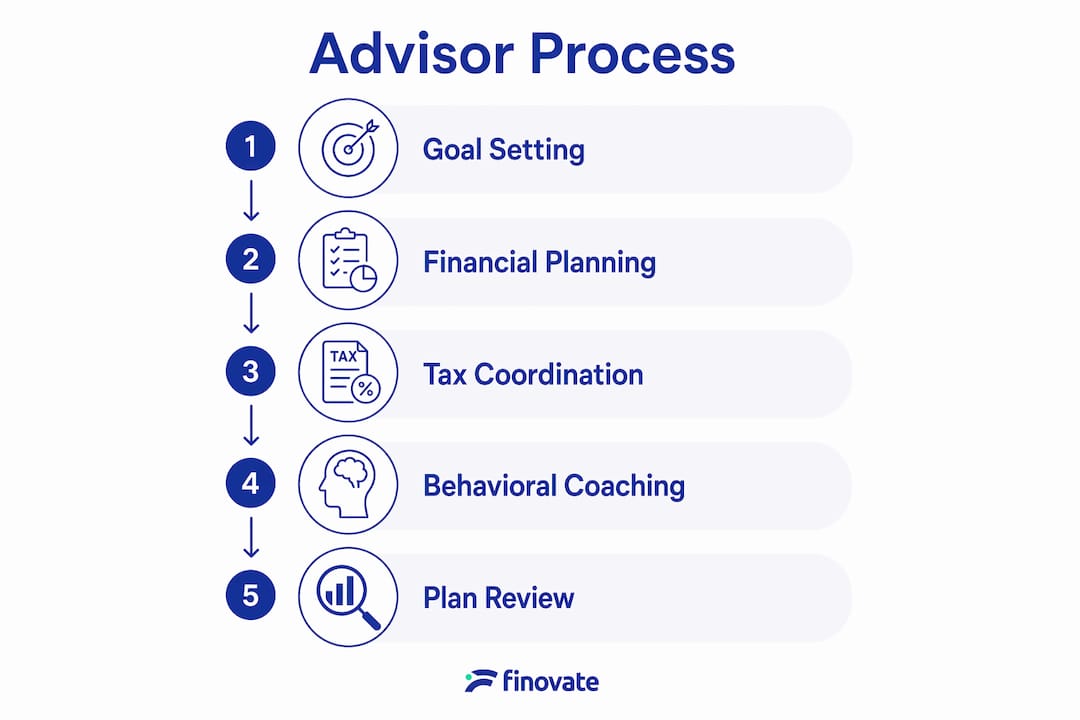
The process typically works as follows:
- Goal-setting session: The advisor works with you to define specific, measurable financial goals tied to your business and personal life.
- Financial assessment: Your current income, liabilities, assets, tax position, and cash flow are mapped in detail.
- Plan documentation: A written plan is produced covering investment allocation, savings targets, tax strategy, and risk management.
- Implementation: The advisor coordinates with your accountant, tax adviser, and other professionals to put the plan into action.
- Regular reviews: The plan is revisited at agreed intervals, typically quarterly or annually, and adjusted for changes in your business, the market, or Finnish tax regulations.
Ongoing check-ins and plan adaptation are what separate a genuine advisory relationship from a one-off consultation. Finnish entrepreneurs face specific planning considerations, including corporate tax rates, the YEL pension system for self-employed individuals, and VAT obligations. An advisor who understands these elements can integrate them into your plan rather than treating them as separate concerns.
Understanding financial management for business owners is the foundation on which good advisory work is built. When you know what your numbers mean, you can have more productive conversations with your advisor and make faster, better decisions. Advisors who work alongside your accounting team add the most value because they can see both the strategic picture and the day-to-day financial reality of your business.
The collaboration between advisors and accountants is particularly important for Finnish SMEs. Business advisory services that combine financial planning with accounting support give business owners a single, coherent view of their finances rather than fragmented advice from separate professionals who never speak to each other.
Key takeaways
Financial advisors deliver the most value when they combine technical planning with consistent behavioural support across all areas of your business finances.
| Point | Details |
|---|---|
| Advisors reduce financial anxiety | 59% of CFP® clients report less financial anxiety than those with other advisors. |
| Value goes beyond investments | Advisors add up to 4.87% to long-term returns through discipline, tax timing, and rebalancing. |
| CFP® plans are more thorough | CFP® professionals cover nearly twice as many planning areas as other advisors. |
| Choose based on expertise and fee structure | Prioritise advisors with Finnish tax knowledge and transparent, conflict-free fee models. |
| Integration with accounting matters | Advisors working alongside your accountant produce more coherent and actionable financial plans. |
What I have seen working with Finnish business owners
After years of working with entrepreneurs across Finland, the pattern I see most often is this: business owners seek a financial advisor only after something goes wrong. A tax bill arrives unexpectedly. A business partner exits. A growth plan stalls because the cash flow was never properly modelled. By that point, the advisor is managing a problem rather than preventing one.
The business owners who get the most from advisory relationships are those who engage proactively. They bring their advisor into conversations about hiring decisions, equipment purchases, and pricing changes before those decisions are made. That is when the advisor's behavioural guidance matters most, not during a crisis, but during the ordinary decisions that compound over time.
I also believe strongly in the integration of advisory and accounting services. When your advisor and your accountant are working from the same numbers and communicating regularly, you stop receiving conflicting advice. You get a clear, consistent picture of your financial position. That clarity is what allows you to make confident decisions about growth, investment, and your own financial future.
Choose a long-term partner, not a one-off consultant. The advisors who deliver real results are those who know your business well enough to challenge your assumptions and support your plans through every stage of growth.
— Busayo
How Finovate supports Finnish business owners alongside financial advisors
Finovate provides accounting, tax, bookkeeping, and payroll services to business owners and entrepreneurs across Finland. These services work directly alongside financial advisory support, giving you accurate, up-to-date financial records that your advisor can use to build and refine your plan.

When your accounts are well-maintained and your tax position is clear, your financial advisor can focus on strategy rather than correcting errors or chasing missing figures. Finovate's team handles the day-to-day financial management so that your advisory conversations stay focused on growth, planning, and the decisions that matter most. Whether you are a sole trader, a limited company, or a light entrepreneur, Finovate has a service structure that fits your situation. Visit finovate.fi to see the full range of accounting and tax services available to Finnish businesses.
FAQ
What does a financial advisor do for a business owner?
A financial advisor helps business owners set financial goals, build investment plans, manage tax obligations, and prepare for retirement or business succession. Their role includes regular plan reviews and behavioural coaching during periods of market or business change.
What is the difference between a financial advisor and a broker?
A financial advisor provides ongoing, personalised financial planning across multiple areas of your finances. A broker primarily executes transactions such as buying or selling securities, often without providing broader planning support.
How do I choose a financial advisor in Finland?
Look for a CFP® professional or a fee-only independent advisor with direct experience in Finnish tax law, VAT, and business structures. Confirm their fee model is transparent and that they offer regular reviews rather than one-off consultations.
Are financial advisor fees worth paying?
Research from Fidelity shows that professional advice can add up to 4.87% to long-term portfolio returns through disciplined planning and tax-efficient decisions. The coordination of tax, investment, and timing decisions alone typically justifies the cost for business owners.
How often should I meet with my financial advisor?
Most business owners benefit from quarterly or annual reviews, with additional meetings when significant business or personal changes occur. Strong advisory relationships involve regular, structured check-ins rather than contact only during problems.