
TL;DR:
- Finnish SMEs are crucial to the economy but often lack structured strategic guidance to realize their growth potential. Business advisory services, offering ongoing strategic support beyond standard consulting, help owners manage risks, improve performance, and build resilience. Access to subsidized advisory support in Finland can significantly enhance SME success, especially when integrated early and tailored to specific business needs.
Finnish SMEs are the backbone of the national economy, yet many owners never fully capitalise on the support available to them. SMEs make up 99.8% of all enterprises across the EU, contributing enormously to employment and value creation. Despite this, a striking number of these businesses operate without structured strategic guidance, leaving significant growth potential untapped. This article explains what business advisory services actually involve, how they differ from standard consulting, and what concrete steps Finnish SME owners can take right now to strengthen performance, manage risk, and build lasting resilience.
Table of Contents
- What is business advisory service?
- How business advisory services support Finnish SMEs
- Business advisory vs. consulting: What's the real difference?
- Common challenges and proven strategies for Finnish SMEs
- Our take: Why most Finnish SMEs underuse advisory and what really works
- How professional advisory and accounting services can support your SME
- Frequently asked questions
Key Takeaways
| Point | Details |
|---|---|
| Business advisory defined | Business advisory provides SMEs with ongoing expert guidance for strategy, growth, and resilience beyond standard compliance. |
| Support for Finnish SMEs | Finnish SMEs can access tailored advisory and funding support from Business Finland and ELY Centres to unlock growth potential. |
| Advisory vs consulting | Advisory means a continuous relationship focused on long-term value, while consulting is usually project-based and short-term. |
| Proven strategies boost outcomes | SMEs using structured advisory see better profitability and resilience, especially when strategies target digital and sustainable growth. |
What is business advisory service?
With the context set, let us clarify exactly what business advisory means and how it stands apart from more familiar services.
Business advisory services are professional consultations provided by experts to business owners and decision-makers, focusing on strategic guidance to improve performance, manage risks, and drive growth through analysis of financial, operational, market, and other aspects. This definition is broad by design, because advisory work genuinely spans many disciplines.
Unlike routine compliance tasks such as bookkeeping or tax filing, advisory is forward-looking. It is not about recording what has already happened. It is about helping you understand where your business is heading and what decisions will shape that trajectory. Many SME owners are familiar with accounting services for small businesses, but advisory goes a step further by combining financial insight with strategic thinking.
Business advisory is also ongoing. This distinguishes it from episodic consulting, where an external expert arrives, delivers a report, and leaves. Advisory builds a continuous relationship where your adviser gains deep knowledge of your business, your industry, and your goals over time. That context makes the guidance far more relevant and actionable.
Key areas typically covered by business advisory services include:
- Strategic planning and goal setting to keep your business on a clear growth path
- Financial health monitoring including cash flow, profitability, and investment returns
- Operational efficiency to reduce waste and improve margins
- Market positioning and competitive analysis to identify opportunities before competitors do
- Risk identification and mitigation to protect your business from foreseeable threats
- Access to funding and grants relevant to your sector and stage of development
Business advisory is not a luxury reserved for large corporations. For Finnish SMEs, it is one of the most cost-effective ways to build strategic clarity, reduce costly mistakes, and accelerate growth in a way that routine compliance work simply cannot deliver.
If you are uncertain whether your business would benefit, consider whether you have ever made a significant financial or operational decision without fully understanding all the implications. Most SME owners have. That is precisely the gap advisory services are designed to fill. Understanding the accountant benefits for Finnish SMEs is a useful starting point for seeing how professional support creates value at every business stage.
How business advisory services support Finnish SMEs
Now that you know what advisory means, let us look at the concrete impact for Finnish SMEs and how to tap into available support.
Finland has a well-developed ecosystem of advisory support, and much of it is subsidised or partly funded. Government-backed advisory in Finland is delivered through organisations including Business Finland, which covers growth, internationalisation, innovation advice, and funding. ELY Centres provide business development aid focused on growth and renewal. Economic Development Centres offer discretionary funding for high-impact projects, though certain sectors such as primary agriculture are excluded.
These organisations exist to make expert guidance accessible without requiring large upfront investment. However, many SME owners are simply unaware of what is available or how to navigate the application processes efficiently.
The performance data reinforces why this matters. EU SME performance data shows that whilst real value added across EU SMEs declined by 0.2% in 2024, employment still grew by 1.1%. The forecast for 2025 is more encouraging, with 1.6% value added growth and 0.9% employment growth projected. Critically, micro-SMEs demonstrate the highest resilience and growth rates, and SMEs with formalised strategies consistently show higher return on assets (ROA) than those operating without one.
| Metric | SMEs without formal strategy | SMEs with formal strategy |
|---|---|---|
| Return on assets (ROA) | Below sector average | Above sector average |
| Employment growth | Reactive, inconsistent | Planned, sustained |
| Resilience to downturns | Lower | Higher |
| Access to external funding | Limited | Broader |
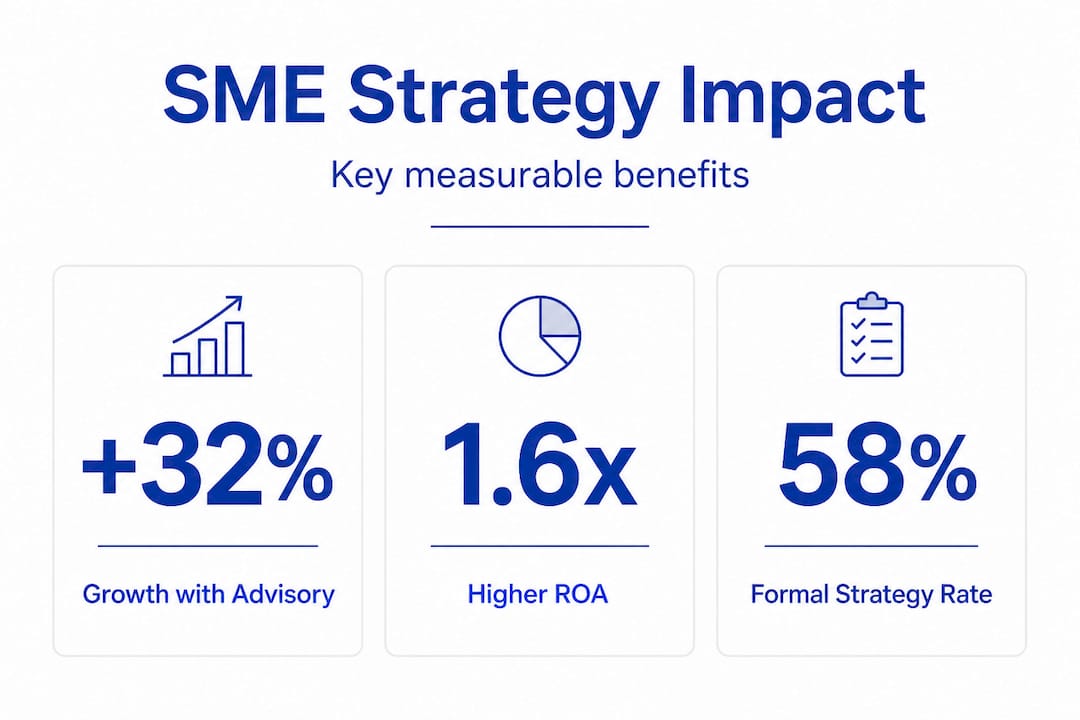
The difference is measurable and significant. A formalised strategy, supported by ongoing advisory, is not a theoretical exercise. It translates directly into better financial outcomes.
Pro Tip: Engage subsidised advisory tools and digital resources early in your business journey, not only when facing a crisis. Early engagement allows advisers to identify opportunities and risks before they become urgent, which is considerably less costly than reactive problem-solving.
If you are ready to start, here are the practical steps to access advisory support in Finland:
- Register on My Enterprise Finland (Oma yritys-Suomi) to access a centralised portal for business support services and tools
- Contact your regional ELY Centre to explore development funding and advisory programmes relevant to your sector
- Check Business Finland eligibility if your business has international ambitions or is developing innovative products or services
- Engage a private adviser or accounting firm for ongoing strategic and financial guidance that complements public support
- Review your current financial reporting to identify gaps in strategic insight before your first advisory session
If you are just starting a business in Finland, it is well worth building advisory relationships from the outset rather than waiting until challenges arise.
Business advisory vs. consulting: What's the real difference?
Next, it is important to understand how business advisory differs from traditional consulting so you can prioritise the right kind of support for your SME.
The terms are often used interchangeably, but they represent genuinely different relationships. Advisers differ from consultants primarily in the nature and duration of their engagement. Consultants are typically hired for specific projects with defined deliverables and end dates. Advisers maintain ongoing relationships focused on execution gaps and sustained value creation, measured by whether return on invested capital exceeds the weighted average cost of capital. That is a considerably higher bar than delivering a one-off report.
Forward-looking advisory also challenges internal assumptions and biases in ways that historical accounting data cannot. Your financial records tell you what happened. Your adviser should help you understand why it happened and what to do next.
| Element | Business advisory | Traditional consulting |
|---|---|---|
| Duration | Ongoing, continuous | Project-based, fixed term |
| Focus | Strategy, execution, capability | Specific problem or deliverable |
| Relationship | Deep, contextual knowledge | Arm's length, transactional |
| Outcome | Long-term resilience and growth | Defined output or recommendation |
| Value measurement | ROA, sustained performance | Project completion |
| Engagement frequency | Regular and proactive | As needed or contracted |
This distinction matters practically. If you need to redesign your pricing model, a consultant might be the right choice. If you want a trusted professional who understands your business well enough to flag risks before they become expensive, you need an adviser. Understanding real SME growth from accounting shows how the right professional relationship can shift your business from reactive to strategic thinking.
Pro Tip: Ask yourself whether your business has recurring strategic questions that arise monthly or quarterly. If the answer is yes, ongoing advisory is likely more cost-effective than commissioning separate consulting projects each time. The accumulated knowledge an adviser builds about your business has genuine financial value.
It is also worth noting that advisory and consulting are not mutually exclusive. Many Finnish SMEs benefit from an ongoing adviser who also coordinates specialist consultants when specific technical expertise is required. This hybrid model gives you both depth and breadth without duplicating costs.
Common challenges and proven strategies for Finnish SMEs
With the differences clear, let us address the challenges Finnish SMEs face and how strategic advisory can help you overcome them.
Finnish SMEs operate in a competitive, increasingly digital environment. Growth opportunities are real, but so are the obstacles. The most common challenges we observe include:
- Internal bias and blind spots that prevent owners from objectively assessing their own strategy or performance
- Short-term focus driven by cash flow pressure, which crowds out longer-term planning
- Slow digital adoption, particularly among micro-enterprises and traditional sectors
- Funding limitations, especially for businesses that have not built relationships with lenders or grant bodies
- Over-reliance on a single revenue stream, which increases vulnerability to market shifts
- Insufficient management capacity, where owners are too operationally involved to work strategically
Each of these challenges has well-documented solutions, and advisory services are instrumental in applying them practically. SMEs leveraging advisory services achieve superior financial health through structured strategic planning and are better positioned to integrate digital tools and sustainability practices for long-term competitiveness, according to EU data.
The digital integration point deserves particular attention. Finnish SMEs that have adopted automated financial reporting, cloud-based payroll systems, and digital customer management tools consistently outperform those relying on manual processes. The investment required is often modest, but many owners delay without an adviser to guide the decision and implementation.

Understanding essential business finance terms is a practical first step, as financial literacy forms the foundation of any effective advisory conversation. Similarly, getting payroll services right from an early stage frees up management time and reduces compliance risk, creating more capacity for strategic work.
Actionable strategies that deliver measurable results for Finnish SMEs include:
- Formalise your strategy annually, even as a simple one-page document reviewed quarterly with your adviser
- Schedule monthly financial reviews rather than waiting until year-end to understand your numbers
- Map your funding landscape by identifying applicable grants, ELY Centre programmes, and Business Finland instruments at least six months ahead of need
- Invest in one digital tool per quarter to gradually modernise operations without overwhelming your team
- Seek external review of major decisions before committing capital or entering new markets
The cumulative effect of these actions, applied consistently over one to three years, is material. SMEs that build these disciplines early find they are far better positioned to scale, attract investment, and weather economic uncertainty.
Our take: Why most Finnish SMEs underuse advisory and what really works
In our experience working with Finnish SMEs across various sectors and regions, the single most common mistake is treating advisory as a last resort. Business owners tend to reach out when something has already gone wrong: cash flow is strained, a key contract is lost, or a tax liability arrives unexpectedly. At that point, advisory becomes crisis management, which is far less effective than preventative planning.
Generic advice also fails frequently. A strategy that works well for a Helsinki-based technology startup is unlikely to suit a family-owned manufacturing business in Tampere or a seasonal tourism operator in Lapland. Region, industry, business stage, and ownership structure all shape what good advisory looks like. We see too many SMEs adopt frameworks that were designed for entirely different contexts and then wonder why the results disappoint.
What actually works is regular engagement built on genuine familiarity. When an adviser knows your business intimately, they can spot a concerning trend in your monthly figures long before it becomes a crisis. They can identify a relevant funding opportunity you would have missed. They can push back on a decision that feels right emotionally but carries significant financial risk.
A practical example: consider a Finnish SME owner contemplating an international expansion into the Swedish market. Without ongoing advisory, this decision might be made on optimism and incomplete data. With an adviser who understands the owner's financial position, operational capacity, and risk tolerance, the decision becomes structured. The timing, funding mechanism, and entry strategy are all evaluated before commitment, which dramatically reduces the chance of an expensive misstep.
Good bookkeeping for compliance and growth also underpins effective advisory, because advisers can only work well with accurate, timely financial information. If your books are not current, strategic conversations become speculative rather than data-driven. We encourage every SME owner to view bookkeeping not as an administrative burden but as the information infrastructure that makes meaningful advisory possible.
The Finnish SMEs we see achieving the best outcomes share one trait: they treat their adviser as a genuine business partner, not a service provider they contact reluctantly. That shift in mindset is, in our view, the highest-value change any SME owner can make.
How professional advisory and accounting services can support your SME
If you are ready to get strategic about growth and compliance, here is where you can find expert, Finland-specific support.
Running a Finnish SME means managing tax obligations, payroll, financial reporting, and strategic growth all at once. That is a considerable load, and it is entirely reasonable to want expert support that covers all of it in one place.
At Finovate, we offer accounting and advisory services tailored specifically to Finnish SMEs. Whether you need bookkeeping, tax planning, payroll processing, or strategic financial guidance, our team provides clear, practical support at every stage of your business journey. For light entrepreneurs and freelancers, our invoicing service makes it straightforward to manage income without the administrative complexity of full company registration. If you would like to discuss how we can support your specific situation, we welcome you to reach out to our team at Finovate directly. We are here to make your financial management straightforward and your growth ambitions achievable.
Frequently asked questions
How do Finnish SMEs choose the right business adviser?
SMEs should assess expertise, verify familiarity with Finnish market conditions, and prioritise advisers who offer ongoing rather than one-off support. Look for professionals who focus on execution gaps and value creation rather than simply delivering reports.
What types of government-backed advisory are available in Finland?
Business Finland and ELY Centres provide growth, innovation, and development services for Finnish SMEs, often with subsidised or discretionary funding to reduce the cost of accessing expert support.
How does advisory differ from standard accounting?
Forward-looking advisory is proactive and strategic, whereas standard accounting is primarily retrospective, focused on statutory compliance, accurate record-keeping, and financial reporting.
Why do SMEs with advisory support perform better?
SMEs using advisory services achieve higher growth, profitability, and resilience because they operate with structured planning and expert guidance. SMEs with formal strategies consistently show higher return on assets compared to those without, according to EU performance benchmarks.