

TL;DR:
- Running a small or medium-sized enterprise in Finland involves managing complex compliance, cash flow, staff, customers, and growth challenges. A structured business advisory framework transforms scattered data into clear priorities and promotes a consistent, forward-looking growth approach. Starting with thorough data preparation across core areas and following a five-level process ensures ongoing progress and avoids common pitfalls.
Running a small or medium-sized enterprise in Finland comes with real complexity. You are managing compliance, cash flow, staff, customers, and growth, often without a clear framework to guide decisions. A structured business advisory guide gives you that framework. It turns scattered financial data into clear priorities and replaces reactive decisions with a consistent, forward-looking approach. This article walks you through everything: what to prepare before engaging in advisory, how to execute a five-level process, common mistakes to avoid, and how to measure results that actually matter.
Table of Contents
- Key takeaways
- Your business advisory guide starts with preparation
- The five-level advisory process for SMEs
- Common mistakes in business advisory adoption
- Measuring the impact of your advisory efforts
- My perspective on advisory as a growth system
- How Finovate supports your advisory journey
- FAQ
Key takeaways
| Point | Details |
|---|---|
| Prepare your data first | Organise financial, operational, and compliance information before starting any advisory process. |
| Follow a five-level framework | Progress through awareness, benchmarking, potential, planning, and accountability for structured growth. |
| Avoid one-off planning | Advisory works as a repeating cycle, not a single annual event, to drive consistent progress. |
| Track the right KPIs | Monitor CAC to LTV ratio, business health scores, and financial levers to verify results. |
| Match your service to your stage | Choose advisory packages and tools that fit your current business complexity and growth phase. |
Your business advisory guide starts with preparation
Before you engage with any advisory process, you need a clear picture of where your business actually stands. Many Finnish entrepreneurs skip this step and jump straight into planning, which means their strategies are built on incomplete or outdated information.
Start by gathering data across four core areas:
- Financial health: Current profit and loss figures, cash flow statements, outstanding debts, and pricing structures
- Operations: Key processes, team capacity, supplier relationships, and workflow bottlenecks
- Legal and compliance: Registration status, VAT obligations, employment contracts, and any outstanding regulatory requirements
- Market position: Customer acquisition channels, retention rates, competitor awareness, and pricing relative to the market
A 47-point business health checklist covers all four areas and typically takes an owner 20 to 30 minutes to complete. It is one of the most practical starting points we recommend because it immediately reveals where the gaps are.
Once you have your data, structure it in a format that is easy to revisit and update. Financial reporting templates designed for Finnish SMEs can help you organise this information consistently from the start.
Pro Tip: Do not try to fix everything at once. After completing your initial assessment, identify two or three areas where a small improvement would have the most immediate financial impact. Address those first before expanding your scope.
| Preparation area | Why it matters | Recommended starting action |
|---|---|---|
| Financial data | Drives all advisory decisions | Pull last 12 months of accounts |
| Operations review | Identifies capacity and inefficiency | Map your top three core processes |
| Compliance status | Reduces legal and financial risk | Complete a business compliance checklist |
| Market position | Informs pricing and growth targets | Analyse your top five customer segments |
The five-level advisory process for SMEs
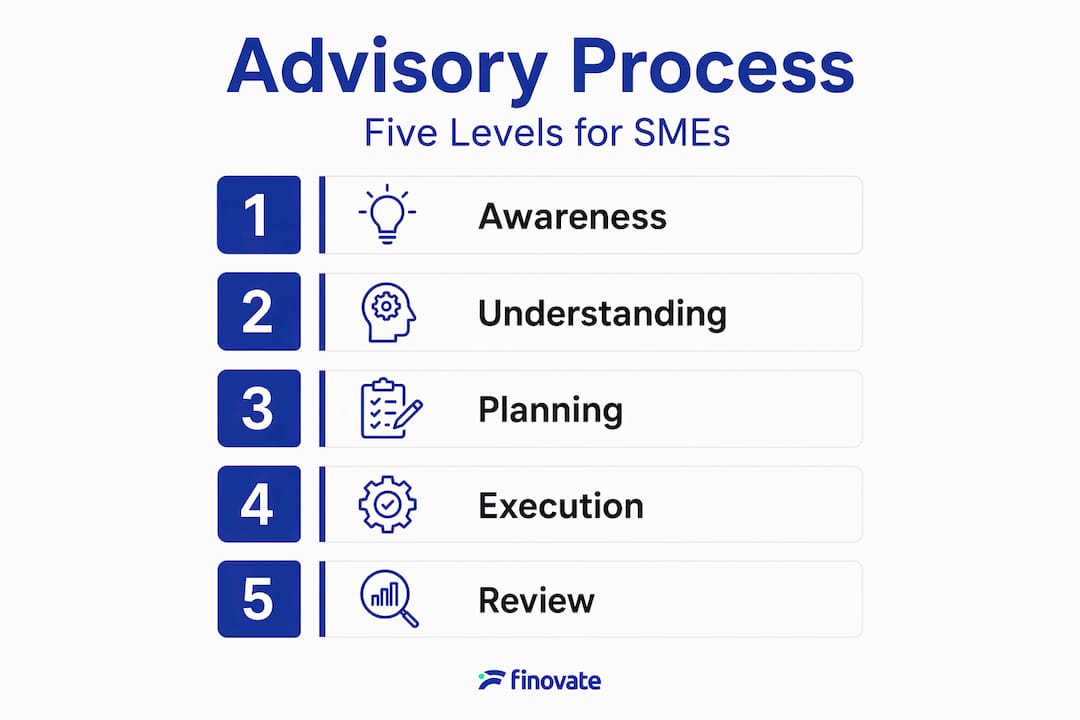
With your data in place, you can move through a structured execution process. Recurring business advisory services use five levels to guide this progression: awareness, benchmarking, potential, strategy, and execution.
Here is how each level works in practice:
-
Awareness. You review your current financial position clearly and honestly. This is not about judgment. It is about seeing the numbers as they are, so you can make informed choices rather than assumptions.
-
Benchmarking. Your figures are compared against sector peers and local Finnish businesses of similar size. This is where you learn whether your margins, costs, or growth rates are strong or lagging. Automated benchmarking tools that integrate with accounting platforms convert raw data into visual outputs, which makes this step accessible even without a financial background.
-
Potential. Based on the benchmarking results, you identify your most significant growth levers. These are the pricing adjustments, cost reductions, or volume improvements that would have the greatest impact on your bottom line.
-
Planning. You co-create a strategic plan with clear milestones. This is your business strategy guide in action. Each milestone has a responsible person, a deadline, and a measurable outcome.
-
Accountability. This is the level most businesses skip. Advisory engagements are most impactful when they include quarterly or monthly review cycles that translate financial data into specific levers owners can adjust, such as price, volume, and costs.
Pro Tip: Set a fixed meeting rhythm with whoever supports your advisory process, whether that is an accountant, an advisor, or a trusted peer. A monthly 60-minute review and a quarterly half-day strategy session creates the structure that keeps momentum going without overwhelming your schedule.
| Advisory level | Primary focus | Key output |
|---|---|---|
| Awareness | Understanding current position | Honest financial snapshot |
| Benchmarking | Comparing against sector peers | Gap and strength analysis |
| Potential | Identifying growth levers | Prioritised opportunity list |
| Planning | Co-creating strategic milestones | Documented action plan |
| Accountability | Reviewing progress and adapting | Updated priorities and next steps |
Common mistakes in business advisory adoption
Even with a solid framework, many Finnish SME owners run into the same avoidable problems. Knowing what they are in advance saves considerable time and money.
-
Confusing advisory with consultancy. These are different roles. Advisors provide ongoing leadership and prioritisation support, whilst consultants solve specific tactical problems. Expecting your advisor to do both, without clarity on which role you need, leads to misaligned expectations and wasted investment.
-
Relying on annual planning alone. Many entrepreneurs treat advisory as a one-time strategic plan rather than an ongoing repeating system. A yearly plan is a useful document, but without regular reviews it becomes obsolete within weeks of being written.
-
Ignoring data quality. Your advisory is only as good as the information feeding it. If your bookkeeping is months behind or your figures are inconsistent, the insights you receive will be unreliable. Keeping your financial records current is not optional. It is the foundation everything else rests on.
-
Undervaluing the insights you receive. Some business owners complete an advisory process, receive clear recommendations, and then file the report away without acting. The value of advisory is not in the document. It is in the decisions you make as a result.
-
Failing to integrate advisory into daily operations. Good advisory is not separate from your business. It should inform how you price, hire, invest, and plan each month. If advisory insights only come up during formal review sessions, you are not getting full value from the process.
Reviewing your SME financial management practices regularly is one of the most practical ways to keep advisory insights active in your day-to-day decisions.
Measuring the impact of your advisory efforts
Knowing that advisory is working requires more than a general sense of progress. You need specific indicators that tell you whether the process is creating measurable change.
The most useful KPIs for Finnish SMEs fall into three categories:
- Financial health: Gross margin percentage, net profit trend, cash flow consistency, and revenue per employee
- Operational efficiency: Customer acquisition cost, time to invoice payment, and staff productivity ratios
- Customer metrics: Retention rate, average order value, and customer lifetime value
One benchmark worth tracking closely is your CAC to LTV ratio. A ratio above 3:1 is recommended for sustainable SME growth. If you are spending more to acquire customers than they return over their lifetime, no amount of advisory will compensate for that structural problem.
Set up a review cadence that fits your business rhythm. Monthly reviews work well for financial levers such as pricing and cash flow. Quarterly reviews are better suited to strategic priorities and market positioning. Using financial 'levers' such as price, volume, and cost metrics reviewed regularly allows you to proactively influence performance rather than simply reacting to results.

A practical way to track progress is to score your business health across the same four areas you assessed at the start: financial, operational, compliance, and market position. Comparing your score after three and six months of structured advisory gives you a concrete picture of improvement. If the scores are not moving, that tells you something too. Either the actions are not being implemented, or the priorities need to be revisited.
My perspective on advisory as a growth system
I have seen a lot of Finnish business owners approach advisory with the mindset of a one-off fix. They complete an assessment, receive a plan, and expect the results to follow automatically. That is not how it works, and I think this misconception is the single biggest barrier to SME growth in Finland.
What actually works is treating advisory as a repeating system. The shift from bespoke, partner-led advisory to repeatable, team-delivered advisory is what enables scalability and consistent outcomes, not just for the firm delivering it, but for the business receiving it. When you have a structured process that runs every month and every quarter, small course corrections become normal. You stop lurching from crisis to plan to crisis.
The businesses I have seen grow most reliably are not necessarily the most talented or the best funded. They are the ones who commit to regular reviews, update their data consistently, and treat their advisor or accountant as a genuine business partner rather than an annual obligation. That shift in mindset is worth more than any tool or template.
If you are a Finnish entrepreneur reading this and wondering where to start, my honest advice is to complete a thorough health assessment first, understand your SME budgeting fundamentals, and then build a rhythm you can sustain.
— Busayo
How Finovate supports your advisory journey
Finovate works with Finnish entrepreneurs and SMEs who want their financial data organised, accurate, and ready to drive real decisions. Our accounting and bookkeeping services provide the clean, current financial foundation that any effective advisory process depends on.
For businesses that invoice clients regularly, our professional invoicing service keeps billing accurate and cash flow predictable, which is one of the most common pressure points for growing Finnish SMEs. We also offer a monthly invoicing plan suited to businesses that prefer a fixed, predictable cost structure.
Pro Tip: If your business is in early growth, start with a lighter service package and upgrade as your invoicing volume and complexity increase. Paying for more than you need at the start is a common and avoidable drain on working capital.
Our services support business advisory for Finnish SMEs by making sure your financial reporting is always ready when you need it. Explore how Finovate can support your business at finovate.fi.
FAQ
What is a business advisory guide?
A business advisory guide is a structured framework that helps business owners assess their current position, identify growth opportunities, and implement a strategic plan with regular accountability. It covers financial, operational, compliance, and market factors.
How is a business advisor different from a consultant?
Advisors provide ongoing leadership and prioritisation support as a long-term partner, whilst consultants typically solve specific tactical problems on a project basis. Confusing these roles can lead to misaligned expectations and inefficient use of your budget.
How often should I review my business advisory plan?
Monthly reviews work well for financial metrics such as pricing and cash flow, whilst quarterly sessions are better suited to strategic priorities. Regular cycles are what make advisory effective rather than a single annual plan.
What KPIs should Finnish SMEs track in advisory?
Key metrics include gross margin, net profit trend, cash flow consistency, customer acquisition cost, and the CAC to LTV ratio. A CAC to LTV ratio above 3:1 is a widely recognised benchmark for sustainable growth.
How do I start an advisory process as a small Finnish business?
Begin by completing a health assessment across your financial, operational, legal, and market data. A structured checklist covering these four areas typically takes 20 to 30 minutes and gives you a clear starting point for your advisory process.