

Most small and medium businesses that run into cash flow trouble do not have a revenue problem. They have a budgeting problem. The most damaging mistakes in business budgeting are overestimating sales, ignoring cash flow timing, skipping contingency funds, failing to include employer tax and payroll costs, never updating the budget after it is set, and keeping it locked away from the people who need to act on it.
Here is a quick summary of the highest-impact errors and their immediate fixes:
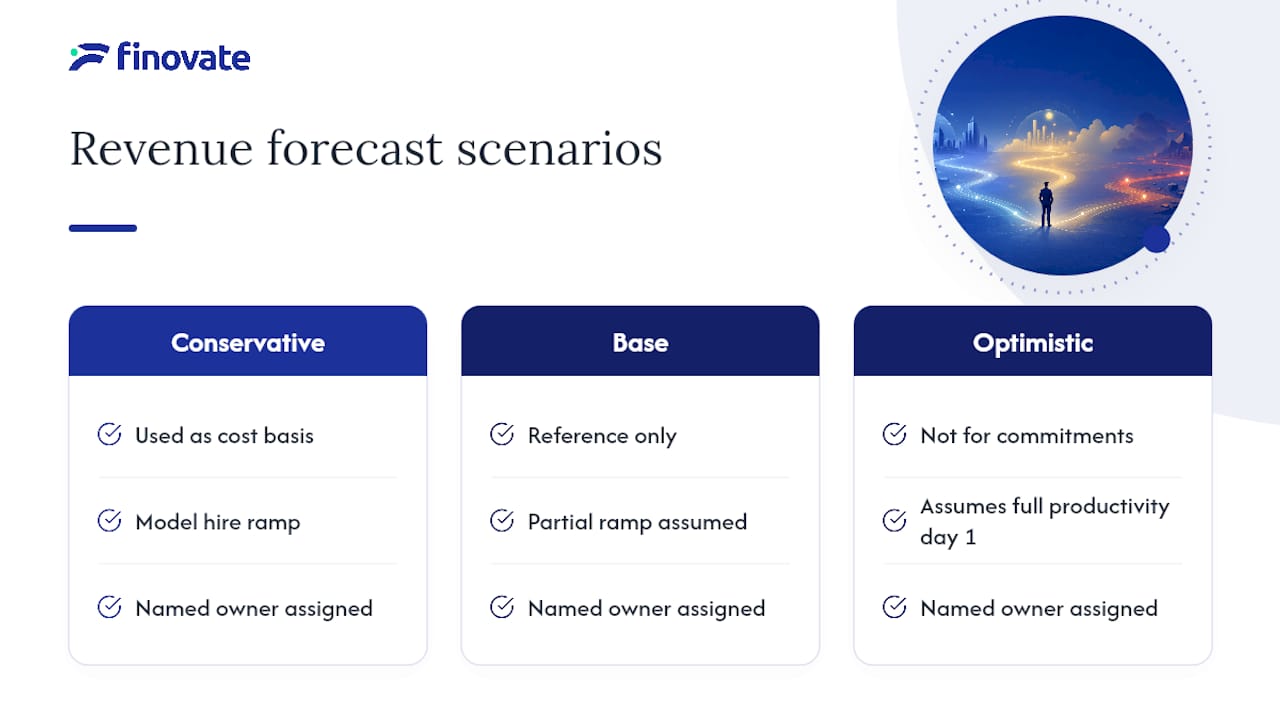
- Optimistic revenue forecasts: Replace gut-feel targets with a three-scenario model (conservative, base, optimistic) and name one person accountable for each assumption.
- No contingency fund: Add a contingency line of 5–10% of total budget before you finalise any spending plan.
- Missing employer costs: Budget for employer National Insurance contributions, PAYE timing, and auto-enrolment pension contributions — not just gross salaries.
- Cash flow blind spots: A profitable P&L does not protect you from a liquidity crisis. Integrate a monthly cash flow forecast alongside every budget.
- Static budgets: Set a monthly review cadence and a quarterly reforecast. A budget that is never updated is a historical document, not a management tool.
- Siloed budgeting: Share the budget with your sales lead, operations lead, and any department head who controls spend. Finovate's advisory team regularly sees businesses where the finance function and operations are working with entirely different assumptions.
Key takeaways
Avoiding the most damaging mistakes in business budgeting requires three habits above all: building on real data, reviewing monthly, and including every employer and compliance cost from the start.
| Point | Details |
|---|---|
| Add a contingency reserve | Set aside 5–10% of total budgeted spend as a contingency line before finalising any plan. |
| Include all employer costs | Budget gross salary plus employer NIC, auto-enrolment pension, and statutory leave provisions for every hire. |
| Review monthly, reforecast quarterly | A budget reviewed only annually cannot prevent cash flow problems; regular variance analysis is essential. |
| Name an owner for every assumption | Assign one accountable person to each material budget assumption so variances are investigated, not debated. |
| Integrate cash flow alongside P&L | Profit on paper does not prevent a liquidity crisis; a monthly cash flow forecast is a non-optional companion to the budget. |
Table of Contents
- 1. The most common mistakes in business budgeting and how to fix them
- How to build a budget that avoids these mistakes
- How to monitor budget performance and run variance analysis
- UK payroll, tax, and compliance costs you must include in your budget
- What to do when your budget goes off track
- An accountant's note on what actually goes wrong
- How to get the most from Finovate's accounting and advisory services
- Sources
1. The most common mistakes in business budgeting and how to fix them
1. Overestimating sales and revenue
Optimistic revenue forecasts are the single most frequent budgeting error among SMEs. Founders and owners set targets based on aspiration rather than evidence, then build an entire cost structure on top of numbers that never materialise. The result is a budget that looks healthy on paper and collapses in practice.
Fix: Build three revenue scenarios — conservative, base, and optimistic — and use the conservative figure as the basis for your cost commitments. Headcount budgeted at full productivity from day one is a particular trap; model a ramp curve that reflects how long it actually takes a new hire to generate revenue. Assign one named owner to each revenue assumption so that when actuals diverge, there is a clear person to review and revise the number.
2. Ignoring seasonality and market fluctuations
A flat monthly revenue line is almost never realistic. Retail businesses see Christmas peaks; construction firms slow in January; professional services firms lose billing days over school holidays. Budgeting with a single average figure obscures the months where cash will be tight.
Fix: Pull two to three years of monthly revenue data and map the seasonal pattern. Build that pattern into your monthly budget rather than dividing annual targets by twelve. Review sector-specific indicators quarterly — inflation, input costs, and consumer confidence all shift the baseline.
3. Weak bookkeeping and poor data foundations
A budget is only as reliable as the data behind it. If your bookkeeping is months behind, your expense categories are inconsistent, or your bank reconciliation is incomplete, you are building forecasts on guesswork. Organisations that treat budgets as a formality and detach finance from operational reality consistently overshoot costs and underperform on revenue.
Fix: Reconcile accounts monthly, not quarterly. Use consistent expense categories so you can compare actuals to budget at a line-item level. If bookkeeping is a bottleneck, address it before the next budget cycle begins — you can find practical controls in our guide on reducing accounting errors.
4. Failing to budget for taxes and employer costs
This is one of the most expensive oversights in business budgeting, particularly for growing businesses adding headcount. Founders frequently budget gross salaries and forget that the true employer cost includes National Insurance contributions, pension auto-enrolment, and any benefits. Underbudgeting for employer payroll taxes creates cash shortfalls precisely when tax payments fall due — often quarterly or monthly under PAYE.
Add HMRC payment dates to your cash flow calendar so you are never caught short.
5. No contingency fund
Unexpected costs are not exceptional — they are routine. Equipment fails, a key supplier raises prices, a client pays late, or a regulatory change creates an unplanned compliance cost. A budget with no contingency line forces you to make reactive decisions under pressure.
Fix: Distinguish fixed from variable costs, then set aside 5–10% of total budgeted spend as a contingency reserve. Treat it as a real line item, not a mental note. Review it quarterly and replenish it if drawn down.

6. Cash flow timing problems
A business can be profitable on paper and still run out of cash. Ignoring cash flow while focusing on profit leaves firms illiquid when receivables are slow and payables are due. A 60-day payment term from a large client combined with 30-day supplier terms creates a structural cash gap that no amount of profit fixes.
Fix: Build a monthly cash flow forecast alongside your P&L budget. Map when cash actually arrives (not when revenue is recognised) and when payments go out. Track receivables days and payables days as standing KPIs. If the gap is structural, address it through invoice financing, revised payment terms, or a credit facility before the crisis hits.
7. Never updating the budget
A budget set in January and reviewed in December is not a management tool. Markets shift, costs change, and assumptions that were reasonable in Q1 may be wrong by Q3. Annual-only budgets hide timing problems and prevent you from making course corrections while there is still runway to act.
Fix: Set a monthly budget review as a fixed calendar commitment. Run a quarterly reforecast where you update the full-year view based on current actuals and revised assumptions. Our guide on effective business budgeting steps covers how to structure this cadence for SMEs.
8. Keeping the budget siloed
When only the finance function sees the budget, the people responsible for spending it are working blind. Sales teams over-commit, operations teams under-resource, and the budget becomes a document that finance owns and everyone else ignores.
Fix: Share the relevant sections of the budget with each department head. Make budget vs actual a standing agenda item in your monthly management meeting. When people can see the numbers, they make better decisions about spend.
9. Misaligned departmental allocations
Allocating budget by historical precedent rather than strategic priority is a common budgeting pitfall. Equally, under-resourcing a function that is critical to delivery creates bottlenecks that cost more to fix than they would have cost to prevent.
Fix: Start each budget cycle by agreeing the top three to five strategic priorities for the year. Allocate spend to those priorities first, then fund the rest. Use category benchmarks — payroll share, go-to-market spend, infrastructure — to sense-check whether your allocation is broadly in line with businesses at a similar stage.
10. Overlooking debt and financing costs
Interest payments, loan repayments, and arrangement fees are real cash outflows that belong in the budget. Many SMEs model revenue and operating costs carefully, then treat debt service as an afterthought. When interest rates rise or a refinancing falls through, the impact on cash flow can be severe.
Fix: List every debt facility, its current interest rate, and its repayment schedule. Include these as fixed line items in your monthly cash flow. If you are considering new financing, model the repayment impact on runway before committing.
Pro Tip: Assign a named owner to every material budget assumption — revenue growth rate, average deal size, headcount ramp, supplier cost increases. When actuals diverge from plan, you want one accountable person who can explain the gap and revise the assumption, not a committee discussion about whose number it was.
How to build a budget that avoids these mistakes
A well-constructed budget follows a clear sequence. Skipping steps is where most budget planning mistakes originate.
-
Scope and data gathering (half a day): Define the budget period (typically 12 months, monthly view). Gather last year's actuals, your current P&L, and any contracts or commitments that are already fixed. Identify who needs to contribute — at minimum: the business owner, a finance lead, the sales lead, and the operations lead.
-
Build your assumptions register (half a day): List every material assumption: revenue growth rate, average transaction value, headcount plan, key supplier costs, rent, and any planned capital expenditure. Assign one named owner to each. This register is the foundation of your variance analysis later.
-
Model three scenarios (one day): Build conservative, base, and optimistic revenue views. Use the conservative scenario to set your cost commitments. The base scenario is your working plan; the optimistic scenario informs upside investment decisions. This approach, recommended for early-stage decision frameworks, keeps the budget as a live tool rather than a fixed target.
-
Model headcount with ramp curves (half a day): Do not budget new hires at full productivity from month one. A salesperson hired in March may not close their first deal until June. Model the ramp — typically three to six months to full productivity — and reflect that in both the cost line (salary from day one) and the revenue line (contribution from month four or five).
-
Build the cash flow model (half a day): Convert your P&L budget into a monthly cash flow by adjusting for payment terms. If customers pay on 45-day terms, revenue recognised in January arrives as cash in mid-March. Map every major outflow — payroll, VAT, corporation tax, loan repayments — to the calendar date it leaves your account.
-
Set contingency and get sign-off (two hours): Add your contingency reserve (5–10% of total spend). Present the budget to the business owner and any relevant board members or investors. Document the approved version and the assumptions register together.
Recommended cadence: Monthly budget vs actual review; quarterly reforecast of the full-year view; annual budget rebuild from scratch. Our financial forecasting guide explains how to integrate scenario planning into this cycle.
How to monitor budget performance and run variance analysis
Setting a budget is the start, not the finish. The value comes from comparing actuals to plan every month and acting on the gaps.
Essential KPIs to track monthly:
- Cash runway: How many months of operating costs does your current cash balance cover?
- Monthly burn rate: Total cash out in the month, net of receipts.
- Gross margin: Revenue minus direct costs, as a percentage of revenue.
- Receivables days: Average number of days customers take to pay.
- Payables days: Average number of days you take to pay suppliers.
- Budget vs actual by category: Every material cost line compared to plan.
Pro Tip: Automate your variance report by connecting your accounting software to a simple dashboard or spreadsheet template. When the report runs itself, you are more likely to review it consistently — and consistent review is what catches problems early.
A practical variance table gives you a structured view of where the budget is holding and where it is not. The structure below works for most SMEs:
These thresholds are a starting point — adjust them to your business size and risk tolerance.
Integrating cash flow forecasting into this monthly review prevents the scenario where the P&L looks acceptable but the bank account is heading toward zero. Our financial reporting workflow guide covers how to structure this reporting for board-level review.
UK payroll, tax, and compliance costs you must include in your budget
These are the items most commonly omitted from SME budgets in the UK. Missing them does not make them go away — it just means you discover the shortfall when the payment is already due.
- Employer National Insurance contributions: Currently 13.8% on earnings above the secondary threshold (£9,100 per year per employee for 2025/26, as set by HMRC). For a team of five employees on average salaries, this is a material annual cost that belongs as a named line in your budget.
- PAYE timing: PAYE and employee NIC deductions must be paid to HMRC by the 19th of the following month (22nd for electronic payment). Budget for this outflow monthly, not as an annual estimate.
- Auto-enrolment pension contributions: Employer minimum contribution is currently 3% of qualifying earnings. This applies to all eligible workers aged 22 to state pension age earning above £10,000 per year. Factor this into your all-in headcount cost from day one of employment.
- VAT payment schedules: If you are VAT-registered, quarterly VAT returns mean a significant cash outflow every three months. Budget for the VAT liability as it accrues, not just when the payment falls due. Businesses on the standard VAT scheme pay HMRC the difference between output and input VAT — model this monthly so the quarterly bill is never a surprise.
- Corporation tax timing: For most SMEs, corporation tax is due nine months and one day after the end of the accounting period. Set this date in your cash flow calendar and accrue for it monthly.
- Business rates: If you occupy commercial premises, business rates are a fixed annual cost payable in ten monthly instalments. Include the full annual liability in your budget, not just the months you remember to pay.
- Statutory sick pay and statutory leave costs: SSP, statutory maternity pay, and statutory paternity pay are legal obligations. Budget a small provision for these — particularly if you have a growing team — rather than treating them as exceptional items.
For authoritative figures on each of these, check the relevant HMRC guidance pages directly, as thresholds and rates are updated at each Budget. When in doubt about payroll calculations, formal payroll advice from a qualified accountant will save you more than it costs.
What to do when your budget goes off track
Discovering a material budget problem is not a failure. Ignoring it is. The first 72 hours after you identify a serious variance determine whether the problem is manageable or becomes a crisis.
Within 24 hours:
- Confirm the cash position: check the actual bank balance, not the accounting system balance.
- Pause all discretionary spend pending a review — subscriptions, non-committed marketing, non-essential travel.
- Identify the single largest variance and establish whether it is a timing issue (cash will arrive, just late) or a structural shortfall (the revenue or cost assumption was wrong).
Within 7 days:
- Run a revised cash flow forecast for the next 13 weeks, week by week.
- Contact any creditors where payment may be delayed — proactive communication almost always produces better outcomes than silence.
- Convene the management team with the revised numbers. Agree which costs can be deferred and which are fixed obligations.
Within 30 days:
- Complete a full reforecast of the remaining budget period.
- Identify whether additional financing is needed and begin that conversation early — lenders respond better to a business that identifies a problem in advance than one that arrives in crisis.
- Update the assumptions register and document what caused the variance so the next budget cycle reflects the lesson.
Red flags that require immediate escalation:
- Runway falls below three months at current burn.
- Payroll cannot be met from existing cash and committed receipts.
- A key customer representing more than 20% of revenue is lost or significantly delayed.
- Receivables ageing shows a material spike in invoices over 60 days.
- Any covenant on a loan or credit facility is at risk of breach.
When any of these apply, notify your accountant, your bank relationship manager, and any investors or board members immediately. Delayed disclosure makes every one of these situations harder to resolve. For practical financial controls that help you catch problems earlier, our guide on financial management tips for SMEs covers the monitoring habits that matter most.
An accountant's note on what actually goes wrong
The pattern we see most often at Finovate is not a single catastrophic error. It is a sequence of small omissions that compound quietly over six to twelve months. A founder sets an optimistic revenue target in January, builds a cost structure around it, and does not review the budget again until the bank balance forces the conversation. By that point, the contingency is gone, the PAYE liability has grown, and the options are narrower than they needed to be.
The corrective sequence is almost always the same: reconcile the books, rebuild the cash flow from actuals, identify the two or three assumptions that were most wrong, and set a monthly review that cannot be cancelled. The budget itself is rarely the problem. The discipline around it is.
Finovate provides accounting, bookkeeping, payroll, and advisory services for entrepreneurs and small businesses. If you need a structured budget review or want to put a monthly monitoring process in place, we can help you build one that works for your business.
How to get the most from Finovate's accounting and advisory services
Whether you are building your first business budget or correcting one that has drifted off course, having the right support in place makes the process faster and more reliable. Finovate offers accounting, bookkeeping, payroll management, VAT reporting, and business advisory services for entrepreneurs and small to medium businesses.

Our monthly invoicing service gives you a structured, ongoing solution for managing your finances without the overhead of a full in-house finance function. For businesses with higher invoicing volumes, our pro invoicing service offers a percentage-based model that scales with your activity. If you would like to discuss a budget review, a payroll setup, or ongoing advisory support, visit Finovate to get in touch.
Sources
The following authoritative resources support the guidance in this article and are worth bookmarking for ongoing reference:
- How to Create a Business Budget for Your Startup | Stripe
- How to Budget as an Early-Stage Startup - Startup Super School
- 10 Common Budgeting Mistakes
- Startup budget template: how to build one that actually drives decisions
- Five Common Budgeting Mistakes in Companies – and How to Avoid Them
This article is general information, not a substitute for advice from a qualified financial advisor. Consult a qualified financial professional about your own circumstances before acting on anything here.