

You can record a credit loss when it becomes probable, not merely possible, that the receivable will never be paid. This happens once you have documented evidence such as a bankruptcy notice, a formal reorganisation or a debt collection agency's confirmation that recovery has failed. Once the loss is final, you expense it, remove it from your receivables, and correct your VAT accordingly.
TL;DR:
- A credit loss can only be recorded when there is documented evidence that recovery is impossible, such as bankruptcy confirmation or collection failure.
- Final credit loss entries involve booking the expense, removing the receivable, and separately adjusting VAT in the period the loss becomes final.
- Supporting documents, reminders, and evidence must be attached to the entry to ensure audit readiness and avoid disputes during tax review.
- Bookkeeping systems typically enable direct credit loss entries, but accuracy depends on matching the loss date, VAT codes, and partial payments properly.
- Proper documentation is essential; well-maintained evidence can prevent many audit queries, especially in complex or recurring bad debt cases.
Table of Contents
- Luottotappiot kirjanpidossa: when is a receivable truly lost?
- How to record the bookkeeping entries for a credit loss
- VAT (ALV) and tax consequences of a credit loss
- Documentation, evidence and audit readiness
- Recording a credit loss in your accounting software
- Why documentation, not the entry itself, decides most disputes
- Sources
Luottotappiot kirjanpidossa: when is a receivable truly lost?
Not every overdue invoice qualifies as a luottotappio. Kirjanpitolautakunta guidance is clear that writing down a receivable presumes real evidence of failed collection, not just a hunch that the customer is slow to pay. You need a specific triggering event, and you need it on file.
The events that typically justify a final credit loss include:
- The debtor has been declared bankrupt (konkurssi) and the bankruptcy estate has confirmed there are no assets to distribute.
- The debtor has entered a company reorganisation (yrityssaneeraus) and the receivable falls outside what will be repaid.
- A debt collection agency has run its process and reports that collection was unsuccessful (tulokseton perintä).
- The debtor cannot be traced. Their address, phone number, and any other contact route have gone cold despite reasonable efforts to find them.
The practical test accountants apply is whether it's more likely than not, over 50%, that the money will never arrive. Several unanswered payment reminders, a debt sitting many months past due, and a documented paper trail of failed contact attempts all build toward that threshold. A single missed payment does not.
This is where the distinction between an epävarma saatava (an uncertain receivable, which you write down as an impairment) and a lopullinen luottotappio (a final, proven loss) becomes critical. Only the second permits an immediate VAT adjustment, because uncertain receivables might still be paid.
Pro Tip: Keep a simple log of every reminder you send, with dates. If a case ever ends up disputed with Verohallinto, that log is often the difference between a smooth deduction and a rejected one.
How to record the bookkeeping entries for a credit loss
The core entry is straightforward once the loss is confirmed as final. Here's the sequence to follow.
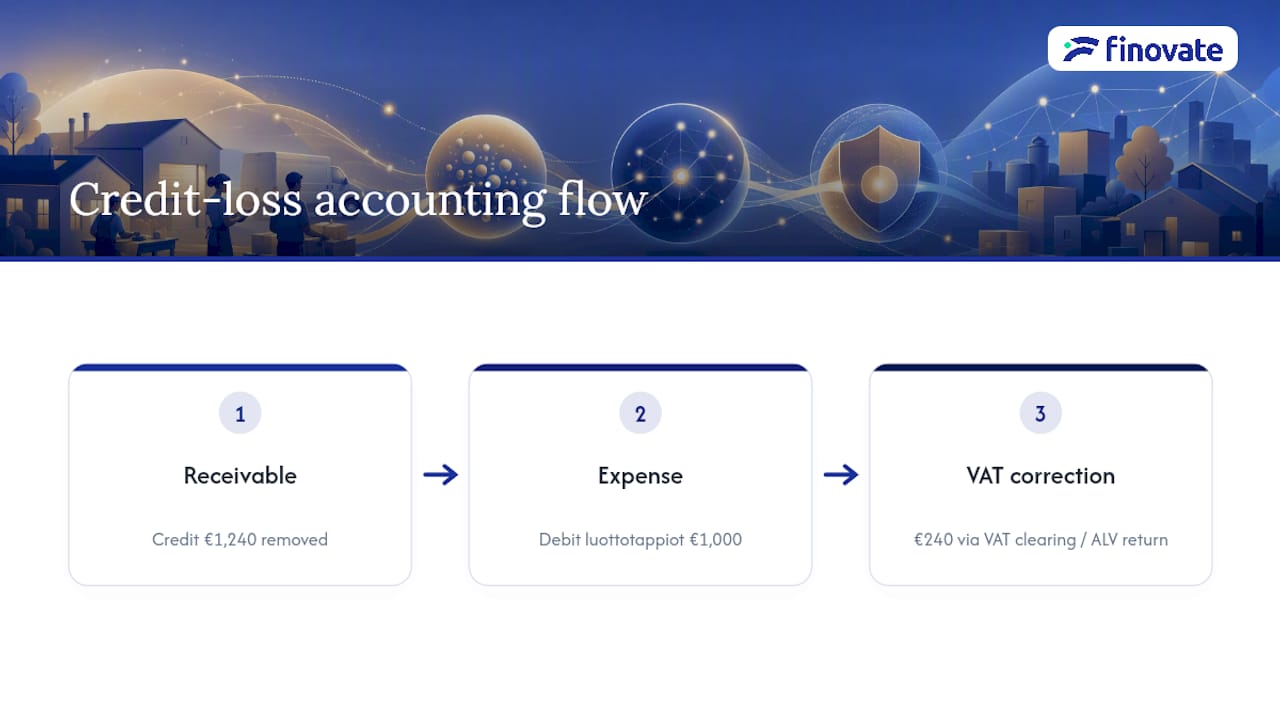
- Debit the expense account. Book the net (VAT-exclusive) amount to an account such as "luottotappiot" under other operating expenses.
- Credit the receivables account. Remove the invoice from "myyntisaamiset" for its full gross value, since the customer's debt to you disappears entirely.
- Separate out the VAT. The VAT portion of the invoice is not an expense; it's a tax correction. Book it to your VAT clearing account so it flows into your next VAT return rather than sitting in the profit and loss account.
- Date the entry to the period the loss becomes final, which is the bankruptcy confirmation date, the collection agency's recommendation date, or the point your own documentation clearly supports.
- Attach the reference documents to the voucher itself so the entry and its evidence travel together in your system.
If your business runs single-entry bookkeeping on a cash basis (maksuperuste), the mechanics shift slightly. Since you never recorded the sale as income until cash arrived, there's often nothing to write-off on the income side. Any invoice already issued but unpaid usually gets addressed at year-end through a note or adjustment (alaskirjaus) rather than a formal double-entry credit loss, though many small businesses find it cleaner to move to accrual-based bookkeeping once receivables become a regular management concern.
The KPL prudence principle requires that assets never be shown above their probable recoverable value, which is exactly why alaskirjaus exists as a distinct step separate from a full credit loss.
VAT (ALV) and tax consequences of a credit loss
VAT correction is only allowed once the loss is final, never while a receivable is merely uncertain. Reclaiming VAT too early is one of the more common triggers for a Verohallinto query, so the timing discipline matters as much as the bookkeeping entry itself.
Practitioners consistently recommend booking the accounting expense and the VAT correction as two distinct steps, first confirming the loss is final, then adjusting the VAT return for that same period. Blurring the two is a frequent source of audit friction.
Once you've confirmed the loss, you report the VAT adjustment on the ALV return covering the period in which the loss became final, reducing your payable VAT by the amount originally charged on that sale. For income tax purposes, a properly documented final credit loss is generally deductible against your business income, provided the bookkeeping follows good accounting practice and the evidence trail supports it.
Here's a worked example. Say you invoiced a customer €1,240, made up of €1,000 net plus €240 VAT at 24%. The customer goes bankrupt and the estate confirms nothing will be paid. You debit "luottotappiot" for €1,000, credit "myyntisaamiset" for €1,240, and correct €240 through your VAT clearing account. Your profit and loss statement absorbs the €1,000 net expense; your VAT return reflects the €240 correction separately.
Collection fees you paid to a debt collection agency are a separate cost line entirely. Those fees are typically deductible as ordinary business expenses, and the agency's own invoice will usually itemise its fee and VAT separately from the underlying debt you're writing off.
Documentation, evidence and audit readiness
Every luottotappio entry needs a paper trail robust enough to survive a Verohallinto review months or years later. Attach the supporting documents directly to the accounting voucher rather than filing them separately, so anyone reviewing the books later sees the entry and its justification together.
At minimum, keep:
- The original invoice showing the sale, its VAT breakdown, and the payment terms.
- Copies of every payment reminder sent, with dates.
- The collection agency's luottotappiosuositus, or the bankruptcy or reorganisation decision if that's the qualifying event.
- Notes on any attempts to trace an unreachable debtor, including which contact routes you tried.
Finnish accounting law requires bookkeeping records to be retained for six years from the end of the financial year, so store these documents where they'll still be retrievable well beyond that. Most modern software lets you attach PDFs directly to a journal entry, which keeps the audit trail intact even if staff or systems change.
Pro Tip: Build a one-page checklist template for credit losses and reuse it every time. Auditors read consistency as a sign of a well-run set of books.
For a broader view of what belongs in your archive, Finovate's guide to essential bookkeeping documents covers retention practice in more depth.
Recording a credit loss in your accounting software
Most Finnish accounting platforms now include a dedicated function for this, but the underlying logic is worth understanding even if the software automates the clicks.
- Locate the unpaid invoice in your receivables ledger and select the "book as credit loss" function, or prepare a manual journal entry if your software lacks one.
- Set the entry date to match when the loss became final, not today's date if they differ.
- Confirm the VAT code applied matches a credit loss correction rather than a standard sale reversal, since these often sit on different tax codes within the chart of accounts.
- For a partial loss, where the debtor pays some but not all of an invoice, adjust the entry to reflect only the unrecoverable portion rather than writing off the full amount.
- If a customer unexpectedly pays after you've already booked the loss, reverse the original entry: reinstate the receivable, remove the expense, and rebook the VAT if it was previously corrected.
Before relying on any of this at year-end, check your software's default settings for the luottotappiot account and its VAT mapping. Check your software's own defaults against your actual chart of accounts, since a mismatched default can silently misclassify entries for months. When a case involves a large sum, a disputed debtor, or anything outside routine late payment, that's the point to bring in your accountant rather than push the entry through alone.
Why documentation, not the entry itself, decides most disputes
The bookkeeping mechanics of a luottotappio are genuinely simple. What separates a clean deduction from a Verohallinto headache is almost always the paper trail sitting behind the entry, not the debit and credit themselves.
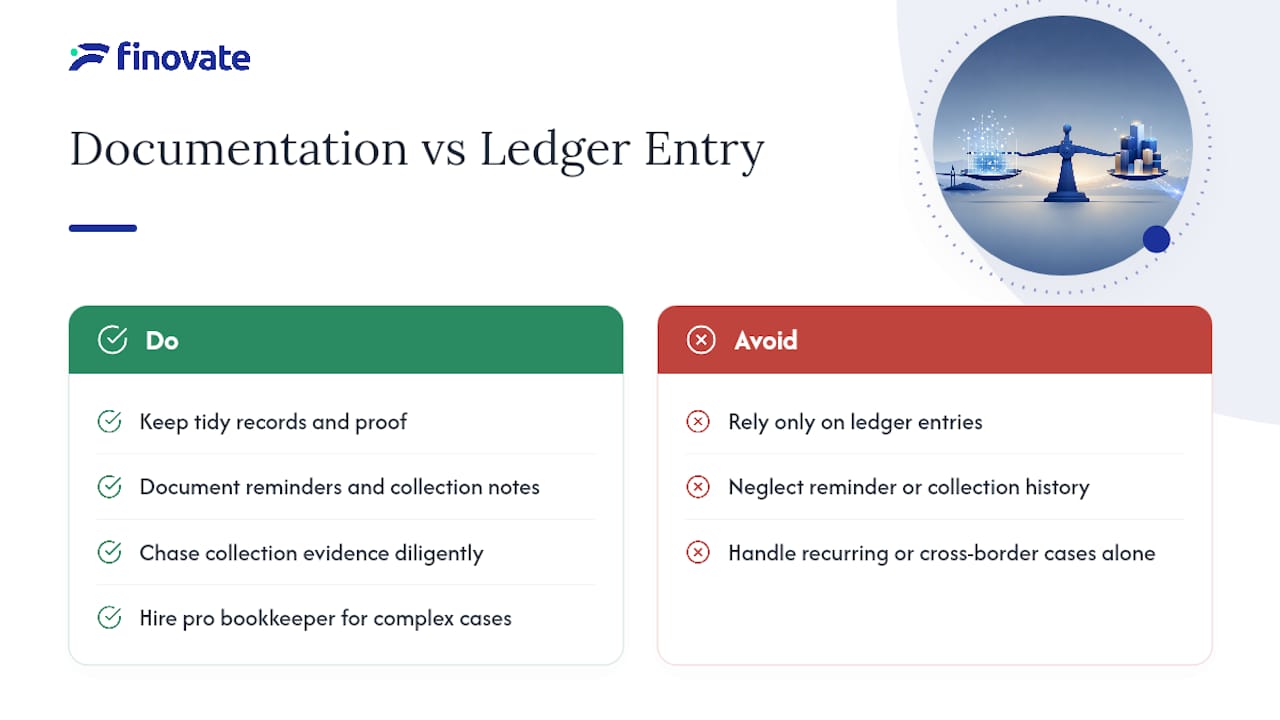
I've seen the same mistake repeatedly in SME accounts: business owners book the loss correctly but then can't produce the reminder history or collection correspondence when asked. The entry looks fine on the ledger and falls apart the moment someone asks for proof. Chase collection evidence as diligently as you chase the money itself.
Handling a single, well-documented credit loss in-house is entirely reasonable if you're comfortable with your bookkeeping system and keep tidy records. Where it gets riskier is with recurring bad debt, complex partial write-offs, or anything touching cross-border VAT, and that's where professional bookkeeping support earns its fee quickly. Finovate's step-by-step bookkeeping guide is a good starting point if you want to sense-check your own process, and our accounting and bookkeeping services are there when a case needs a second, professional pair of eyes.
— Busayo
Sources
- Neuvontapalvelut: asiakkaan maksuongelmat ja luottotappiot | Lapin kauppakamari
- Perintäkulujen arvonlisäveron käsittely | Uuva