

Every company must track three core annual filings: the corporate income tax return, the annual accounts and financial statements, and the AGM or board approval of those accounts. In Finland, the Finnish Tax Administration (Vero) maintains the authoritative list of corporate tax deadlines, with submissions processed through MyTax. Annual accounts go to the Finnish Patent and Registration Office (PRH) via its e-services portal. Your immediate action: open the Vero and PRH portals, confirm the exact dates for your fiscal year-end, and assign a named owner to each deadline in your company calendar.
Must-check portals and sources:
- Vero — important dates for corporate taxpayers (tax return filing and payment deadlines)
- MyTax (vero.fi/mytax) — the e-filing portal for corporate income tax, VAT, and payroll withholding
- PRH e-services (prh.fi) — submission portal for annual accounts and financial statements
- OP tax calendar for entrepreneurs — a practical cross-reference for common business filing dates
Once you have confirmed your fiscal year-end, map each statutory window to a calendar date and assign an internal owner. Every deadline without a named owner tends to slip.
Key takeaways
Staying on top of key annual financial deadlines requires mapping your fiscal year-end to each statutory window, assigning a named owner to every obligation, and verifying dates against official portals — Vero, MyTax, and PRH — at the start of each year.
| Point | Details |
|---|---|
| Map fiscal year-end first | Every statutory deadline (AGM, accounts filing, tax return) is calculated from your fiscal year-end date, not the calendar year. |
| Separate filing from payment | Filing on time and paying on time are distinct obligations; schedule payments at least one business day before the due date. |
| AGM triggers accounts filing | The two-month window to file accounts with PRH starts from the AGM approval date, not the fiscal year-end. |
| Retain records for the statutory minimum | Accounting records, invoices, and payroll data must be retained for a minimum of six years from the end of the accounting period. |
| Finovate manages the full cycle | Finovate handles annual accounts, tax filings, VAT, payroll, and PRH submissions for Finnish businesses, with compliance calendars configured to your fiscal year. |
Table of Contents
- What does the annual compliance calendar look like?
- What must you file annually, and who receives each filing?
- How do VAT and payroll returns interact with annual obligations?
- How does your fiscal year-end determine statutory approval and filing windows?
- What happens if you miss a deadline, and how do you correct it?
- How do you build a compliance calendar that actually works?
- Where do these deadlines come from, and how do you verify them each year?
- What the compliance calendar gets wrong more often than you'd expect
- How Finovate supports your annual compliance obligations
- Sources
What does the annual compliance calendar look like?
The key annual financial deadlines cluster into four distinct phases across the year. The table below reflects typical statutory windows; your exact dates shift based on your fiscal year-end.
| Compliance checkpoint | Typical timing rule | Recipient / portal |
|---|---|---|
| Year-end accounts close | Within 1–4 months of fiscal year-end | Internal / auditor |
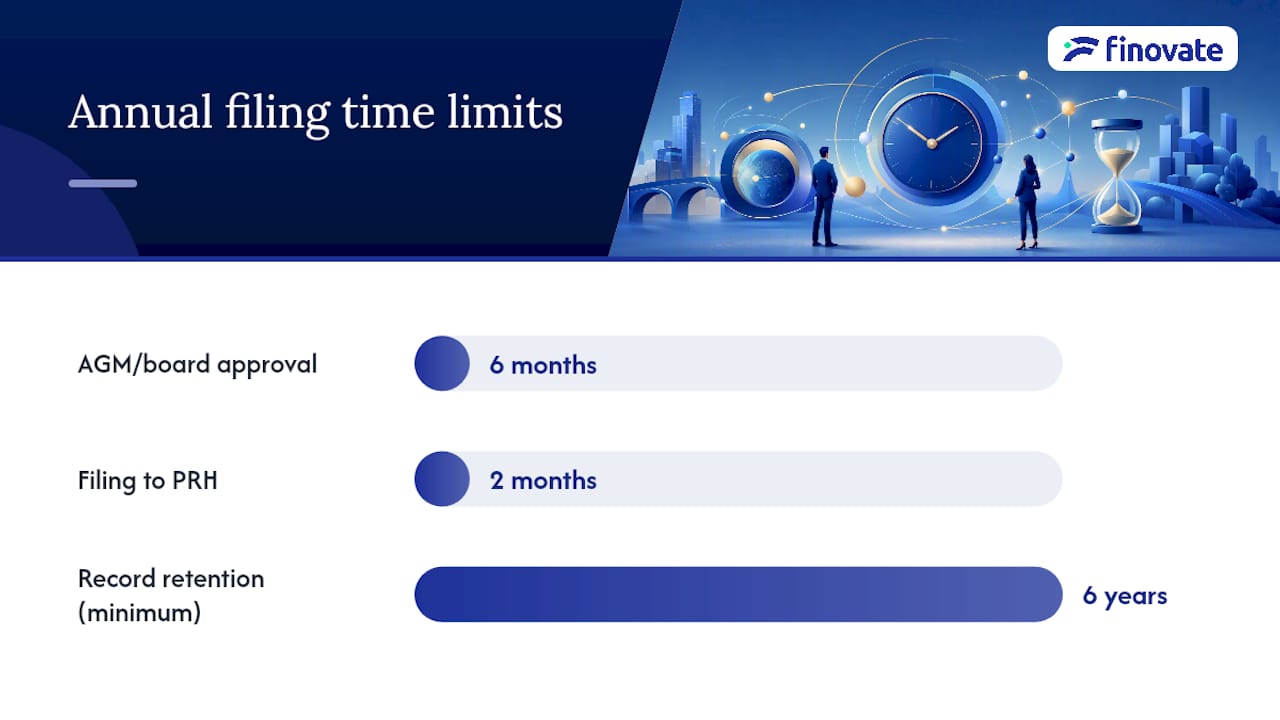
| AGM or board approval of accounts | Within 6 months of fiscal year-end | Internal record |
| Annual accounts filed with registry | Within 2 months of AGM approval | PRH e-services |
| Corporate income tax return | Varies by jurisdiction and fiscal year-end | MyTax / Vero |
| Annual VAT reconciliation | Aligned with final periodic return | MyTax |
| Payroll annual summary / year-end report | January of the following year (typical) | MyTax |
For calendar-year filers (fiscal year ending 31 December), most of these deadlines fall between January and August of the following year, creating a concentrated compliance season. For non-calendar fiscal year filers, every date shifts proportionally. A company with a 31 March fiscal year-end, for example, would expect its AGM window to close around September and its accounts filing to follow shortly after.
The OP tax calendar provides a useful cross-reference for mapping these windows to specific months.
Pro Tip: Schedule electronic tax payments at least one full business day before the statutory due date. Bank processing and authority receipt confirmation can take time, and a payment that leaves your account on the due date may not register as received until the following day, triggering a late-payment penalty.
Key points to build into your schedule:
- Confirm whether your jurisdiction moves a deadline that falls on a weekend or public holiday to the next business day. This rule is common but not universal across every filing type.
- Set internal close deadlines two weeks ahead of statutory windows to give your accountant or auditor adequate preparation time.
- Treat the AGM approval date as the trigger for the accounts filing window, not the fiscal year-end itself.
What must you file annually, and who receives each filing?
Annual compliance obligations split into two categories: filings with the tax authority and filings with the company registry. Understanding which authority receives what, and by when, prevents the most common administrative errors.
Corporate income tax return
The corporate income tax return goes to the tax authority — in Finland, submitted via MyTax on the Vero platform. The due date is tied to your fiscal year-end, not to the calendar year. As a general rule applied in many jurisdictions, the IRS states that fiscal-year filers have their return due on the 15th day of the fourth month after the close of their fiscal year; calendar-year filers typically face a mid-April deadline. When that date falls on a weekend or public holiday, it moves to the next business day.
Prepayments of corporate tax are usually due throughout the year on a schedule set by the tax authority. Missing a prepayment instalment is not the same as missing the annual return, but both carry consequences.
Annual accounts and financial statements
Annual accounts must be approved by the AGM or the board (depending on your company structure) within six months of the fiscal year-end. Once approved, they must be filed with the company registry — in Finland, the PRH — within two months of that approval. The PRH e-services portal handles submission electronically.
Small entities may qualify for simplified reporting. In Finland, a company that falls below two of the three thresholds (balance sheet total, net turnover, and average number of employees) for two consecutive financial years can file abbreviated accounts. Check the current PRH guidance for the precise thresholds, as these are updated periodically.
Record-keeping requirements tied to annual filings typically mandate retention of accounting records, invoices, contracts, and payroll data for a minimum of six years from the end of the accounting period, though some documents require longer retention. Confirm the specific period under the applicable legislation for your jurisdiction.
Key filing obligations at a glance:
- Corporate income tax return → Vero / MyTax
- Annual accounts and financial statements → PRH e-services (post-AGM approval)
- Payroll annual summary → MyTax (typically January of the following year)
- Annual VAT reconciliation → MyTax (aligned with the final periodic return)
- Employer's annual notification → MyTax or equivalent authority portal
For practical guidance on tax tips for Finnish entrepreneurs, including small-entity rules and filing mechanics, Finovate's resource library covers these obligations in detail.
How do VAT and payroll returns interact with annual obligations?
Periodic returns — VAT and payroll withholding — run on monthly or quarterly cycles throughout the year. They feed directly into the annual reconciliation, so errors in periodic filings compound at year-end.
Typical cadences and due dates
Monthly filers face twelve VAT deadlines per year. Quarterly filers face four, but each carries a larger aggregate liability, making the payment amount more significant if delayed. The quarterly tax filing guide from Finovate walks through the cadence in detail for Finnish businesses.
Pro Tip: Never conflate the filing deadline with the payment deadline. In many systems, you can submit a return on time but schedule the payment too late. The penalty for late payment applies from the day after the due date, regardless of whether the return itself was filed correctly and on time.
A common scheduling error: a finance team submits the VAT return on the 12th but schedules the bank transfer for the same day. The payment does not reach the authority until the 13th. The return is on time; the payment is not. The result is a late-payment charge on the full VAT liability for that period.
For additional context on tax savings strategies for small business owners, including how periodic payment timing affects overall tax cost, the principles apply across jurisdictions.
How does your fiscal year-end determine statutory approval and filing windows?
Your fiscal year-end is the anchor point for every downstream statutory deadline. Get this calculation right and the rest of the calendar follows logically.
Step-by-step example: 31 December fiscal year-end
- Fiscal year closes — 31 December
- Accounts preparation and audit — January to March (internal target: draft accounts ready by end of February)
- AGM or board approval of accounts — by 30 June (six months after fiscal year-end)
- Annual accounts filed with PRH — by 31 August (two months after the latest permissible AGM date)
- Corporate income tax return — check Vero for the specific due date; typically several months after fiscal year-end
- Payroll year-end summary — filed in January of the new year
Non-calendar fiscal year: how to offset dates
If your fiscal year ends on 31 March, shift every date above by three months. The AGM window closes by 30 September; the accounts filing deadline falls by 30 November. The principle is consistent: add six months for the AGM window, then two months for the registry filing.
IRS guidance confirms the same logic for tax returns: fiscal-year filers have their return due on the 15th day of the fourth month after their fiscal year-end. A 31 March year-end therefore produces a 15 July tax return deadline in that framework. Always verify the equivalent rule with Vero for Finnish corporate tax.
Note that when a statutory deadline falls on a weekend or public holiday, it commonly moves to the next business day. This rule is widespread but not guaranteed for every filing type or jurisdiction. Always verify with the specific authority.
For more on accounting periods for Finnish SMEs and the implications of choosing a non-standard fiscal year, Finovate's guidance covers the practical considerations.
If you miss the AGM deadline:
- Convene the meeting as soon as possible after the missed date.
- Document the reason for the delay in the board minutes.
- File the accounts with PRH without further delay once approved.
- Consult your legal adviser regarding any statutory notification obligations to the registry.
- In Finland, persistent failure to file annual accounts can result in the company being struck off the register.
What happens if you miss a deadline, and how do you correct it?
Missing a filing or payment deadline triggers penalties and interest. The two consequences are distinct, and understanding the difference shapes your corrective response.
Late filing typically attracts a fixed penalty or a daily accruing charge from the day after the deadline. Late payment attracts interest calculated on the unpaid amount from the due date. You can face both simultaneously if you file late and pay late, or just one if you file on time but pay late.
Corrective steps when a deadline is missed:
- File immediately. A late filing is almost always better than no filing. Authorities generally accept late submissions, though penalties apply.
- Pay the outstanding liability and any accrued interest. Calculate interest from the due date to the payment date using the authority's published rate.
- Submit an amended return if the original filing contained errors. On MyTax, corrections to previously submitted returns can be made through the amendment function. On PRH, contact the registry directly for guidance on replacing a filed document.
- Document your reasons. If you have grounds for penalty relief (illness, system failure, force majeure), prepare written evidence before contacting the authority.
- Request relief early. Authorities are more receptive to relief applications submitted promptly after the missed deadline than to those filed months later. Early engagement with an adviser significantly improves the prospects of a favourable outcome.
Pro Tip: Keep a written record of every communication with tax authorities — dates, reference numbers, and the substance of each exchange. If a penalty dispute escalates, this documentation is your primary evidence.
For a detailed guide on avoiding tax penalties and the specific consequences of non-compliance for Finnish businesses, Finovate's resources address both prevention and remedy. The compliance guide for Finnish businesses also covers the legal ramifications of persistent non-filing.
How do you build a compliance calendar that actually works?
A compliance calendar is only useful if it is maintained, owned, and integrated with your accounting close schedule. A list of statutory dates sitting in a spreadsheet that nobody updates is not a compliance calendar.
Quarterly compliance checklist:
- Q1 (January–March): File payroll year-end summary; submit January and February VAT and payroll withholding returns; begin accounts preparation for December year-end companies; schedule AGM for June deadline.
- Q2 (April–June): File Q1 VAT return (if quarterly filer); hold AGM and approve accounts for December year-end companies; confirm tax prepayment schedule with Vero.
- Q3 (July–September): File annual accounts with PRH (for December year-end companies); submit Q2 VAT return (if quarterly filer); review mid-year tax position and adjust prepayments if needed.
- Q4 (October–December): Begin year-end close preparation; review record-keeping completeness; confirm all periodic returns are reconciled; plan for the following year's compliance calendar.
Compliance calendar template
Use this structure for each recurring obligation:
- Obligation name — e.g., VAT return (monthly)
- Statutory due date — e.g., 12th of the following month
- Internal preparation deadline — e.g., 5th of the following month
- Owner — named individual or role
- Required documents — e.g., sales ledger, purchase invoices, bank statements
- Portal / submission method — e.g., MyTax
- Payment method and scheduling date — e.g., bank transfer, scheduled by the 10th
Pro Tip: Maintain one canonical compliance calendar shared across your finance, payroll, and legal functions. When each team keeps its own list, dates diverge and obligations fall through the gaps. Integrate the statutory calendar with your accounts-close schedule so that every internal deadline feeds the external one.
For a ready-to-use accounting reminders checklist for Finnish SMEs, Finovate's 2026 guide covers the full year in a format you can adapt directly.
Where do these deadlines come from, and how do you verify them each year?
This calendar draws on official authority publications and practitioner resources. Statutory deadlines change — sometimes annually — so verification against primary sources is non-negotiable.
Authoritative sources used:
- Vero (Finnish Tax Administration) — the primary source for all corporate tax filing and payment deadlines in Finland. Vero publishes its important dates for corporate taxpayers and updates them for each tax year. MyTax is the submission portal.
- PRH (Finnish Patent and Registration Office) — the authority for annual accounts filing and company registry obligations. Check prh.fi for current filing windows and small-entity thresholds.
- IRS (for US-framework reference) — the IRS filing guidance illustrates the fiscal-year offset rule (15th day of the fourth month) used in many jurisdictions as a structural reference point.
- Broadridge EDGAR filing calendar — the 2026 EDGAR filing calendar lists SEC reporting deadlines for 10-K and 10-Q filings by filer category (large accelerated, accelerated, non-accelerated), assuming a 31 December fiscal year. Relevant for any company with SEC reporting obligations.
- Skadden 2026 SEC briefing — the Skadden briefing on 2026 SEC filing deadlines and financial statement staleness dates explains how staleness windows are calculated for public companies and is a practical reference for any entity with SEC obligations.
- Kirkland & Ellis 2026 practitioner alert — the Kirkland & Ellis alert on 2026 SEC filing deadlines and staleness dates provides a complementary reference for public companies mapping their filing windows.
How to verify year-specific dates: Visit the Vero and PRH websites directly at the start of each calendar year. Both authorities publish updated deadline lists, and any legislative changes affecting filing windows are announced on their official pages. Do not rely on third-party summaries alone — confirm against the primary source before locking dates into your calendar.
Finovate's team monitors these publications as part of its compliance service for Finnish businesses, which means clients receive updated deadline information as part of their ongoing engagement.
What the compliance calendar gets wrong more often than you'd expect
The conventional wisdom on annual financial deadlines treats them as a straightforward list: know the dates, file on time, pay on time. The reality for most business owners is more complicated, and the gap between the list and the execution is where penalties accumulate.
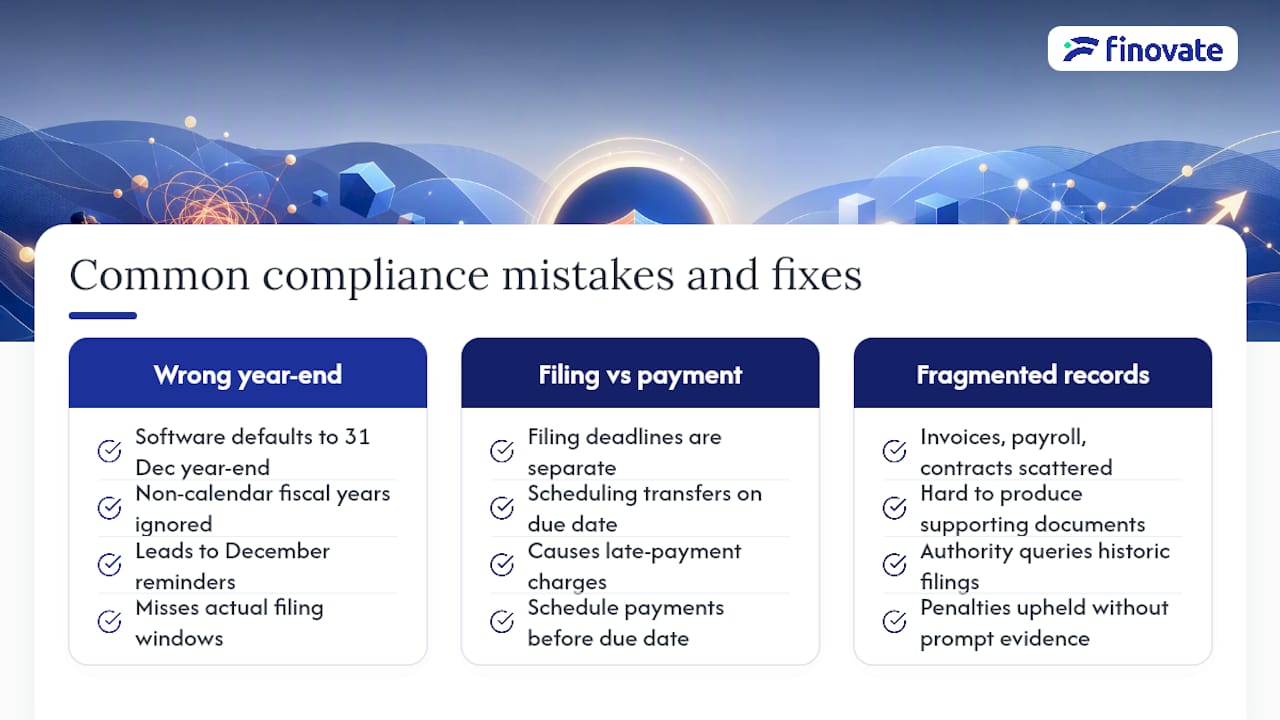
Three patterns appear repeatedly in practice. First, companies with non-calendar fiscal years assume the standard December-based deadlines apply to them. Accounting software often defaults to a 31 December year-end and will not flag shifted deadlines without deliberate configuration. A company with a 31 March year-end that uses an unconfigured system will see December-based reminders and miss its actual windows.
Second, finance teams conflate filing deadlines with payment deadlines. Filing the return on time satisfies one obligation; paying the liability on time satisfies a separate one. Scheduling the bank transfer on the due date rather than ahead of it is the single most common source of avoidable late-payment charges.
Third, record-keeping is treated as an afterthought rather than a compliance obligation in its own right. When an authority queries a historic filing, the ability to produce supporting documentation within a short window is what determines whether a penalty is upheld or waived. Fragmented records — invoices in one system, payroll in another, contracts in email — make that response nearly impossible under time pressure.
The best practice that addresses all three: assign a named owner to each compliance obligation, configure your accounting system to reflect your actual fiscal year-end, and maintain a single document repository linked to each filing period. Automation handles reminders; a named owner handles judgement calls. Neither works without the other.
How Finovate supports your annual compliance obligations
Managing year-end financial obligations across tax, payroll, and registry filings is time-consuming, and the cost of errors is disproportionate to the effort of getting it right the first time. Finovate provides Finnish businesses with a practical alternative to managing these obligations in-house without dedicated compliance resource.
Finovate's services cover the full annual compliance cycle: preparation and filing of annual accounts, corporate income tax returns via MyTax, VAT and payroll withholding returns, PRH submissions, and compliance calendar set-up tailored to your fiscal year-end. Before contacting us, it helps to have your fiscal year-end date confirmed, your most recent filed accounts to hand, and access credentials for MyTax and your accounting system.
To discuss your compliance requirements and get a clear picture of what needs to be filed and when, contact Finovate for a service enquiry. We will map your obligations, assign the right deadlines, and take the filing burden off your team.
Sources
Verify your exact filing dates against these primary sources at the start of every year, as statutory deadlines and thresholds are updated annually:
- Important dates and deadlines for corporate taxpayers
- Tax calendar for entrepreneurs
- When, how and where to file | Internal Revenue Service
Check each source directly rather than relying on cached or third-party summaries. Official pages are updated when legislation changes; secondary sources often are not.
This article provides general information about financial filing obligations and is not a substitute for professional advice. Confirm current deadlines and rules with Vero, PRH, or a qualified adviser before taking action.