

TL;DR:
- UK entrepreneurs should prioritize separating personal and business finances early to ensure accurate accounting and credibility. Achieving break-even within twelve months and building sufficient cash reserves are crucial milestones for business survival and growth. Regular financial reviews and a living, adaptable plan help founders act proactively and avoid common credit and liquidity pitfalls.
The financial milestones every UK entrepreneur should prioritise, in order, are: separate your personal and business finances; reach break-even; pay yourself a consistent salary; build sufficient cash runway; achieve positive net profit; install a rolling cash-flow forecast; hit VAT registration readiness; prepare investor-ready financial records; secure your first external funding round; and plan for exit or succession. These are not aspirational targets. They are the structural steps that determine whether your business survives, scales, or stalls.
If you are in your first 90 days, focus on the first three: open a dedicated business account, set up bookkeeping, and calculate your break-even point. Break-even — the point at which monthly revenue equals monthly operating expenses — is the earliest proof that your model works, and most advisors target it within an early timeframe.
- Separate personal and business finances
- Calculate and target break-even
- Pay yourself a regular, documented salary
- Build one month of cash runway (three months by year three)
- Achieve consistent positive net profit
- Install a rolling 13-week cash-flow forecast
- Register for VAT and meet HMRC obligations
- Build a credible financial model for lenders and investors
- Secure external funding aligned to your growth stage
- Plan for exit, succession, or long-term ownership
Pro Tip: Finovate's advisory team, led by Busayo, recommends treating these milestones as a sequence rather than a checklist. Completing them in order reduces the risk of building growth on an unstable financial base.
Table of Contents
- What are the key financial milestones for entrepreneurs, stage by stage?
- What financial controls and reporting routines should you install early?
- When and how should you finance your business growth?
- How do you protect your business and personal finances as you grow?
- What benchmarks and measurable targets should you use?
- How do you turn milestones into a review routine you can actually keep?
- Your action checklist and UK resources for this quarter
- Key takeaways
- Why financial planning must be a living system, not a one-off exercise
- Authoritative UK sources and further reading
What are the key financial milestones for entrepreneurs, stage by stage?
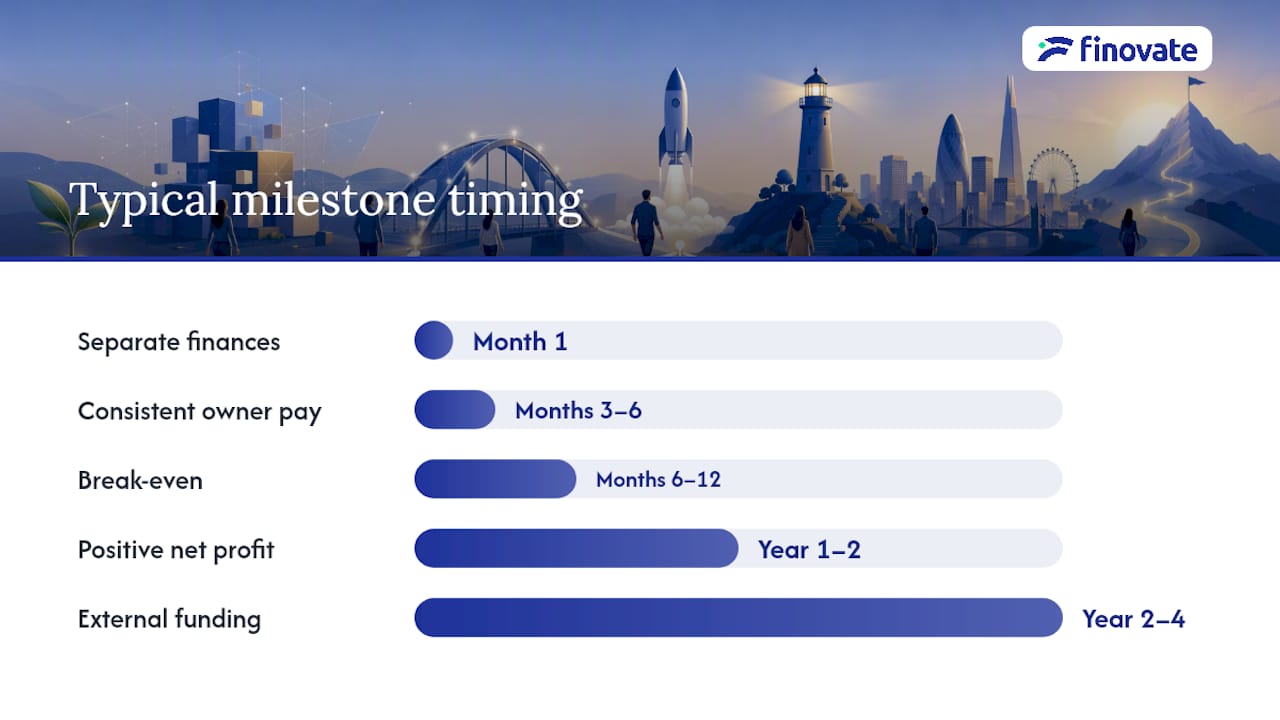
Financial milestones for entrepreneurs are most useful when they are tied to a specific stage and a measurable metric. The table below maps each milestone to its typical timing, the metric that confirms you have reached it, and the primary action required.
| Milestone | Stage | Metric | Typical timing | Key action |
|---|---|---|---|---|
| Separate finances | Pre-launch | Business account open; bookkeeping live | Month 1 | Open a dedicated business current account |
| Break-even | Startup | Monthly revenue ≥ monthly operating costs | Months 6–12 | Build a simple P&L; track monthly |
| Consistent owner pay | Startup | Regular salary drawn and documented | Months 3–6 | Set a fixed monthly draw; record via payroll |
| One month cash runway | Startup | Cash reserve = 1× monthly operating costs | End of year one | Automate a monthly transfer to a reserve account |
| Positive net profit | Growth | Positive net profit | Year 1–2 | Review pricing and cost structure quarterly |
| 13-week cash forecast | Growth | Rolling forecast updated weekly | Year 2 | Implement in a spreadsheet or accounting tool |
| VAT registration | Growth | Taxable turnover approaching £90,000 | As threshold nears | Register with HMRC before the threshold is crossed |
| Investor-ready model | Scale | Credible model with CAC, LTV, burn rate | Year 2–3 | Build a driver-based financial model |
| External funding | Scale | Debt service ratio ≥ 1.20:1 | Year 2–4 | Clean accounts; prepare two-year forecasts |
| Exit planning | Pre-exit | Documented valuation and succession plan | Year 5+ | Engage an accountant and solicitor |
Separating personal and business finances
This is the first and most foundational step. Without a clean separation, you cannot produce accurate accounts, claim legitimate expenses, or give a lender a credible picture of your business. Open a dedicated business current account before you take your first payment. Set up bookkeeping from day one, whether through software such as Xero or QuickBooks, or through a bookkeeper. Our guide on why separate business finances explains the practical and legal reasons in detail.
Break-even and the business plan
A business plan with financial projections is not a formality. It is the document that forces you to calculate your break-even point before you spend money. Your break-even is the revenue level at which total costs are covered. Track it monthly from launch. If you are not on a trajectory to reach it within 12 months, your pricing, cost base, or both need to change.
Paying yourself consistently
Many founders delay paying themselves, which distorts the true cost of running the business. Set a fixed monthly salary from the point the business can support it, even if it is modest. Record it through payroll. This matters for two reasons: it gives you an accurate picture of profitability, and it establishes a PAYE record that HMRC will expect once you employ others.
Building cash runway
Experts recommend holding at least one month of operating expenses as a cash runway in the early stages, scaling it further as your business matures. Having several months of runway allows you to absorb a slow quarter, a late-paying client, or an unexpected cost without making fear-driven decisions. Automate a monthly transfer to a separate reserve account so the habit is built in.

VAT registration in the UK
In the UK, a VAT registration threshold applies based on taxable turnover measured over a rolling 12-month period. You must register with HMRC before you cross this threshold, not after. Missing the threshold is a common and costly mistake: HMRC can charge VAT on all sales from the date you should have registered, even if you did not collect it from customers. Monitor your rolling 12-month turnover monthly as you approach this level.
Hiring and payroll milestones
Before you hire your first employee, you need to register as an employer with HMRC, set up a PAYE scheme, and understand your auto-enrolment pension obligations. The trigger for auto-enrolment is employing someone aged 22 or over who earns above the earnings trigger (currently £10,000 per year). Budget for employer National Insurance contributions and pension contributions as part of your total employment cost, not as an afterthought.
What financial controls and reporting routines should you install early?
Financial controls are the processes that prevent errors, fraud, and cash surprises. Most founders install them too late. The right time is before you need them.
Core controls to put in place
- Open a dedicated business bank account and never mix personal and business transactions.
- Set up a chart of accounts in your accounting software that matches your business model.
- Reconcile your bank account at least monthly, weekly if cash flow is tight.
- Set a spend approval threshold: any purchase above a defined amount (for example, £500) requires sign-off.
- Keep all receipts and invoices in a digital system from day one.
- Run payroll through a compliant payroll system and file RTI submissions to HMRC on time.
The reporting cadence every founder needs
Nearly 86% of businesses experiencing financial difficulties did not regularly review their financial statements. Monthly reviews are not optional at any stage of growth. Your minimum reporting pack should include:
- Monthly profit and loss (P&L) statement
- Monthly balance sheet
- Rolling 13-week cash-flow forecast, updated weekly
- Gross margin percentage, tracked against prior months
- Burn rate and runway in months (for pre-profit businesses)
- Debt service ratio once you carry any debt
- Customer acquisition cost (CAC) and lifetime value (LTV) once you have enough data
The 13-week rolling cash-flow forecast is particularly valuable at the growth stage. It gives you operational certainty for short-term decisions such as hiring, inventory purchases, or delaying a supplier payment. Our financial forecasting guide covers how to build one from scratch.
What to do yourself versus when to bring in help
In the early months, most founders can manage basic bookkeeping themselves using accounting software. Once monthly revenue exceeds a level where errors carry real tax or cash consequences, a bookkeeper is worth the cost. When you are preparing for external funding, filing complex VAT returns, or managing payroll for a team, a qualified accountant becomes necessary. A fractional CFO is worth considering when you are approaching £1M in revenue and need someone to own the financial model and investor relationships. Our financial statements guide explains what each report tells you and why regular review matters.
When and how should you finance your business growth?
Choosing the wrong funding route at the wrong stage is one of the most common and expensive mistakes founders make. Each route has a natural trigger milestone.
Bootstrapping suits the pre-revenue and early-revenue stage. It preserves equity and forces cost discipline. The trigger to move beyond bootstrapping is when growth is constrained by capital, not by product or market.
Business loans and overdrafts become relevant once you have 12 months of trading history, a clean set of accounts, and a debt service ratio that demonstrates you can service the debt. Lenders typically look for a ratio of at least 1.20:1, meaning your operating income covers debt payments by 1.2 times.
Invoice financing is useful when you have strong receivables but a cash-flow gap between invoicing and payment. It does not require a long trading history, but lenders will scrutinise the quality of your debtors.
Angel investment is typically available once you have a working product, some early revenue or traction, and a credible financial model. Angels invest in people as much as numbers, but they will still expect to see a clear use of funds and a realistic path to return.
Venture capital requires demonstrated growth, a large addressable market, and unit economics that suggest scalability. Most VC conversations happen at Series A and beyond, where you need a full financial model with CAC, LTV, gross margin trajectory, and burn rate clearly documented.
Pro Tip: When preparing for any external funding conversation, investors and lenders focus on the intellectual honesty of your financial model. A clear link between your operational inputs — headcount, CAC, pricing — and your cash burn is more persuasive than a complex spreadsheet with optimistic assumptions.
Non-dilutive versus equity capital
The core question is whether you want to retain ownership. Non-dilutive capital (loans, grants, revenue-based financing) costs money but preserves equity. Equity capital costs ownership but may bring expertise and networks. As a general principle, use non-dilutive capital for working capital and asset purchases, and equity capital for growth investments where the return justifies the dilution.
Before any funding conversation, prepare: two years of clean, accountant-reviewed financial statements; a two-year forward forecast with clear assumptions; a documented use of funds; and a summary of your key unit economics. Our financial management tips cover how to prepare these documents.
How do you protect your business and personal finances as you grow?
Growth creates new financial risks. The protections that were adequate at launch may not be sufficient at scale.
- Legal structure: Review your structure as revenue grows. A sole trader arrangement that worked at £30,000 turnover may expose you to unnecessary personal liability at £200,000. Most UK founders incorporate as a limited company once the tax and liability benefits outweigh the administrative cost.
- Insurance: Public liability insurance is necessary from the moment you interact with clients or the public. Professional indemnity cover is required if you give advice or provide professional services. Employer liability insurance becomes a legal requirement the moment you hire your first employee.
- Business interruption cover: This protects revenue if an insured event prevents you from trading. Review the policy limits annually as revenue grows.
- Contracts: Use written contracts with clients, suppliers, and employees. A verbal agreement is enforceable in principle but almost impossible to prove in practice.
- Personal financial separation: Pay yourself a documented salary. Do not use the business account for personal expenses. This protects you in the event of an HMRC enquiry and gives you a clear picture of your personal financial position.
- Tax-efficient pensions: As a limited company director, contributing to a pension through the company is one of the most tax-efficient ways to extract value. Contributions are generally deductible against corporation tax. Consult an accountant before setting contribution levels.
- VAT and PAYE compliance: Register for VAT before you cross the £90,000 threshold. Register as an employer and set up PAYE before your first employee starts. Late registration carries penalties from HMRC.
Setting aside a portion of income regularly for tax reduces the risk of a large unexpected bill at year end. HMRC's guidance on VAT registration and PAYE for employers are the primary references for UK obligations.
What benchmarks and measurable targets should you use?
Benchmarks give milestones a number. Without a number, a milestone is a direction, not a destination.
Research note: Nearly 86% of businesses experiencing financial difficulties did not regularly review their financial statements. Monthly reviews, tied to the benchmarks below, are the single most reliable habit for avoiding financial distress.
| Benchmark | Target | When to apply |
|---|---|---|
| Break-even | Achieved within 12 months | Startup stage |
| Cash reserve (runway) | 1 month of operating costs by end of year one | Year one |
| Cash reserve (runway) | 3 months of operating costs by year three | Year three |
| Debt service ratio | ≥ 1.20:1 | Before taking on debt |
| Rolling cash forecast | 13-week forecast updated weekly | Growth stage onwards |
| Gross margin | Positive and improving quarter on quarter | From first revenue |
| Net profit margin | Positive by end of year two | Growth stage |
| VAT threshold monitoring | Monthly check of rolling 12-month turnover | As you approach £90,000 |
Adapting benchmarks to your business model
A SaaS business will typically have higher gross margins than a product business, so its net profit timeline may be shorter even if its upfront costs are higher. A services business may reach break-even faster but face a harder ceiling on scalability. The benchmarks above are starting points. Adjust them based on your cost structure, payment terms, and growth rate.
Financial planning for startups works best as a living system: a driver-based financial model that connects your operational assumptions to your cash position, a budget that enforces day-to-day discipline, and a rolling forecast that tells you how long your runway lasts under different scenarios. Our start-up budgeting guide explains how to build these three components together.
One point worth emphasising: founders often treat revenue as the primary measure of progress, but infrastructure milestones — a working 13-week forecast, a multi-department budget, clean management accounts — should be in place before you push for larger revenue bands. Growing without these controls in place is how businesses grow into insolvency.
How do you turn milestones into a review routine you can actually keep?
A milestone without a review date is a wish. The routine below converts your targets into a repeatable habit.
Monthly review (30 minutes)
- Review your P&L against last month and against budget.
- Update your 13-week cash-flow forecast with actual figures.
- Check your cash reserve balance against your runway target.
- Review outstanding invoices and chase anything overdue by more than 14 days.
- Confirm your VAT position if you are approaching the registration threshold.
- Note any variance greater than 10% from budget and identify the cause.
Quarterly review (90 minutes)
- Review gross margin and net profit margin trends over the past three months.
- Update your financial model with actual results and revise forward assumptions.
- Check your debt service ratio if you carry any debt.
- Review your CAC and LTV if you have enough data.
- Assess whether you are on track for your next milestone and adjust your 90-day plan.
- Prepare a summary to share with your accountant or advisor.
Setting SMART financial targets
A SMART target tied to a milestone might read: "Reach one month of cash runway within six months by increasing gross margin by three percentage points through a price increase, and reducing discretionary spend by 15%." That target is specific, measurable, time-bound, and tied to two operational levers you control.
When a metric slips: the escalation plan
If cash runway falls below two weeks, stop all discretionary spend immediately and accelerate collections. If gross margin falls for two consecutive months, review your pricing and your cost of goods or delivery. If net profit turns negative, identify the largest cost line and assess whether it is fixed or variable. If revenue drops more than 20% against forecast, revisit your sales pipeline and consider a temporary hiring freeze. The key is to act on the signal early, before the variance becomes a crisis.
Your action checklist and UK resources for this quarter
90-day action checklist
- Open a dedicated business bank account if you have not already done so.
- Set up bookkeeping software (Xero, QuickBooks, or FreeAgent are widely used in the UK).
- Calculate your break-even point and record it in a simple P&L template.
- Set a fixed monthly owner salary and run it through payroll.
- Build a 13-week cash-flow forecast. For practical examples, the InvoiceLabs cash-flow guide provides useful templates.
- Open a separate savings account and transfer one month of operating costs as your initial reserve.
- Check your rolling 12-month taxable turnover against the £90,000 VAT threshold.
- Register as an employer with HMRC before hiring your first employee.
- Set aside a portion of income regularly for tax to avoid a large year-end bill.
- Book a quarterly review with your accountant.
UK authorities and tools to consult
| Resource | What it covers | When to use it |
|---|---|---|
| HMRC VAT registration | VAT threshold, registration process, returns | As turnover approaches £90,000 |
| HMRC PAYE for employers | Employer registration, RTI, payroll obligations | Before hiring your first employee |
| Companies House | Incorporation, annual accounts filing, confirmation statements | At incorporation and annually |
| GOV.UK business support | Government grants, loans, and advisory services | When exploring non-dilutive funding |
| Xero / QuickBooks / FreeAgent | Bookkeeping, VAT returns, payroll | From day one |
| Finovate | Accounting, bookkeeping, VAT, payroll, advisory | When you need professional support |
For founders who want professional support with invoicing, bookkeeping, and financial reporting, Finovate offers a range of accounting and invoicing services tailored to entrepreneurs and small businesses. Whether you need a monthly invoicing package or full advisory support as you prepare for scale, we can help you reach the next milestone with confidence.

Key takeaways
Reaching your financial milestones requires a sequence of measurable steps, not a single plan: separate your finances first, reach break-even within 12 months, then build the controls and runway that support every decision after that.
| Point | Details |
|---|---|
| Separate finances first | Open a dedicated business account and start bookkeeping before your first transaction. |
| Target break-even within 12 months | Track monthly revenue against operating costs from launch; adjust pricing or costs if you are off track. |
| Build cash runway to three months | Hold one month of operating costs by end of year one, scaling to three months by year three. |
| Review monthly without exception | Nearly 86% of businesses in financial difficulty did not review statements regularly; monthly reviews prevent this. |
| Install a 13-week cash forecast | Update it weekly from the growth stage onwards to support hiring, spending, and funding decisions. |
This article provides general financial information for UK entrepreneurs. It is not a substitute for professional accounting, tax, or legal advice. Confirm current thresholds and obligations with HMRC or a qualified adviser.
Why financial planning must be a living system, not a one-off exercise
Most founders write a business plan once, file it, and never look at it again. The plan becomes a historical document rather than a decision-making tool. That is the single most common financial planning mistake I see.
The milestones in this guide are only useful if they are reviewed regularly and updated when circumstances change. A founder who builds a 13-week cash forecast, reviews it weekly, and adjusts their spending or pricing in response to what it shows is doing something fundamentally different from one who sets annual targets and checks in at year end. The first founder makes small corrections continuously. The second discovers large problems too late.
Consider what happens when a business moves from break-even to three months of cash runway. That shift is not just a number improving. It changes the quality of every decision the founder makes. They can hire without panic. They can negotiate better terms with suppliers. They can turn down a bad client without fear. The runway milestone enables the hiring milestone, which enables the revenue milestone. The sequence matters.
Financial planning for startups works best when it combines three components: a driver-based model that connects your assumptions to your cash position, a budget that enforces discipline day to day, and a rolling forecast that tells you how long you can operate under different scenarios. None of these is complicated. All of them require consistency.
The founders who reach their financial milestones are not always the ones with the best product or the largest market. They are the ones who review their numbers every month, act on what they find, and ask for help before a problem becomes a crisis.
Authoritative UK sources and further reading
| Source | What it covers |
|---|---|
| HMRC VAT guidance | VAT registration thresholds, returns, and compliance for UK businesses |
| HMRC PAYE for employers | Employer registration, payroll obligations, and RTI submissions |
| Companies House | Company incorporation, annual accounts, and confirmation statements |
| GOV.UK business support | Government-backed funding, grants, and business advisory services |
| University of York: managing business finances | Practical guidance on separating personal and business finances |
| Finovate accounting and advisory services | Full-service accounting, bookkeeping, VAT, payroll, and business advisory |
| Finovate: financial statements for entrepreneurs | How to read and use P&L, balance sheet, and cash-flow statements |
| Finovate: financial management for business owners | Broad overview of financial management principles for founders |