

If you earn more than £1,000 from self-employment in a tax year, you must register with HMRC, file a Self Assessment tax return, and pay Income Tax plus National Insurance on your profits. Those are the three non-negotiable obligations at the heart of UK self-employment tax, and getting any one of them wrong can trigger penalties that compound quickly.
For the 2026/27 tax year, the key figures are:
- Personal allowance: £12,570 (no Income Tax below this threshold)
- Basic rate: 20% on profits from £12,571 to £50,270
- Higher rate: 40% on profits from £50,271 to £125,140
- Additional rate: 45% on profits above £125,140
- Class 4 National Insurance: 6% on profits between £12,570 and £50,270, then 2% above £50,270
- Class 2 National Insurance: no longer compulsory from april 2024; voluntary payments of approximately £3.50 per week protect your State Pension entitlement
Key figure: The personal allowance of £12,570 is frozen until 2028, meaning more self-employed people will be pulled into higher tax bands as their income grows.
Tax is charged on your profits, not your turnover. That distinction shapes every calculation you make.
How to register as self-employed with HMRC
The registration deadline is 5 October following the end of the tax year in which you started trading. If you began working for yourself in July 2025, you must register by 5 October 2026. Miss that date and an automatic penalty of at least £100 applies, regardless of whether you owe any tax.
Registration and filing are separate processes. Many people confuse them, assuming that submitting a tax return covers their registration obligation. It does not—you must register first, then file.
What you need to register:
- Your National Insurance number
- A Government Gateway account (create one at GOV.UK if you do not already have one)
- Basic details about your business, including the date you started trading
Once registered, HMRC will issue your Unique Taxpayer Reference (UTR), a 10-digit number you will need for every Self Assessment filing. Allow up to 10 working days to receive it, longer if you are based abroad.
What happens after registration:
- You receive your UTR by post
- HMRC activates your Self Assessment portal
- You must file a return every year until you formally deregister
Pro Tip: Register as soon as you start trading, even if your income is modest. Early registration gives you time to receive your UTR well before the January filing deadline, and it removes the risk of an automatic penalty for late registration.
What taxes do self-employed people pay in the UK?
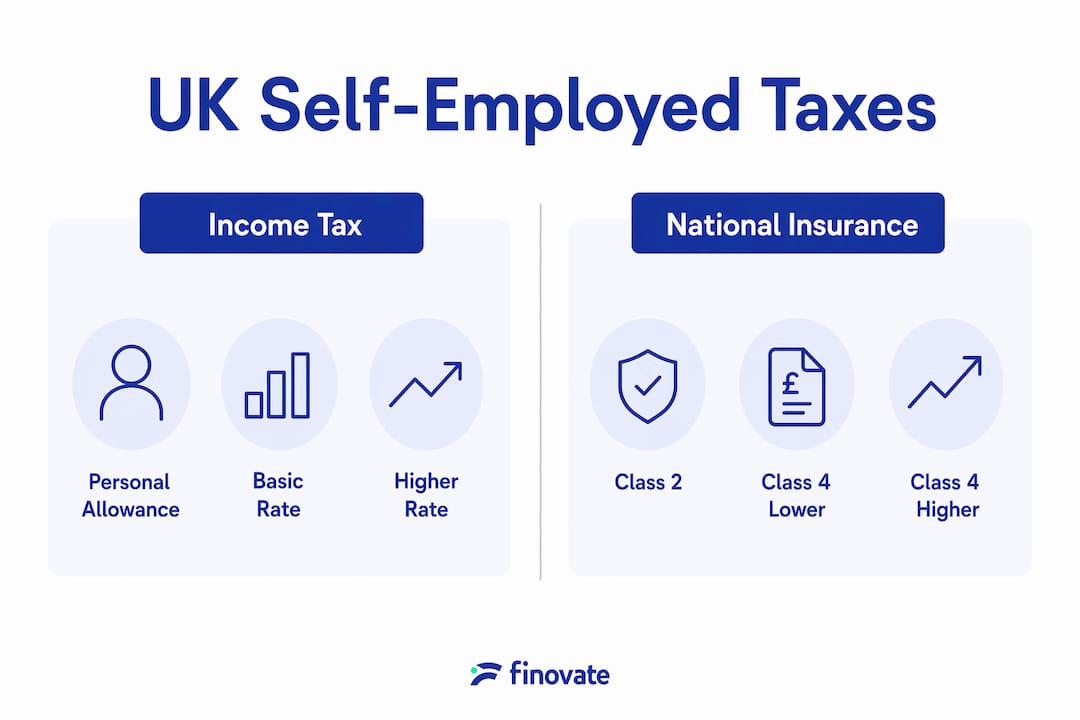
Self-employed people in the UK pay two main taxes: Income Tax and National Insurance contributions. Both are calculated on your profits, which is your total income minus allowable business expenses.
Income Tax
Income Tax bands for 2026/27 apply to England, Wales, and Northern Ireland. Scotland uses different rates, ranging from 19% up to 48%, though the £12,570 personal allowance remains UK-wide.

| Tax band | Taxable profit | Rate |
|---|---|---|
| Personal allowance | Up to £12,570 | — |
| Basic rate | £12,571 to £50,270 | 20% |
| Higher rate | £50,271 to £125,140 | 40% |
| Additional rate | Above £125,140 | 45% |
One important threshold: if your adjusted net income exceeds £100,000, the personal allowance reduces by £1 for every £2 over that figure, disappearing entirely at £125,140. That creates an effective 60% marginal rate in that band.
Class 4 National Insurance
On top of Income Tax, you pay Class 4 National Insurance on your trading profits. For 2026/27:
| Profit band | Class 4 rate |
|---|---|
| Up to £12,570 | — |
| £12,570 to £50,270 | 6% |
| Above £50,270 | 2% |
Class 4 is calculated through Self Assessment and paid alongside Income Tax. There is no separate personal allowance against it.
Class 2 National Insurance
Class 2 National Insurance is no longer compulsory from April 2024. If your profits are at or above the Small Profits Threshold of £6,845, your contributions are treated as paid automatically, protecting your State Pension entitlement at no cost. If your profits fall below that threshold, you can pay voluntarily at approximately £3.50 per week. For anyone with a patchy National Insurance record, voluntary Class 2 payments remain one of the most cost-effective ways to secure a qualifying year.
Key figure: The personal allowance and Income Tax bands remain unchanged until 2028. As your income grows, a larger proportion will fall into higher bands, even without a rate change.
How to file your Self Assessment tax return accurately
Filing your Self Assessment return requires preparation well before the january deadline. The process involves gathering documents, completing the SA100 form, calculating your tax liability, and choosing how to pay.
Documents to gather before you start
- UTR number and National Insurance number
- Records of all business income (invoices, bank statements)
- Expense receipts and records
- Pension contribution details
- P60 or P45 if you also have employment income
- Details of any other income: rental, dividends, interest, or capital gains
Filing online vs by paper
Most self-employed people file online through HMRC's Self Assessment portal, which calculates your tax bill automatically once you enter your figures. The online route also gives you until 31 january to submit, compared to 31 October for paper returns. Filing online is faster, reduces arithmetic errors, and gives you an immediate confirmation of receipt.
Key steps to complete your return
- Log in to your Government Gateway account and select Self Assessment.
- Complete the SA100 main form, adding the self-employment supplementary pages (SA103S for turnover under £90,000, or SA103F for more complex affairs).
- Enter your total turnover, then deduct allowable expenses to arrive at your taxable profit.
- Report any other income sources: employment, rental, dividends, or savings interest.
- Claim any reliefs, including pension contributions or Gift Aid donations.
- Review the calculated tax figure before submitting.
- Submit by the deadline and note your submission reference.
Payments on account and balancing payments
Payments on Account apply when your Self Assessment tax bill exceeds £1,000 and less than 80% of your tax is collected at source through PAYE. HMRC requires you to make two advance payments toward the following year's bill:
- 50% by 31 january (paid alongside your balancing payment for the current year)
- 50% by 31 july
In your first year of filing, this can mean paying 150% of your actual tax liability in a single january payment. That surprises many first-time filers. A balancing payment settles any remaining tax owed after Payments on Account are taken into account.
Pro Tip: If your income drops significantly from one year to the next, you can apply to reduce your Payments on Account through your HMRC online account. Do not simply ignore them — unpaid Payments on Account attract interest and penalties just like any other tax debt.
How to claim allowable expenses and reduce your tax bill
Every pound of allowable expenses you claim reduces your taxable profit, which directly reduces your tax bill. The governing principle is that an expense must be incurred "wholly and exclusively" for business purposes. Personal costs, even those partly related to work, are generally not deductible unless you can identify and separate the business element.
Common allowable expense categories
- Office costs: stationery, postage, business phone and internet (business proportion only), software subscriptions
- Travel: business mileage at 45p per mile for the first 10,000 miles, then 25p; train, taxi, and accommodation for business trips (not commuting)
- Home office: flat rate of £6 per week, or a proportionate share of actual household bills based on the space and time used for work
- Professional fees: accountancy fees, legal fees for business matters, professional indemnity insurance
- Marketing: website hosting, advertising, business cards
- Equipment: computers, cameras, tools, and machinery via capital allowances
- Training: courses that develop existing skills (not qualifications for a new career)
- Financial costs: business bank charges, interest on business loans, business insurance
Capital allowances
Large purchases such as vehicles, machinery, and equipment are not expensed in full in the year of purchase under traditional accounting. Instead, you claim capital allowances. The Annual Investment Allowance (AIA) lets most sole traders deduct 100% of qualifying equipment costs in the year of purchase, up to the current limit.
The £1,000 trading allowance
The £1,000 trading allowance is a gross income threshold, not a profit threshold. If your total self-employment receipts are £1,000 or less, you pay no tax and do not need to file a return. Once you exceed £1,000 in gross income, you must register and report, even if your actual profit is lower. You cannot claim the trading allowance and also deduct allowable expenses; you choose one or the other, so if your expenses exceed £1,000, calculating actual profit will give you a lower tax bill.
What you cannot claim
Non-allowable expenses include client entertainment, private travel, parking fines, and everyday clothing (unless it is specialist protective wear). Claiming these by mistake is one of the most common errors in Self Assessment filings.
Pro Tip: Keep digital records of every receipt as you go, not in a batch at year-end. A photo taken on your phone the day you make a purchase is accepted by HMRC and takes seconds. Reconstructing a year's worth of expenses from memory in january is where errors creep in.
Deadlines, penalties, and interest you need to know
Missing a deadline in Self Assessment does not just mean a fine. Penalties escalate the longer you delay, and interest accrues on unpaid tax from the day it was due. The dates below apply to the 2025/26 tax year return.
Key dates
- 5 October 2026: deadline to register for Self Assessment if you started trading in the 2025/26 tax year.
- 31 October 2026: deadline to submit a paper Self Assessment return.
- 31 january 2027: deadline to submit your online return, pay your balancing payment, and make your first Payment on Account for 2026/27.
- 31 july 2027: deadline for your second Payment on Account.
Late filing penalties
HMRC's penalty structure for late filing is fixed and escalating:
- Day 1 after 31 january: automatic £100 penalty, even if you owe no tax.
- After 3 months: daily penalties of £10 per day, up to a maximum of £900.
- After 6 months: an additional penalty of £300 or 5% of the tax owed, whichever is higher.
- After 12 months: a further £300 or 5% of the tax owed, whichever is higher, plus potential additional charges if HMRC determines the delay was deliberate.
Late payment penalties and interest
- 5% surcharge on unpaid tax after 30 days.
- A further 5% after 6 months.
- A further 5% after 12 months.
- Interest accrues from the payment due date at HMRC's current rate.
Key consequences of missing dates:
- Automatic £100 fine for a return filed one day late, even with no tax liability
- Penalties compound: a return filed 12 months late can attract over £1,600 in fixed penalties alone, before interest
- Late registration triggers penalties separately from late filing
- HMRC can open an enquiry if returns are consistently late or inaccurate
Common pitfalls and expert tips for UK self-employed tax compliance
Most Self Assessment problems are preventable. The mistakes below appear repeatedly, and each one has a straightforward fix.
Waiting too long to register
Registration and filing are separate obligations. A common trap is assuming you only need to act when the filing deadline approaches. If you started trading in the 2025/26 tax year, you must register by 5 October 2026, regardless of when you plan to file your return. Missing that date triggers an automatic penalty.
Underestimating Payments on Account
New filers are regularly caught out by Payments on Account. Your january bill can be 150% of your actual tax liability in your first year, because you are paying the current year's balance and 50% of next year's bill simultaneously. Setting aside 25–30% of every payment you receive throughout the year is a reliable way to avoid a cash shortfall. Payments on Account are advance payments, not penalties, but they arrive at the same time as your balancing payment and the shock is real for those unprepared.
Confusing turnover with profit
Tax is charged on profit, not turnover. Many self-employed people calculate their expected bill on their total income and then underpay because they have not deducted allowable expenses first. The reverse error also occurs: claiming expenses that are not genuinely business-related inflates your deductions and can trigger an HMRC enquiry.
Forgetting Class 4 National Insurance
Income Tax and Class 4 National Insurance are both calculated on your profits and paid through Self Assessment, but they are separate charges. Someone on £40,000 profit pays Income Tax on the amount above £12,570 and also pays 6% Class 4 National Insurance on the same band. Saving only for Income Tax and ignoring Class 4 is a consistent source of underpayment.
Poor record keeping
Accurate digital records reduce errors and make filing faster. HMRC can request records going back several years, so keeping organised receipts, invoices, and bank statements is not optional. Making Tax Digital for Income Tax Self Assessment (MTD for ITSA) will require digital record-keeping and quarterly updates for self-employed people with income above £50,000 from april 2026, and above £30,000 from april 2027.
Additional tips for clean compliance:
- File early. You can submit your return from 6 april, and early filing gives you months to plan how to pay your bill.
- Review your Payments on Account each year. If your income has dropped, apply to reduce them rather than overpaying and waiting for a refund.
- Keep a separate bank account for tax savings. Mixing tax funds with operating income is how cash shortfalls happen.
- Consider professional advice if you have multiple income streams, capital gains, or income above £50,000. The cost of an accountant is itself an allowable expense.
Pro Tip: Filing your return in may or june rather than january gives you the same legal standing but far less stress. You also discover your tax bill months earlier, giving you time to budget for it or reduce it through pension contributions before the payment deadline.
Effective tax planning is not just about compliance. Strategies like pension contributions, timing of income, and proper use of capital allowances can meaningfully reduce your liability within the rules. For broader context on how professional advisers approach tax planning across jurisdictions, the tax planning principles applied in formal advisory practices share common ground with UK self-employment planning.
How VAT registration affects self-employed individuals
VAT registration becomes compulsory when your taxable turnover exceeds £90,000 in any rolling 12-month period. That threshold was raised from £85,000 in april 2024. Once you cross it, you must register with HMRC, charge VAT on your sales, and submit regular VAT returns.
What compulsory VAT registration means in practice
Once registered, you charge VAT (typically at the standard rate of 20%) on top of your prices and pay that amount to HMRC, usually quarterly. In return, you can reclaim the VAT you pay on business purchases. The net effect on your cash position depends on whether your customers are VAT-registered themselves.
If your clients are VAT-registered businesses, they can reclaim the VAT you charge them, so your prices remain competitive. If your clients are consumers or small businesses that cannot reclaim VAT, adding 20% to your prices may affect demand, or you may need to absorb some of the cost within your margin.
Voluntary VAT registration
You can register voluntarily at any turnover level. This makes sense if you have significant VAT on your purchases and want to reclaim it, or if registering signals a professional standing to larger clients. The trade-off is the administrative burden of quarterly VAT returns and the need for VAT-compliant invoicing.
VAT accounting schemes
HMRC offers several schemes that can simplify administration or improve cash flow:
- Flat Rate Scheme: pay a fixed percentage of gross turnover to HMRC, varying by industry, for businesses with turnover up to £150,000. You keep the difference between the flat rate and the standard 20% you charge clients.
- Cash Accounting: pay VAT on income actually received rather than invoices issued, which helps cash flow when clients pay late.
- Annual Accounting: submit one VAT return per year with monthly or quarterly payments on account, reducing paperwork.
Making Tax Digital for VAT
MTD for VAT has applied to all non-exempt VAT-registered businesses since april 2022. If you are VAT-registered, you must keep digital VAT records and submit returns using MTD-compatible software. Non-compliance with MTD requirements carries its own penalty regime, separate from Self Assessment.
VAT registration does not change your Income Tax or National Insurance obligations. You still file a Self Assessment return and pay tax on your profits in the usual way. VAT is a separate reporting and payment obligation layered on top.
How to handle taxes with multiple income sources
Self-employment is rarely a person's only source of income. Many sole traders also have employment income, rental income, dividends, or savings interest. All of these must be reported on your Self Assessment return, and they interact with your self-employment profits in ways that can affect your tax band and your National Insurance position.
Employment income alongside self-employment
If you are employed and self-employed simultaneously, your employer deducts Income Tax through PAYE on your salary. Your Self Assessment return then combines both income sources to calculate your total tax liability. Any underpayment from your self-employment is collected through Self Assessment; any overpayment from PAYE is refunded. Your personal allowance applies to your total income, not to each source separately.
Rental income
Rental income is reported on the property pages of your Self Assessment return. It is taxed as income, stacked on top of your self-employment profits for the purposes of determining your tax band. If your combined income pushes you into the higher rate band, your rental profits above that threshold are taxed at 40%.
Dividends and savings interest
If you operate through a limited company rather than as a sole trader, dividends are taxed differently from trading profits. For sole traders with savings or investment income, the Personal Savings Allowance and Dividend Allowance provide some tax-free headroom, but both have been reduced significantly in recent years and must be reported on your return.
National Insurance with multiple income sources
Class 4 National Insurance applies only to self-employment profits. If you are also employed, your employer deducts Class 1 National Insurance from your salary. There is a maximum annual National Insurance contribution, and if you are paying both Class 1 and Class 4, you may be able to defer or reclaim some Class 4 contributions. HMRC's deferment process handles this, but it requires an application.
For self-employed people managing several income streams, professional advice pays for itself. The interaction between income sources, tax bands, and National Insurance can produce unexpected bills without careful planning. Tax-saving strategies that work well for sole traders with mixed income are covered in depth in resources like tax efficiency guides for professional services providers, where the underlying principles of income planning translate across jurisdictions.
How Finovate can support your self-employment tax compliance

Managing self-employment tax accurately takes time, attention to detail, and up-to-date knowledge of HMRC's rules. Finovate provides accounting and tax services designed to take that burden off your plate, from bookkeeping and invoicing through to tax planning and Self Assessment support.
Whether you are a freelancer filing your first return or a sole trader managing multiple income streams, we can help you stay compliant, claim every allowable expense, and avoid the penalties that come from missed deadlines or miscalculated liabilities. Our monthly invoicing service gives self-employed professionals a structured way to manage income records throughout the year, making the january filing process straightforward rather than stressful.
Get in touch with Finovate to discuss how we can support your tax compliance for the 2026/27 tax year.
Key takeaways
Self-employed people in the UK must register with HMRC by 5 October, pay Income Tax and Class 4 National Insurance on profits above £12,570, and file a Self Assessment return online by 31 january each year.
| Point | Details |
|---|---|
| Registration deadline | Register with HMRC by 5 October following the tax year you started trading to avoid automatic penalties. |
| Tax is on profits, not turnover | Deduct allowable expenses from your income first; the resulting profit figure is what HMRC taxes. |
| Class 4 National Insurance | Pay 6% on profits between £12,570 and £50,270, and 2% on profits above £50,270, alongside Income Tax. |
| Payments on Account | If your tax bill exceeds £1,000, pay 50% by 31 january and 50% by 31 july as advance payments toward next year. |
| Late filing penalty | An automatic £100 fine applies from day one after the 31 january deadline, even if you owe no tax. |