

TL;DR:
- Preparing accurate financial statements requires a fixed order and clean data to ensure compliance and correct reporting. Small businesses in Finland should reconcile accounts monthly, post all adjustments, and use these reports to guide strategic decisions. Consistent financial review improves business transparency, lender trust, and regulatory compliance.
Financial statements preparation is the systematic process of compiling the four core reports that reflect your business's financial health: the Income Statement, Balance Sheet, Cash Flow Statement, and Statement of Shareholders' Equity. For entrepreneurs and small business owners in Finland, this process is not optional. Finnish accounting law requires accurate, timely financial reporting, and the quality of your statements directly affects your tax position, your ability to secure funding, and the decisions you make every day. This financial statements preparation guide walks you through every stage, from gathering source documents to interpreting the final figures.
What does a financial statements preparation guide actually cover?
A complete guide to financial reporting covers four distinct areas: prerequisites, preparation steps, error prevention, and strategic use of the finished reports. Each area builds on the last. Skipping the prerequisites, for example, guarantees errors in the final statements regardless of how carefully you follow the preparation steps.

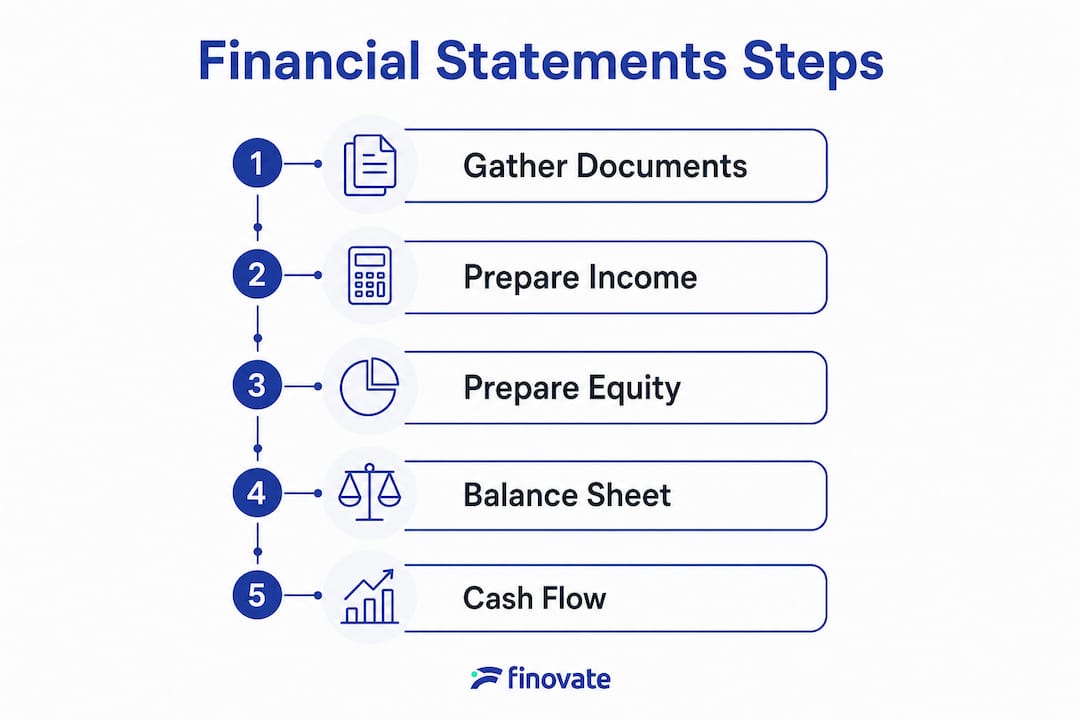
The four core statements are prepared in a specific order because each one feeds data into the next. Net income from the Income Statement updates the equity figures in the Statement of Shareholders' Equity. Those equity figures then populate the Balance Sheet. The Cash Flow Statement is completed last, using data from both the Income Statement and the Balance Sheet. Preparing them out of sequence creates rework and inconsistencies.
Finnish SMEs must also align their reporting with Finnish accounting principles, which follow the Accounting Act (Kirjanpitolaki). This means accrual basis accounting is the standard. Revenue and expenses are recorded when they are earned or incurred, not when cash changes hands.
What do you need before you start preparing financial statements?
Gathering the right source documents is the first practical step. Without complete inputs, your statements will be incomplete before you write a single figure.
The documents you need include:
- Bank statements for every account, covering the full reporting period
- Sales invoices and purchase invoices, both paid and outstanding
- Payroll records, including employer contributions and pension payments
- Loan agreements and repayment schedules
- Asset registers showing fixed assets and their depreciation rates
- VAT records and any tax prepayments made during the period
Clean, validated data is the single most critical input. Misclassified expenses or missing entries produce flawed insights regardless of the software you use. No accounting program corrects data that was wrong before it was entered.
Choosing your accounting method matters too. Accrual basis accounting gives a more accurate picture of your business's financial position than cash basis. Finnish accounting standards require accrual accounting for most registered businesses, so this is not a discretionary choice for the majority of Finnish entrepreneurs.
For software, cloud-based accounting platforms that integrate with Finnish banking systems and support VAT reporting reduce manual data entry and the errors that come with it. Understanding Finnish accounting principles before selecting a tool helps you choose one that fits your reporting obligations.
Pro Tip: Reconcile your bank accounts at the end of every month, not just at year end. Monthly reconciliation catches discrepancies when they are still easy to trace and correct.
How do you prepare the four main financial statements step by step?
The preparation sequence is fixed because of data dependencies. Start with the Income Statement and work through to the Cash Flow Statement in order.
Step 1: Prepare the Income Statement
- List all revenue earned during the period, including sales, service fees, and any other income.
- Subtract the cost of goods sold or direct service costs to calculate gross profit.
- Deduct operating expenses: salaries, rent, utilities, marketing, and administrative costs.
- Apply depreciation on fixed assets for the period.
- Record any interest income or interest expense.
- Calculate net income before tax, then apply the applicable corporate tax rate.
The Income Statement tells you whether your business made a profit or a loss. That net income figure is the starting point for the next statement.
Step 2: Prepare the Statement of Shareholders' Equity
- Start with the opening equity balance from the previous period.
- Add net income from the Income Statement you just completed.
- Subtract any dividends or owner withdrawals made during the period.
- Record any new capital contributions.
- The closing balance is the equity figure that carries into the Balance Sheet.
Step 3: Prepare the Balance Sheet
The Balance Sheet follows the accounting equation: Assets = Liabilities + Equity. Every figure must balance.
- List all current assets: cash, accounts receivable, inventory, and prepaid expenses.
- List all non-current assets: property, equipment, and intangible assets, net of accumulated depreciation.
- List all current liabilities: accounts payable, accrued wages, VAT payable, and short-term loan instalments.
- List all non-current liabilities: long-term loans and deferred tax liabilities.
- Enter the closing equity figure from the Statement of Shareholders' Equity.
- Verify that total assets equal total liabilities plus equity. If they do not balance, locate the discrepancy before proceeding.
Step 4: Prepare the Cash Flow Statement
The Cash Flow Statement is divided into three sections.
| Section | What it shows | Key inputs |
|---|---|---|
| Operating activities | Cash generated from core business operations | Net income, changes in working capital |
| Investing activities | Cash spent on or received from assets | Asset purchases, proceeds from disposals |
| Financing activities | Cash flows from debt and equity | Loan drawdowns, repayments, dividends |
Adjusting entries for accruals, prepayments, and depreciation must be posted before you finalise any statement. These entries ensure revenues and expenses appear in the correct period. A balanced ledger without adjusting entries still produces misstated profitability figures.
Reconciling your trial balance to the general ledger and all subledgers is the final check before you sign off. Cross-check every balance and confirm that all journal entries have been posted correctly.
Pro Tip: Print a trial balance report before you start building each statement. Any unexplained variance at this stage is far quicker to resolve now than after the statements are complete.
What are the most common mistakes when preparing financial statements?
Errors in financial statements cluster around a small number of recurring causes. Recognising them early saves significant time at year end.
The most frequent mistakes include:
- Misclassified expenses: recording a capital purchase as an operating expense, or vice versa, distorts both the Income Statement and the Balance Sheet
- Missing invoices: a purchase invoice that arrives after period end but relates to the current period must be accrued, not ignored
- Unreconciled accounts: failure to reconcile data sources is the primary cause of inaccurate reporting for small businesses
- Omitted adjusting entries: skipping accruals for unpaid wages or outstanding invoices understates liabilities and overstates profit
- Depreciation errors: applying the wrong depreciation rate or forgetting to depreciate an asset entirely misstates asset values over time
Ignoring period-end adjusting entries leads to a misstated financial position even when the ledger appears balanced. A business can show a healthy profit on paper while carrying unrecorded liabilities that would change the picture entirely. Adjusting entries are not optional corrections. They are the mechanism that makes accrual accounting work.
Monthly reconciliations reduce end-of-year stress significantly. When you close your books monthly, discrepancies surface within weeks of the transaction, not months later when the trail has gone cold. Practitioners call this a "soft close," and it is one of the most effective habits a small business owner can build.
How do financial statements support decisions and compliance in Finland?
Accurate financial statements help owners evaluate profitability, liquidity, and cash flow trends. That information is the foundation of every sound business decision, from hiring to investment to pricing. Statements prepared only for compliance purposes miss most of their value.
For Finnish SMEs, the regulatory obligations are clear. The Accounting Act requires annual financial statements to be filed within four months of the financial year end. Limited liability companies (Oy) must also file their financial statements with the Finnish Patent and Registration Office (PRH). VAT returns, corporate income tax returns, and payroll tax reports all draw on the same underlying figures, so errors in your statements ripple through every regulatory submission.
Beyond compliance, your Balance Sheet tells a lender whether your business is creditworthy. Your Income Statement tells a potential investor whether the business is profitable. Your Cash Flow Statement tells you whether you can meet next month's payroll. These are strategic tools for business growth, not just compliance checklists.
Regular review of your financial reports, ideally monthly, lets you spot trends before they become problems. A gradual decline in gross margin, for example, is visible in monthly Income Statements long before it becomes a crisis. For more on applying this thinking, the role of financial statements for entrepreneurs is worth reading alongside this guide.
Pro Tip: Set a fixed date each month to review your management accounts. Treat it as a non-negotiable appointment. Business owners who review their figures monthly make faster, better-informed decisions than those who wait for the annual accounts.
Key takeaways
Preparing financial statements in the correct order, with clean data and complete adjusting entries, is the single most reliable way to produce accurate, compliant reports for your Finnish business.
| Point | Details |
|---|---|
| Preparation order is fixed | Prepare Income Statement first, then equity, Balance Sheet, and Cash Flow Statement in sequence. |
| Clean data comes first | Misclassified or missing entries produce inaccurate statements regardless of the software used. |
| Adjusting entries are non-negotiable | Accruals, depreciation, and prepayments must be posted before finalising any statement. |
| Monthly reconciliation prevents year-end errors | Soft closes catch discrepancies early, when they are still straightforward to resolve. |
| Statements serve strategy, not just compliance | Use your reports monthly to monitor profitability, liquidity, and cash flow trends. |
Busayo's perspective: what Finnish entrepreneurs get wrong about financial statements
Most small business owners I speak with treat financial statements as something they produce once a year for their accountant. That mindset is the root cause of most of the problems I see.
The businesses that manage their finances well are the ones that treat their monthly figures as a management tool. They review their Income Statement to understand margin trends. They check their Cash Flow Statement before committing to a new expense. They use their Balance Sheet to understand how much debt they are carrying relative to their assets. That discipline is not complicated, but it requires consistency.
The other thing I see repeatedly is an over-reliance on software without attention to the underlying data. A well-configured accounting platform is genuinely useful. But if your chart of accounts is poorly structured, or if invoices are being posted to the wrong categories, the software will produce beautifully formatted reports that are wrong. Clean data and sound bookkeeping practices are the foundation. Technology supports that foundation. It does not replace it.
Finnish entrepreneurs also underestimate how much their financial statements communicate to external parties. A bank reviewing a loan application reads your Balance Sheet carefully. An investor looks at your Cash Flow Statement before anything else. Statements that are accurate, consistent, and well-organised signal that you run a serious business. That impression has real commercial value.
— Busayo
How Finovate helps Finnish SMEs with financial reporting
Preparing financial statements accurately takes time, technical knowledge, and consistent attention to detail. For many small business owners in Finland, that combination is difficult to maintain alongside running the business itself.
Finovate provides expert accounting and bookkeeping services for Finnish SMEs, covering everything from monthly bookkeeping and bank reconciliations to VAT reporting and annual financial statement preparation. Our team understands Finnish accounting law and works with you to keep your records clean, your reports accurate, and your compliance obligations met. For entrepreneurs who need support with invoicing and billing, our monthly invoicing service gives you a reliable, professionally managed solution. Contact Finovate to find out how we can support your financial reporting.
FAQ
What are the four main financial statements?
The four core financial statements are the Income Statement, Statement of Shareholders' Equity, Balance Sheet, and Cash Flow Statement. They are prepared in this order because each statement provides data that the next one requires.
How do I prepare financial statements step by step?
Start by gathering all source documents and reconciling your bank accounts. Then prepare the Income Statement, followed by the Statement of Shareholders' Equity, the Balance Sheet, and finally the Cash Flow Statement. Post all adjusting entries before finalising any report.
What is the most common mistake in financial statement preparation?
Failure to reconcile data sources is the primary cause of inaccurate reporting for small businesses. Missing invoices, unreconciled accounts, and omitted adjusting entries are the most frequent errors.
Do Finnish SMEs have to file financial statements?
Yes. The Finnish Accounting Act requires annual financial statements within four months of the financial year end. Limited liability companies must also file with the Finnish Patent and Registration Office (PRH).
How often should I review my financial statements?
Monthly review is the recommended practice. Monthly figures help you spot margin trends, cash flow issues, and unexpected costs before they escalate into serious problems.